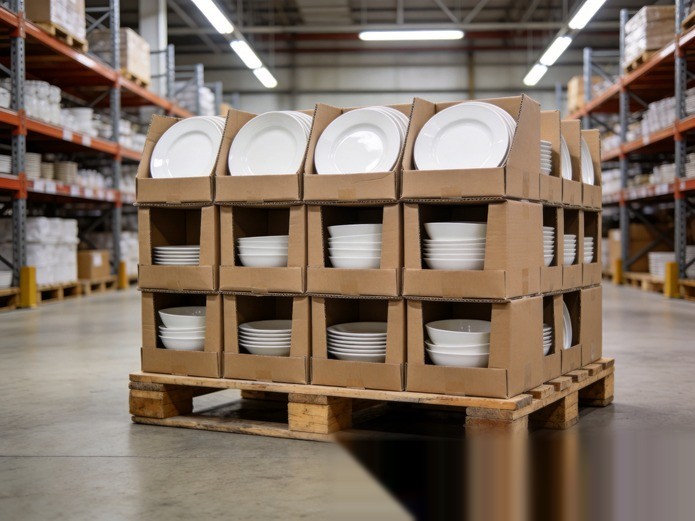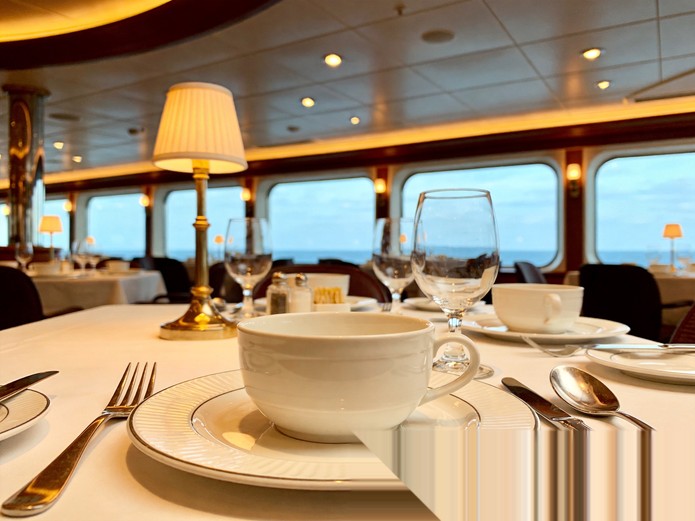
Cruise lines and airlines that serve meals on ceramic dinnerware send a clear signal about brand positioning—but sourcing the right pieces requires specifications that go well beyond standard hospitality tableware. Marine and aviation galleys operate under tight weight budgets, constant vibration, and strict safety codes. A plate that performs flawlessly in a land-based restaurant may chip, crack, or fail compliance checks at sea or altitude.
This guide explains what procurement teams at cruise operators and airline caterers should specify when sourcing ceramic dinnerware, how to evaluate whether a factory can deliver fleet-scale orders, and where the most expensive procurement mistakes hide. You will also get a decision table, a supplier evaluation checklist, and a cost-versus-quality framework you can use on your next RFP.
Why Cruise Lines and Airlines Still Specify Ceramic Over Melamine
Despite the operational advantages of melamine—lower weight, lower unit cost, and near-unbreakable impact resistance—premium cruise lines and full-service airlines continue to specify ceramic for main dining rooms and business-class service. The reason is not nostalgia. Ceramic offers three advantages that matter to procurement committees:
- Temperature retention: Ceramic holds heat longer than melamine, which improves the perceived quality of hot meals served in main dining rooms [INTERNAL DATA REQUIRED].
- Surface hardness and cut resistance: Ceramic glazes resist knife marks better than melamine, keeping tableware looking new over a 12–18 month replacement cycle.
- Brand perception: Passengers associate ceramic with full-service dining. For cruise lines charging premium fares, this association has measurable impact on guest-satisfaction scores [CASE STUDY REQUIRED].
The trade-off is weight and breakage. A typical ceramic dinner plate weighs 450–650 grams, while a melamine equivalent weighs 180–250 grams. On a cruise ship carrying 50,000 pieces across 2,000 cabins, that difference adds measurable fuel cost. Procurement teams therefore look for lightweight ceramic engineering—thinner walls, refined clay bodies, and optimized foot rings—to close the gap without switching materials entirely.
Material Selection: What Works Best at Sea and Altitude
Not all ceramic performs equally in marine or aviation galleys. The following decision table compares the three most common materials used in commercial food service:
| Material | Weight (dinner plate) | Impact Resistance | Heat Retention | Best Use Case | Typical Price Range (FOB) |
|---|---|---|---|---|---|
| Porcelain | 400–550g | Moderate | Excellent | Main dining, premium cabins | [INTERNAL DATA REQUIRED] |
| Stoneware | 500–700g | High | Very Good | Buffet, crew mess, high-traffic areas | [INTERNAL DATA REQUIRED] |
| Bone China | 300–450g | Low–Moderate | Good | First-class airline service, luxury suites | [INTERNAL DATA REQUIRED] |
Procurement recommendation: For mixed-use fleets, specify porcelain as the default for passenger-facing service and stoneware for crew and buffet areas. Bone china should be reserved for ultra-premium segments where replacement budgets are highest and breakage rates can be absorbed.
Weight, Stackability, and Galley Storage Math
Galley storage on both cruise ships and aircraft is measured in vertical rack slots and weight limits, not shelf footage. Procurement teams should request the following data from suppliers before placing fleet orders:
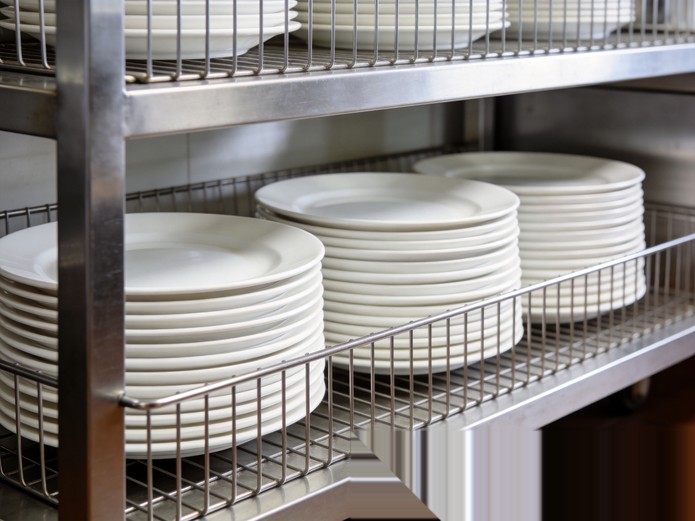
- Stacking height per 50 pieces: A well-designed dinner plate should stack to under 35 cm for 50 units. Deep bowls and irregular shapes often exceed 50 cm, reducing rack capacity by 30–40 percent.
- Interlocking foot ring design: Plates with raised foot rings that nest precisely reduce lateral shifting during transport. Ask suppliers for cross-section diagrams of the foot ring geometry [FACTORY PHOTO REQUIRED].
- Weight per rack: On narrow-body aircraft, a single meal-cart drawer may have a 12 kg limit. If 24 dinner plates plus underplates and bowls exceed this, the cart cannot be loaded to capacity, increasing turnaround time.
When evaluating samples, stack 50 units on a flat surface and measure total height. If the result is more than 40 cm, the design is likely unsuitable for high-density galley storage without custom rack redesign—which adds cost and lead time.
Durability Testing for High-Vibration Environments
Ships and aircraft vibrate continuously. Ceramic that survives a drop test on land may develop micro-cracks under prolonged vibration. Request that suppliers provide the following test evidence:
- Thermal shock resistance: ASTM C1525 or equivalent test showing survival of a 200°C to 20°C water quench cycle. This matters because galley dishwashers use high-temperature rinse cycles, and ambient temperatures vary between port and open sea [VERIFY BEFORE PUBLISHING].
- Edge-chip resistance: A modified pendulum impact test on the rim. Ask for video evidence of at least 10 impacts at 0.3 J without visible chipping [CERTIFICATE REQUIRED].
- Vibration fatigue: While no universal standard exists for ceramic tableware, some marine-equipment suppliers subject samples to IEC 60068-2-6 sinusoidal vibration testing. If your supplier cannot provide this, negotiate a pilot batch for onboard testing over 30 days [VERIFY BEFORE PUBLISHING].
Be specific in your RFQ: “Supplier must provide thermal shock test report, edge-chip video evidence, and agree to a 30-day onboard pilot before full production.” Vague requests produce vague quotes.
Safety Compliance: Maritime and Aviation Regulations
Ceramic dinnerware used on registered vessels and commercial aircraft must meet food-contact safety standards. The regulatory landscape is layered:
- FDA 21 CFR 175.300: Governs resinous and polymeric coatings, including ceramic glazes, for indirect food contact in the United States. Lead and cadmium migration limits apply [VERIFY BEFORE PUBLISHING]. The FDA maintains current guidance at FDA Food Contact Substances.
- EU Regulation 1935/2004: The framework regulation for materials intended to come into contact with food. Ceramic-specific testing follows EN 1388-1 for lead and cadmium release [VERIFY BEFORE PUBLISHING]. Official text available via the EUR-Lex database.
- IMO/SOLAS fire safety: While ceramic is non-combustible, any silicone or rubber anti-slip pads bonded to the base must meet flame-retardant standards for marine use [VERIFY BEFORE PUBLISHING].
- IATA/CAA guidance: Aviation regulators do not specifically certify dinnerware, but galley equipment must not present projectile hazards during turbulence. Ceramic with anti-slip base treatment is generally acceptable if secured in locking drawers [VERIFY BEFORE PUBLISHING].
When sourcing from Chinese manufacturers, request third-party test reports from accredited laboratories such as SGS, Bureau Veritas, or TÜV Rheinland. Do not accept factory self-certification as sufficient for fleet-level contracts.
MOQ, Lead Times, and Customization for Fleet Orders
Fleet orders differ from restaurant replenishment in scale and customization depth. The following parameters are typical for cruise and airline ceramic programs, though exact figures vary by factory:
- MOQ per SKU: 2,000–5,000 pieces for standard shapes; 5,000–10,000 for custom molds or embossed logos. Some factories will accept 1,000-piece MOQs for initial fleet trials if a multi-year contract is signed.
- Sample lead time: 14–21 days for existing molds; 30–45 days for new mold development including 3D printed prototypes.
- Production lead time: 60–90 days after sample approval for orders under 20,000 pieces; 90–120 days for 50,000+ piece programs. Add 2–3 weeks during Chinese New Year factory closures.
- Customization options: Underglaze logo printing, embossed rim patterns, custom glaze colors matched to Pantone references, and anti-slip silicone base rings. Laser etching is also available for matte-glaze surfaces but adds per-unit cost [INTERNAL DATA REQUIRED].
- Packaging: Individual PE foam sleeves, 24-piece inner cartons with corrugated dividers, and outer pallets shrink-wrapped for ocean freight. Request drop-test certification to ISTA 3A for air-freighted samples [VERIFY BEFORE PUBLISHING].
Actionable tip: If your fleet has 5–10 different cabin classes, negotiate a “family mold” approach where one base plate shape is produced in three glaze colors. This reduces mold amortization cost per SKU and simplifies inventory management.
Three Common Mistakes When Sourcing Marine Tableware
Mistake 1: Specifying land-based restaurant durability standards
A supplier who tests drop resistance on a concrete floor is not proving anything about vibration fatigue at sea. Request vibration-specific testing or arrange a 30-day onboard pilot before committing to full production.
Mistake 2: Ignoring weight until the galley team rejects the delivery
Weight per piece determines how many units fit in a meal cart, how many carts fit in a galley, and how much fuel the vessel burns carrying tableware. Measure stack density with actual samples before signing a purchase order.
Mistake 3: Treating anti-slip base treatment as an afterthought
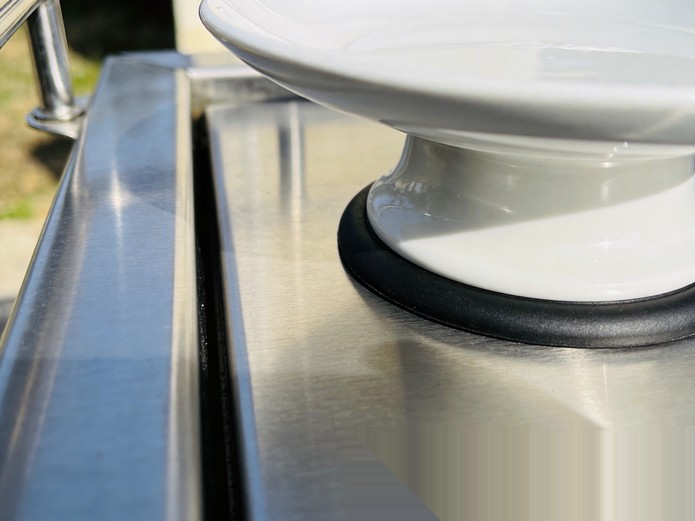
Ceramic plates slide on polished galley surfaces and cloth-covered tray tables. Anti-slip silicone rings or micro-textured bases are essential for marine and aviation use. Adding this treatment after mold completion requires secondary processing and adds 2–3 weeks to lead time. Specify it in the original RFQ.
Cost-Quality-Lead Time Trade-offs for Fleet Buyers
Fleet ceramic programs face a three-way constraint. The following framework helps procurement teams communicate priorities to suppliers:
- Optimize for cost: Choose standard stoneware molds, existing glaze colors, and no custom branding. Lead time drops to 45–60 days, but differentiation against competitors is minimal. Best for crew mess and economy-class service.
- Optimize for quality: Specify high-alumina porcelain, custom glaze development, and anti-slip base treatment. Lead time extends to 90–120 days, and per-unit cost increases 25–40 percent. Best for premium cabins and flagship vessels.
- Optimize for speed: Source from factories with existing marine-tableware catalogs and bonded inventory. Lead time can compress to 21–30 days, but design choices are limited to in-stock shapes and glazes. Best for emergency replenishment or new route launches.
Most experienced procurement managers split orders across two or three suppliers: one for fast-turn replenishment, one for custom premium lines, and one for trial volumes on new routes.
How to Shortlist Suppliers for Cruise and Airline Contracts
Use this checklist during supplier qualification. Score each factory on a 1–5 scale. Any factory scoring below 3 on items 1–4 should be eliminated before sample evaluation.
| # | Evaluation Item | What to Request | Pass Threshold |
|---|---|---|---|
| 1 | Export experience to marine/aviation | Client list, reference letters, or case studies | At least 1 marine or aviation client in past 3 years |
| 2 | Third-party test reports | SGS/BV/TÜV reports for FDA and EU food contact | Reports dated within 24 months |
| 3 | Mold development capability | 3D design portfolio, CNC mold workshop photos | In-house mold making (not outsourced) |
| 4 | Production scale | Daily output per SKU, kiln capacity | Can deliver full fleet order within 90 days |
| 5 | Customization flexibility | Pantone matching accuracy, logo placement options | ±2 Delta E on glaze color match |
| 6 | Packaging engineering | Drop-test video, inner carton design samples | ISTA 3A or equivalent pass result |
| 7 | English communication | Technical drawing review call | Can discuss tolerance specs without translator |
Keep this checklist as a live document. Update it after each factory visit or sample round. Over time, you will build a supplier scorecard that speeds up future RFPs by 50 percent or more.
Frequently Asked Questions
Is ceramic allowed in commercial aircraft galleys?
Yes, provided it is secured in locking drawers or carts during takeoff, landing, and turbulence. Some low-cost carriers restrict ceramic to business-class service to reduce handling complexity. Check your carrier’s internal galley-loading manual for class-specific rules.
How much lighter can ceramic be compared to standard hotel porcelain?
Engineered lightweight porcelain can reach 280–350 grams for a 26 cm dinner plate, compared to 500–650 grams for standard hotel porcelain. The weight reduction comes from thinner walls, refined clay formulation, and optimized foot-ring geometry.
What is the typical replacement cycle for cruise ship ceramic?
Premium cruise lines replace passenger-facing ceramic every 12–18 months due to edge chipping and surface wear. Crew tableware typically lasts 24–36 months. Budgeting for a 15 percent annual replenishment rate is standard practice [INTERNAL DATA REQUIRED].
Can suppliers match existing fleet colors for replacement orders?
Yes, but color matching across production batches requires a retained standard sample at the factory. If you are switching suppliers, send a physical reference piece—not a digital photo—for glaze matching. Digital color representation varies by screen calibration and is not reliable for ceramic glaze specification.
Should I air-freight or sea-freight ceramic for fleet orders?
For initial samples and urgent replenishment under 5,000 pieces, air freight is justified. For full fleet orders above 20,000 pieces, ocean freight reduces landed cost by 60–75 percent. The break-even threshold typically falls between 8,000 and 12,000 pieces depending on destination port [INTERNAL DATA REQUIRED].
What anti-slip treatments are available for ceramic plates?
The most common options are silicone ring bonding, micro-etched base surfaces, and textured glaze on the foot ring. Silicone rings offer the best grip but can discolor after 200+ dishwasher cycles. Micro-etched bases last longer but provide less grip on polished surfaces. Specify the expected wash cycle count in your RFQ so the supplier recommends the appropriate treatment.
Ready to evaluate ceramic dinnerware for your fleet? Request marine-grade ceramic samples matched to your galley specifications, weight targets, and compliance requirements. Our team can coordinate Pantone matching, anti-slip base treatment, and pilot-batch delivery for onboard testing.