Ceramic tableware accessories are specified last and complained about first, because nothing on a dinnerware quote says which rule they are tested under. A 240 mL sauce boat and a 240 mL creamer sit on the same quote line at similar prices yet land in different categories in the US, different depth classes in the EU and different capacity tiers in Canada. The fix is a sequence: settle the depth class, the lid treatment and the order quantity before the plate spec is signed.
Ceramic tableware accessories are typically 8 to 12 percent of an order’s value and 9 percent of its pieces, yet carry a disproportionate share of claims: they are cast not pressed, decorated on more surfaces, and bought in quantities their moulds cannot serve.
The 25 mm Line Sits Inside Your Accessory Range
Every major market classifies glazed ceramic foodware by internal depth. EU Directive 84/500/EEC puts anything 25 mm deep or less in Category 1, limited in mg/dm²; everything else fillable is Category 2, in mg/L. Canada’s SOR/2016-175 uses the same 25 mm for flatware versus hollowware, then splits hollowware at 1.1 L. FDA’s guide matches both.
Your accessory range straddles that line. A butter dish at 22 mm and a condiment dish at 18 mm are flatware; a ramekin at 45 mm and a sauce boat at 55 mm are hollowware. Drawn at one body height because they look alike on a sketch, two of them land in a category with another test method, limit basis and paperwork.
| Accessory | Internal depth | EU category | Canada class | US class (FDA CPG) |
|---|---|---|---|---|
| Condiment dish | 18 mm | Cat 1 (mg/dm²) | Flatware | Flatware, 3.0 µg/mL |
| Butter dish | 22 mm | Cat 1 (mg/dm²) | Flatware | Flatware, 3.0 µg/mL |
| Ramekin, 90 mL | 45 mm | Cat 2 (mg/L) | Small hollowware | Small hollowware, 2.0 µg/mL |
| Creamer, 200 mL | 75 mm | Cat 2 (mg/L) | Small hollowware | Small hollowware, 2.0 µg/mL |
| Sauce boat, 240 mL | 55 mm | Cat 2 (mg/L) | Small hollowware | Small hollowware, 2.0 µg/mL |
| Teapot, 1.1 L and above | >100 mm | Cat 2 (mg/L) | Large hollowware | Large hollowware, 1.0 µg/mL |
Two results are counter-intuitive. Category 2 is not automatically the lenient one: on a straight-sided vessel, area times depth equals litres, so the allowances are equal at 20 mm. Above that the mg/L basis permits 25 percent more at 25 mm; below it the area basis is looser.
Capacity labels move items across a limit step. A teapot at 1.1 L is large hollowware in both North American systems, halving permitted lead from 2.0 to 1.0 µg/mL; at 1.05 L it is small hollowware at 2.0. The label moved 50 mL; nobody re-measures after glazing.
FDA’s guide is explicit that creamers, coffeepots and teapots are not pitchers; Canada carries the same exclusion. A 200 mL creamer classed as small hollowware may leach 0.4 mg; declared a pitcher, 0.1 mg. Writing “creamers / pitchers” on one line moves it into the strictest non-cup category.
Canada adds a provision for decorated drinking vessels: where a distinctive exterior pattern sits within 20 mm of the rim, lead must not exceed 4 mg/L and cadmium 0.4 mg/L. Against the cup limits of 0.5 and 0.50, that permits eight times the lead but only 80 percent of the cadmium.
Press and Cast Are Not Interchangeable at This Size
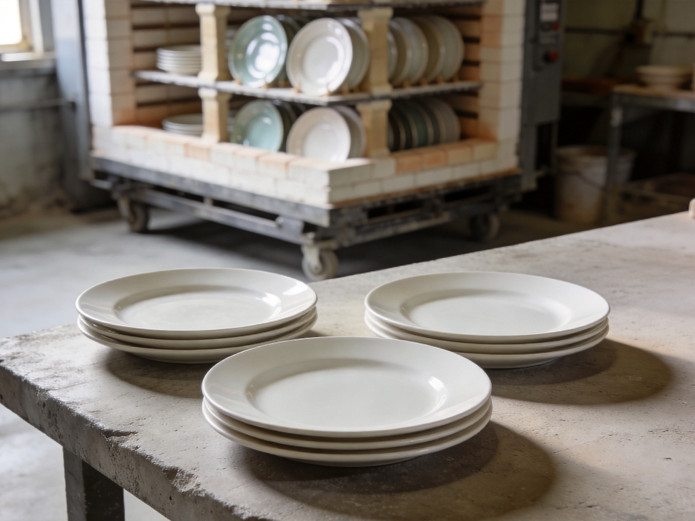
Plates are pressed. Sauce boats, creamers, teapots and anything with a spout are cast, because a press tool cannot release a re-entrant spout.
An illustrative press on an 8-second cycle makes 450 pieces per hour, 4,500 a 10-hour shift. A four-cavity casting bench on a 22-minute cycle yields 10.9 per hour, 109 a shift. At USD 3.20 a plate and USD 4.80 a boat, that is USD 14,400 a shift against USD 524: 27.5 times the value, and 41.25 benches to match one press in pieces.
Accessory capacity, not plate capacity, constrains your delivery date, so a lead time quoted off the plate line is not the accessory lead time. Labour dominates cost per piece, so a 10 percent discount on a sauce boat is usually a 10 percent change in glaze grade or decoration. Private-label work fails quietly here: a creamer offers body, handle, spout and rim, so OEM and ODM decoration must be specified surface by surface.
The Lidded Pair Is One Article for Testing, Two for Selling
Sauce boats ship with a stand, not a lid. Teapots, sugar bowls, butter dishes and tureens ship with a lid, and Article 2(3) of Directive 84/500/EEC makes that a testing problem: vessel and lid are tested separately and the sum is related to the vessel alone.
The lid gets no allowance of its own; it consumes the vessel’s. On a Category 2 article limited to 4.0 mg/L, a vessel reading 2.8 passes with 30 percent headroom and a lid reading 1.9 passes alone. Summed as the directive requires, the article reads 4.7 against 4.0: 17.5 percent over, and it fails. With a vessel at 2.8 the lid may read at most 1.2. A PO saying “vessel: 4.0 max” and nothing about the lid lets the factory spend the allowance twice.
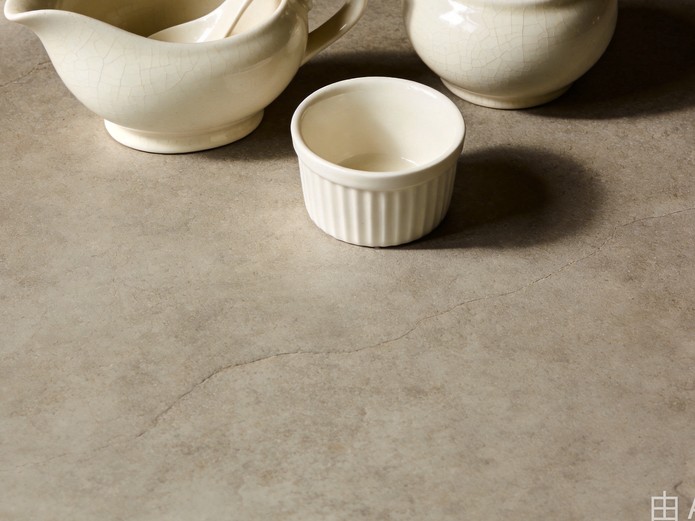
A retest route exists. An article over the limit by no more than 50 percent is still deemed compliant if three others of the same shape, dimensions, decoration and glaze average within the limit and none is more than 50 percent over. Four units reading 5.8, 3.2, 2.9 and 3.5 against 4.0: the worst fails alone at 45 percent over, the average is 3.85 and passes, so the article passes as a set. FDA tests any one of six units; Canada averages nothing.
What Changed in 2026 for EU-Bound Accessories
The EU-wide limits in Directive 84/500/EEC have not moved in four decades, a live problem for anyone shipping ceramic tableware accessories into the Benelux. The Benelux Committee of Ministers adopted safeguard measure M (2024) 5; the Netherlands implemented it in Staatscourant 2026, 16308, in force 29 May 2026. Articles first placed on the market before 1 December 2026 that complied with the rules as they stood on 28 May 2026 may be traded until stock is exhausted.
| Category | EU 84/500/EEC (EU-wide) | NL from 29 May 2026 | Tightening |
|---|---|---|---|
| Cat 1 lead | 0.8 mg/dm² | 6 µg/dm² | 133x |
| Cat 1 cadmium | 0.07 mg/dm² | 4 µg/dm² | 17.5x |
| Cat 2 lead | 4.0 mg/L | 30 µg/L | 133x |
| Cat 2 cadmium | 0.3 mg/L | 20 µg/L | 15x |
| Cat 3 lead | 1.5 mg/L | 10 µg/L | 150x |
| Cat 3 cadmium | 0.1 mg/L | 7 µg/L | 14.3x |
The same 240 mL sauce boat that may leach 0.96 mg of lead under EU Category 2 may leach 0.0072 mg under the Dutch limit. Against the US guideline of 0.48 mg, the EU allowance is twice the US figure and the Dutch one a sixty-seventh of it. One ceramic tableware accessories report cannot serve all three markets unless it says what it was compared against. The paperwork chain is set out in this guide to the declaration of conformity.
The detail that catches buyers is analytical. A 30 µg/L lead limit is 0.030 mg/L, below the working range of an inductively coupled plasma optical emission instrument whose limit of quantification typically sits near 0.05 mg/L. The old 4.0 mg/L limit was 8,000 percent of that figure, so nobody thought about it; the new one is 60 percent of it, and a lab reporting “below the limit of quantification” has told you nothing usable. Ask which instrument and which LOQ the report used. The regulation also lets the operator calculate or estimate migration, a technical file you defend rather than a form you tick.
The Accessory MOQ Is Seven Times Your Actual Need
Accessory minimums are set by the mould and the glaze batch, not by demand. A 300-seat room turning 1.8 times a night gives 540 covers. One sauce boat to six covers puts 90 in service; add 35 percent pipeline for the wash cycle and back of house plus a 12 percent reserve, and the need is 137 pieces.
At a 1,000-piece minimum you buy 863 more than the room needs: 7.3 times the requirement, USD 4,800 instead of USD 657.60, and USD 4,142.40 of stock sitting for 7.3 years at this rate of use. The boats will not wear out first; the glaze and decoration date, and the mould may be retired before you reorder. That is the risk behind any open stock reorder.
Three ways out, in order: buy against a multi-year forecast and negotiate on it, since a 1,000-piece run suits the factory better than four 250s; cast the accessories inside a flatware run’s glaze batch so colour matches and setup is shared, which is where the discount lives; or order fewer than needed and cut the settings they serve.
Yield compounds it. An illustrative 96 percent first-pass rate on pressed plates against 88 percent on cast accessories means 1,042 plates or 1,137 accessories for 1,000 usable: 95 extra pieces, 9.12 percent above the plate order. On a nominal USD 4.80 boat the real cost per usable piece is USD 5.4576, 13.7 percent above the quote.
The Smallest Line Carries the Largest Claim Share
An illustrative 20-SKU collection: 15 flatware SKUs at 1,000 pieces and USD 3.60, five accessory SKUs at 300 pieces and USD 4.80. Flatware is USD 54,000, accessories USD 7,200: accessories are 11.76 percent of value, 25 percent of SKUs, 9.09 percent of pieces.
Apply a 3 percent claim rate on flatware and 8 percent on accessories, the shape casting and multi-surface decoration produce. Claims come to USD 1,620 and USD 576, so accessories carry 26.23 percent of claim dollars on 11.76 percent of value: USD 0.356 per accessory dollar against USD 0.08 per flatware dollar.
| Item | Value share | Piece share | Assumed defect rate | Claim share |
|---|---|---|---|---|
| Flatware, 15 SKUs | 88.24% | 90.91% | 3% | 73.77% |
| Accessories, 5 SKUs | 11.76% | 9.09% | 8% | 26.23% |
What follows is a sampling decision, not a quality opinion. One inspection level under-samples the line producing the most claim dollars per unit of spend. A full check is cheap: a 100 percent visual on five 300-piece SKUs is 1,500 pieces, a few hours on a bench.
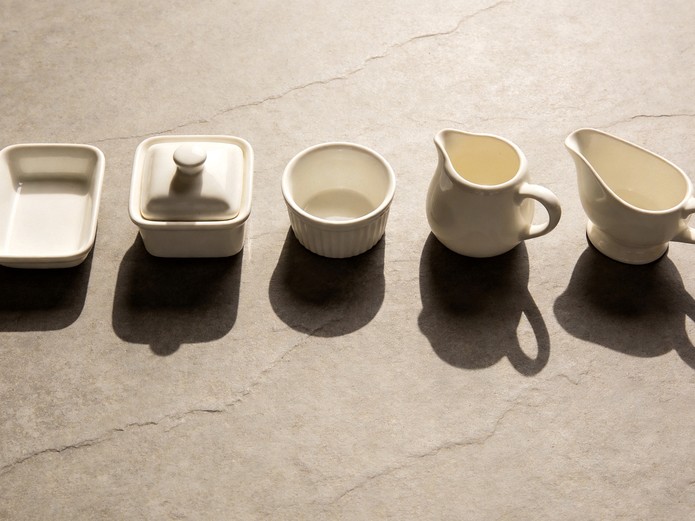
The Six-Line Specification, Three Mistakes, Three Actions
Most accessory disputes trace to a PO that described the item rather than specified it. Six lines fit on one page and belong on every SKU.
- Capacity and the method. Nominal mL plus the fill level it was measured at; 1.05 L and 1.1 L straddle a limit step.
- Internal depth and class. Lowest interior point to the plane through the upper rim, named in the jurisdiction’s own words.
- Lid treatment. State that vessel and lid are tested separately and summed, and give the maximum lid reading, not only the vessel limit.
- Decoration zone. On-glaze or in-glaze, plus distance from the rim for banded decoration.
- Test basis. Which market’s limit, which instrument, which limit of quantification.
- Quantity basis. Gross or net of first-pass scrap, and who owns the scrap.
Written once, it is a reusable accessory schedule: one row per SKU, six columns. The same nine-field logic sits behind a full ceramic tableware specification sheet, of which this is the accessory page.
Testing the vessel and calling it a lidded article. A teapot tested as one unit passes on a report the sum rule would fail, and the cost surfaces at the border.
Quoting accessories off the plate’s lead time. Plate capacity is pressed and fast, accessory capacity cast and slow. An incomplete set is usually unsaleable, so the shipment waits on its slowest SKU.
Buying to a round number. A 1,000-piece minimum against a 137-piece need is 7.3 years of stock and a reorder that will not match the glaze.
Three actions before the deposit clears. Fix the class on the drawing: have the factory write depth, capacity and class on the drawing it manufactures from, so the class becomes a manufacturing attribute. Split the accessory PO from the flatware PO: two delivery dates, two inspection plans, payment held until its report lands. Name the limit of quantification: one sentence separates a usable report from paper.
On cost, quality and lead time: the cheapest route is a shared glaze batch with the flatware, fixing colour match while locking you to the flatware schedule. The fastest is a stock mould, nearly eliminating tooling cost and confining you to shapes already in the factory, where class surprises come from. Custom moulds give the depth and capacity you want at tooling cost and a longer run. Pick two.
If you are building a ceramic tableware accessories set for a hotel or restaurant group, the count is the first decision, not the last. Our team can weigh capacity classes and quantities against your seating plan and return a production schedule estimate; start from the sourcing guides or send drawings through contact.
Frequently Asked Questions
Is a sauce boat flatware or hollowware?
Hollowware. Its internal depth sits above 25 mm, so it is Category 2 in the EU and small hollowware in the US and Canada. Flatware covers only articles not exceeding 25 mm: condiment dishes, nothing with a spout.
Does a lid need its own lead test?
Under Directive 84/500/EEC the lid gets no allowance of its own. Vessel and lid inner surface are tested separately and the results summed, then compared with the limit for the vessel alone. The lid must be tested, but its result is added to the vessel’s.
Why is my creamer being tested as a pitcher?
Because someone grouped creamers and pitchers on one spec line. FDA’s guide says creamers, coffeepots and teapots are not pitchers and are classed by capacity as small or large hollowware; Canada carries the same exclusion. The pitcher limit is four times stricter.
What changed for the Netherlands in 2026?
The Netherlands implemented the Benelux safeguard measure in Staatscourant 2026, 16308, in force 29 May 2026. Lead and cadmium limits tighten by roughly 15 to 150 times by category. Goods first placed on the market before 1 December 2026 that met the earlier rules may be traded until stock is exhausted.
How many sauce boats should a 300-seat restaurant order?
Work from covers, not seats. At 540 covers a night and one boat per six covers, 90 are in service; with pipeline and reserve, the requirement is about 137. A 1,000-piece minimum is roughly seven times that, so it is a stock decision, not a purchasing one.
Can one test report cover the EU and the US?
Only if it reports raw readings and states the limit each was compared against. The EU Category 2 lead allowance for a 240 mL boat is twice the US small hollowware guideline, so one reading can pass one market and fail the other.