ISPM 15 wood packaging is the phytosanitary standard that decides whether the pallet, crate and dunnage boards under your ceramic shipment may cross a border, and the rectangular stamp burned into the pallet is the part an inspector actually reads. A container of dinnerware can be held, re-treated or sent back over a wrongly applied mark, and the cost lands on the buyer, not the factory.
This article reads the stamp as a procurement document: the four components inside its border, the bark tolerance in millimeters, the four treatment codes and the dwell time each commits a supplier to, and a clause block for your purchase order.
A wood stamp that replaces a certificate
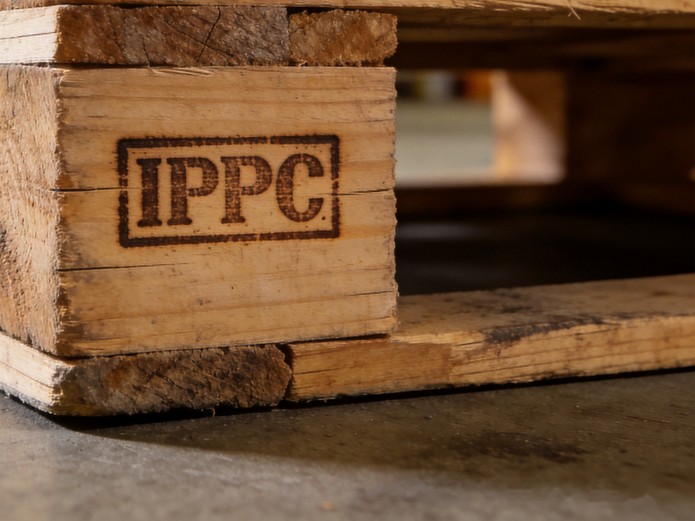
The mark is not decorative. ISPM 15 states that its application renders a phytosanitary certificate unnecessary, because the stamp declares that the accepted measures were applied. A port can clear a consignment unopened.
What it certifies is a combination, not a step: wood that has been debarked, plus an approved treatment. A pallet treated correctly but built from boards carrying heavy bark is non-compliant; clean boards that never entered a chamber are non-compliant too. Both halves must hold at once, and the stamp is where they are claimed together.
The standard covers crates, boxes, packing cases, dunnage, pallets, cable drums and spools or reels, including consignments nobody expected to be inspected. It exempts these articles outright:
- Packaging made entirely of wood 6 mm thick or less (0.236 in)
- Packaging made wholly of processed material such as plywood, particle board, oriented strand board or veneer
- Wine and spirit barrels heated during manufacture
- Gift boxes made from wood processed so that it is free of pests
- Sawdust, wood shavings and wood wool
- Wood components permanently attached to freight vehicles and containers
Read the 6 mm line in reverse and the surprise appears. A crate from 5 mm plywood skins needs no mark; the same crate with 8 mm solid wood corner posts needs treatment and a mark on those posts. Mixed construction is where unmarked shipments come from.
Four components inside the border, and three that get copied wrong
Annex 2 fixes the composition. Inside the border there must be a symbol, an ISO two-letter country code, a producer or treatment provider code, and a treatment code from Annex 1. The symbol sits to the left of the codes, separated by a vertical line. The country code is hyphenated to the producer code. The treatment code goes on its own line, or hyphenated onto the same line.
Three failures recur. The first is the country code, which belongs to the country whose national plant protection organization assigned the producer code: where the wood was treated and marked, not where the goods are sold from. A pallet stamped with the trading company’s country describes wood that is not underneath it.
The second is extra content inside the frame; trademarks and authorizing-body logos belong outside it. The third is the hand-drawn or re-stencilled mark, which must be legible without a visual aid and not transferable.
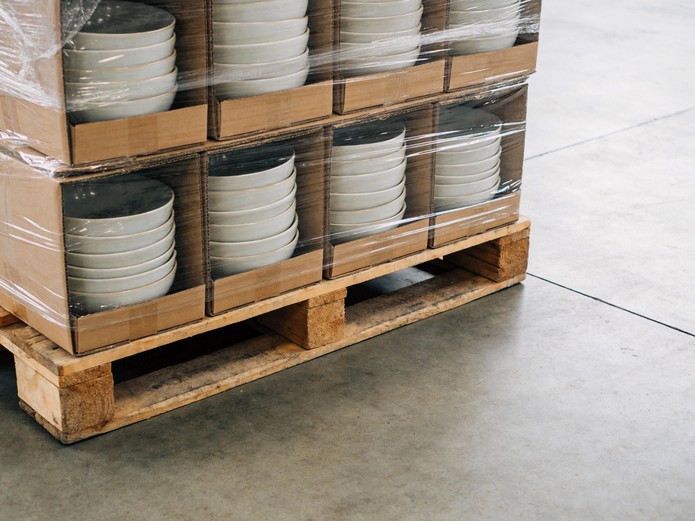
Position matters as much as content. A mark visible only on an empty pallet gets buried by the load. Annex 2 asks for placement that stays visible in use, preferably on two opposite sides, meaning exposed stringers and corner posts with clearance under the shrink wrap. Avoid red and orange, which belong to dangerous-goods labeling.
Bark, the half of ISPM 15 that photographs miss
The tolerance is two narrow alternatives. Wood packaging must be made of debarked wood, but any number of visually separate, clearly distinct pieces of bark may remain if each is less than 3 cm wide regardless of length, or if wider than 3 cm with an individual surface area under 50 cm².
The first route has no length limit, which surprises people. A 2.9 cm wide strip running 40 cm along a board is 116 cm² of bark and still compliant, because width decides. The second route caps area, and 50 cm² is small: a piece 3.1 cm wide and 20 cm long reaches 62 cm² and fails. As a length ceiling per width that is 16.67 cm at 3.0 cm wide, 12.5 cm at 4 cm, 10 cm at 5 cm and 8.33 cm at 6 cm.
Timing differs by treatment, which makes a supplier’s process sequence visible on the wood. For methyl bromide and sulfuryl fluoride, bark removal must precede treatment, since bark interferes with gas penetration. For heat treatment it may come off before or after. For dielectric heating, where a thickness limit applies, any bark still present counts inside the measured dimension, so a board that passes alone can fail once a bark patch is included.
None of this shows in a photograph of a wrapped pallet, which is why bark surfaces most often at destination.
Four codes, four different commitments
The code tells you which Annex 1 treatment was applied. All four are acceptable at import when correctly applied, so what matters is whether the record behind it exists.
| Code | Method | Parameter that must be met | Bark | What it commits a supplier to |
|---|---|---|---|---|
| HT | Heat chamber (steam or dry kiln) | 56 °C minimum for 30 continuous minutes through the whole profile, including the core | Before or after | Core sensors or an NPPO-proven schedule, plus chamber records per batch |
| DH | Dielectric heating (microwave or radio frequency) | 60 °C minimum for 1 continuous minute through the whole profile, including the surface | Before or after; bark counts toward thickness | A dielectric chamber; bidirectional application over 5 cm at 2.45 GHz |
| MB | Methyl bromide fumigation | CT of 650 / 800 / 900 g·h/m³ over 24 h by temperature band, final 24 / 28 / 32 g/m³ | Must be before | Gas-tight enclosure, readings at 2, 4 and 24 h, an ozone-depleting fumigant |
| SF | Sulfuryl fluoride fumigation | CT of 1,400 g·h/m³ over 24 h at 30 °C or above, or 3,000 over 48 h at 20 °C or above | Must be before | Either a 48-hour dwell or a 30 °C chamber, plus longer monitoring |
HT is the usual answer in quotes, and its parameter is precise: 56 °C held at least 30 continuous minutes throughout the profile including the core, verified by core sensors or by schedules proven against chamber air temperature.
DH is hotter and far faster and needs different equipment: 60 °C for 1 continuous minute through the whole profile including the surface. Four degrees hotter for a thirtieth of the dwell is a real trade, but it exists only where a dielectric chamber runs, and wood over 5 cm thick at 2.45 GHz needs bidirectional application.
MB carries a chemistry budget instead of a timer: a concentration-time product over 24 hours that rises as the wood gets colder, 650 g·h/m³ at 21 °C and above, 800 at 16.0–20.9 °C, 900 at 10.0–15.9 °C, with minimum final concentrations of 24, 28 and 32 g/m³ and gas readings at 2, 4 and 24 hours. Cold wood costs 38.5% more dose-time than warm wood for the same load.
SF trades temperature for duration the other way: 1,400 g·h/m³ at 30 °C or above over 24 hours, or 3,000 at 20 °C or above over 48 hours, a 114.3% increase bought to avoid holding at 30 °C. The practical read is short: MB uses a fumigant the standard flags as ozone-depleting, and DH needs equipment most yards do not run.
The one-third line: reused, repaired, remanufactured
Reuse carries no paperwork. A unit already treated and marked that has not been repaired, remanufactured or otherwise altered needs no re-treatment and no new mark for its service life, an exemption inherited with a closed pallet loop.
Repair is bounded by a fraction: up to approximately one third of components removed and replaced. Where treated wood goes into a repair, each added component must be individually marked. Above roughly one third replaced the unit is remanufactured: previous marks obliterated, the unit re-treated, the mark applied anew.
On an 11-component pallet the boundary is concrete. Replacing 3 components is 27.3% and stays inside repair; replacing 4 is 36.4% and crosses into remanufacture. On a 9-component pallet, 3 replaced is 33.3%, right at the line, and 4 is 44.4%. Whether a yard counts a replacement as a whole component or a repair of the same component moves a pallet between two very different paperwork burdens.
One reassurance: several marks on a single unit is not, by itself, non-compliance. The standard says so and directs inspectors to trace the origin of the non-compliant component, so a mixed-mark pallet is a question to answer, not an automatic rejection.
What non-compliance actually costs
The options at the border run to five, each costlier than the last: detention while the case is addressed, removal of the non-compliant material, treatment, destruction or secure disposal, and reshipment. They target the packaging where possible, but a container held at a berth is still a schedule problem.
Two quantities make the exposure concrete. A 40-foot high-cube has 12.032 m of internal length and 2.352 m of width, so 28.3 m² of floor. Twenty 1200 × 1000 mm pallets use 84.8% of it; twenty 1200 × 800 mm pallets also fit and use 67.8%. A narrower footprint buys no extra positions and gives away close to a sixth of the floor.
The moisture figure belongs in a supplier meeting. A 22 kg pallet at 18% moisture carries 3.36 kg of water; the same pallet kiln-dried to 12% carries 2.36 kg. Across a 20-pallet container, drier board removes about 20 kg of water vapor from a sealed steel box on a long ocean leg. Moisture content is dry-basis, so these are water masses per pallet rather than shares of total weight.
Both sit inside one decision: a yard that heat-treats to 56 °C is also drying the board, which argues for buying treated pallets from a yard that runs a chamber rather than one that buys in marked stock.
The clause block for your purchase order
The reusable part of this article is a clause block: five ISPM 15 wood packaging instructions a pallet supplier or ceramic factory can accept or refuse in writing before the order is placed.
- All wood packaging material, including pallets, crates and dunnage, to be ISPM 15 compliant, made of debarked wood, and marked per Annex 2.
- Bark: no piece wider than 3 cm, and none wider than 3 cm with a surface area over 50 cm². Bark removal to precede treatment where MB or SF is used.
- Treatment record: chamber record or certificate stating treatment code, date and parameter achieved, supplied with shipping documents for every lot.
- Repair and remanufacture: any unit with more than approximately one third of components replaced to be re-treated and re-marked, and any added component individually marked.
- Mark placement: legible without a visual aid, on at least two opposite sides, not obscured by load or stretch wrap.
Item three is the blank in most specifications. Buyers write the code on the drawing and stop, then discover at destination that the mark is present and the record is not, turning a wood-treatment question into a documentary dispute.
Three commercial terms move with the mark. Minimum order is usually per pallet or per chamber batch, because a chamber pays only when filled, so ask the batch minimum before negotiating the pallet price. Lead time has two parts, the pallet build and the treatment slot plus cooling before the load can be wrapped, and the second moves when a port is busy. Customization is where the footprint lives: 1200 × 1000 mm for floor utilization, 1200 × 800 mm for aisle clearance.
For buyers who want the version we use with our own carton and pallet suppliers, request our export packaging specification and we will send the clause block with the pallet and carton drawings attached.
A ten-point check at goods receipt
Run this before the container leaves the yard. Every line is answerable from the wood and the document pack.
- Mark present on at least two opposite sides, still visible with the load in place
- Symbol at the left, vertical line separating it from the codes
- Country code two letters, hyphenated to the producer or treatment provider code
- Treatment code is HT, DH, MB or SF, on its own line or after a hyphen
- Nothing else printed inside the border frame
- Not hand drawn, not a peelable paper label, not transferable ink
- No red or orange in the mark
- No bark piece wider than 3 cm with an area over 50 cm²
- No more than roughly one third of components replaced on a marked unit
- Treatment record in the document pack, matching the code burned into the wood
Three recommendations follow. Attach the clause block to every packaging order instead of describing the requirement in an email. Require the treatment record per lot rather than per year. Inspect at goods receipt, because every hour before loading is an hour a defect is still your supplier’s to fix.
Five questions come up often enough to answer directly.
Does the mark replace a phytosanitary certificate? Yes, for wood packaging material. ISPM 15 states that application of the mark renders a phytosanitary certificate unnecessary, because the mark declares that the approved measures were applied. The goods themselves may still need a certificate under other rules, but the pallet should not generate one.
Is a heat-treated pallet automatically compliant? No. Treatment is one of two obligations. The wood must also be debarked, with bark limited to pieces under 3 cm wide or, if wider, under 50 cm² of surface area. A correctly treated pallet built from boards carrying large bark patches fails on the wood rather than the treatment.
Can I keep exporting on pallets that already carry a mark? Yes, if the unit has not been repaired, remanufactured or otherwise altered. Treated and marked units need no re-treatment or new mark. Once components are replaced beyond roughly one third the unit counts as remanufactured and must be re-treated and re-marked.
What happens if a pallet arrives without a mark? The importing authority may detain the consignment while the case is addressed, then require removal of the non-compliant material, treatment, destruction or secure disposal, or reshipment. The schedule cost usually exceeds the treatment cost.
Must the mark stay visible after the cartons are stacked? It must sit where it is visible while the packaging is in use, preferably on two opposite sides. A mark on a face covered by the load or the stretch wrap does not satisfy that, so pallet drawings should fix the mark position early.
The stamp is a small rectangle of burned wood that carries an obligation, a parameter and a record. Treated as part of the specification, with a clause block and a ten-point check behind it, it stops producing questions at a berth.
If you are sourcing ceramic tableware and want packaging requirements settled before the first production run, request our export packaging specification or start from the product range.