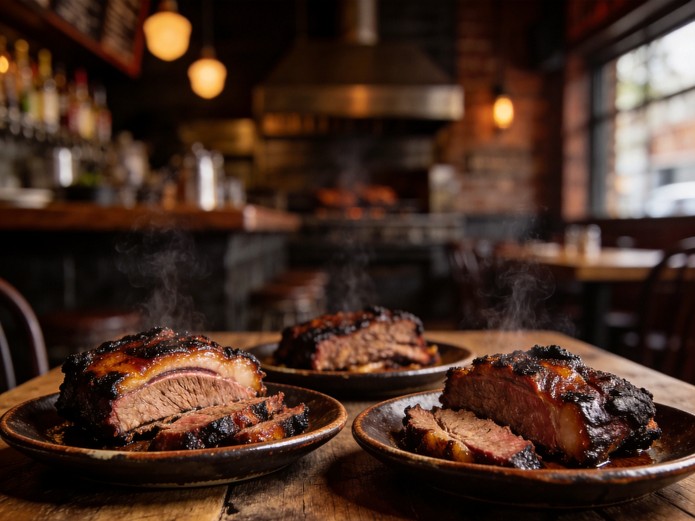
BBQ restaurant ceramic plates face a unique challenge: they need to handle brisket fresh off a 200°C smoker, resist the acids in vinegar-based sauces, and survive three dishwasher cycles a day without chipping. Most standard restaurant ceramics fail within six months in this environment. The plates that last are high-fired stoneware or vitrified porcelain with thermal-shock-resistant glazes, paired with the right portion sizing and edge design. In this guide, you will learn how to evaluate ceramic plates for BBQ service, what specs to request from suppliers, and how to avoid the common mistakes that cost smokehouse operators thousands in replacement tableware.
Why Standard Restaurant Ceramics Fail in BBQ Service
The average casual-dining ceramic plate is fired at 1,180–1,220°C and glazed for moderate thermal exposure. In a BBQ restaurant, that same plate receives food at 90–110°C, sits under heat lamps, then goes straight into a commercial dishwasher running 82°C rinse cycles. The thermal swing exceeds 100°C in under three minutes.
Three failure modes dominate:
- Thermal shock cracking — Rapid temperature change causes micro-fractures that propagate through the body, especially in low-fired earthenware and thin porcelain.
- Glaze crazing from acid exposure — Vinegar, tomato, and mustard-based sauces seep into hairline cracks in the glaze, staining the body and creating bacterial harbors. [VERIFY BEFORE PUBLISHING: Acid resistance data varies by glaze formulation.]
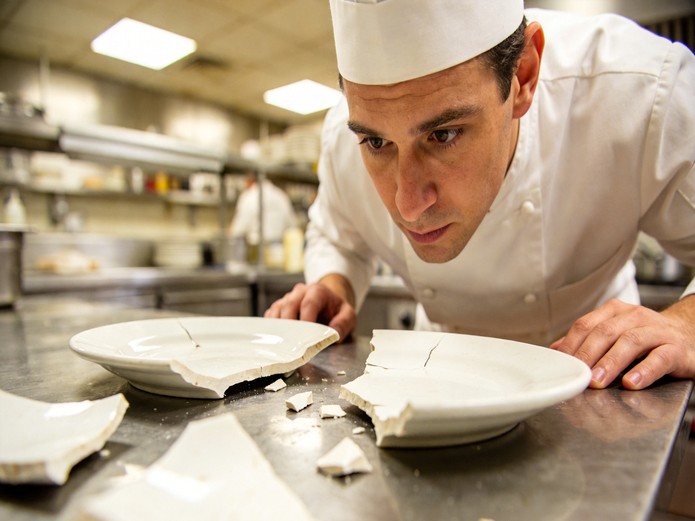
- Edge chipping from weight and impact — A loaded BBQ platter with brisket, ribs, and sides can weigh 1.2–1.8 kg. Dropping that weight 5 cm onto a stainless steel counter chips standard plate edges.
Smokehouses that switch from standard restaurant ceramics to BBQ-rated stoneware typically reduce replacement rates from 15–20% annually to under 5%. [INTERNAL DATA REQUIRED: Confirm typical replacement rate benchmarks from existing customer data.]
Ceramic Material Types for BBQ: What Actually Works
Not all ceramics handle heat, acid, and impact the same way. Here is how the main material types compare for BBQ service.
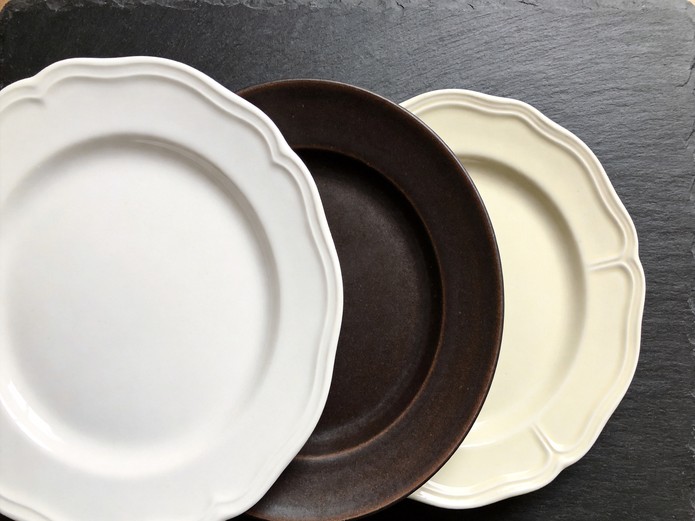
| Material | Firing Temp | Thermal Shock Resistance | Acid Resistance | Impact Strength | Best For | Approx. Unit Cost |
|---|---|---|---|---|---|---|
| Vitrified Porcelain | 1,280–1,350°C | Excellent (ΔT ≥ 180°C) | High (non-porous) | Moderate | Smokehouses with fine-dining positioning | $2.80–$4.50 |
| High-Fire Stoneware | 1,220–1,280°C | Very Good (ΔT ≥ 150°C) | High | High | High-volume casual BBQ, buffet service | $1.80–$3.20 |
| Ironstone | 1,200–1,250°C | Good (ΔT ≥ 120°C) | Moderate-High | Very High | Rustic-style smokehouses, heavy platter service | $2.20–$3.80 |
| Low-Fire Earthenware | 1,000–1,150°C | Poor (ΔT < 80°C) | Low (porous body) | Low | Not recommended for BBQ service | $1.20–$2.00 |
| Melamine (for comparison) | N/A (resin) | Excellent | High | Very High | Outdoor BBQ, poolside, temporary setups | $0.80–$1.50 |
Key takeaway: For indoor BBQ restaurants with table service, high-fire stoneware offers the best balance of thermal shock resistance, acid durability, impact strength, and cost. Vitrified porcelain works if your brand positioning leans upscale, but expect higher per-unit cost and more careful handling. Melamine is not ceramic, but it is worth comparing if you run outdoor or fast-casual service where plate loss from drops is your biggest cost driver.
Plate Sizing and Shape: Matching Portions to BBQ Service
BBQ portions are larger than standard restaurant fare. A full brisket plate with two sides needs 30–35 cm of surface area. Ribs served as a half-rack need a long rectangular platter to present cleanly. Here are the plate sizes that match actual smokehouse menus.
- 28–30 cm round dinner plate — Standard combo plate (meat + two sides). Minimum viable size for BBQ service. Anything smaller and portions look cramped or overflow.
- 30–33 cm round plate or oval platter — Full rack of ribs, whole chicken, or large brisket portions. Also works for shared platters.
- 36–40 cm rectangular platter — Sampler flights, family-style BBQ spreads, or catering presentations. Allows clean separation of different meats and sides.
- 18–20 cm side plate — Cornbread, pickles, or extra sauce ramekins. Stackable, multi-functional.
- 450–600 ml bowl — Baked beans, mac and cheese, coleslaw. Deeper bowls prevent sauce migration onto the main plate.
Edge design matters. Rolled or slightly raised edges (8–12 mm lip) contain sauce runoff better than flat plates. Wide rims (2.5–4 cm) create visual framing for smoked meats and make carrying hot plates easier for servers. Avoid gold or metallic rim decorations — they degrade in commercial dishwashers and can create arcing in microwave reheating.
Glaze Requirements: What to Specify for Sauce and Heat Resistance
The glaze is where most BBQ ceramic plates fail. A beautiful matte glaze that looks perfect in the showroom can craze and stain within weeks under BBQ sauce exposure. When specifying glazes for your order, request these characteristics:
- Thermal expansion coefficient matched to the body — The glaze and ceramic body must expand and contract at similar rates. Mismatch causes crazing (fine surface cracks) that trap sauce pigments and bacteria. Ask your supplier for the glaze-body expansion differential; it should be within ±0.5 × 10⁻⁶/°C. [VERIFY BEFORE PUBLISHING: Confirm standard acceptable differential range with technical source.]
- Matte or satin finish for scratch hiding — High-gloss glazes show knife marks and metal-scratch streaks within weeks in a busy smokehouse. Matte and satin finishes hide wear better and complement the rustic BBQ aesthetic.
- Lead-free and cadmium-free certification — Non-negotiable for food contact. Require FDA 21 CFR 175.300 or EU Regulation 1935/2004 compliance documentation. [VERIFY BEFORE PUBLISHING: Confirm correct regulation references.]
- Acid resistance test results — Request ASTM C650 or ISO 10545-13 test results showing ≤ 0.5 mg/dm² surface alteration after 24-hour exposure to citric acid solution. [VERIFY BEFORE PUBLISHING: Confirm test standard and acceptable threshold.]
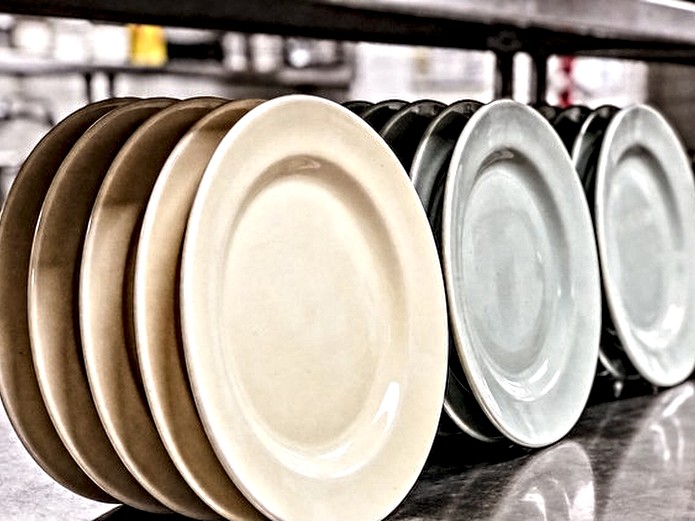
Color recommendation: Dark earth tones (charcoal, slate, deep brown, forest green) hide sauce stains and smoke residue far better than white or light cream. If your brand requires white or light-colored plates, budget for more frequent replacement or select glazes with enhanced stain-resistant formulations.
MOQ, Lead Time, and Customization: What to Expect from Suppliers
Here is what realistic sourcing looks like for BBQ restaurant ceramic plates from Chinese manufacturers.
- MOQ: 500–1,000 pieces per SKU for existing designs; 2,000–3,000 pieces for custom molds or glazes. Some suppliers offer mixed-SKU orders (e.g., 3,000 total across 5 plate sizes) at slightly higher per-unit pricing.
- Sample lead time: 10–15 days for existing designs; 25–35 days for custom samples requiring new molds.
- Production lead time: 45–60 days for standard orders; 70–90 days for custom glaze development or new mold production.
- Customization options: Logo embossing (mold-based, adds $0.15–$0.30/unit), decal printing (suitable for complex logos, adds $0.20–$0.40/unit), custom glaze colors (requires 2,000+ MOQ and 3–4 week color-matching time).
- Packaging: Standard export packaging uses 5-ply corrugated cartons with paper pulp dividers. For BBQ plates with wide rims or irregular shapes, request custom foam inserts or corner protectors. Transit breakage rates should be under 1.5% with proper packaging; negotiate replacement terms for breakage exceeding this threshold.
Cost-quality-lead time trade-off: You can get low-fire earthenware BBQ plates at $1.20/unit with 30-day lead time, but expect 20%+ annual replacement. High-fire stoneware at $2.50/unit with 60-day lead time typically lasts 3+ years. The higher upfront cost pays back within 12–18 months through reduced replacement and better customer perception.
Common Mistakes Smokehouse Buyers Make (And How to Avoid Them)
Mistake 1: Buying Based on Appearance Without Thermal Testing
A plate that looks great under showroom lighting may craze after three weeks of BBQ service. Always request thermal shock test samples: heat the plate to 150°C in an oven, then submerge it in 20°C water. Repeat 10 cycles. Any cracking or crazing disqualifies the supplier.
Mistake 2: Ignoring Dishwasher Compatibility
Commercial dishwashers use alkaline detergents at 65–82°C with rapid drying. Some decorative glazes (especially reactive and crystalline glazes) degrade under alkaline exposure. Ask suppliers for dishwasher durability test data — specifically, appearance retention after 200+ commercial wash cycles. [VERIFY BEFORE PUBLISHING: Confirm standard commercial dishwasher test protocol.]
Mistake 3: Ordering One Size Fits All
Smokehouses need a range of plate sizes. A single 28 cm plate works for sandwiches and lunch combos but fails for dinner platters and shared catering presentations. Build a three-size system: standard plate (28–30 cm), large platter (33–36 cm), and side plate (18–20 cm). This covers 90% of menu items without overcomplicating inventory.
BBQ Ceramic Plate Sourcing Checklist
Use this checklist when evaluating suppliers or placing orders. Save it and send it to each candidate supplier.
- ☐ Firing temperature ≥ 1,220°C confirmed in technical data sheet
- ☐ Thermal shock resistance ΔT ≥ 150°C (tested, not claimed)
- ☐ Lead-free and cadmium-free certification provided (FDA or EU equivalent)
- ☐ Acid resistance test results available (ASTM C650 or ISO 10545-13)
- ☐ Dishwasher durability data: 200+ cycles with no visible degradation
- ☐ Sample lead time ≤ 20 days for existing designs
- ☐ Production lead time ≤ 65 days for standard orders
- ☐ MOQ ≤ 1,000 pieces per SKU (or mixed-SKU flexibility offered)
- ☐ Transit breakage guarantee ≤ 1.5%
- ☐ Custom logo capability confirmed with mold or decal options
- ☐ Packaging specification includes corner/edge protection
- ☐ Third-party inspection (SGS, Bureau Veritas) accepted before shipment
Send this checklist to three suppliers and compare their responses. Any supplier that cannot provide documented answers to items 1–5 should be disqualified for BBQ service.
Three Actionable Sourcing Tips for BBQ Restaurant Operators
Tip 1: Order samples and abuse-test them before committing. Do not rely on supplier claims. Order 5 samples of each finalist, run them through your actual dishwasher for two weeks, serve your hottest and sauciest dishes on them, and stack-drop them from counter height onto a steel surface. Only proceed with suppliers whose samples survive this test intact.
Tip 2: Negotiate a replacement clause in your purchase contract. Specify that the supplier replaces any plate that chips, cracks, or crazes within 90 days of normal BBQ service use, provided thermal shock guidelines are followed. This transfers quality risk to the supplier and forces them to confirm their durability claims.
Tip 3: Plan your reorder cycle before you open. BBQ restaurants see 15–25% higher tableware loss in their first six months due to staff learning curves and menu refinement. Order 20% more than your calculated opening stock, and set a reorder trigger at 75% remaining inventory. This prevents the rush-order premiums and quality compromises that come from emergency restocking.
Internal Links and Related Resources
For more guidance on commercial ceramic sourcing, see our complete collection of sourcing guides. If you are comparing materials for your restaurant, our ceramic vs melamine vs glass comparison breaks down cost-per-use across different service environments. For heat resistance standards, refer to our thermal shock resistance guide. Ready to source? Contact our team for a specification sheet tailored to your smokehouse concept.
Frequently Asked Questions
Can ceramic plates handle food straight from a 200°C smoker?
High-fire stoneware and vitrified porcelain with thermal shock ratings of ΔT ≥ 150°C can handle the transition from smoker to table without cracking. Low-fire earthenware cannot. Always verify the thermal shock rating with your supplier before ordering.
How long do BBQ-rated ceramic plates last in commercial use?
With proper specification, high-fire stoneware plates typically last 2.5–4 years in active BBQ service before replacement is needed for cosmetic reasons. Low-fire alternatives often require replacement within 8–12 months.
Are dark-colored glazes safer for BBQ service than white?
Dark earth-tone glazes hide sauce stains and smoke residue better than white or cream, but color alone does not determine durability. The glaze formulation and firing temperature matter more. A well-fired white glaze outperforms a poorly fired dark glaze.
What is the minimum plate size for a full BBQ combo?
A 28–30 cm round plate is the minimum viable size for a meat-and-two-sides BBQ combo. For shared platters or catering presentations, use 36–40 cm rectangular platters to allow clean separation of meats and sides.
Should I choose ceramic or melamine for outdoor BBQ service?
For permanent outdoor seating, high-fire stoneware works if staff handling is careful. For poolside, temporary events, or high-drop-risk environments, melamine is more practical due to its impact resistance and lower replacement cost. Many operators use a hybrid system: ceramic indoors, melamine outdoors.
How do I test ceramic plates before placing a bulk order?
Order samples and run three tests: (1) thermal shock — oven-heat to 150°C then plunge into cold water, repeat 10 cycles; (2) acid exposure — leave BBQ sauce on the plate for 24 hours, then wash and inspect for staining; (3) impact — drop from counter height onto a steel surface. Any failure in these tests disqualifies the supplier.