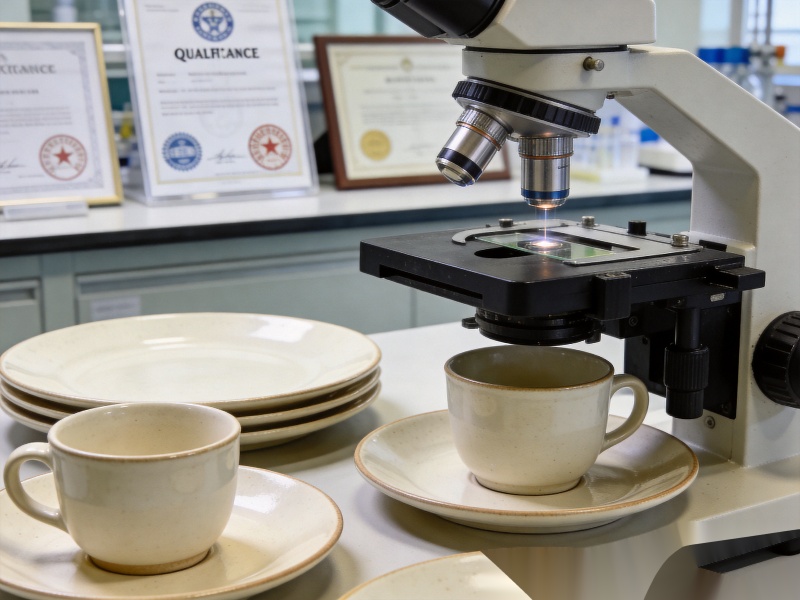
Ceramic certification standards are a non-negotiable requirement for any B2B buyer importing tableware into regulated markets. Whether you are supplying hotel chains in the United States, retail distributors in the European Union, or e-commerce platforms in Australia, your ceramic products must meet specific food-contact safety regulations before they can legally enter the market. Yet many buyers treat certification as an afterthought — addressing it only when shipments are held at customs or when a retail partner demands documentation at the last minute.
This guide provides a comprehensive overview of the major ceramic certification standards that govern international tableware trade, including FDA compliance, LFGB regulations, EU framework directives, and SGS third-party testing protocols. By understanding these requirements upfront, you can avoid costly delays, ensure market access, and build trust with your downstream customers.
Why Ceramic Certification Standards Matter for International Trade
Ceramic tableware comes into direct contact with food and beverages, making it subject to stringent food-safety regulations in virtually every major market. The primary concern is the migration of heavy metals — particularly lead and cadmium — from ceramic glazes and decorations into food. Ceramic certification standards exist to verify that products release these substances within safe limits defined by each regulatory jurisdiction.
For B2B buyers, non-compliance with ceramic certification standards can result in:
- Customs seizure: Shipments without valid certification documentation may be detained or rejected at the port of entry
- Product recalls: Retailers face legal liability and will recall non-compliant products immediately
- Financial penalties: Fines for importing non-compliant food-contact materials can reach $100,000+ per violation in some jurisdictions
- Reputational damage: A single compliance failure can permanently damage supplier-buyer relationships
- Market access denial: Some retailers and distributors will not onboard suppliers without current, valid certification
Understanding which ceramic certification standards apply to your target markets is the first step toward building a compliant supply chain. Let us examine each major standard in detail.
FDA Ceramic Certification Standards: U.S. Market Requirements
The U.S. Food and Drug Administration (FDA) regulates ceramic tableware under the Federal Food, Drug, and Cosmetic Act. The key regulatory framework is the FDA Compliance Policy Guide (CPG) 7117.06 and 7117.07, which establish permissible limits for lead and cadmium release from ceramic ware.
FDA Lead and Cadmium Release Limits
The FDA classifies ceramic ware into categories based on intended use and sets different limits for each:
- Flatware (plates, saucers): Lead ≤ 3.0 mg/L; Cadmium ≤ 0.50 mg/L
- Small hollowware (bowls, cups ≤ 1.1L): Lead ≤ 2.0 mg/L; Cadmium ≤ 0.50 mg/L
- Large hollowware (serving dishes > 1.1L): Lead ≤ 1.0 mg/L; Cadmium ≤ 0.25 mg/L
FDA Testing Protocol
FDA ceramic certification standards testing follows a specific protocol:
- Samples are filled with 4% acetic acid solution (food simulant)
- The solution remains in contact with the ceramic surface for 24 hours at room temperature (22±2°C)
- The solution is then analyzed using atomic absorption spectroscopy (AAS) or ICP-MS
- Results are compared against the permissible limits for the applicable product category
- A minimum of 6 samples per product type must be tested
FDA Registration and Compliance Documentation
While the FDA does not require pre-market approval for ceramic tableware, importers must maintain documentation proving compliance. This includes test reports from ISO 17025-accredited laboratories, factory registration with the FDA (for foreign manufacturers), and a Declaration of Compliance (DoC) that can be presented to customs officials upon request.

LFGB Ceramic Certification Standards: EU and German Market Requirements
The LFGB (Lebensmittel- und Futtermittelgesetzbuch) is the German food safety law that sets some of the strictest ceramic certification standards in the world. While it is a German regulation, LFGB compliance is widely recognized across the EU and is often required by European retailers even when EU-wide regulations would technically suffice.
LFGB vs. EU Framework Directive 84/500/EEC
The EU Framework Directive 84/500/EEC (amended by 2005/31/EC) sets baseline migration limits for ceramic ware across all member states. However, LFGB ceramic certification standards are significantly more stringent:
- EU Directive lead limits (flatware): 4.0 mg/dm² — LFGB: 0.8 mg/dm² (5x stricter)
- EU Directive cadmium limits (flatware): 0.3 mg/dm² — LFGB: 0.07 mg/dm² (4x stricter)
- LFGB also tests for additional substances not covered by the EU directive, including cobalt, arsenic, and specific heavy metals in colored decorations
LFGB Testing Conditions
LFGB ceramic certification standards testing uses more rigorous conditions than FDA testing:
- Test solution: 4% acetic acid (same as FDA)
- Contact time: 24 hours at 22°C — but LFGB may require repeated testing (3 extraction cycles) to assess cumulative migration
- LFGB also requires testing with additional food simulants for certain product types (e.g., 10% ethanol for alcoholic beverages)
- Decorated surfaces that contact food must be tested separately from undecorated areas
When LFGB Compliance Is Required
B2B buyers should request LFGB certification when:
- Selling to German retailers (e.g., Kaufhof, Karstadt, IKEA Germany)
- Supplying premium European hospitality chains
- Targeting European e-commerce platforms where German consumers are the primary market
- Positioning products in the premium segment where stricter standards signal higher quality
SGS and Third-Party Ceramic Certification Standards Testing
SGS (Société Générale de Surveillance) is the world’s leading third-party inspection and certification company. While SGS does not create its own ceramic certification standards, it provides independent testing and verification services against all major international standards including FDA, LFGB, EU directives, and country-specific regulations.
What SGS Testing Covers for Ceramic Tableware
- Heavy metal migration testing: Lead, cadmium, cobalt, and other regulated substances per FDA, LFGB, or EU standards
- Physical property testing: Thermal shock resistance, microwave safety, dishwasher durability, and water absorption rates
- Surface quality inspection: Glaze defects, pinholes, crazing, and color consistency
- Packaging compliance: Verification that packaging materials meet food-contact and environmental regulations
- Labeling review: Confirmation that product markings, country-of-origin labels, and compliance symbols meet target market requirements
Choosing the Right SGS Test Protocol
The specific SGS test protocol depends on your target market. Key options include:
- SGS-FDA: For U.S. market entry — tests per CPG 7117.06/07
- SGS-LFGB: For German/EU premium market — tests per LFGB Section 30
- SGS-EU: For general EU market — tests per Directive 84/500/EEC
- SGS-Australia/NZ: For Australian market — tests per Food Standards Australia New Zealand (FSANZ)
- SGS-Proposition 65: For California-specific lead/cadmium limits (stricter than federal FDA standards)
For buyers sourcing from China, SGS maintains laboratories in Shenzhen, Guangzhou, Shanghai, and other major manufacturing hubs, enabling efficient pre-shipment testing without international sample shipping. Explore our sourcing guides for more strategies on quality management.
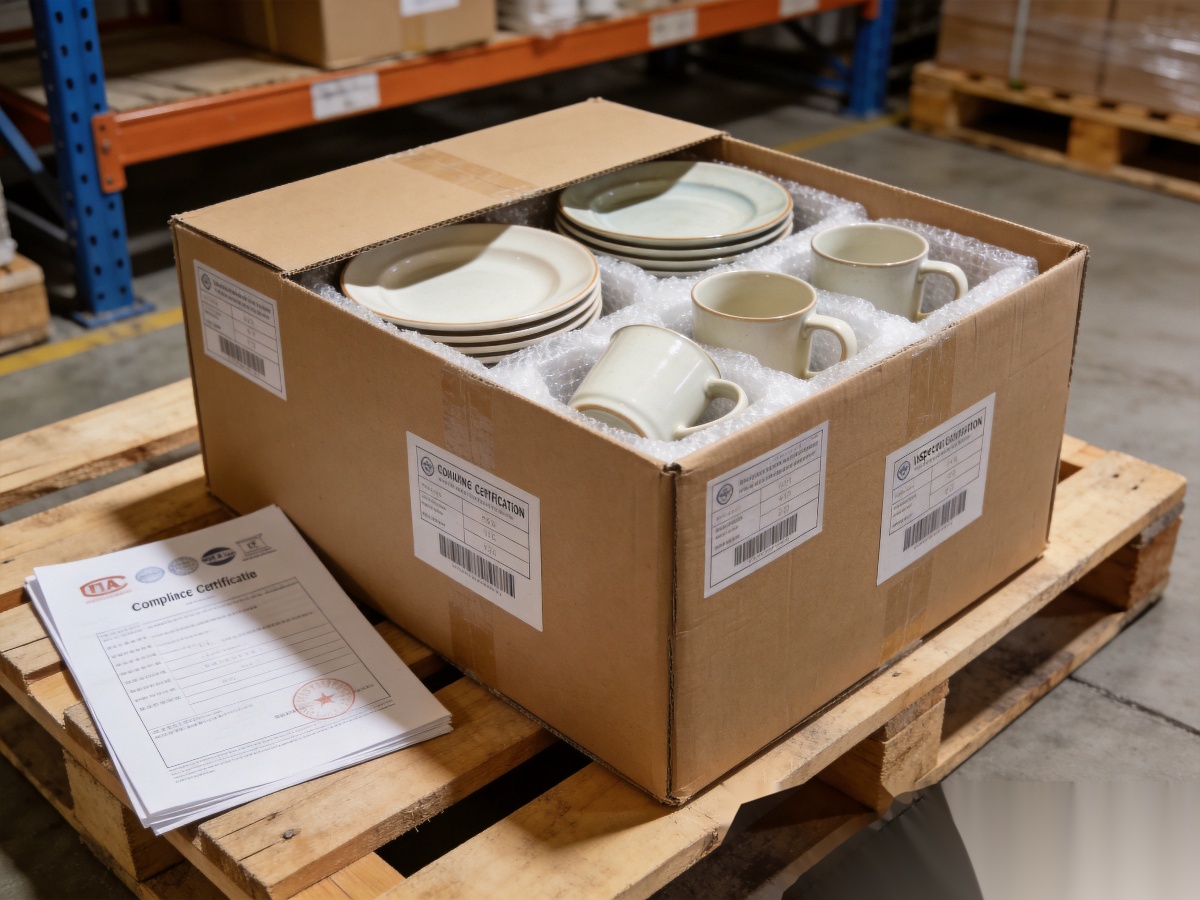
Ceramic Certification Standards by Target Market: A Quick Reference
Different markets require different ceramic certification standards. Here is a quick reference to help B2B buyers identify which standards apply to their export destinations:
- United States: FDA CPG 7117.06/07 + California Proposition 65 (stricter lead limits)
- European Union (general): Directive 84/500/EEC + Regulation (EC) No 1935/2004
- Germany: LFGB Section 30 (most stringent in EU)
- United Kingdom: UK Statutory Instrument 2005 (post-Brexit equivalent of EU directive)
- Australia/New Zealand: FSANZ food-contact standards
- Japan: Japanese Food Sanitation Act (JFSL) — specific limits for ceramic and porcelain
- Canada: Consumer Chemicals and Containers Regulations (CCCR) + Hazardous Products Act
Many B2B buyers adopt a “highest standard” approach — obtaining LFGB certification even when only FDA is technically required — because LFGB compliance satisfies virtually all other market requirements worldwide. This strategy simplifies compliance management and positions products favorably with quality-conscious buyers. For more on sourcing quality tableware, see our ceramic quality control checklist.
How Ceramic Certification Standards Affect Sourcing Costs and Timelines
Ceramic certification standards compliance has direct implications for your sourcing budget and production timeline. Here is what B2B buyers need to plan for:
Certification Testing Costs
- FDA testing (per product type): $200–$400 — tests lead/cadmium migration for one product category
- LFGB testing (per product type): $500–$900 — more extensive testing including additional heavy metals and multiple extraction cycles
- EU Directive testing: $300–$500 — intermediate level between FDA and LFGB
- Proposition 65 testing: $300–$600 — required for California market specifically
- Physical property testing (thermal shock, dishwasher): $150–$300 per test suite
Testing Timeline
Standard testing turnaround times from accredited laboratories:
- Standard turnaround: 7–14 business days from sample receipt
- Express turnaround: 3–5 business days (typically 30–50% surcharge)
- Pre-shipment inspection + testing combined: 10–20 business days
Cost Optimization Strategies
To manage ceramic certification standards compliance costs effectively:
- Group testing by glaze type: If multiple products share the same glaze formulation, one test report can cover all items in the group
- Request factory pre-testing: Many established Chinese ceramic factories maintain current FDA/LFGB test reports for their standard glaze lines — request these before ordering your own tests
- Consolidate testing at pre-shipment: Combine compliance testing with your pre-shipment quality inspection to reduce per-test costs
- Annual re-certification planning: Most buyers accept test reports valid for 12–24 months — plan renewal testing well in advance of expiration
Building a Ceramic Certification Standards Compliance Program
For B2B buyers with ongoing ceramic tableware sourcing programs, establishing a systematic ceramic certification standards compliance program is essential. Here is a framework:
Step 1: Map Your Target Markets
Identify every market where your products will be sold and list the applicable ceramic certification standards for each. Create a compliance matrix that maps products to required certifications.
Step 2: Qualify Suppliers by Certification Capability
During supplier evaluation, verify that factories can consistently produce to the required standards. Ask for existing test reports, check their laboratory relationships, and assess their understanding of specific testing protocols. Our supplier selection checklist covers this in detail.
Step 3: Define Testing Frequency and Triggers
Establish a testing schedule that includes:
- Initial certification before first shipment
- Annual re-certification for ongoing production
- Re-testing whenever glaze formulations change
- Re-testing when switching to a new factory or production line
- Spot testing on random samples from production runs (1–2 per quarter)
Step 4: Maintain a Documentation System
Keep all certification documents organized and accessible. You should have current test reports available within 24 hours of any customer or regulatory request. Digital document management systems with expiration alerts prevent compliance gaps from expired certifications.
Frequently Asked Questions About Ceramic Certification Standards
Q1: How long are ceramic certification standards test reports valid?
Most retailers and regulatory authorities accept ceramic certification standards test reports for 12 to 24 months, provided the product specifications (glaze, decoration, shape) have not changed. Some strict markets like Germany may require annual re-certification. Always confirm validity requirements with your target market’s specific regulations and your customer’s compliance team.
Q2: Do all ceramic products need FDA certification to enter the U.S. market?
Yes, all ceramic tableware and food-contact products sold in the United States must comply with FDA ceramic certification standards for lead and cadmium migration. While the FDA does not issue a formal “certificate,” importers must maintain test reports from accredited laboratories proving compliance. Products without valid compliance documentation risk seizure at customs. California products must additionally meet Proposition 65 requirements.
Q3: What is the difference between LFGB and FDA ceramic certification standards?
LFGB ceramic certification standards are significantly stricter than FDA standards. LFGB limits for lead and cadmium migration are approximately 4–5 times lower (more restrictive) than FDA limits. LFGB also tests for additional heavy metals not covered by FDA regulations, and requires multiple extraction cycles to assess cumulative migration. Products passing LFGB testing will typically meet FDA requirements, but not vice versa.
Q4: Who pays for ceramic certification standards testing — the buyer or the factory?
This is negotiable and varies by supplier relationship. Many established Chinese ceramic factories will cover initial testing costs for their standard product lines as part of their sales support. For custom designs or new glaze formulations, buyers typically bear the testing cost ($200–$900 per test). Some buyers negotiate testing costs into the unit price or request cost-sharing arrangements for the first order. Always clarify testing responsibility before production begins.
Q5: Can I use one ceramic certification standards test report for multiple markets?
It depends on the standard. LFGB test reports are widely accepted across EU markets and satisfy the stricter German requirements. FDA test reports are specific to the U.S. market. If you sell to both U.S. and EU markets, you will likely need separate testing for each regulatory framework. The most efficient approach is to test to the highest applicable standard (LFGB) and supplement with FDA-specific testing only if required by U.S. customers.
Conclusion: Make Ceramic Certification Standards a Strategic Priority
Ceramic certification standards are not just a regulatory hurdle — they are a competitive differentiator. B2B buyers who proactively manage compliance gain faster market access, stronger customer relationships, and reduced supply chain risk. Those who treat certification as an afterthought face delays, penalties, and lost business opportunities.
By understanding the key ceramic certification standards — FDA, LFGB, EU directives, and third-party testing — and building a systematic compliance program, you position your sourcing operation for long-term success in regulated international markets.
Ready to source ceramic tableware with guaranteed compliance documentation? Contact CeraSupply today for a free consultation on ceramic certification standards requirements for your target markets. Our team will help you navigate compliance and deliver certified products on schedule.