When sourcing ceramic tableware from overseas manufacturers, a ceramic factory audit is one of the most important steps in the procurement process. Whether you are a restaurant chain owner, a wholesale distributor, or an e-commerce brand, visiting the production facility before placing bulk orders can save you from costly mistakes, quality issues, and supply chain disruptions.
At CeraSupply, we welcome factory audits from all our clients because transparency builds trust. In this comprehensive guide, we will walk you through everything you need to know about conducting a ceramic factory audit, including the essential checklist items, red flags to watch for, and how to evaluate a supplier’s production capabilities before committing to large orders.
Why a Ceramic Factory Audit Matters for Bulk Buyers
A ceramic factory audit gives you direct visibility into the manufacturer’s actual production conditions, quality management systems, and operational standards. Unlike relying solely on product samples or online catalogs, an on-site inspection reveals the real capabilities and limitations of a potential supplier.
Here are the key reasons why conducting a ceramic factory audit is essential:
- Verify production capacity — Confirm the factory can handle your order volume within your timeline
- Assess quality control systems — Evaluate whether QC processes are systematic and reliable
- Check compliance certifications — Verify that FDA, LFGB, and other certifications are current and legitimate
- Evaluate working conditions — Ensure the factory meets ethical manufacturing standards
- Identify potential risks — Spot red flags before they become costly problems
- Build direct relationships — Face-to-face communication establishes trust and reduces miscommunication
For international B2B buyers, the cost of a factory visit is minimal compared to the potential losses from working with an unreliable supplier. A single failed container of ceramic tableware can cost tens of thousands of dollars in returns, replacements, and damaged reputation.
The Essential Ceramic Factory Audit Checklist
A thorough ceramic factory audit covers multiple areas of the manufacturing operation. Below is a comprehensive checklist that professional sourcing agents and quality inspectors use when evaluating ceramic tableware manufacturers.
1. Production Equipment and Technology
During your ceramic factory audit, carefully inspect the production equipment. Look for:
- Forming machines — Are they modern automated pressing machines or older manual equipment? Modern machines produce more consistent shapes and dimensions.
- Glazing lines — Check whether glazing is done by automated spray systems or manual dipping. Automated systems provide more uniform coating thickness.
- Kilns — Inspect the kiln type (roller kiln, shuttle kiln, or tunnel kiln), temperature control systems, and firing consistency. Well-maintained kilns are critical for consistent product quality.
- Decorating equipment — If you need printed or decal-decorated products, check the printing machines, transfer equipment, and color consistency controls.
- Maintenance records — Ask to see equipment maintenance schedules. Well-maintained machinery indicates good factory management.
2. Quality Control Systems
Quality control is arguably the most critical area of any ceramic factory audit. Evaluate the following:
- Incoming raw material inspection — Does the factory test clay, glaze materials, and pigments before use?
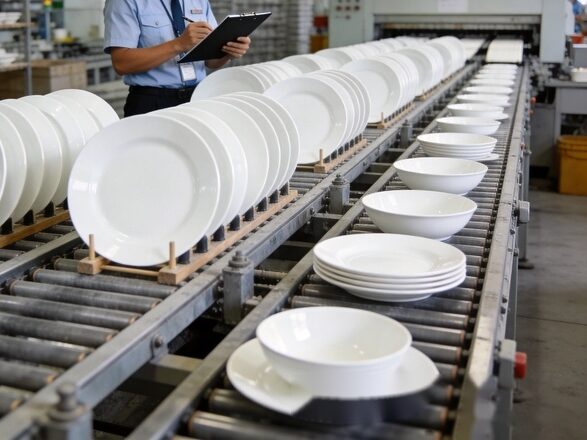
- In-process quality checks — Are there QC stations at key production stages (forming, drying, bisque firing, glazing, final firing)?
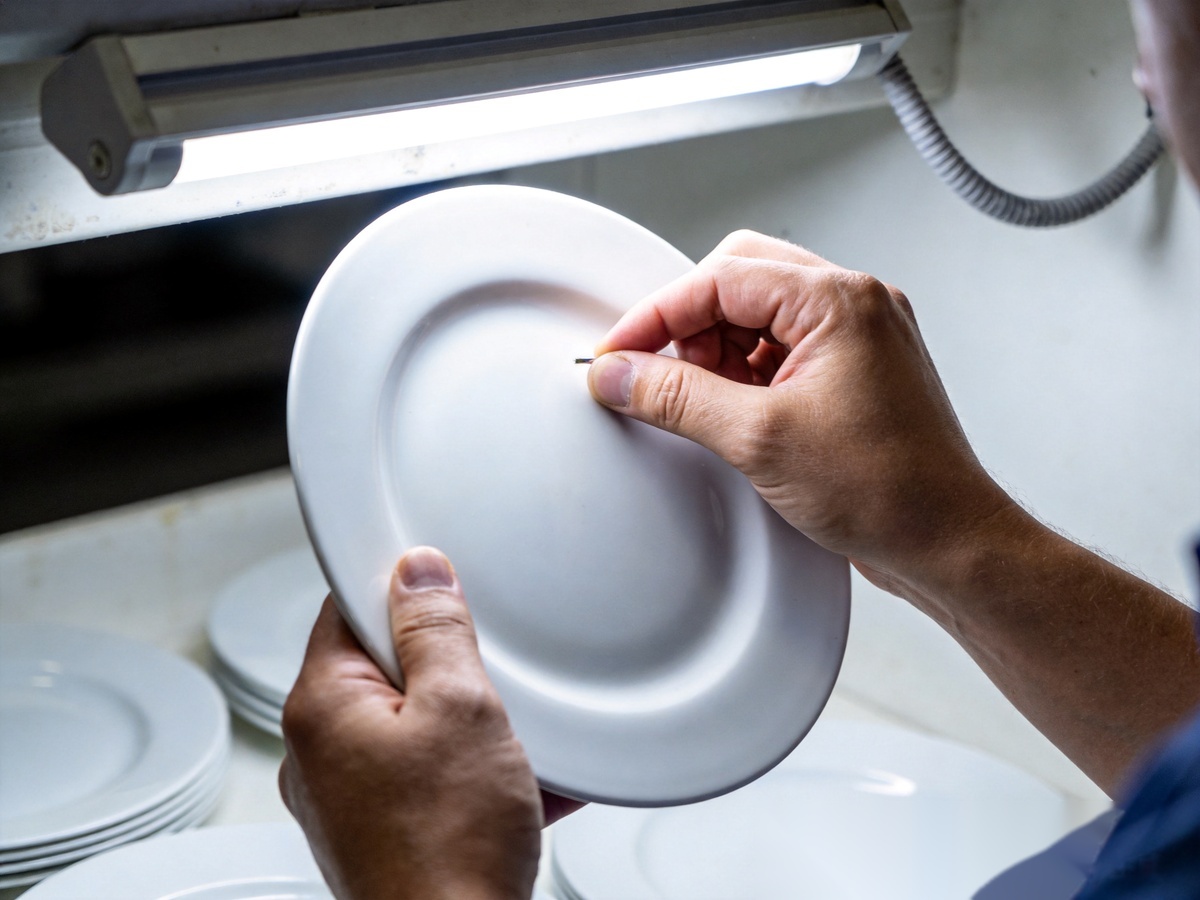
- Final product inspection — Check the sorting criteria for defects such as warping, pinholes, crazing, color variation, and dimensional tolerance.
- Testing equipment — Look for thermal shock testers, lead and cadmium testing kits, water absorption testers, and dimensional measurement tools.
- QC documentation — Review inspection records, defect rate tracking, and corrective action logs.
- AQL standards — Ask about the Acceptable Quality Level (AQL) the factory follows. Standard ceramic tableware typically uses AQL 2.5 for major defects and AQL 4.0 for minor defects.
For a deeper understanding of quality standards in ceramic manufacturing, check our guide on ceramic certification standards to learn more about international compliance requirements.
3. Raw Materials and Supply Chain
The quality of finished ceramic products starts with raw materials. During your ceramic factory audit, investigate:
- Clay sources — Where does the factory source its clay? Kaolin and ball clay from established suppliers produce stronger, whiter products.
- Glaze materials — Are glazes sourced from certified suppliers? Do they comply with food safety regulations in your target market?
- Material storage — Raw materials should be stored in dry, organized conditions to prevent contamination.
- Supplier relationships — Long-term relationships with material suppliers indicate stability and reliability.
4. Production Capacity and Lead Times
Understanding the factory’s actual production capacity prevents delivery delays and unfulfilled orders:
- Monthly output — What is the factory’s total monthly production capacity in pieces?
- Current utilization — How much of the capacity is already committed to other clients?
- Order scheduling — How does the factory plan and schedule production runs?
- Lead time track record — Ask for references or past order records to verify claimed lead times.
- Peak season handling — How does the factory manage increased demand during peak seasons?
5. Packaging and Warehousing
Ceramic products are fragile, making packaging a critical part of your ceramic factory audit. Inspect:
- Inner packaging — Are products individually wrapped with foam, bubble wrap, or tissue paper?
- Carton quality — Check the grade and thickness of export cartons. 5-layer or 7-layer corrugated boxes are standard for ceramic exports.
- Palletizing — Are cartons properly palletized with corner protectors and shrink wrap?
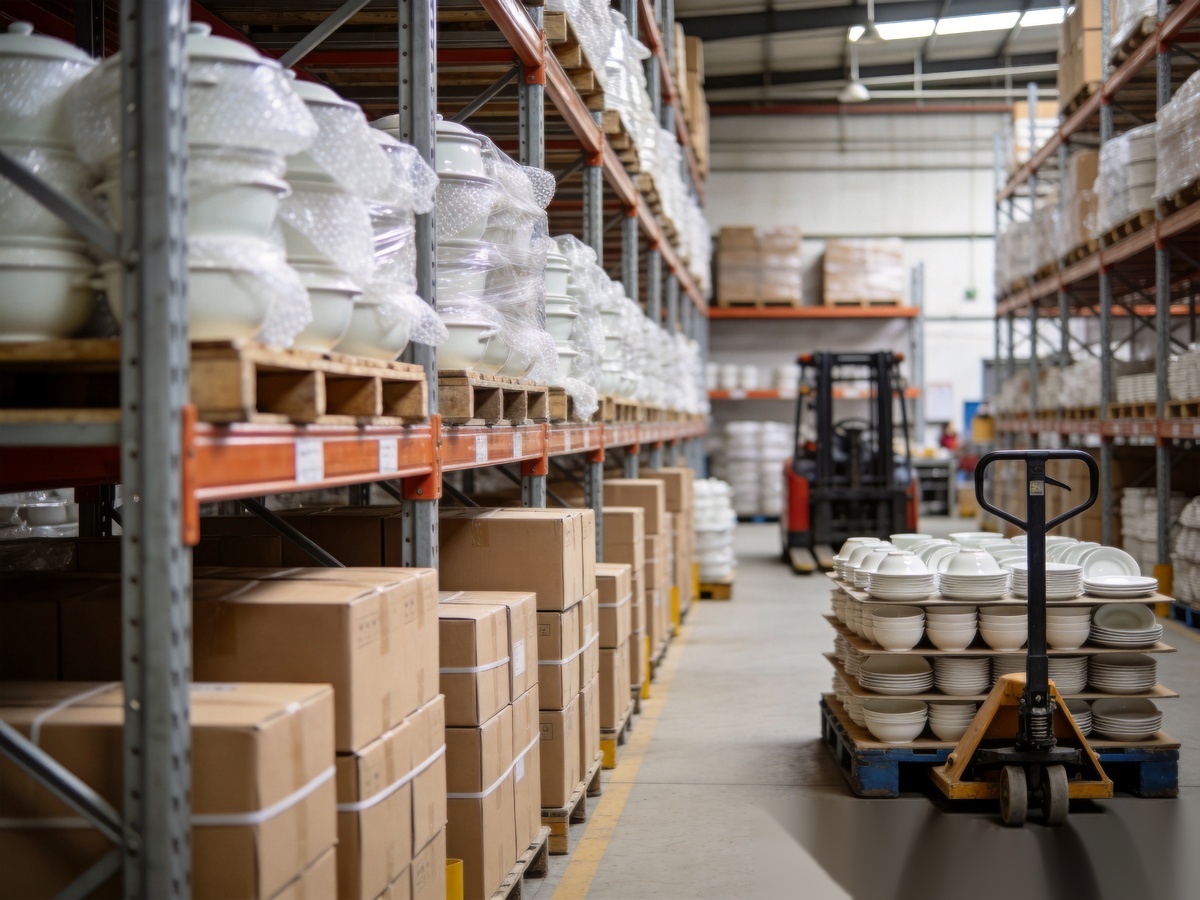
- Warehouse conditions — Finished goods should be stored in dry, clean, elevated areas away from moisture.
- Loading procedures — Observe how containers are loaded. Proper loading prevents transit damage.
6. Compliance and Certifications
Verify all claimed certifications during your ceramic factory audit:
- ISO 9001 — Quality management system certification
- FDA compliance — Required for ceramic tableware sold in the United States
- LFGB/EC 1935/2004 — Required for ceramic products sold in the European Union
- SGS/Bureau Veritas/TUV reports — Third-party testing reports for lead and cadmium release
- BSCI/Sedex — Social compliance audit certifications
- Environmental certifications — Waste water treatment, emissions control, and energy efficiency records
Always ask to see original certificates and verify them with the issuing organization. Certificates can be forged, and a legitimate factory will have no problem providing verification details.
Red Flags to Watch for During a Ceramic Factory Audit
Not every factory visit will reveal a perfect operation. Here are the warning signs that should raise concerns during your ceramic factory audit:
- No visible QC process — If workers do not perform any quality checks during production, defect rates will be high.
- Dirty or disorganized workshop — Poor housekeeping often correlates with poor product quality and inconsistent output.
- Reluctance to show certain areas — If the factory avoids showing you specific production areas, they may be hiding substandard practices.
- No testing equipment — A factory without basic testing equipment cannot guarantee product safety or consistency.
- Expired or unverifiable certifications — Certifications must be current and verifiable through the issuing body.
- Inconsistent product samples — Significant variation between samples on display suggests quality control problems.
- No export experience — A factory without international export experience may struggle with documentation, customs requirements, and compliance standards.
- Unusually low prices — Prices significantly below market rates often indicate corners being cut in materials or processes.

How to Plan and Conduct Your Ceramic Factory Audit
Planning your ceramic factory audit properly ensures you get maximum value from the visit. Follow this step-by-step approach:
- Schedule in advance — Contact the factory at least two weeks before your visit. This gives them time to prepare and ensures key personnel will be available.
- Prepare your checklist — Customize the checklist above for your specific product requirements and quality standards.
- Bring the right tools — A camera, measuring tape, caliper, flashlight, and notebook are essential for thorough documentation.
- Visit during production — Schedule your visit when the factory is running production, not during maintenance or holiday shutdowns.
- Take photos and notes — Document everything: equipment, processes, certifications, and any areas of concern.
- Request samples — Collect product samples directly from the production line (not just from the showroom) for independent testing.
- Interview key staff — Talk to the production manager, QC manager, and export manager separately to get different perspectives.
- Follow up with testing — Send collected samples to an independent lab for lead/cadmium testing, thermal shock testing, and dimensional analysis.
If traveling to China for a factory visit is not feasible, consider hiring a professional third-party inspection service. Companies like SGS, Bureau Veritas, and Intertek offer factory audit services starting from $300-$500 per visit, which is a small investment compared to the risk of working with an unverified supplier. Learn more about choosing the right supplier in our supplier selection checklist.
Ceramic Factory Audit vs. Third-Party Inspection: Which Should You Choose?
Many buyers wonder whether to conduct the ceramic factory audit themselves or hire a professional inspection company. Here is a comparison to help you decide:
Self-conducted factory audit:
- You see everything firsthand and can ask detailed questions
- Builds stronger personal relationships with the supplier
- You have full control over what to inspect and prioritize
- Requires travel time and cost (flight, hotel, transportation)
- May lack professional inspection expertise
Third-party inspection service:
- Professional inspectors know exactly what to look for
- Detailed reports with photos and documentation
- No travel costs or time commitment required
- Can be scheduled quickly and frequently
- Less personal relationship building with the factory
For the best results, many experienced buyers combine both approaches: conduct an initial factory visit to evaluate the supplier, then use third-party inspections for ongoing quality control on subsequent orders.
Frequently Asked Questions About Ceramic Factory Audits
How much does a ceramic factory audit cost?
The cost varies depending on whether you conduct the audit yourself or hire a third-party service. Self-conducted audits involve travel expenses (typically $1,000-$3,000 for a China trip), while professional inspection services charge $300-$800 per audit depending on the scope and location. Some sourcing agents offer audit services bundled with their commission structure.
How often should I audit my ceramic supplier’s factory?
Best practice is to audit a new supplier before placing the first order, then conduct follow-up audits annually or whenever you notice quality issues. For high-volume orders, consider pre-shipment inspections on every batch. If the supplier has a consistent track record over several years, you can reduce audit frequency to every 18-24 months.
Can I rely on product samples instead of a factory audit?
Product samples are useful for initial evaluation but should never replace a factory audit. Samples are often hand-picked and may not represent the quality of mass production. A factory audit reveals the actual production conditions, QC systems, and consistency of output that samples alone cannot show. Always combine sample evaluation with an on-site audit for the most reliable assessment.
What certifications should I verify during a ceramic factory audit?
The key certifications to verify include ISO 9001 for quality management, FDA compliance for the US market, LFGB or EC 1935/2004 for the European market, and third-party testing reports from SGS, Bureau Veritas, or TUV for lead and cadmium release levels. For ethical sourcing, also check for BSCI or Sedex social compliance audits. Always verify certificates directly with the issuing organization.
Do I need to speak Chinese to conduct a ceramic factory audit in China?
While not strictly necessary, having a translator or hiring a bilingual sourcing agent significantly improves the audit experience. Most ceramic factories in China’s major production regions like Jingdezhen, Chaozhou, and Dehua have export teams who speak basic English, but technical discussions about production processes and quality standards are more effective with a translator. Many third-party inspection companies provide bilingual auditors as part of their service.
Ready to Source with Confidence?
Conducting a thorough ceramic factory audit is an investment that pays for itself many times over. By following this checklist, you can identify reliable suppliers, avoid costly quality problems, and build long-term partnerships that drive your business forward.
At CeraSupply, we believe in full transparency. We welcome factory audits from all clients and partners. Whether you want to visit our production facilities in person or arrange a third-party inspection, we are ready to accommodate. Explore our ceramic tableware product range and see why hundreds of B2B buyers trust us as their sourcing partner.
Get a free quote today and let our team help you find the perfect ceramic tableware solutions for your business. We offer factory-direct pricing, full quality guarantees, and complete audit support for all our clients.