Ceramic tableware country of origin marking is a specification decision, not a shipping formality. Under 19 U.S.C. 1304 the mark has to sit on the article itself, and 19 CFR 134.41 suggests that on earthenware or chinaware it be glazed on in the process of firing – which places the decision in the decoration booking, not in the carton printing. Treat it as a packing-line detail and the difference arrives at the port: an unmarked entry carries additional duty of 10% of the final appraised value under 19 CFR 134.2, or a redelivery demand under 134.3. What follows is where the mark legally belongs, what holds on glazed ware, the two traps that void an approved backstamp, and the eight lines to add to your specification.
Why ceramic tableware country of origin marking belongs on the piece, not the master carton
Section 1304(a) is written about the article: every article of foreign origin imported into the United States must be marked in a conspicuous place, as legibly, indelibly and permanently as the nature of the article permits. The container is a fallback, not the default.
Part 134 carries a container exception. Section 134.32(d) excepts articles for which marking the containers will reasonably indicate the origin, and Subpart C moves the obligation onto the container. The operative idea is the usual container – the one in which the article ordinarily reaches the ultimate purchaser. For retail dinnerware that is the retail box or sleeve, not the export carton. Customs guidance is direct: usual containers imported filled must be marked with the origin of their contents unless the contents are marked and the container can be readily opened for inspection.
So a shipment carrying “Made in China” on the master carton only, with unmarked plates in unmarked retail boxes, has not been marked. The master carton is discarded long before an ultimate purchaser sees a plate, and the redelivery clock in 134.3 runs from entry or examination, so discovery often lands after the goods are in your warehouse.
What actually counts as a lawful mark on glazed ceramic
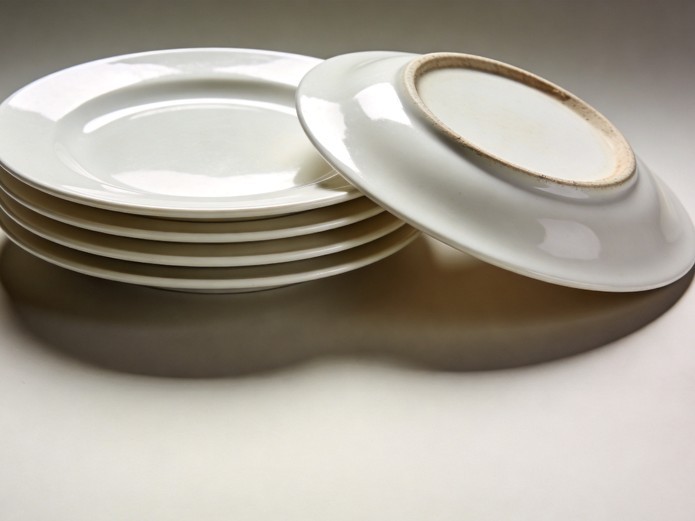
Section 134.41(a) sets the statutory adjectives – legible, indelible, permanent – then makes a suggestion rather than a mandate: marking is best done by working the mark into the article at the time of manufacture, and on earthenware or chinaware the origin is suggested to be glazed on in the process of firing. It is the regulation’s preferred method, not a prescribed one. Section 134.42 lets the Commissioner require a specific method for a class of goods, but 134.43 prescribes methods only for a short list – cutlery, watches, timing apparatus, Native American-style jewellery – and ceramic tableware is not on it.
Section 134.44(a) then opens the field: any method at any location is acceptable provided the marking is legible and permanent enough to remain until the article reaches the ultimate purchaser unless deliberately removed. On glazed dinnerware that gives three routes – a mark worked into body or glaze at making, a decoration fired onto the glazed surface, or a label attached after firing.
Section 134.44(b) accepts paper or pressure-sensitive labels, but requires them conspicuous and so securely affixed that, unless deliberately removed, they stay through storage and display until delivery. Customs guidance calls labels non-recommended: adhesive fails and the importer pays for remarking. On food-contact ware the adhesive is also a migration question, so a label belongs on the foot or outside wall, never in the well.
The permanence standard in 134.41(b) is narrower than most specifications assume: the mark must survive normal distribution and store handling, and the ultimate purchaser must find and read it without strain. That is where the legal requirement ends for ceramic tableware country of origin marking. For a hotel or restaurant the venue is the ultimate purchaser, and commercial dishwashing is not a Section 1304 test. It is a commercial consideration you may impose – legitimate engineering, wrong as a statement of customs law.
Two backstamp traps that void artwork already approved
A US place name, or your own address, on the backstamp
Section 134.46 catches private-label buyers. Where the words United States, American or U.S.A., any variation of them, the name of any city or location in the United States, or the name of any foreign country or locality other than the place of manufacture appears on the article or container and may mislead as to actual origin, the origin must appear legibly and permanently in close proximity, in at least comparable size, preceded by “Made in”, “Product of” or similar words.
Against a private-label backstamp that catches: a brand built on an American city name, a “Designed in California” line, a US address in the fine print, a collection named after a US region – any can put the artwork inside 134.46. The remedy is not to delete the brand line but to place “Made in China” beside it at the same or larger size, laying the artwork out around the origin statement instead of dropping it into leftover space. Where a US name sits inside a trademark rather than a locality claim, 134.47 accepts close proximity or another conspicuous location: wider, but still required.
“Fine China” is a ware type, not an origin statement
Section 134.45(a)(1) requires the full English name of the country. Section 134.45(c) accepts the adjectival form provided it does not appear with other words so as to refer to a kind or species of product, and gives “English walnuts” and “Brazil nuts” as unacceptable examples. The ceramic equivalents are everywhere: Fine China, Bone China, China Clay – and “Made in E.U.”, which Customs guidance treats as unacceptable because it does not identify the individual country.
The rule I give buyers: the country name gets its own line and type size, and no ware-type word touches it. “Made in China” on a separate baseline is unambiguous; “Fine China” under a crest is a quality claim that happens to contain a country name, and an officer may read the piece as unmarked.
Two failures recur between sample approval and loading. One is a backstamp carrying a US address or US-sounding brand with no adjacent origin statement – artwork approved against a brand guideline rather than a marking rule, the failure I meet most on private-label work. The other is an E.U. mark or ware-type word standing in for the country name: both read as marking to anyone not looking for it, neither satisfies 134.45.
Draw the mark in fired dimensions, not mould dimensions
A glazed-on backstamp is part of the body, so it shrinks with the body. Every figure on the artwork approval belongs in fired dimensions, with the tooling drawing carrying the compensated number.
| Application route | Shrinks with body? | 6.0 mm nominal fires to | Draw on tooling for 6.0 mm fired |
|---|---|---|---|
| Mark worked into body or glaze at making | Yes | 5.28 mm at 12% linear | 6.82 mm |
| Underglaze stamp, before glost firing | Yes | 5.28 mm at 12% linear | 6.82 mm |
| Decal or transfer, after glost firing | No | 6.00 mm | 6.00 mm |
The spread runs from 5.16 mm at 14% linear shrinkage to 5.64 mm at 6% – a 0.48 mm band from one nominal artwork. A 20 mm mark on a 270 mm plate occupies 7.4% of the diameter, and losing 12% of its linear size cuts the marked area by 22%: on a fine-line crest, the difference between a readable mark and a grey smudge. Legibility is the statutory test in 134.41(b), not a nicety.
The reverse bites too. If marketing signs off at a fired height, the mould or decal artwork has to be compensated upward before release: 6.0 mm fired needs 6.59 mm drawn at 9% and 6.82 mm at 12%. An uncompensated file sent to a factory gets whatever the factory’s default assumption produces.
Two commercial consequences follow. A body or underglaze mark is cut into the mould or stamp at tooling stage, so it rides the tooling charge with no separate minimum; a fired decal is printed separately, so it carries a print minimum and its own lead time even when the body is already in production. Re-cutting an origin statement after the mould exists means new tooling, which is why the wording belongs on the first artwork approval. Our OEM/ODM tooling process runs from that same artwork file, so the fired number is set once, at release.
What a non-compliant mark costs at the border
| Exposure | Legal basis | Trigger and clock | Who carries it |
|---|---|---|---|
| Additional duty, 10% of final appraised value | 19 CFR 134.2; 19 U.S.C. 1304(f) | An entry not marked as required; avoidable by export or destruction under Customs supervision before liquidation | Importer of record |
| Delivery withheld | 19 CFR 134.3(a) | Held until marked, or until estimated duties or adequate security are deposited | Importer |
| Redelivery demand | 19 CFR 134.3(b), by way of 141.113(a) | Not later than 30 days after the date of entry, or of examination | Importer |
| Criminal exposure | 19 CFR 134.4; 19 U.S.C. 1304(h) | Intentional removal, defacement or alteration to conceal origin: up to $5,000 and/or 1 year | Individual |
| Remarking and repacking at destination | Commercial | On discovery, off the redelivery clock | Importer |
Set that against what most buyers optimise. On a $100,000 appraised entry a 3% price concession is $3,000; the additional duty is $10,000 – 3.3 times the concession, before remarking labour, repacking and delay. On a $1.80 plate the exposure is $0.18 a piece: trivial per unit until it multiplies across the order. Duty classification is a separate question, covered in our ceramic tableware HS code guide.
One backstamp cannot serve both the US and the EU
The two regimes are built on different ideas of where the information lives. The US statute is about the article; EU Regulation (EC) No 1935/2004 Article 15 is about what accompanies the article. Article 15(1) requires, for materials not yet in contact with food when placed on the market: the words “for food contact” or a specific indication as to use or the Annex II symbol; special instructions for safe use where necessary; the name or trade name and, in either case, the address or registered office of the manufacturer, processor or seller placing it on the market; and adequate labelling or identification for traceability under Article 17. Article 15(3) requires that information to be conspicuous, clearly legible and indelible.
Then Article 15(8) does what the US rules never do: at marketing stages other than retail, the Article 15(1) information may sit on the accompanying documents, on labels or packaging, or on the articles themselves. At the business-to-business stage the EU file can carry the set on paper, and Article 16 adds the written declaration of compliance with supporting documentation on demand.
For a supplier running one body for both markets the consequence is concrete. Printing the EU operator name and address onto the backstamp to “cover both” adds a locality line the US never asks for, consumes backstamp area the origin statement needs, and – where the registered office names a country other than the place of manufacture – can itself engage 134.46. The cleaner split is a US-facing backstamp carrying origin plus brand, with the EU set on documents and retail packaging as Article 15(8) permits, declaration held in the file. Where one box ships to both markets the box satisfies both; the piece usually only has to satisfy the US side. Build that file from our declaration of conformity walk-through and settle decoration language on the specification sheet before the first sample.
The eight lines to add to your backstamp specification
Treat ceramic tableware country of origin marking as eight lines on the tooling release, not a packaging brief the decorator never receives. Six settle before a single piece is fired.
- Origin statement, verbatim, country spelled in full on its own line – no ware-type word adjacent to it
- Application route named explicitly: body or glaze mark at making, underglaze stamp, or fired decal – never left to the factory’s default
- Fired dimensions: minimum character height and minimum mark width as fired sizes, with tooling compensation shown separately
- Location on the piece: foot ring, outside wall or well floor, not covered by a later attachment, visible without touching the food surface
- Brand artwork interaction: any US place name, US address or trademark containing one, plus the “Made in” statement beside it at equal or larger size
- The durability requirement you actually need, named as store handling, retail display or your own wash-cycle figure – and labelled commercial where it is commercial
- Carton and retail-box marking, so the usual container is covered independently of the piece
- Evidence at pre-shipment: close-up photographs of the fired mark on production pieces, plus approved artwork carrying fired dimensions
The clause that does the work, ready to paste into a purchase order:
BACKSTAMP AND ORIGIN MARKING
1. Origin text: "Made in [country]", country name in full, own line, minimum character height [ ] mm FIRED.Three things I would change next order. Put the backstamp on the tooling release rather than the packaging brief: the mark is decided at decoration booking, and correcting it later means new tooling or a reprint. Ask for a photograph of the fired mark at pre-shipment rather than a PDF sign-off, because the only evidence that matters is what survived the kiln. Split the US and EU obligations onto different documents, so neither set inflates the backstamp the other side reads. If ceramic tableware country of origin marking lands alongside the closure or decoration spec, our commercial plates and platters and wholesale ceramic mugs lines both carry a backstamp plate in the mould, keeping the origin in the glaze rather than on a sticker. If you want a live artwork file read against these eight lines, send it to us before the tooling release.
Frequently asked questions
Can we use a sticker instead of a backstamp?
Yes, with caveats. Section 134.44(b) permits paper or pressure-sensitive labels, but they must be conspicuous and securely affixed so they stay through storage and display unless deliberately removed. Customs guidance calls labels a non-recommended form because adhesive fails and the importer pays for remarking. On food-contact ware the adhesive is also a migration question, so use the foot or outer wall, never the well.
Does the mark have to survive commercial dishwashing?
Not as a customs requirement. The Section 1304 test is that the mark survives normal distribution and store handling and stays readable until it reaches the ultimate purchaser – for hotel tableware, the venue. Wash-cycle durability is a separate commercial expectation you may impose, but it is not what the border checks.
Our brand name includes a US city. Is that a problem?
It can be, under Section 134.46. If the city name may mislead as to origin, “Made in China” must appear in close proximity and at least comparable size. If the name sits inside a trademark rather than acting as a locality claim, Section 134.47 applies and allows close proximity or another conspicuous location, with a mark still required.
We sell to distributors, not retailers. Can the marking live on the carton?
Only if that carton is the usual container in which the article ordinarily reaches the ultimate purchaser. An export master carton opened and discarded at a distribution centre is not. Where goods are repacked after release, the importer must certify that the origin mark will not be obscured and that the new container will be properly marked.
Can one mark satisfy both the US and the EU?
Not economically. The US wants origin on the article; Article 15(8) of Regulation (EC) No 1935/2004 lets the EU information sit on accompanying documents at the business-to-business stage. Print EU operator details onto a US backstamp and you add a locality line that can itself engage Section 134.46 while spending backstamp area the origin statement needs.
Who counts as the ultimate purchaser for a hotel order?
Normally the hotel or restaurant receiving the ware in the form in which it was imported. A party that substantially transforms the article before resale can be the ultimate purchaser instead, which is why ceramic tableware country of origin marking is worth settling with your broker before artwork approval, not after the entry is filed.