Ceramic tableware for cafes is far more than just plates and cups — it is a silent brand ambassador that shapes every customer’s experience from the first sip to the final bite. For coffee shop owners, bakery operators, and café chains, selecting the right ceramic tableware directly impacts perceived quality, operational efficiency, and long-term cost control. Whether you are launching a new specialty coffee shop or upgrading an existing café’s dinnerware collection, understanding how to choose, source, and maintain commercial-grade ceramic tableware is essential.
In this comprehensive guide, we break down everything B2B buyers need to know about sourcing ceramic tableware for cafes — from material types and design principles to durability testing, bulk ordering strategies, and supplier selection. By the end, you will have a clear framework for making informed purchasing decisions that align with your brand identity, operational needs, and budget.
Why Ceramic Tableware for Cafés Matters More Than You Think
Ceramic tableware for cafes serves three critical functions simultaneously: it is a functional serving vessel, a visual branding element, and an operational workhorse. Get it right, and your tableware reinforces your brand identity while reducing replacement costs. Get it wrong, and you face chipped edges, faded colors, and constant reordering — all of which eat into your bottom line.
Brand Perception and Customer Experience
Customers form impressions within seconds of receiving their drink or dish. A well-chosen ceramic latte cup with the right weight, glaze, and shape elevates the entire coffee experience. It signals attention to detail, quality consciousness, and brand personality. Whether your café has a minimalist Scandinavian aesthetic, a rustic artisanal vibe, or a bold contemporary look, your ceramic tableware should amplify — not contradict — that identity.
Operational Efficiency
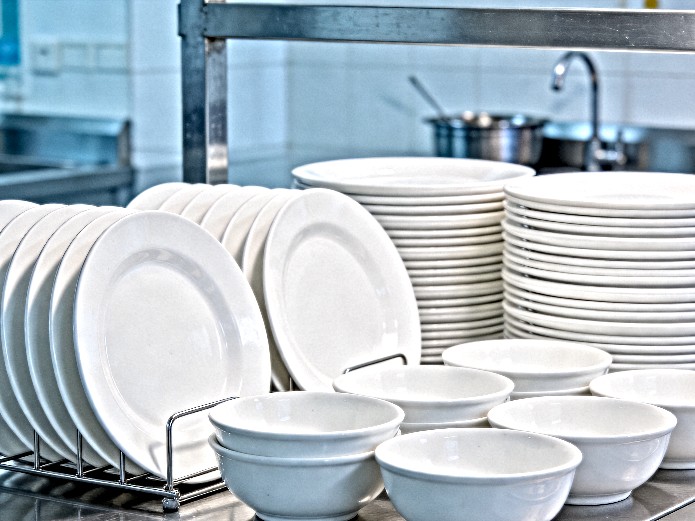
Beyond aesthetics, ceramic tableware for cafes must survive the realities of commercial service: high-temperature dishwashing, frequent stacking, accidental drops, and constant handling. Commercial-grade ceramics are engineered for this environment, with reinforced edges, chip-resistant formulations, and glaze systems designed to withstand detergent and heat cycling. Investing in quality upfront reduces breakage rates, lowers long-term replacement costs, and minimizes service interruptions.
Cost of Ownership
Many first-time buyers focus only on unit price, but the total cost of ownership tells a different story. A $2 cup that chips after three months is more expensive than a $4 cup that lasts three years. When evaluating ceramic tableware for cafes, consider the expected lifespan, warranty terms, minimum order quantities for replacements, and whether the supplier offers consistent reorder availability. The best B2B suppliers provide long-term stock guarantees, ensuring you can match existing pieces years after your initial purchase.
Essential Ceramic Tableware Pieces for Coffee Shops & Bakeries
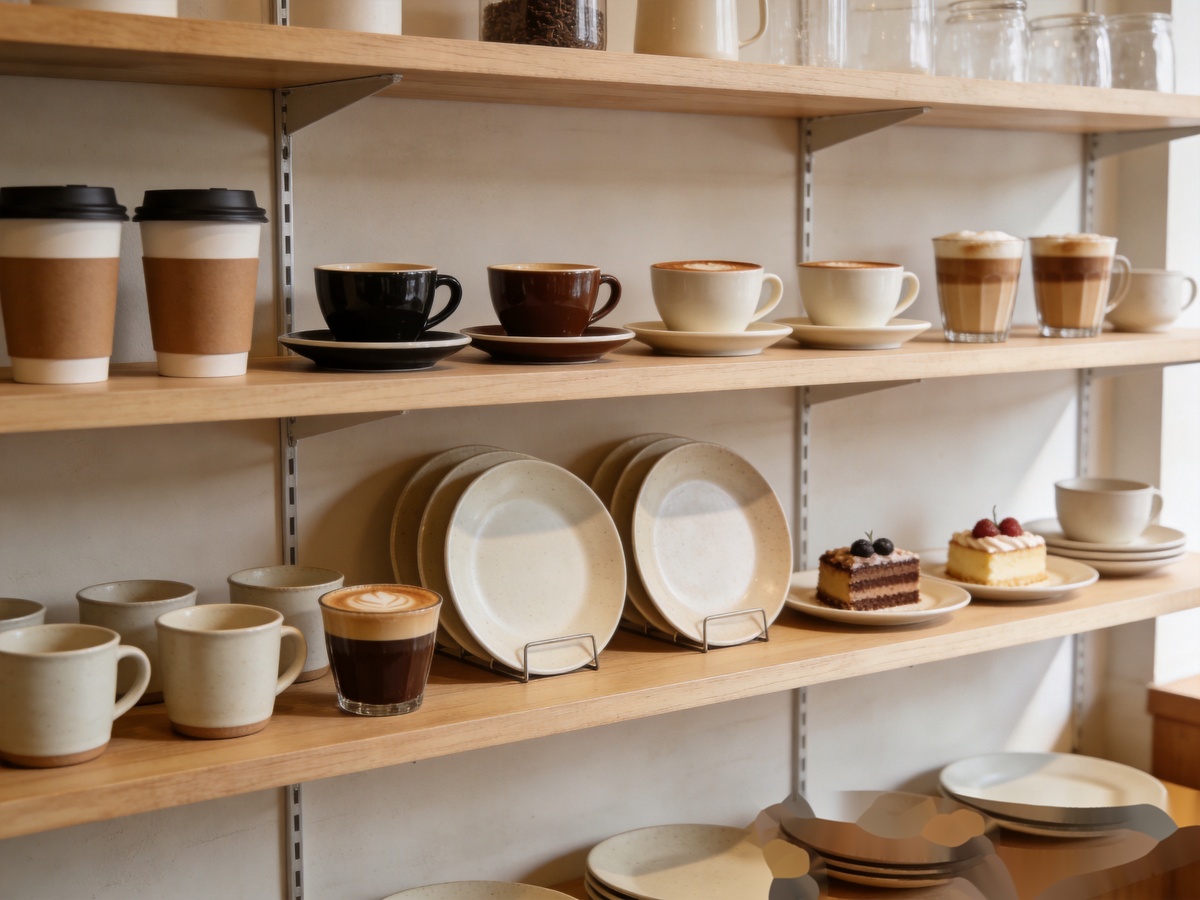
Building a ceramic tableware collection for a café requires more than just buying cups. You need a coordinated set that covers every service scenario — from espresso service to dessert plating to branded merchandise. Here are the core pieces every coffee shop and bakery should consider.
Espresso Cups and Saucers
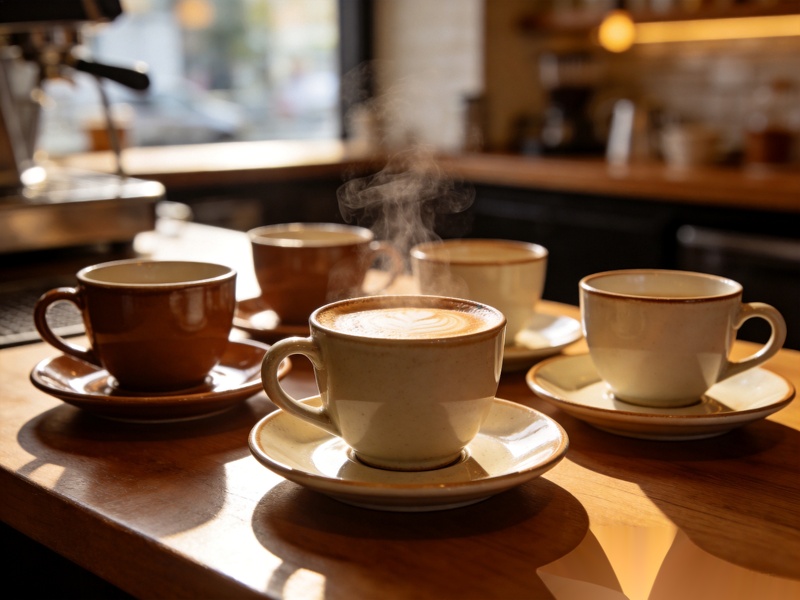
The foundation of any specialty coffee program, espresso cups typically hold 60–90 ml (2–3 oz). Look for thick-walled ceramic construction that retains heat and a rounded interior that supports crema formation. Saucers should provide stable seating and enough surface area for a spoon and sugar packet. For high-volume cafes, stackable designs save valuable storage space behind the bar.
Cappuccino and Latte Cups
Cappuccino cups generally hold 150–180 ml (5–6 oz), while latte cups range from 240–360 ml (8–12 oz). The shape matters: wide, bowl-shaped latte cups give baristas room for latte art, while narrower cappuccino cups maintain foam structure. Handle design is equally important — ergonomic handles that stay cool to the touch improve both staff comfort and customer experience.
Pour-Over and Drip Coffee Mugs
For customers who prefer slow coffee service, 300–400 ml (10–14 oz) ceramic mugs are essential. Look for designs with good thermal retention and comfortable handles. Many cafés also offer oversized mugs (450–500 ml) for signature drinks or American-style coffee service.
Dessert Plates and Cake Stands
If your café serves pastries, cakes, or light food, you will need a range of ceramic plates. Small plates (15–18 cm / 6–7 in) work for cookies and individual pastries, while medium plates (20–23 cm / 8–9 in) handle cake slices and sandwiches. For display, ceramic cake stands add visual appeal to your countertop presentation.
Specialty Pieces
- Tea cups and teapots: Porcelain options for premium tea service
- Cereal and oatmeal bowls: For breakfast menu items
- Soup bowls and salad plates: If you offer light meals
- Share plates and serving boards: For group orders and sharing platters
- Branded retail mugs: Sell custom-printed ceramic mugs as merchandise
Choosing the Right Ceramic Material for Café Tableware
Not all ceramic tableware for cafes is created equal. The material composition determines everything from durability and heat retention to price point and aesthetic character. Understanding the differences between stoneware, porcelain, and bone china helps you match your tableware to your specific operational needs.
Stoneware: The Workhorse Choice
Stoneware is the most popular choice for high-volume cafes and casual dining concepts. Fired at high temperatures (1200–1300°C), stoneware is dense, durable, and naturally chip-resistant. Its slightly porous body is fully vitrified during firing, making it food-safe and dishwasher-compatible. Stoneware comes in a wide range of glaze finishes — from matte earth tones to glossy whites — and its substantial weight conveys quality and sturdiness. For most café applications, stoneware offers the best balance of durability, aesthetics, and price.
Porcelain: The Premium Option
Porcelain is fired at even higher temperatures (1300–1450°C) using a finer clay body, resulting in a translucent, elegant finish. It is harder and less porous than stoneware, with a smooth, non-porous surface that resists staining and bacteria growth. Porcelain tableware is lighter and more delicate in appearance, making it ideal for high-end specialty coffee shops, fine dining bakeries, and premium tea houses. While porcelain can be more expensive upfront, its hardness means it resists scratching and maintains its appearance longer than many stoneware alternatives.
Bone China: The Luxury Statement
Bone china contains bone ash (calcium phosphate from animal bones), which gives it exceptional whiteness, translucency, and strength. It is the most expensive ceramic tableware option and is typically reserved for luxury hotels, fine dining restaurants, and premium afternoon tea services. For most cafés, bone china is unnecessary — but it can be a differentiator for high-end concepts or specialty tea programs.
| Material | Durability | Weight | Price Point | Best For |
| Stoneware | High | Medium-Heavy | $$ | High-volume cafes, casual concepts |
| Porcelain | Very High | Medium-Light | $$$ | Specialty coffee shops, premium bakeries |
| Bone China | Medium-High | Light | $$$$ | Luxury tea houses, fine dining |

Design Considerations for Ceramic Tableware for Cafés
The design of your ceramic tableware for cafes should serve both form and function. A beautiful cup that is uncomfortable to hold or unstable on saucers creates more problems than it solves. Here are the key design factors to evaluate when selecting café tableware.
Shape and Functionality
Cup shape directly impacts the sensory experience of coffee. Conical shapes (wider at the rim, narrower at the base) concentrate aroma and are preferred for espresso. Bowl-shaped cups provide surface area for latte art and allow milk-based drinks to cool slightly faster. Cylindrical mugs offer maximum volume and thermal retention. Consider your menu profile — if 70% of your drinks are milk-based, prioritize bowl-shaped latte cups. If you focus on pour-over and black coffee, cylindrical or conical designs may work better.
Glaze Finish and Color
Glaze selection is where your brand personality shines through. Glossy whites are classic and versatile, making coffee colors pop. Matte finishes convey artisanal quality and work well with minimalist and rustic concepts. Reactive glazes create unique, one-of-a-kind patterns — though be aware that color variation between pieces is inherent to the process, which may or may not align with your brand consistency requirements. For food safety, ensure all glazes are certified lead-free and cadmium-free, meeting FDA and/or LFGB standards.
Handle Ergonomics
Handle design is often overlooked but significantly impacts both customer satisfaction and staff efficiency. Handles should be large enough for fingers to fit comfortably, with smooth edges that do not dig into skin. For commercial use, look for handles that stay cool to the touch — poorly designed handles can conduct heat and make hot drinks uncomfortable to hold. Test handles with your baristas and staff before committing to a large order.
Stackability and Storage
In a busy café, storage space is at a premium. Stackable ceramic tableware designs save valuable shelf and counter space. Look for cups and plates designed with nesting in mind — they should stack securely without wobbling, and the base of each piece should not scratch the glaze of the piece below. Some manufacturers add protective foot rings specifically to prevent glaze-on-glaze scratching during stacking.
Customization and Branding
Many B2B buyers want their ceramic tableware to carry their logo or brand colors. Customization options include screen printing, decal application, hand-painting, and custom glaze colors. Minimum order quantities (MOQs) for custom pieces vary — screen-printed logos may start at 500 pieces, while custom shapes or glazes can require 1,000–2,000 pieces per design. Work with a supplier experienced in OEM/ODM customization to ensure your branding is applied correctly and durably.
Durability Standards: What to Look for in Commercial-Grade Ceramics
When evaluating ceramic tableware for cafes, durability is non-negotiable. Commercial kitchen conditions are harsh — repeated dishwashing cycles, thermal shock from hot coffee to cold dishwater, and the inevitable bumps and drops of busy service. Here are the key durability metrics and standards to verify before purchasing.
Chip Resistance and Edge Strength
Chipping is the number one reason café tableware gets replaced. Look for ceramics with reinforced rims — many commercial-grade lines use thicker, rolled edges that resist chipping on impact. The material density also matters: fully vitrified porcelain and high-fired stoneware have better chip resistance than low-fired earthenware. Some manufacturers publish chip resistance test data or offer warranties against chipping under normal commercial use.
Dishwasher and Microwave Safety
All ceramic tableware for cafes must be dishwasher-safe. Commercial dishwashers use higher temperatures, stronger detergents, and more aggressive water pressure than residential models. Look for products certified to withstand 2,000+ commercial dishwashing cycles without significant fading, glaze deterioration, or gold/silver trim loss (if applicable). Microwave safety is also important for many cafes — note that metallic trim (gold, silver, platinum) makes pieces microwave-incompatible.
Thermal Shock Resistance
Thermal shock occurs when ceramics experience rapid temperature changes — for example, pouring boiling water into a cold cup, or moving a piece directly from the freezer to the microwave. High-quality ceramic tableware for cafes is formulated to resist thermal shock, reducing the risk of cracking or shattering. Look for thermal shock test certifications, typically expressed as temperature differentials (e.g., resistant to 180°C thermal shock).
Food Safety Certifications
Food safety is paramount. Verify that any ceramic tableware you source meets relevant food contact safety standards:
- FDA (US Food and Drug Administration): Required for the US market, testing for lead and cadmium leaching
- LFGB (German Food and Feed Code): Strict European standard, widely accepted globally
- California Prop 65: Additional requirements for the California market
- SGS / Intertek / Bureau Veritas: Independent third-party testing and certification
Always request test reports from suppliers before placing bulk orders. Reputable manufacturers will provide current certification documentation upon request.
How to Source Ceramic Tableware for Cafés in Bulk
Sourcing ceramic tableware for cafes in bulk requires a systematic approach. Whether you are opening a single location or rolling out a multi-store chain, following these steps ensures you get the right products at the right price, with reliable long-term supply.
Step 1: Define Your Requirements
Start by creating a detailed specification sheet that includes:
- Complete item list with sizes, shapes, and quantities
- Material preference (stoneware, porcelain, etc.)
- Glaze color and finish specifications
- Customization requirements (logo, brand colors, custom shapes)
- Certification requirements (FDA, LFGB, etc.)
- Target price range per piece
- Expected annual reorder volume
Step 2: Request Samples
Never place a bulk order based solely on photos or catalog descriptions. Physical samples are essential for evaluating weight, glaze quality, handle comfort, stackability, and overall feel. Order samples from 3–5 different suppliers and test them in your actual café environment — run them through your dishwasher, test them with your menu items, and get feedback from baristas and customers. Sample fees are typically nominal and often credited toward your first bulk order.
Step 3: Evaluate Suppliers
When comparing suppliers, look beyond unit price. Consider:
- Factory experience: How long have they produced commercial ceramic tableware? Do they specialize in hospitality?
- Production capacity: Can they handle your initial order and future reorders without delays?
- Quality control: What inspection processes do they have? What is their acceptable defect rate?
- Customization capability: Can they produce custom shapes, glazes, and logo applications in-house?
- Certifications: Do they hold current FDA, LFGB, or other relevant food safety certifications?
- Communication: Are they responsive, professional, and easy to work with?
- Packaging: How do they pack for international shipping? What is their breakage rate in transit?
Step 4: Negotiate Terms
Once you have shortlisted 2–3 suppliers, negotiate pricing and terms. Key negotiation points include:
- Unit pricing at different volume tiers
- Sample fee credits on first orders
- Payment terms (T/T, L/C, etc.)
- Lead time and production schedule
- Quality inspection procedures (pre-shipment inspection)
- Breakage replacement policy
- Reorder guarantee and stock availability
Step 5: Place a Trial Order
Before committing to a full container or large-scale order, consider placing a smaller trial order (50–200 pieces per item). This lets you verify production quality, packaging, shipping, and after-sales support before scaling up. If the trial order meets expectations, you can confidently place larger reorders. Many B2B buyers also maintain dual-sourcing strategies — working with two suppliers — to mitigate supply chain risk.
For more detailed guidance on factory evaluation, check out our ceramic factory audit checklist and our comprehensive sourcing guides for B2B buyers.
Frequently Asked Questions
Q: How many ceramic cups should I order for my café?
A: A general rule of thumb is to have 2–3 times your peak hourly customer volume in cups. For example, if your busiest hour serves 80 customers with coffee drinks, plan for 160–240 cups per size. This accounts for cups in use, in the dishwashing cycle, and in reserve. Factor in seasonal peaks and growth projections to avoid running short during busy periods.
Q: What is the average lifespan of ceramic tableware in a commercial café?
A: With proper care, commercial-grade stoneware typically lasts 2–4 years in high-volume café settings, while porcelain can last 3–5 years or more. Actual lifespan depends on dishwashing practices, handling care, staff training, and the specific product quality. Investing in thicker, reinforced pieces and training staff on proper handling significantly extends tableware life.
Q: Can I get custom colors and shapes for my café tableware?
A: Yes, most B2B ceramic manufacturers offer OEM/ODM customization including custom glaze colors, logo printing, and even custom shape development. Custom colors typically require MOQs of 500–1,000 pieces per color, while custom molds (new shapes) may require 1,000–3,000 pieces per design plus mold development fees. Lead times for custom orders are typically 45–75 days depending on complexity.
Q: How do I reduce breakage in my café?
A: Breakage reduction combines product selection with operational practices. Choose chip-resistant, fully vitrified ceramics with reinforced edges. Use appropriate dishwashing racks that separate pieces and prevent clanking. Train staff on proper handling — no stacking cups rim-to-rim, careful busing, and proper loading of dish racks. Finally, invest in quality transport bins and storage to minimize damage during back-of-house movement.
Q: What is the difference between ceramic and porcelain tableware for cafes?
A: Porcelain is a type of ceramic — specifically a high-fired, fine-grained ceramic made from kaolin clay. The term “ceramic” is the broader category that includes stoneware, porcelain, earthenware, and bone china. For café use, porcelain is harder, more scratch-resistant, and more translucent than stoneware, but also typically more expensive. Stoneware is heavier, more chip-resistant to impact, and generally more affordable, making it the most popular choice for high-volume operations.
Ready to Source Ceramic Tableware for Your Café?
Choosing the right ceramic tableware for cafes is an investment in your brand, your operations, and your customer experience. The right supplier does more than just sell you cups — they become a long-term partner who understands your brand, supports your growth, and delivers consistent quality order after order.
At CeraSupply, we specialize in B2B ceramic tableware for cafes, coffee shops, bakeries, and hospitality businesses worldwide. With factories in Chaozhou and Jingdezhen — China’s premier ceramic production regions — we offer a full range of stock and custom ceramic tableware solutions, from espresso cups to complete dinnerware sets. All our products meet FDA and LFGB food safety standards, and our quality control team inspects every order before shipment.
Whether you need 500 pieces for a single location or 50,000 for a chain rollout, we can help. Contact us today for a free consultation and quote — tell us about your café concept, and we will recommend the perfect ceramic tableware collection for your brand.