Ceramic tableware for pizza restaurants must withstand oven temperatures exceeding 500°F, resist thermal shock from rapid temperature changes, and survive the rough handling of a high-turnover kitchen. After sourcing ceramic dinnerware for pizzerias across the US and Europe for over a decade, I’ve learned that the wrong plate choice leads to cracked rims, scorched tabletops, and replacement costs that erase profit margins within two years.
This guide covers the specific ceramic requirements for pizza service: plate diameters, thickness profiles, glaze formulations that handle extreme heat, and the quality checks that separate commercial-grade from consumer-grade products. You’ll also get a supplier evaluation checklist and a plate-type comparison table you can use in your next sourcing conversation. If you need specification sheets for your procurement team, get our pizza restaurant ceramic tableware catalogue.
Why Standard Restaurant Plates Crack Under Pizza Heat
Pizza comes out of wood-fired ovens at 450–550°F and deck ovens at 400–500°F. A standard porcelain plate rated for 300°F will develop micro-cracks within weeks under this stress. The thermal expansion coefficient of standard ceramics exceeds what pizza service demands, especially when a 500°F pie lands on a room-temperature plate.
The problem compounds in three ways. First, pizza plates are larger—13 to 16 inches—so thermal stress spreads across a wider surface with less structural support at the center. Second, pizza service is fast: plates go from ambient to scorching to dishwasher in under 10 minutes, creating rapid contraction cycles. Third, pizzeria kitchens are rough. Plates get stacked hot, scraped with pizza peels, and dropped into bus tubs. A plate that survives gentle service in a fine-dining restaurant will fail within months in a pizzeria.
The right ceramic for pizza service uses a thicker body—typically 8–12 mm at the rim—and a glaze formulation with higher thermal shock resistance. Stoneware and high-fired porcelain (1,280–1,320°C) perform better than standard porcelain because the denser vitrified body absorbs less thermal shock. [INTERNAL DATA REQUIRED: Specific thermal shock resistance data for CeraSupply pizza plate line]
Pizza Plate Profiles: Coupe vs Flat vs Deep-Dish
Not all pizza plates are flat discs. The profile you choose affects heat retention, sauce containment, stackability, and how the pizza is presented to the customer. Here’s how the three dominant profiles compare for commercial pizza service:
| Profile | Best For | Diameter Range | Heat Retention | Stackability | Typical Thickness |
|---|---|---|---|---|---|
| Coupe (slightly raised rim) | Neapolitan, NY-style, general service | 12–14 in | Moderate (rim traps heat) | Good | 8–10 mm |
| Flat (no rim) | Roman al taglio, square cuts, modern presentation | 13–16 in | Low (heat dissipates fast) | Poor (slips when stacked) | 10–12 mm |
| Deep-dish (1–1.5 in wall) | Chicago-style, baked pasta, oven-to-table | 10–12 in | High (walls insulate) | Poor | 12–15 mm (walls) |
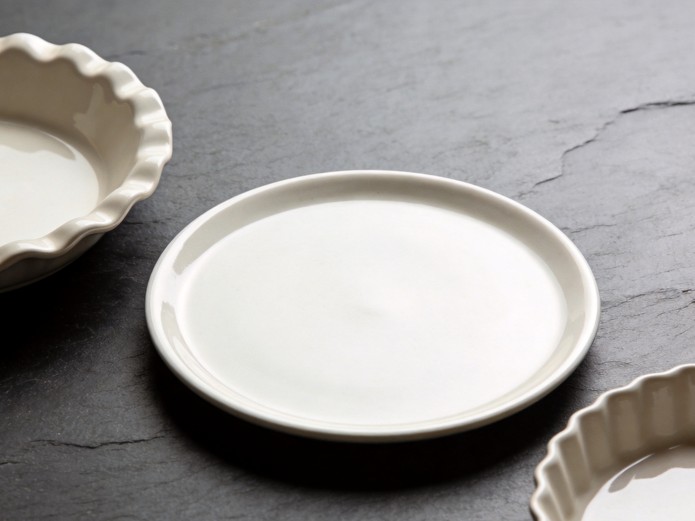
My recommendation: start with coupe plates for 80% of your service. They handle most pizza styles, stack efficiently in storage, and the raised rim prevents sauce and oil from sliding onto the table. Flat plates work well if your brand emphasizes minimal presentation, but you’ll need plate caddies or liners because they don’t stack securely. Deep-dish ceramics are essential only if Chicago-style or baked pasta is a core menu item—they’re heavy, expensive, and require separate storage racks.
Weight matters more than most buyers realize. A 14-inch coupe plate at 10 mm thickness weighs approximately 1.2–1.5 kg. Servers carrying two plates per hand will fatigue faster with heavier pieces, but lighter plates feel cheap to customers and chip more easily. The 1.2–1.4 kg range is the practical sweet spot for full-service pizzerias. [INTERNAL DATA REQUIRED: Weight specifications for CeraSupply pizza plate catalog]
Heat Resistance Specs That Actually Matter
Suppliers will quote “oven safe” or “high heat resistant” without numbers. Ask for these specific metrics:
- Maximum use temperature: Should be 550°F (288°C) or higher for wood-fired service. Standard restaurant porcelain tops out at 350°F—insufficient.
- Thermal shock resistance (ΔT): The temperature difference the plate can survive without cracking. For pizza service, ΔT ≥ 300°F is the minimum. Premium pizza ceramics achieve 350–400°F ΔT.
- Vitrification temperature: Higher firing (1,280°C+) produces denser, less porous ceramics that handle thermal stress better. Ask your supplier for the peak kiln temperature.
[VERIFY BEFORE PUBLISHING: Thermal shock testing standards vary by region. ASTM C1525 covers thermal shock testing for advanced ceramics. For food-service ceramics, contact your supplier for third-party test reports. SGS and Bureau Veritas offer thermal shock testing as part of food-contact safety packages, but testing protocols are not legally standardized across jurisdictions.]
A simple field test you can run on samples: place the plate in a 500°F oven for 15 minutes, then immediately transfer it to a room-temperature metal surface. A plate rated for pizza service should survive 20+ cycles without crazing or cracking. Consumer-grade plates often fail on the first cycle.
Glaze and Surface Requirements for Pizza Service
Pizza grease, acidic tomato sauce, and high temperatures degrade standard glazes over time. The glaze on a pizza plate needs three properties that general restaurant ceramics don’t prioritize:
- Acid resistance: Tomato sauce has a pH of 3.5–4.5. Over months of daily service, acidic exposure can etch soft glazes and create staining. Ask for glaze hardness ratings; a Mohs hardness of 5+ is preferable.
- Coefficient of thermal expansion (CTE) match: The glaze CTE must closely match the ceramic body CTE. A mismatch causes crazing—fine surface cracks that trap bacteria and look unsightly. Reputable suppliers will provide CTE data for both body and glaze.
- Matte vs glossy for pizza: Glossy glazes clean more easily in commercial dishwashers but show scratches faster. Matte glazes hide wear but can stain if the surface is too porous. For pizza service, I recommend a satin glaze (semi-matte) that balances cleanability with scratch concealment.
Color matters operationally. White and cream plates show tomato stains and oil marks fastest, requiring more aggressive washing that wears the glaze. Earth tones—terracotta, slate gray, olive—hide wear and align with the rustic aesthetic most pizzerias target. Dark glazes also retain heat slightly longer, keeping pizza warmer during service.
Lead and cadmium compliance is non-negotiable. All pizza ceramics must meet FDA 21 CFR 175.300 (US) or EU Regulation 1935/2004 (Europe) for food-contact materials. [VERIFY BEFORE PUBLISHING: Specific migration limits for lead and cadmium are defined in EU Regulation 84/500/EEC and updated by (EU) 2016/217. FDA limits are outlined in 21 CFR 109.16 and Compliance Policy Guide 545.450. Always request current test reports; regulatory limits are subject to revision.]
Supplier Evaluation Checklist for Pizza Ceramic Orders
Use this checklist during supplier qualification. Print it or save it for your sourcing calls:
| Check | What to Ask | Pass Criteria |
|---|---|---|
| 1 | What is the maximum use temperature? | ≥ 550°F (288°C) |
| 2 | What is the thermal shock resistance (ΔT)? | ≥ 300°F (149°C) |
| 3 | What kiln temperature is used? | ≥ 1,280°C |
| 4 | Can you provide lead and cadmium test reports? | Current reports from SGS, Bureau Veritas, or equivalent |
| 5 | What is the glaze Mohs hardness? | ≥ 5 |
| 6 | Do you have pizza-specific references? | At least 2 pizzeria or restaurant chain clients |
| 7 | What is the chipping rate under commercial use? | < 3% per year under normal service |
| 8 | Can you match custom colors for private label? | Pantone matching within ΔE < 3 |
| 9 | What packaging protects plates in ocean freight? | Individual foam sleeves + corrugated dividers + palletized |
| 10 | What is your defect replacement policy? | Replacement or credit for > 2% defect rate on arrival |
A supplier who cannot answer questions 1–5 with specific numbers is likely reselling consumer-grade ceramics with a commercial markup. Move on. The best pizza ceramic suppliers have in-house R&D and can customize glaze formulations for specific oven types. Use our factory audit guide to verify production capabilities during your visit.
MOQ, Lead Time, and Pricing Reality
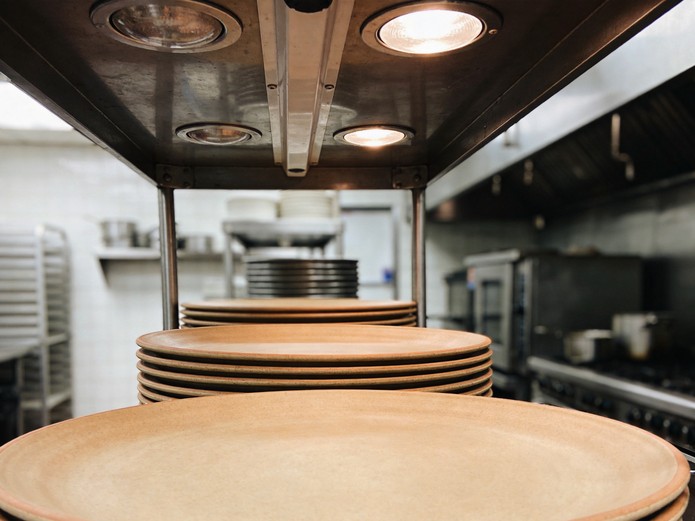
Pizza plates are harder to source than standard 10-inch dinner plates because of the larger diameter and thicker body. Here’s what to expect:
MOQ: Standard pizza plates (12–14 inch, coupe profile, stock glaze) typically require 500–1,000 pieces per SKU. Custom colors or shapes push MOQ to 2,000–3,000 pieces. For a pizzeria opening with 100 seats and 2.5 turns per dinner service, you’ll need approximately 300–400 plates. Order at least 1.5x your immediate need to account for breakage during the first year.
Lead time: Stock items ship in 2–4 weeks. Custom production runs require 45–75 days depending on mold complexity and kiln scheduling. If you need plates for a grand opening, place the order 90 days before your target date. [INTERNAL DATA REQUIRED: CeraSupply lead time schedule for pizza plate SKUs]
Pricing: Ex-factory pricing for commercial pizza ceramics ranges from $2.80–$5.50 per piece depending on size, glaze complexity, and order volume. Deep-dish profiles and custom colors sit at the high end. Freight, duties, and inland delivery add 25–40% to the ex-factory cost. For a 1,000-piece order of 14-inch coupe plates at $3.50 ex-factory, your landed cost will be approximately $4.40–$4.90 per piece.
Cost-quality tradeoff: The cheapest option is rarely the cheapest long-term. A $2.80 plate with 15% annual replacement rate costs more over three years than a $4.20 plate with 3% replacement. For pizzerias planning to operate 5+ years, invest in the higher-spec ceramic. For pop-ups or test concepts, stock-grade plates are a rational starting point. See our total cost of ownership guide for the full calculation framework.
Three Mistakes That Cost Pizzerias Money
These are the errors I see most often when pizzeria owners source ceramics without procurement experience:
Mistake 1: Buying Standard Restaurant Plates and Assuming They’ll Work
A 12-inch standard dinner plate and a 12-inch pizza plate are not the same product. Standard plates are thinner, use lower-temperature glazes, and are not tested for thermal shock above 300°F. The $1.50-per-piece savings disappear when you replace 30% of your inventory in year one.
Mistake 2: Ignoring Stack Height and Storage
Pizza plates are big. A stack of fifty 14-inch coupe plates is approximately 50 cm tall and weighs 60+ kg. If your storage shelving or dish racks aren’t rated for that weight, you’ll have safety issues and damaged inventory. Measure your storage before ordering. Standard 18-inch dish racks handle most pizza plates, but verify the slot width—some deep-dish profiles don’t fit standard racks.
Mistake 3: Ordering Exact Quantities Without Breakage Buffers
Ceramic breakage in pizzerias runs 8–15% annually for first-time buyers who underestimate kitchen roughness. Order 20% more than your calculated need. Running out of plates during service is worse than the small upfront cost of extras. And reordering 50–100 pieces later is expensive—suppliers charge premium pricing below MOQ or refuse small reorders entirely.
FAQ
Can I use pizza stones instead of ceramic plates?
Pizza stones are designed for oven use, not table service. They’re unglazed, absorb grease and sauce, and are too heavy for servers to carry. Use stones for baking; use glazed ceramics for serving.
How long do commercial pizza ceramics last?
With proper handling, commercial-grade pizza ceramics last 3–5 years in full-service pizzerias. High-volume fast-casual locations with aggressive dishwashing may see 2–3 year lifespans. The first sign of end-of-life is glaze crazing, followed by rim chips.
Are ceramic pizza plates dishwasher safe?
Yes, if the glaze is formulated for commercial dishwasher chemicals. High-alkaline detergents can etch soft glazes over time. Ask your supplier for dishwasher compatibility confirmation. [VERIFY BEFORE PUBLISHING: Commercial dishwasher chemical compatibility is supplier-specific; verify with your chemical vendor and ceramic supplier before committing to a product line.]
What is the best plate size for Neapolitan pizza?
Neapolitan pizzas are 10–12 inches in diameter. A 13-inch coupe plate provides enough rim space for cutting and presentation without the plate overwhelming the pizza. For 16-inch NY-style pies, use a 16–17 inch flat or coupe plate.
Can I get custom logos printed on pizza plates?
Yes, through screen printing, decal application, or embossing. Screen printing is most cost-effective for orders above 2,000 pieces. Decals allow full-color logos but have higher per-unit cost. Embossing creates a permanent, dishwasher-safe mark but requires custom mold investment. See our custom ceramic guide for full options and MOQ details.
Should I buy from a trading company or factory direct?
For pizza ceramics, factory direct is usually better. Pizza plates require custom mold work and glaze formulation that trading companies often can’t modify. Factory direct also gives you faster problem resolution when defects appear. Read our factory direct vs. trading company comparison for the full breakdown.
Need specification sheets, sample pricing, or a production timeline for your pizzeria? Get our pizza restaurant ceramic tableware catalogue and we’ll send detailed specs for coupe, flat, and deep-dish profiles matched to your menu and volume.