When sourcing ceramic tableware at scale, the decoration method you choose directly impacts cost, lead time, design complexity, and brand consistency. Yet many B2B buyers overlook this critical decision point — focusing on material and shape while leaving decoration as an afterthought. Understanding the core ceramic decoration techniques available today is essential for anyone importing bulk tableware for hospitality, retail, or private-label brands.
In this guide, we break down the three primary ceramic decoration techniques — screen printing, decal application, and hand-painting — comparing them across cost, durability, customization flexibility, and production scalability. Whether you are ordering 500 pieces or 50,000, this comparison will help you make the right choice for your product line.
Why Ceramic Decoration Techniques Matter for Bulk Buyers
The decoration method affects far more than aesthetics. For B2B buyers, the choice of ceramic decoration techniques determines:
- Unit cost at scale — some methods have high setup costs but low per-unit pricing, while others are the reverse
- Design reproducibility — how consistently patterns reproduce across thousands of pieces
- Lead time — setup complexity can add days or weeks to production timelines
- Durability and compliance — dishwasher safety, microwave resistance, and food-contact certifications vary by technique
- Brand consistency — critical for hospitality chains and private-label retailers
Before committing to a production run, buyers should evaluate each method against their specific requirements. Let us examine the three dominant techniques in detail.
Screen Printing: High-Volume Efficiency for Ceramic Decoration
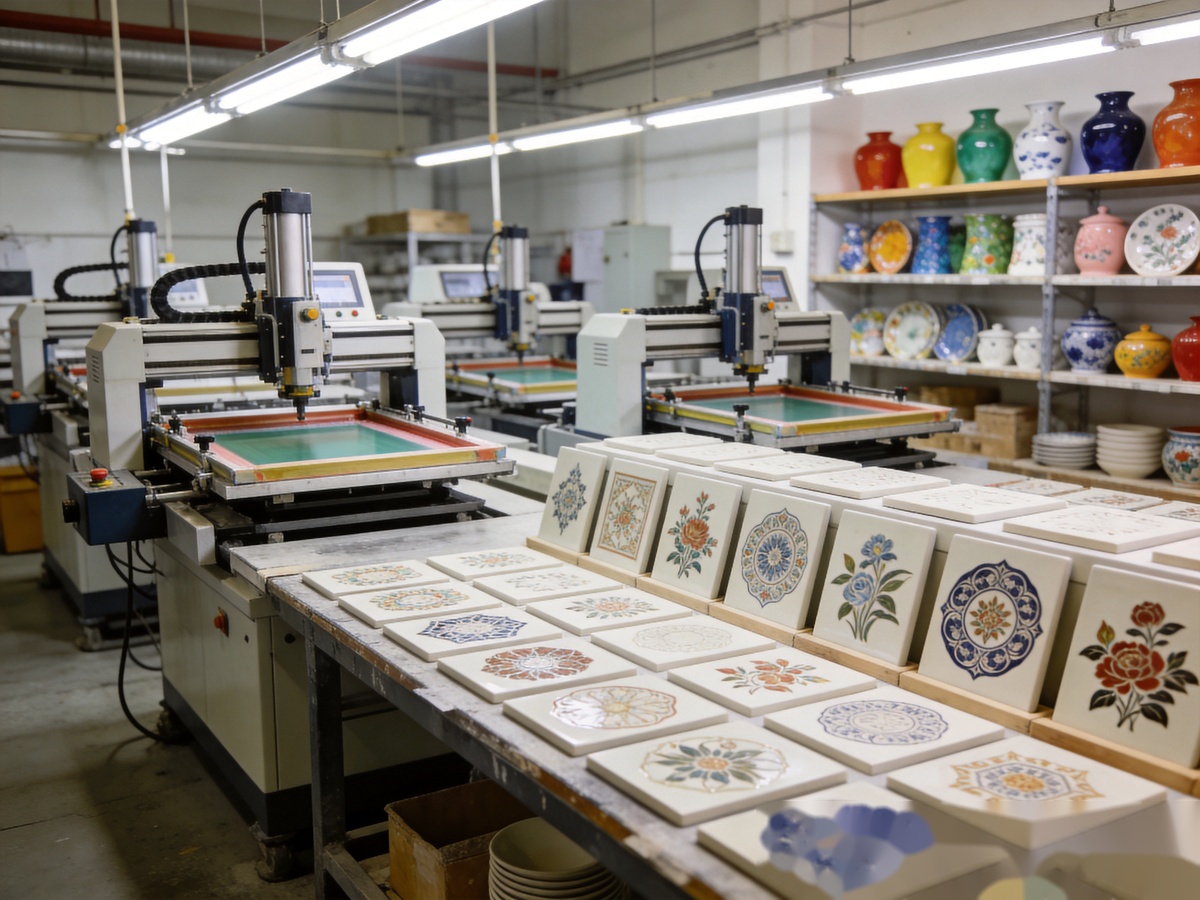
Screen printing is one of the most established ceramic decoration techniques in industrial production. The process involves pushing ceramic inks through a fine mesh screen onto the surface of the ware. Each color requires a separate screen, which means multi-color designs involve multiple passes.
How Screen Printing Works
- A fine mesh screen is prepared with the desired pattern — one screen per color
- Ceramic ink is applied to the screen and pushed through using a squeegee
- The printed piece is fired in a kiln at high temperature (typically 750–850°C) to fuse the ink permanently
- For multi-color designs, the process repeats with additional screens and firings
Advantages of Screen Printing
- Cost-effective at high volumes: Once screens are prepared, per-unit cost drops significantly — ideal for orders of 5,000+ pieces
- Consistent output: Every piece looks identical, ensuring brand consistency across large production runs
- Durable finish: Kiln-fired inks are dishwasher-safe, scratch-resistant, and long-lasting
- Bold, graphic designs: Excellent for solid colors, geometric patterns, and logos
Limitations of Screen Printing
- High setup cost: Each color requires a separate screen ($50–$200 per screen), making small runs expensive
- Limited color gradients: Not suitable for photographic or highly detailed gradient designs
- Longer setup time: Screen preparation adds 3–7 days before production can begin
- Flat or simple curvature only: Best suited for flat plates, mugs with simple cylindrical shapes
Screen printing is the go-to ceramic decoration technique for buyers who need large volumes of consistent, boldly designed tableware — think hotel chains, fast-casual restaurant groups, and branded merchandise programs.
Decal Application: Precision and Versatility in Ceramic Decoration
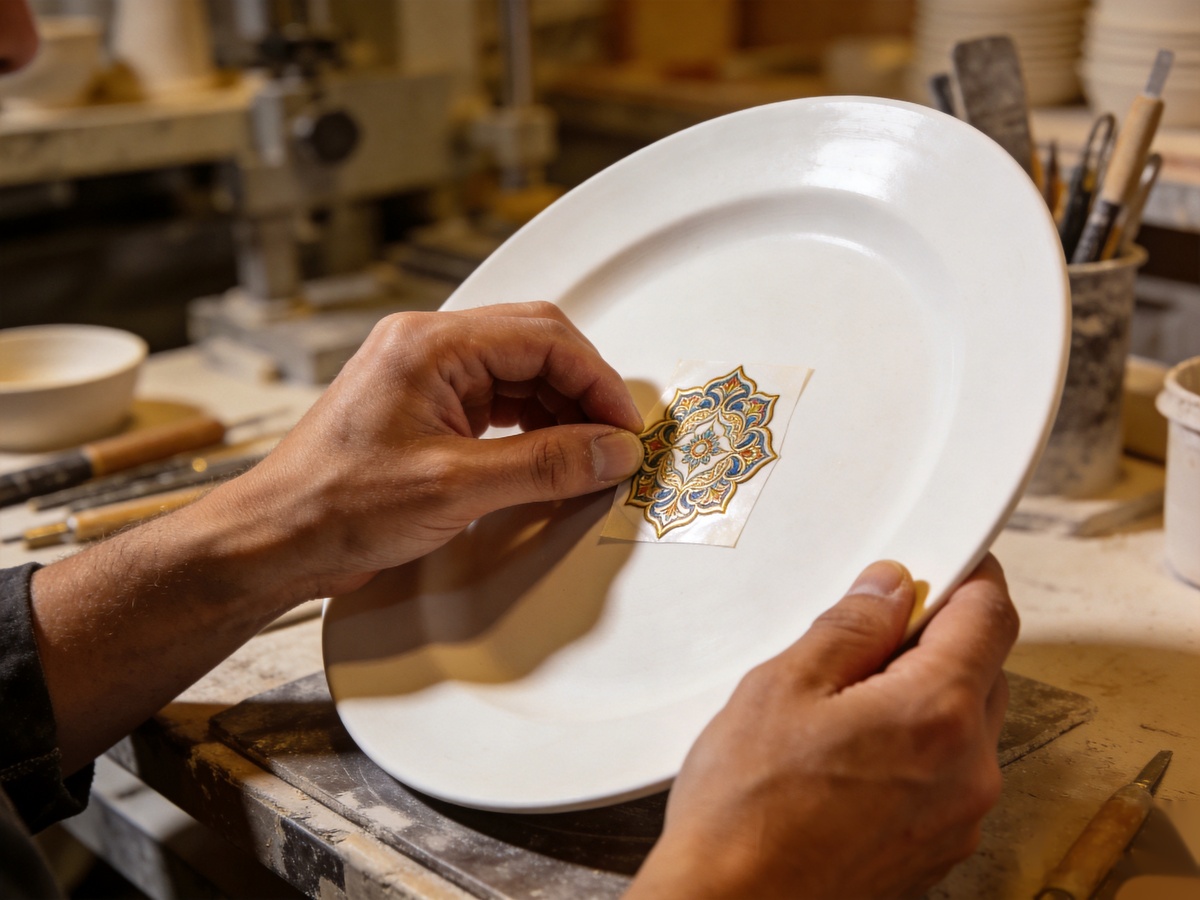
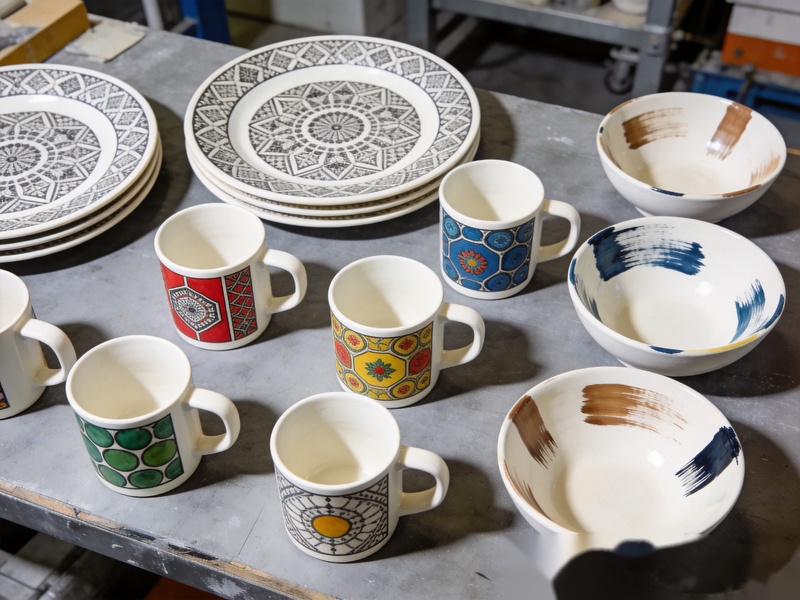
Decal application (also known as decal transfer or waterslide decal) is the most versatile of the three ceramic decoration techniques. Designs are first printed onto special transfer paper, then soaked in water and carefully applied to the ceramic surface before firing.
How Decal Application Works
- The design is digitally printed onto waterslide decal paper using ceramic toners or inks
- The printed decal is cut to shape and soaked in warm water
- The decal film slides off the backing paper and is carefully positioned on the ceramic piece
- The applied decal is smoothed to remove air bubbles and excess moisture
- The piece is kiln-fired at 750–820°C, permanently fusing the design into the glaze
Advantages of Decal Application
- Full-color, high-detail designs: Photographic images, intricate patterns, and smooth gradients are all achievable
- Lower setup cost: No screens needed — digital printing makes short runs viable (as low as 500 pieces)
- Wraparound capability: Decals can conform to curved and complex surfaces that screen printing cannot reach
- Design flexibility: Easy to iterate on designs without significant retooling costs
- Multi-surface application: Can decorate inside, outside, and rim areas in a single application
Limitations of Decal Application
- Higher per-unit cost: Each decal is individually printed and hand-applied, keeping per-piece costs higher than screen printing at volume
- Labor-intensive: Application requires skilled workers to avoid wrinkles, bubbles, and misalignment
- Slightly lower durability: While still kiln-fired, decals can be more susceptible to scratching over time compared to screen-printed inks
- Color consistency challenges: Batch-to-batch color variation can occur with digital ceramic printing
Decal application is the preferred ceramic decoration technique for buyers who need complex, full-color designs at moderate volumes — ideal for boutique hotels, specialty restaurants, gift markets, and seasonal collections. Learn more about our other sourcing guides for additional strategies.
Hand-Painting: Artisan Quality for Premium Ceramic Decoration
Hand-painting remains the most labor-intensive and artisanal of all ceramic decoration techniques. Skilled painters apply ceramic pigments directly to the ware using brushes, sponges, or other tools, creating one-of-a-kind pieces that carry inherent artistic value.
How Hand-Painting Works
- The ceramic piece is bisque-fired (first firing) to create a porous surface for painting
- Artisans apply ceramic pigments using brushes, sponges, or specialized tools
- Designs may follow a template or be freehand, depending on the desired outcome
- The painted piece undergoes a final glaze firing to seal and protect the design
Advantages of Hand-Painting
- Unique, artisanal appeal: Each piece is slightly different, adding perceived value and exclusivity
- No setup costs: No screens, decals, or digital files needed — just brushes and pigments
- Ultimate design freedom: Artists can create any style, from traditional folk art to contemporary abstract
- Premium positioning: Hand-painted tableware commands higher retail prices and appeals to luxury markets
Limitations of Hand-Painting
- High per-unit cost: Skilled labor is expensive, and output per worker is low (typically 20–50 pieces per day)
- Inconsistency: Natural variation between pieces can be a feature or a bug, depending on brand requirements
- Scalability challenges: Difficult to scale beyond small batches without significant quality variation
- Longer lead times: Production speed is limited by the number of available skilled painters
Hand-painting is the right ceramic decoration technique for luxury brands, limited-edition collections, and artisan-focused product lines where uniqueness and craftsmanship are the primary selling points. For bulk commercial orders, however, it is generally not cost-effective.
Ceramic Decoration Techniques Compared: Cost, Speed, and Scalability
To help B2B buyers make quick comparisons, here is a summary of how the three ceramic decoration techniques stack up across key procurement criteria:
Setup Cost: Screen Printing (High) | Decal Application (Low–Medium) | Hand-Painting (None)
Per-Unit Cost at 5,000 pcs: Screen Printing ($0.15–$0.40) | Decal Application ($0.30–$0.80) | Hand-Painting ($2.00–$8.00+)
Minimum Order Quantity: Screen Printing (3,000–5,000) | Decal Application (500–1,000) | Hand-Painting (100–500)
Design Complexity: Screen Printing (Limited colors, bold graphics) | Decal Application (Full color, photographic) | Hand-Painting (Unlimited, artisan quality)
Lead Time (including setup): Screen Printing (25–40 days) | Decal Application (20–35 days) | Hand-Painting (30–60 days)
Durability: Screen Printing (Excellent) | Decal Application (Good–Very Good) | Hand-Painting (Good, varies by artist technique)
Best For: Screen Printing (Large commercial orders) | Decal Application (Mid-volume, detailed designs) | Hand-Painting (Luxury, limited editions)
How to Choose the Right Ceramic Decoration Techniques for Your Order
Selecting the optimal ceramic decoration technique depends on a combination of factors. Ask yourself these questions:
- What is your order volume? Above 5,000 pieces, screen printing typically offers the best economics. Below 1,000, decals or hand-painting become more viable.
- How complex is your design? If you need photographic detail or full-color gradients, decal application is the clear winner among ceramic decoration techniques.
- What is your brand positioning? Premium and luxury brands benefit from the artisan appeal of hand-painting, while commercial brands prioritize consistency and cost.
- What is your timeline? Screen printing and decals have faster turnaround for large runs; hand-painting requires more lead time.
- Do you need consistency or uniqueness? Chain restaurants need identical pieces — choose screen printing or decals. Boutique hotels may prefer the charm of hand-painted variation.
Many experienced buyers combine techniques within a single product line — for example, using screen printing for the base pattern and adding hand-painted accents for a premium tier. Explore our ceramic product catalog to see examples of each decoration method applied to real products.
Ceramic Decoration Techniques FAQ
Q1: Which ceramic decoration techniques are most dishwasher-safe?
Screen printing and decal application both produce dishwasher-safe results when properly kiln-fired at the correct temperature (750°C+). The key factor is whether the decoration is applied under the glaze (underglaze) or over the glaze (overglaze). Underglaze decorations — common in screen printing — offer the highest durability and are virtually impervious to dishwasher wear. Always specify underglaze application when ordering for commercial foodservice environments.
Q2: Can I combine multiple ceramic decoration techniques on one product?
Yes. Many manufacturers offer hybrid approaches — for example, a screen-printed base pattern with hand-painted gold accents, or a decal-applied main design with screen-printed border elements. Combining techniques allows you to balance cost, consistency, and visual appeal. Discuss hybrid options with your supplier early in the sampling phase.
Q3: What is the typical cost difference between screen printing and decal application?
At volumes above 5,000 pieces, screen printing is typically 30–50% cheaper per unit than decal application. However, the initial screen setup cost ($50–$200 per color) makes screen printing less economical for small runs. For orders under 1,000 pieces, decal application often has a lower total cost despite the higher per-unit price, because there are no screen setup fees.
Q4: How do ceramic decoration techniques affect food safety certifications?
All three techniques can achieve FDA, LFGB, and SGS food-contact certifications when using compliant ceramic inks and proper firing protocols. The critical factor is the ink composition — lead-free and cadmium-free inks are mandatory for most export markets. Always request certification documentation from your supplier and verify that the specific ink system used has been tested to the standards required by your destination market.
Q5: Which ceramic decoration techniques are best for custom logo printing?
For simple logos with 1–3 colors, screen printing is the most cost-effective choice for bulk orders. For logos with gradients, fine detail, or more than 4 colors, decal application produces superior results. For luxury branding where an artisan feel is desired, hand-painting can create a distinctive look — though at significantly higher cost. For a detailed comparison of customization options, see our customization guides.
Ready to Start Your Ceramic Tableware Project?
Choosing the right ceramic decoration techniques is a strategic decision that affects your product quality, brand positioning, and bottom line. Whether you need 500 hand-painted artisan bowls or 50,000 screen-printed restaurant plates, understanding these methods ensures you get exactly what you need at the right price.
At CeraSupply, we offer all three ceramic decoration techniques with full customization support — from design development to final production. Our team can help you evaluate which method is best for your specific requirements and provide samples for comparison.