Ceramic warehousing climate control is the most overlooked margin factor in bulk ceramic imports. Most ceramic damage happens after the factory ships it. Humidity, temperature swings, and poor stacking crack more plates than production defects do. If you import ceramic tableware in bulk, how you store it between port arrival and final distribution directly determines your sell-through rate and return volume.
This guide covers the climate controls, stacking methods, and inspection routines that protect your inventory. You will get a warehouse condition comparison table, a pre-dispatch checklist you can hand to your warehouse team, and three mistakes that destroy margins before a single unit reaches your customer.
Why Warehousing Conditions Matter More Than Most Buyers Assume
Most importers focus 90% of their attention on factory selection, pricing, and shipping. Warehousing gets treated as an afterthought. That is a costly error.
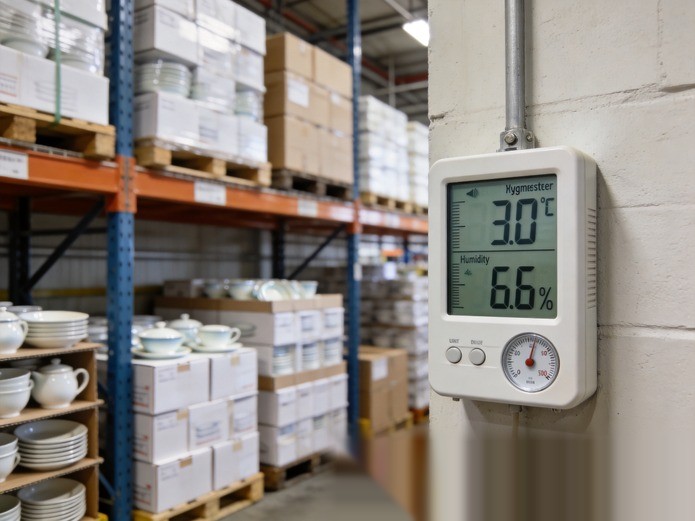
Ceramic is hygroscopic to a degree. Unglazed feet and the porous body of low-fired stoneware absorb ambient moisture. When humidity exceeds 65% for extended periods, boxes soften, labels peel, and in extreme cases mold forms on cardboard dividers. Glazed surfaces can develop a hazy film if stored in damp conditions with poor air circulation.
Temperature swings are equally damaging. A warehouse that drops to 5°C overnight and hits 35°C by afternoon creates thermal stress in ceramic bodies. Hairline cracks may not appear during storage but show up the first time the piece contacts hot water or a dishwasher cycle.
The financial impact is not just replacement cost. It includes customer returns and chargebacks, re-inspection labor, re-packaging or discounted resale, and lost repeat orders from damaged reputation.
Climate Targets for Ceramic Tableware Storage
Here is what your warehouse environment should maintain for bulk ceramic inventory:
| Parameter | Target Range | Risk if Outside Range | Cost to Correct |
|---|---|---|---|
| Relative Humidity | 45–55% | Box softening, mold, label damage | Dehumidifier: $200–800/month for 500 sqm |
| Temperature | 18–24°C (64–75°F) | Thermal stress, glaze micro-cracks | HVAC: $300–1,200/month |
| Air Circulation | 6–10 air changes/hour | Stagnant moisture pockets | Industrial fans: $50–150/unit |
| Light Exposure | Indirect, low UV | Fading of colored packaging | Window film or blinds: $100–300 |
| Floor Conditions | Dry, level, load-rated | Box deterioration, pallet collapse | Floor repair: variable |
Key trade-off: Climate-controlled warehousing costs 15–30% more per pallet per month than ambient storage. For high-value decorated ceramics or seasonal inventory held longer than 90 days, the investment pays for itself. For fast-moving standard white plates in dry climates, ambient storage with basic humidity monitoring may be sufficient.
Stacking and Pallet Configuration
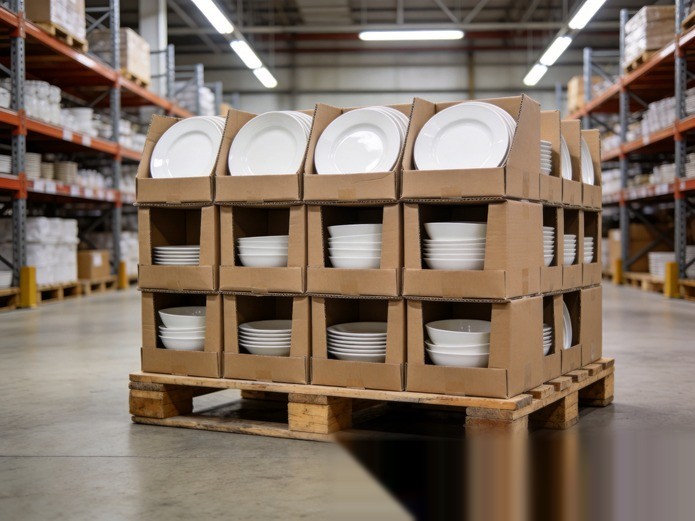
How you stack matters as much as where you store. These ceramic warehousing climate control principles apply to ceramic tableware imported in standard master cartons.
Correct stacking principles:
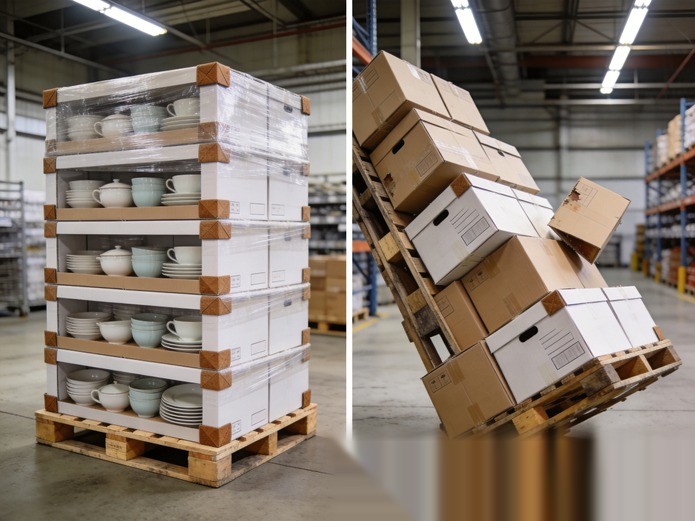
- Maximum 5 layers of master cartons per pallet for standard dinner plates
- Use corner boards and stretch wrap to prevent leaning
- Keep pallets 10–15 cm from walls for air circulation
- Do not stack different box sizes on the same pallet (creates pressure points)
- Rotate stock on a first-in, first-out basis
| Product Type | Cartons per Pallet | Max Stack Height | Pallet Weight |
|---|---|---|---|
| Dinner plates (10.5″) | 48–60 | 1.8 m | 450–600 kg |
| Bowls (6–8″) | 60–72 | 1.9 m | 380–500 kg |
| Mugs (12–16 oz) | 72–96 | 2.0 m | 320–450 kg |
| Tea sets (boxed) | 36–48 | 1.6 m | 280–380 kg |
[INTERNAL DATA REQUIRED: Confirm actual carton weights and pallet configurations for CeraSupply product range.]
Packaging Integrity During Storage
The packaging that protected your ceramics during ocean freight must survive warehousing too. Inspect these points on arrival and during storage.
Inspect on arrival:
- Master carton corners for crush damage
- Moisture stains on any box surface
- Strap or tape integrity
- Inner divider displacement
During storage:
- Keep cartons off concrete floors (use pallets, even for short-term)
- Re-tape any carton showing seam separation within 48 hours
- Do not write on master cartons with permanent marker (can bleed through to product in humid conditions)
Recommended packaging specs for long-term storage:
- Double-wall corrugated master cartons (ECT 32+)
- Moisture-resistant VCI paper for unglazed items
- Color-coded pallet labels by SKU and production batch
Three Common Storage Mistakes That Destroy Margins
Mistake 1: Storing Near Loading Docks
Loading dock areas experience the widest temperature and humidity swings. Every time a bay door opens, external air floods in. Ceramic stored within 5 meters of a dock absorbs these changes. Move inventory to internal rows at least 8 meters from any exterior door.
Mistake 2: Ignoring Seasonal Humidity Spikes
Even in dry climates, monsoon season or winter heating can push humidity above 60% for weeks. Buyers who check conditions once at move-in miss these cycles. Install a digital hygrometer with logging capability and review weekly reports.
Mistake 3: Mixed-Product Stacking
Stacking heavy dinner plate cartons on top of lightweight mug boxes compresses the lower layer. The damage may not be visible until unboxing. Always segregate by product type and weight class.
Cost-Quality-Location Trade-offs in Warehousing
Most importers face a three-way decision. The table below compares common warehousing options for bulk ceramic tableware.
| Option | Monthly Cost per CBM | Climate Control | Best For |
|---|---|---|---|
| Bonded warehouse near port | Low ($3–6) | Minimal | Fast-turn SKUs, dry seasons |
| Third-party logistics (3PL) | Medium ($6–12) | Moderate | Mixed inventory, regular dispatch |
| Dedicated climate-controlled | High ($12–20) | Full | Long-hold inventory, premium products |
Rule of thumb: If your ceramic inventory turns over in under 60 days and your local climate is temperate, ambient storage with monitoring is usually sufficient. If you hold stock for 90+ days or operate in tropical or humid regions, climate control is not optional.
Pre-Dispatch Warehouse Inspection Checklist
Before any shipment leaves your warehouse to customers, run through this checklist. Print it and hand it to your warehouse supervisor.
- Carton exterior: no crush, moisture, or puncture damage
- Pallet integrity: no broken boards, no nails protruding
- Product count matches pick list (spot-check 5% of SKUs)
- No dust accumulation on top cartons (indicates long storage; inspect for degradation)
- Random sample unboxing: check 1 piece per 500 for glaze haze, chips, or cracks
- Label readability: barcodes scan correctly, batch codes visible
- Moisture reading inside warehouse: 45–55% RH
- Temperature log: within 18–24°C for past 7 days
- FIFO rotation: oldest batch picked first
- Documentation: batch traceability recorded
MOQ, Lead Time, and Customization Considerations
Warehousing decisions directly affect your ordering strategy. Here is how storage connects to sourcing.
MOQ implications: Larger MOQs reduce per-unit factory cost but increase storage duration and risk. If your warehouse cannot handle a 20-foot container quantity safely, negotiate partial shipments or split the order across two delivery windows. This adds 5–10% to shipping cost but may cut storage losses by 20–30%.
Lead time and storage overlap: Factory production lead time for bulk ceramic tableware typically runs 45–75 days. Ocean freight adds 20–40 days. Plan warehouse capacity to receive the shipment before the previous batch sells through. A 2-week buffer prevents overflow stacking.
Customization and storage: Custom-branded or color-matched ceramics often have longer storage requirements because they are SKU-specific and harder to liquidate. If you order custom private label ceramic mugs, budget for dedicated climate-controlled space and shorter inventory cycles.
Three Actionable Steps to Protect Your Inventory This Month
Step 1: Install Continuous Monitoring
Place a digital hygrometer and thermometer in the center of your storage area and at the highest stack level. Set alerts for humidity above 60% or temperature outside 15–28°C. Log data for 30 days to identify problem patterns before they damage inventory.
Step 2: Audit Your Current Stacking
Walk your warehouse today. Identify any pallet with more than 5 layers or mixed box sizes. Re-stack immediately. Label each pallet with product type, batch date, and maximum stack height. This 30-minute audit can prevent thousands of dollars in compression damage.
Step 3: Create a Damage Documentation Protocol
Define exactly what your team photographs and records when damage is found: date, batch code, photos of carton exterior and damaged product, approximate quantity affected. This documentation is essential for supplier claims, insurance filings, and identifying whether damage originated in production, transit, or storage.
Related Resources
For more on protecting ceramic inventory through the supply chain, see our guides on ceramic packaging and shipping best practices and ceramic defect classification standards. If you are selecting products for your next order, browse our ceramic plates and platters and ceramic bowls collections.
FAQ
How long can ceramic tableware be safely stored?
With proper climate control (45–55% RH, 18–24°C), glazed ceramic can be stored indefinitely. Unglazed items or those with porous bodies should be inspected after 12 months. Always rotate stock on a first-in, first-out basis.
Does warehousing affect my product warranty or supplier return window?
Most suppliers specify a 30–60 day inspection window from delivery. Damage caused by poor warehousing after that period is typically not covered. Store inspection records and photos to support any early claims. [VERIFY BEFORE PUBLISHING: Confirm CeraSupply warranty terms.]
Should I climate-control my entire warehouse or just a section?
For mixed inventory, partition your warehouse. Store ceramics in a climate-controlled zone and general merchandise in ambient space. This cuts costs by 40–60% versus full-warehouse climate control.
What humidity level causes mold on ceramic packaging?
Cardboard begins to degrade at sustained humidity above 65%. Mold growth on packaging typically starts at 70%+ RH over 48+ hours. Keep RH below 60% as a safety margin.
Can I store ceramic tableware in a shipping container long-term?
No. Containers experience extreme temperature swings (the greenhouse effect) and humidity spikes. Use containers only for transit. Transfer to warehouse storage within 72 hours of arrival.
Get Storage Specifications for Your Next Shipment
Proper warehousing is not a luxury for bulk ceramic importers. It is margin protection. If you are planning your next shipment and want storage specifications matched to your product mix and local climate, request our ceramic warehousing specification sheet.