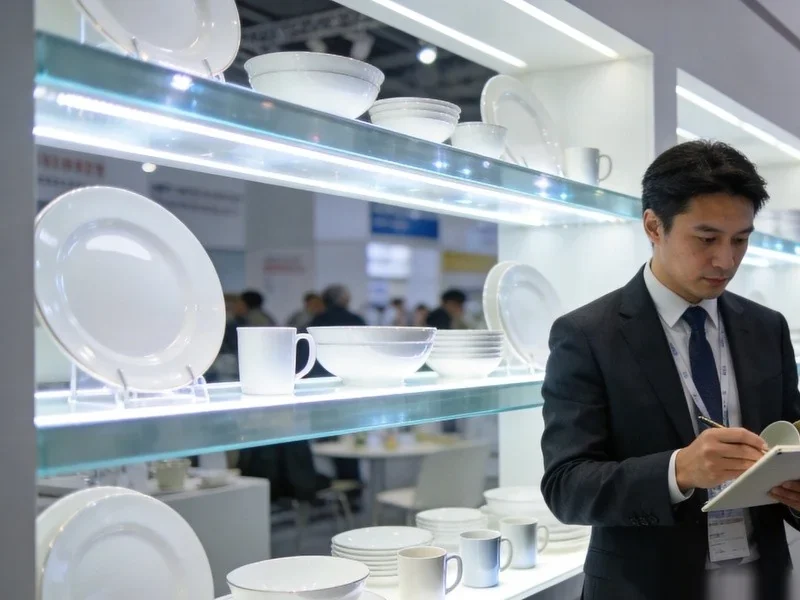
You have 15 minutes at a booth to decide if a ceramic vendor is worth a follow-up factory visit or a year-long production partnership. Most buyers waste hours on the wrong booths because they rely on gut feeling instead of a structured evaluation. After walking Canton Fair’s ceramic halls for over a decade, I have learned that the vendors who look best at first glance are rarely the ones who deliver consistent quality six months later.
This article gives you a field-tested canton fair ceramic vendor checklist that you can use during booth visits. It covers what to research before you arrive, the seven points to audit in under 15 minutes, the red flags that should send you walking away, and the documentation habits that turn a chaotic trade show into a qualified supplier shortlist.
How to Use This Canton Fair Ceramic Vendor Checklist
Print or save this checklist to your phone before you arrive in Guangzhou. Bring a one-page spec sheet for your target product, a pen, and the vendor scorecard below. Allocate 10–15 minutes per booth. Fill out the scorecard immediately after each conversation while details are fresh. Rank your top candidates the same evening. Most buyers can thoroughly evaluate 15–20 booths over two days using this system.
Before You Arrive: Research That Saves Hours
Canton Fair’s ceramic section spans multiple halls and hundreds of booths. Walking in without a plan means spending your first day wandering and your second day rushing. A few hours of preparation before your flight to Guangzhou will cut your floor time by half.
Download the exhibitor list and filter by product category
Canton Fair publishes the exhibitor list roughly two weeks before each phase. Filter for ceramic tableware, mugs, plates, or your specific product category. Cross-reference company names against business registries if you want an extra layer of verification. Canton Fair participation provides a useful starting point, but it should not replace supplier due diligence. Buyers should still verify the vendor’s legal entity, factory address, production ownership, export records and product-specific test reports.
Prepare your target specifications
Bring a one-page brief with your target specifications: material type, glaze finish, dimensions, capacity, and any customization requirements. When you hand a vendor a clear spec sheet, you immediately learn whether they understand technical details or are simply reading from a catalog.
Schedule booth appointments for your top 10 targets
Send introductory emails to your priority vendors two weeks in advance. Request a 20-minute meeting and mention your estimated order volume. Vendors who are serious about B2B relationships will reserve time. Those who do not respond before the fair are often the same ones who ignore emails after it.
The 7-Point Booth Audit Checklist
Use this canton fair ceramic vendor checklist at every booth. Allocate roughly two minutes per point. If a vendor fails three or more points, move on. There are 200 more booths to see.
| Check | What to Look For | Pass / Fail Criteria |
|---|---|---|
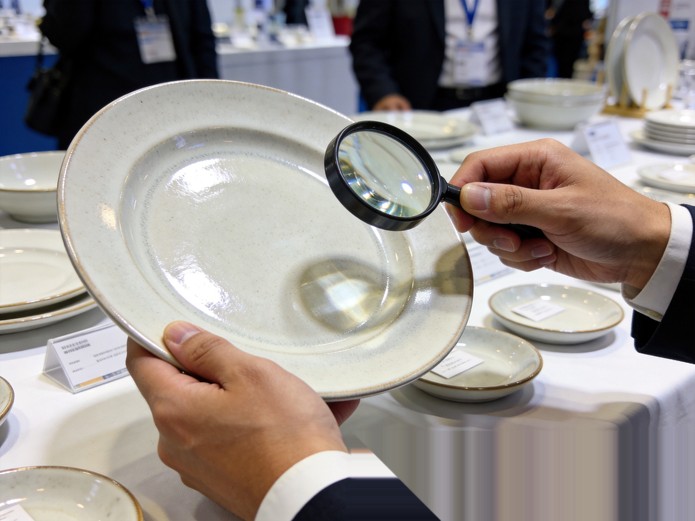
| 1. Booth presentation | Sample quality, display organization, cleanliness | Pass: Samples match catalog specs; no chips or glaze defects on display pieces |
| 2. Product range focus | Whether they specialize in your product type or carry everything | Pass: 60%+ of displayed items are in your category |
| 3. Staff technical knowledge | Can they explain firing temperature, clay composition, glaze chemistry? | Pass: Answers without checking notes; mentions specific numbers |
| 4. Certification display | FDA ceramicware lead and cadmium guidance, Regulation (EC) No 1935/2004, Directive 84/500/EEC for ceramic articles, or LFGB-related destination-market testing documents visible or quickly produced | Pass: Original test reports or clear photocopies shown within 2 minutes |
| 5. Price structure transparency | Do they quote FOB, break down mold costs, and explain volume discounts? | Pass: Written quote with Incoterm and payment terms |
| 6. Production capacity clarity | Daily output, current order backlog, peak season constraints | Pass: Specific numbers given; not vague “we can handle any volume” |
| 7. Customization capability | Color matching, logo application, mold development, packaging design | Pass: Shows physical examples of past custom work |
Score each vendor out of 7. A score of 5 or above warrants a factory visit request. A score of 3 or below means you should keep walking. Scores of 4 require a second visit later in the fair after you have seen more options.
Red Flags: When to Walk Away Immediately
Some warning signs are subtle. Others are impossible to miss. These three red flags have saved me from months of quality disputes and missed deliveries.
Red Flag 1: The vendor cannot or will not provide a factory address
A legitimate manufacturer will give you their factory address without hesitation. If the salesperson deflects, claims the factory is “too far,” or offers only a city name without a street address, you are likely talking to a trading company posing as a factory. Trading companies are not inherently bad, but you need to know who you are dealing with before you negotiate pricing. For guidance on verifying factory credentials, see our ceramic factory audit checklist.
Red Flag 2: Prices are 40% below every other booth for the same spec
When a quote is dramatically lower than the market range, the gap usually comes from corner-cutting: inferior clay bodies, thinner walls, low-temperature firing, or substandard glaze. Ask the vendor to explain the cost difference. If they cite “better efficiency” without specifics, the real answer is usually lower quality. For a detailed breakdown of what drives ceramic pricing, read our ceramic tableware pricing breakdown.
Red Flag 3: Sales staff cannot answer basic technical questions
If you ask about firing temperature, lead-cadmium compliance testing, or clay shrinkage rates and the salesperson needs to call a colleague or check a phone, the booth is staffed by traders, not technical staff. This is not a dealbreaker if you are buying standard catalog items, but it is a serious concern if you need any level of customization or quality assurance.
Questions That Separate Real Factories from Middlemen
The fastest way to determine whether you are talking to a factory or a middleman is to ask questions only a factory insider can answer confidently. Use this comparison table during your booth conversations.
| Question | Real Factory Response | Middleman / Trader Response |
|---|---|---|
| What is your MOQ per SKU? | A number tied to kiln capacity and existing mold inventory. Ask the vendor to explain how they calculate the MOQ, and request written confirmation before you leave the booth. | “Very flexible, we can discuss” or “as low as 100 units” |
| What is your typical production lead time? | A process breakdown with estimated days for each stage: molding, bisque firing, glazing, glaze firing, QC, and packing. Ask for written confirmation of the full timeline, including how peak season affects delivery. | “About 3–4 weeks” with no process breakdown |
| Can I visit the factory? | “Yes, please contact us to schedule. Here is the address.” | “The factory is in another province” or “It is not convenient right now” |
| What is your defect rate in last year’s production? | An explanation of the QC process and how defects are categorized and handled. Ask for the last third-party inspection report rather than an oral percentage claim. | “We have very good quality control” with no numbers |
| Can you show me a sample of custom work you did for another client? | Shows physical sample or detailed photos with process documentation | “We can do anything you want” but shows no evidence |
If you need a deeper framework for evaluating suppliers beyond the trade show floor, our ceramic sample evaluation guide covers lab testing and physical inspection protocols.
Sample Collection and Documentation Rules
The samples you collect at Canton Fair are your only physical reference until the next visit. Poor documentation turns a promising lead into a guessing game three months later. Follow these rules at every booth.
- Label every sample immediately. Write the vendor name, booth number, date, and your contact person’s name directly on the sample or its bag. A ceramic mug without a label is useless after day three.
- Photograph the booth display. Take wide shots of the booth and close-ups of the specific items that interest you. These photos help you remember the context when you review samples back at your hotel.
- Request a printed or digital catalog. Ask for the vendor’s full catalog with SKU codes, dimensions, and MOQ. If they only have a WeChat mini-program or Alibaba page, screenshot the relevant pages before you leave.
- Record pricing and terms on the spot. Do not rely on memory. Write down the quoted FOB price, Incoterm, payment terms, and estimated lead time for each SKU you are considering.
- Collect business cards and scan them. Use a business card scanning app or take clear photos of both sides. Add notes about the conversation immediately after the scan.
From Booth Visit to Supplier Shortlist: Three Actionable Steps
Collecting business cards is not sourcing. Turning booth visits into a qualified shortlist requires discipline in the 48 hours after each day at the fair.
Step 1: Score and rank vendors the same evening
Do not wait until you return home. While the conversations are fresh, score each vendor using the 7-point checklist above. Add notes about personality fit, communication clarity, and any gut concerns. A vendor who scores 6/7 but feels evasive about timelines should rank below a 5/7 vendor who is transparent about constraints.
Step 2: Send follow-up emails within 48 hours
Reference your booth conversation, restate your interest, and request the specific follow-up you need: a factory visit, a formal quotation, or sample shipment. Vendors who respond promptly and thoroughly within 48 hours are demonstrating the communication habits that matter during production. Vendors who ghost you for a week will likely ghost you when a shipment deadline approaches.
Step 3: Request factory audits for your top three
No booth visit replaces a factory audit. For your top three ranked vendors, schedule an on-site visit within 30 days of the fair. If travel is not feasible, request a video factory tour and ask to see specific production areas: the kiln room, glazing line, QC station, and packing area. For a complete audit framework, see our ceramic factory audit checklist.
What to Know About MOQ, Lead Time, and Customization
Trade show conversations about pricing and capacity are often optimistic. Here is what realistic terms look like for ceramic tableware sourced through Canton Fair.
| Factor | Typical Range at Canton Fair | What Affects the Number |
|---|---|---|
| MOQ per SKU | Varies by kiln size, mold inventory, and glaze complexity. Ask for written MOQ confirmation per SKU. | Kiln size, existing mold availability, glaze color matching complexity |
| Production lead time | Varies by order size, custom mold needs, and season. Ask for a written production schedule with stage-by-stage estimates. | Order size, custom mold development, peak season (August–November) |
| Sample lead time | Varies by mold complexity and glaze development. Request a written sample timeline before leaving the booth. | Mold complexity, glaze color development, courier transit time |
| Customization options | Logo printing, custom glaze colors, decal application, packaging design | Volume commitment, artwork complexity, color matching tolerance |
| Quality testing | Third-party lab testing by accredited bodies for destination-market requirements. The scope depends on whether you are shipping to the United States, the European Union, or Germany. Ask the vendor which standards the reported tests cover, and confirm that the test report matches your exact product configuration. | Regulatory requirements of destination market; testing scope and lab accreditation |
| Export packaging | Corrugated master cartons, bubble wrap dividers, palletized for FCL | Product fragility, shipping method (sea vs. air), retailer requirements |
The specific regulatory frameworks that apply to ceramic food contact materials include FDA ceramicware lead and cadmium guidance for the United States, EU Regulation (EC) No 1935/2004 on food contact materials, and EU Directive 84/500/EEC for ceramic articles. Do not accept a generic test report without confirming which standard was tested and whether the report covers your exact product configuration.
For a detailed breakdown of ceramic production timelines and how to plan around peak season bottlenecks, see our ceramic production lead time guide. If you are negotiating MOQ for the first time, our ceramic MOQ strategy article covers volume commitments and risk mitigation.
Your Trade Show Sourcing Tool: The Vendor Scorecard
Copy this scorecard into a spreadsheet or print it before you arrive at Canton Fair. Use one row per vendor. The scorecard forces you to evaluate every booth on the same criteria, which prevents the common mistake of overweighting first impressions.
| Vendor Name | Booth | Booth Quality (1–3) | Technical Knowledge (1–3) | Certifications (1–3) | Price Transparency (1–3) | Capacity Clarity (1–3) | Customization (1–3) | Communication (1–3) | Total / 21 | Follow-Up Action |
|---|---|---|---|---|---|---|---|---|---|---|
| Example Vendor A | 3.2B15 | 2 | 3 | 2 | 3 | 2 | 3 | 3 | 18 | Factory audit requested |
| Example Vendor B | 4.1C08 | 3 | 1 | 1 | 2 | 1 | 2 | 2 | 12 | No follow-up |
Save this scorecard to your phone or tablet. Filling it out in real time at each booth takes under two minutes and creates an objective record that outlasts your memory of the conversation.
Frequently Asked Questions
How many ceramic vendors should I plan to visit at Canton Fair?
Plan to visit 15–20 booths if you are sourcing a new product line. For a single SKU expansion, 8–10 booths is sufficient. Quality of evaluation matters more than quantity. A thorough 15-minute audit at 10 booths beats a rushed 5-minute chat at 30.
Should I place orders at the fair or wait until after the factory audit?
Never place a bulk order at the fair. Use the trade show to build a shortlist. Place orders only after you have verified the factory through an on-site or virtual audit, reviewed samples, and confirmed compliance documentation. The vendors who pressure you to sign at the booth are usually the ones with the most to hide.
How do I verify test reports shown at a booth?
Ask for the complete laboratory report rather than a certificate image. Check the tested product description, ceramic body, glaze or decoration, report number, issue date, test method, result limits and laboratory identity. Confirm that the report covers the exact product configuration you intend to purchase. For LFGB-related destination-market testing, request the test report with the accredited lab’s stamp. Be aware that some vendors display reports for “similar” products rather than the exact item you are buying. For a full guide to verification, see our ceramic certification standards guide.
What is the best way to ship samples home from Canton Fair?
Consolidate all samples into one shipment through your hotel’s courier service or a local freight forwarder. Declare the shipment as “samples for evaluation” with a nominal value to avoid customs complications. Keep photos of each sample in case of damage during transit. For detailed packaging guidance, see our ceramic packaging and shipping guide.
Can I negotiate MOQ at the booth?
You can ask, but significant MOQ reductions rarely happen at the booth. Sales staff at trade shows usually have limited authority to adjust minimums. The real negotiation happens after the fair, when you have established interest and can offer a multi-SKU commitment or a longer-term partnership in exchange for lower per-SKU minimums.
How do I handle language barriers during booth visits?
Most Canton Fair ceramic vendors have English-speaking sales staff, but technical discussions can still get lost in translation. Bring a printed spec sheet with diagrams and dimensions. Use a translation app for complex terms. If a vendor provides a translator who is not a technical employee, be cautious: the translator may smooth over answers that a direct conversation would expose.
Ready to Source Smarter at Canton Fair?
A structured approach to trade show sourcing separates buyers who leave with a qualified shortlist from buyers who leave with a bag of business cards and no clear next step. Use the canton fair ceramic vendor checklist above at every booth, document everything, and follow up within 48 hours. If you are looking for a ceramic tableware partner with transparent pricing, documented compliance, and clear production timelines, send us your specifications and we will provide a detailed quotation with lead times and customization options. You can also browse our ceramic tableware collection to see our current product range.