Brunch restaurant ceramic tableware needs to handle a unique combination of demands that separate breakfast service from lunch or dinner. Runny eggs and hollandaise sauce test glaze porosity. Hot coffee refills demand thermal shock resistance. Wide pancakes and shared avocado toasts require specific plate dimensions. And every dish that lands on a customer’s table is likely to be photographed before it is eaten.
After sourcing tableware for dozens of brunch concepts across North America and Europe, I have learned that the wrong plate choice shows up within the first month — stains that will not scrub out, chips from stacking too high, or cups that crack when the barista pours a second espresso shot into a still-warm mug.
This article breaks down the specific plate shapes, glaze types, and durability standards that matter for brunch service, with actionable specs you can send directly to a supplier.
Why Brunch Service Demands Specialized Ceramic Tableware
Brunch is not dinner served earlier. The menu mix, service pace, and customer expectations create a distinct set of tableware requirements.
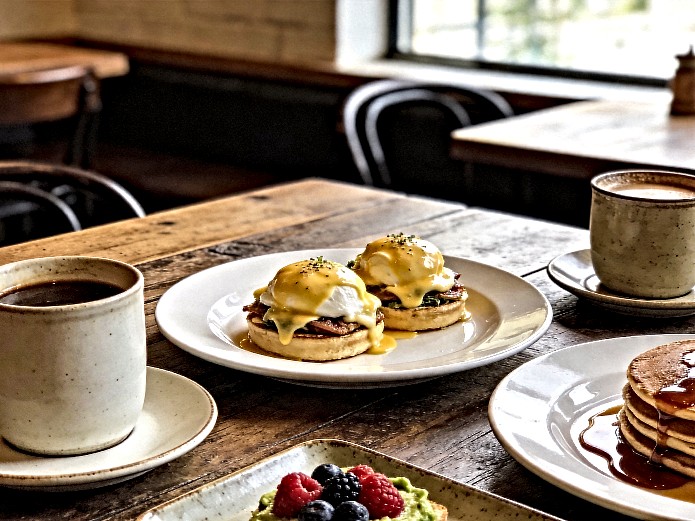
The menu mix problem. A typical brunch ticket includes runny eggs, acidic tomato sauces, oily hash browns, and sticky maple syrup — all on the same plate. Glazes that hold up fine against a dry steak may stain permanently after two weeks of hollandaise exposure.
The turnover problem. Brunch windows are compressed — 9 AM to 2 PM in most markets. A single plate may cycle through the dishwasher four to six times on a Sunday morning. That is 20 to 30 washes per week per piece, versus 10 to 15 for dinner-only service.
The presentation problem. Brunch dishes are photographed more than any other meal category. The plate is part of the product. Matte glazes photograph better under natural light than high-gloss finishes. Wide rims give food breathing room. Color consistency across the entire collection matters because a mismatch between the egg plate and the coffee saucer shows up in every overhead shot.
The cost-per-use reality. A $4.50 plate that chips in three months costs $1.50 per month. A $7.00 plate that lasts 18 months costs $0.39 per month. Brunch operators who calculate cost-per-use rather than cost-per-piece make better long-term decisions.
Plate Shapes and Sizes That Work for Brunch Menus
Not every dish belongs on the same plate. Here is how I match plate type to menu item.
| Brunch Dish | Recommended Plate Type | Size Range | Why It Works |
|---|---|---|---|
| Eggs Benedict / Florentine | Coupe plate or shallow bowl | 9–10 inch (23–25 cm) | Curved edges contain runny yolk and hollandaise; easier to sauce around |
| Pancakes / French toast | Wide flat plate with low rim | 10–11 inch (25–28 cm) | Maximizes surface area; syrup spreads instead of pooling |
| Avocado toast / grain bowls | Deep plate or pasta bowl | 8–9 inch (20–23 cm), 2 inch depth | Contains loose toppings; photographs well from overhead |
| Shared mezze / brunch boards | Rectangular platter | 12×8 inch (30×20 cm) | Fits multiple small items; works for tableside sharing |
| Pastry / croissant | Side plate with slight rim | 6–7 inch (15–18 cm) | Right scale for single pastry; stacks efficiently |
| Full English / big breakfast | Large oval platter | 12–13 inch (30–33 cm) | Separates hot and cold items; reduces sauce migration |
Key purchasing decision: Coupe plates cost 15–25% more than flat plates but reduce sauce runoff and breakage from edge chips. For egg-heavy menus, the extra cost pays back within two months in reduced replacement rates.
[INTERNAL DATA REQUIRED: Specific price ranges from CeraSupply catalog for coupe vs flat plates in stoneware and porcelain grades]
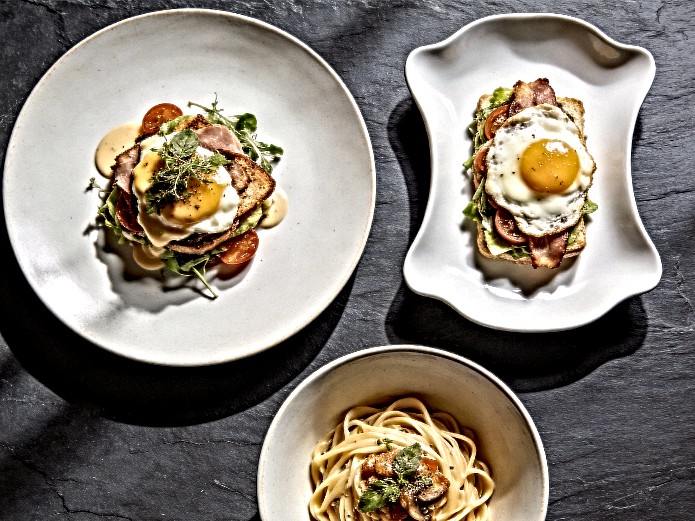
Egg Dish Plates: Glaze Porosity and Stain Resistance
Eggs are the single biggest tableware stressor in brunch service. Yolk proteins bond with porous glaze surfaces. Acidic tomato-based dishes etch low-fire glazes over time.
What to look for in a glaze:
- Water absorption rate below 0.5% (ASTM C373 standard for vitrified ware). Above 0.5%, stains penetrate the glaze body and cannot be removed.
- High-fire glaze (cone 8–10, approximately 1,200–1,280°C). Low-fire glazes (cone 04–06) are more porous and less durable.
- Fully vitrified porcelain or high-fire stoneware. Earthenware absorbs water even when glazed and should be avoided for commercial brunch service.
The lemon test: Ask your supplier for a sample plate. Cut a lemon in half, place it glaze-side down, and leave it for 24 hours. If the plate shows discoloration, the glaze is too porous for egg service.
[CERTIFICATE REQUIRED: ASTM C373 test report sample for current plate lines]
Coffee Cup and Mug Specifications for High-Refill Service
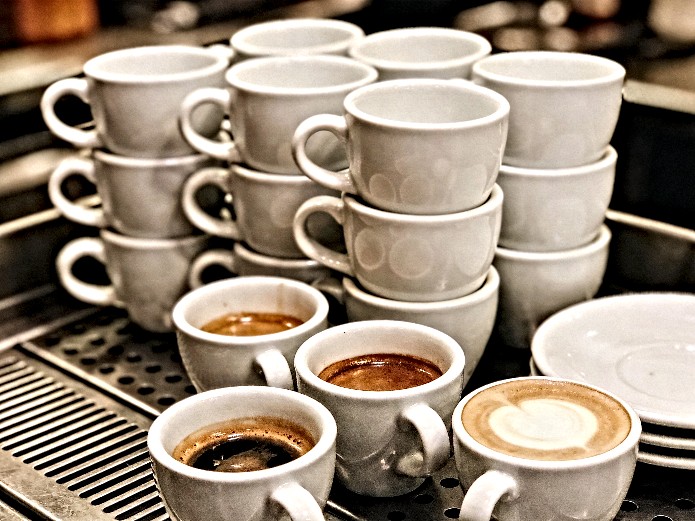
Brunch customers drink more coffee per visit than lunch or dinner guests. A table of four may generate 12 to 20 cup refills in a 90-minute seating. That means cups are subjected to repeated thermal shock — hot coffee poured into a cup that just came out of the dishwasher.
Thermal shock resistance specifications:
- Thermal expansion coefficient below 4.0 × 10⁻⁶/°C for porcelain, below 5.5 × 10⁻⁶/°C for stoneware
- Wall thickness of 4–5 mm minimum. Thinner walls look elegant but crack under thermal stress.
- Handle attachment must be solid — the handle is the most common failure point in commercial cups
Capacity guidelines:
- Espresso cup: 80–100 ml
- Cappuccino cup: 150–180 ml (wider diameter for latte art)
- Americano / filter coffee mug: 300–350 ml
Practical note: Stackable mugs save 40% of shelf space compared to non-stackable designs. In a small brunch kitchen with limited storage, this matters more than aesthetics.
Shared Plates and Serving Platters for Brunch Culture
Brunch is increasingly a shared meal. Board-style presentations — avocado toast boards, pastry assortments, mezze spreads — require serving pieces that are both functional and photogenic.
Serving platter requirements:
- Size: 12×8 inch (30×20 cm) minimum for two-person sharing; 16×10 inch (40×25 cm) for four-person tables
- Weight: Under 1.2 kg when empty. Heavier platters are dropped more often by servers carrying multiple plates.
- Surface: Slightly textured or matte finish prevents food from sliding during transport
- Handles: Optional but recommended for hot items. Integrated handles (molded into the body) are more durable than attached handles.
Cost-quality tradeoff: Slate or wood boards are cheaper upfront but cannot be dishwashed and harbor bacteria in scratches. Ceramic platters cost 30–50% more but last years longer and meet health code requirements without special handling.
Durability Requirements for High-Turnover Brunch Operations
Commercial brunch service is hard on tableware. Here are the durability benchmarks I use when evaluating samples.
Minimum commercial-grade specifications:
- Edge chip resistance: Must survive a 50 cm drop onto a hard surface without chipping (this is a practical test, not a formal standard)
- Glaze hardness: Mohs hardness of 5+ to resist knife scratches from cutlery
- Thermal shock: Must survive a 150°C temperature differential (hot plate to cold water) without cracking
- Dishwasher safe: Minimum 2,000 wash cycles without glaze degradation or discoloration
Porcelain vs. stoneware for brunch:
- Porcelain: Whiter, thinner, more chip-resistant at the edges. Better for fine-casual brunch concepts. Costs 20–35% more per piece.
- Stoneware: Heavier, more thermal mass (keeps food warm longer). Better for rustic or farmhouse-style brunch concepts. More affordable but slightly more prone to edge chipping.
[VERIFY BEFORE PUBLISHING: ASTM C1525 thermal shock test procedures and acceptance criteria for ceramic tableware]
Brunch Tableware Procurement: MOQ, Lead Time, and Cost Breakdown
Here is what realistic procurement looks like for a 120-seat brunch restaurant.
Typical order profile:
- Dinner plates (coupe or flat): 200–240 pieces
- Side / pastry plates: 150–180 pieces
- Coffee cups with saucers: 200–240 sets
- Shared platters: 30–40 pieces
- Soup / grain bowls: 100–120 pieces
- Total pieces: 680–820
MOQ realities:
- Standard MOQ per design: 500–1,000 pieces for factory-direct orders
- Mix-and-match MOQ: Some suppliers allow 300 pieces per SKU if the total order exceeds 2,000 pieces
- Custom color: Adds 30–45 days and may require 1,000+ pieces per color
Lead time breakdown:
- Sample approval: 2–3 weeks
- Production: 6–8 weeks for standard designs
- Shipping (FOB China to US West Coast): 3–4 weeks
- Total from order to delivery: 11–15 weeks
Cost-per-piece range (FOB, standard white or cream glaze):
- Coupe plate (9 inch): $2.80–$4.50
- Flat plate (10 inch): $2.20–$3.80
- Coffee cup + saucer set: $3.50–$5.50
- Shared platter (12×8 inch): $5.50–$8.50
- Grain bowl (8 inch): $2.50–$4.00
[INTERNAL DATA REQUIRED: Current CeraSupply FOB pricing for verified accuracy]
Common Mistakes When Sourcing Brunch Ceramic Tableware
These are the three mistakes I see most often from first-time brunch operators.
Mistake 1: Buying dinner plates for everything. A flat dinner plate works for a dry steak. It does not work for runny eggs. Sauce runs off the edge. The plate stains. Staff end up double-plating — an extra cost and extra dishwasher load.
Mistake 2: Ignoring stack height limits. A coupe plate nests less efficiently than a flat plate. If your storage shelves were designed for flat plates, coupe plates may not fit. Measure your existing storage before ordering.
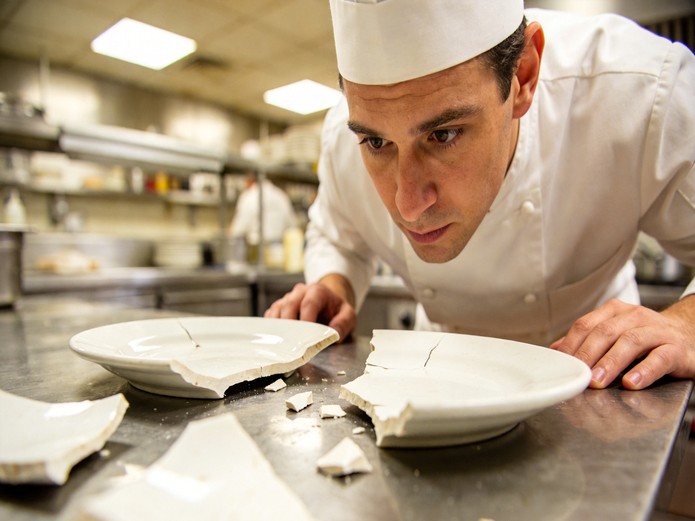
Mistake 3: Choosing aesthetics over thermal shock resistance. A thin-walled, hand-thrown lookalike cup photographs beautifully on Instagram. It also cracks the first time a barista pours hot coffee into a cup that just came out of a 65°C dishwasher cycle.
Brunch Tableware Quality Checklist
Use this checklist when evaluating samples from a supplier. Print it, take it to the sample review, and score each item 1–5.
Glaze and Surface
- Water absorption rate documented and below 0.5%
- No visible pinholes, bubbles, or glaze irregularities
- Glaze color consistent across all sample pieces (hold side-by-side in natural light)
- Lemon test passed (24-hour exposure, no discoloration)
- Knife scratch test: light surface marking only, no exposed body clay
Shape and Function
- Coupe plates contain 50 ml of water without spillage when tilted 15 degrees
- Flat plates have a rim height of at least 8 mm to contain light sauces
- Cup handles support the weight of a full cup when held at the handle alone
- Stackability confirmed: plates stack 12+ high without wobble; cups stack 8+ high
- Shared platters pass the one-hand lift test when loaded with 500 g of food
Durability
- Edge chip test: 50 cm drop onto tile, no chip larger than 2 mm
- Thermal shock: cup survives boiling water poured in, then immediate cold water rinse
- Dishwasher test: 20 cycles, no glaze clouding or color shift
- Weight within ±5% of quoted specification
Logistics
- MOQ per SKU confirmed in writing
- Lead time confirmed with buffer for delays
- Packaging spec reviewed: carton strength, divider type, pieces per carton
- Sample approval process documented
FAQ
What is the best plate shape for eggs Benedict?
A coupe plate or shallow bowl with a 9–10 inch diameter works best. The curved edge contains runny yolk and hollandaise, reducing cleanup and table stains.
How many pieces of tableware does a 100-seat brunch restaurant need?
Plan for 6–7 turns of each piece per piece in inventory. A 100-seat restaurant serving 300 covers on a busy Sunday needs approximately 600–700 total pieces across all SKUs.
Should I choose porcelain or stoneware for brunch service?
Porcelain is whiter, thinner, and more chip-resistant — best for modern or fine-casual concepts. Stoneware retains heat better and costs less — best for rustic or farmhouse-style concepts. Both work if the glaze is high-fire and vitrified.
How do I test if a glaze is porous enough to stain?
Place a halved lemon cut-side down on the plate for 24 hours. Any discoloration indicates the glaze is too porous for egg and acidic sauce service.
Can I mix and match plate styles from different suppliers?
Technically yes, but color matching becomes a problem. Even “white” varies significantly between factories. If you need a cohesive collection, source the full line from one supplier or request color-matched samples before splitting the order.
What is a realistic lead time for a custom-branded brunch tableware order?
From sample approval to delivery: 11–15 weeks for standard designs, 14–18 weeks for custom colors or logos. Order 4 months before your opening date.
Get a Tailored Brunch Tableware Recommendation
Building out a brunch concept or refreshing an existing menu? The right tableware affects food presentation, kitchen workflow, and replacement costs for years.
Get the brunch restaurant tableware catalogue — send us your menu mix and seating count, and we will recommend the specific plate shapes, sizes, and glaze types that match your service style and budget.
Request a brunch tableware consultation — include your menu and seating count for a tailored recommendation.