A well-structured ceramic tableware purchase contract is the single most important document between you and your supplier after you have selected a vendor. It is not a formality. It is the enforceable record of what you ordered, when it must arrive, how it must look, and who pays when something goes wrong. Without the right clauses, a $50,000 order can turn into a six-month dispute over color drift, cracked rims, or a missing deposit. This article walks through the eight contract clauses every B2B buyer should negotiate before signing, shows how different buyer types need different protections, and gives you a ready-to-use checklist you can take to your legal review.
Why Most Ceramic Purchase Contracts Fail
The typical “contract” most buyers receive is a proforma invoice with a few lines about payment and delivery. That document might hold up in a commercial dispute, but it rarely protects the buyer on the issues that actually cause losses in ceramic sourcing: glaze color variation between batches, handle strength failures after dishwasher cycling, or a supplier who ships 60 days late without consequence.
The real problem is not bad faith. It is misaligned expectations written in vague language. “Good quality” means different things to a factory QC inspector and a restaurant owner opening a container in Chicago. A contract fixes that alignment before production starts.
8 Essential Clauses Every Ceramic Tableware Purchase Contract Needs
1. Deposit and Payment Terms
Never send a 100% deposit upfront. The standard structure for ceramic tableware orders is 30% deposit on order confirmation and 70% against copy of bill of lading (BL). For repeat orders with established suppliers, some buyers negotiate 20/80 or even 10/90 terms after two to three successful shipments. Your contract should state the exact deposit percentage, the payment method (T/T, L/C, or escrow), and the trigger for each subsequent payment.
Include a refund clause tied to supplier breach. If the factory fails to start production within 15 days of deposit receipt, or if the final inspection fails the agreed acceptance standard, the deposit becomes refundable within 10 business days. Without this clause, your deposit is at the supplier’s discretion.
2. Production Timeline and Delivery Schedule
Break the timeline into milestones: mold confirmation, first article sample approval, mass production start, mid-production inspection, final inspection, and ex-factory date. For a standard 5,000-piece ceramic dinnerware order, the typical timeline runs 45-60 days from deposit to ex-factory. Custom shapes or hand-painted designs add 15-30 days. Your contract should attach a Gantt-style schedule as an exhibit and define liquidated damages for delays: typically 0.5% to 1% of the order value per week of delay, capped at 5-10%.
Do not accept open-ended language like “approximately 60 days.” Use hard dates with grace periods. “Ex-factory date: 60 calendar days from deposit receipt, with a 7-day grace period. Delay beyond 67 days triggers liquidated damages at 0.5% per week.”
3. Quality Acceptance Standards and AQL
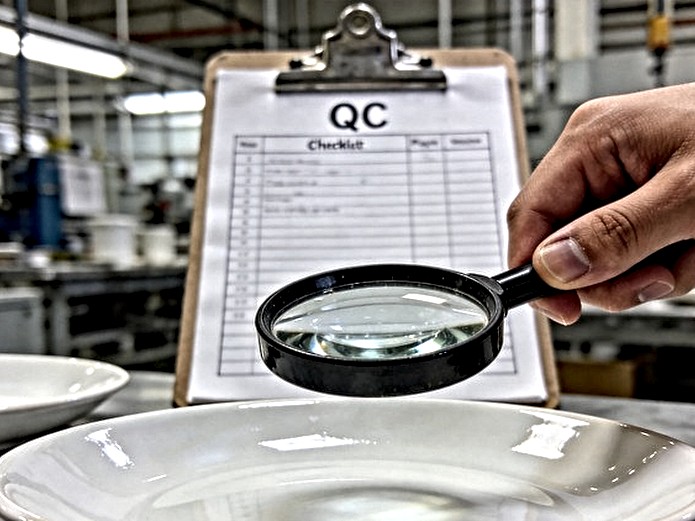
This is where most disputes originate. Your contract must define the inspection standard, the acceptable quality limit (AQL), and the inspection body. For ceramic tableware, the industry reference is ISO 2859-1 sampling with AQL 2.5 for major defects and AQL 4.0 for minor defects. Major defects include cracks, chips, glaze pinholes, and dimensional deviations beyond tolerance. Minor defects include slight color variation within an acceptable range and minor surface imperfections.
Specify who inspects. Options include third-party inspection (SGS, Bureau Veritas, Intertek), your own QC representative, or a pre-shipment sample approval process. For orders above $30,000, third-party inspection is usually worth the $300-500 cost. State in the contract that final payment is contingent on passing inspection.
Also include a reference sample clause: “The approved pre-production sample, signed by both parties, shall serve as the binding quality reference for mass production.” This gives you a physical standard to enforce.
4. Packaging and Shipping Liability
Define the Incoterms clearly. FOB is the most common for ceramic tableware imports from China: the supplier loads the container at the port and hands risk to the buyer at that point. CIF shifts ocean freight to the supplier but leaves insurance and destination costs to the buyer. DDP is the most buyer-friendly but adds cost. Your contract should state the exact Incoterm, the port of loading, and the shipping method (FCL vs. LCL).
Packaging specification deserves its own paragraph. For ceramic, the standard is individual polybag + egg-crate foam or corrugated divider + master carton. State the maximum weight per carton (typically 15-20 kg), the stacking limit, and the moisture protection requirement. Include a damage claim process: photos of damaged outer cartons upon arrival, unpacking photos, and a written claim within 48 hours of delivery.
5. Mold and Custom Design Ownership
If you are paying for mold development, you own the mold. Period. This should be explicit in the contract: “All molds, tooling, and design files developed at the buyer’s expense remain the exclusive property of the buyer. The supplier shall not use, reproduce, or sell the mold design to any third party without written consent.” This is especially critical for OEM buyers who have invested $2,000-10,000 in unique shapes.
Include a mold transfer clause: if the relationship ends, the supplier must deliver the physical mold and CAD files to the buyer or a nominated third-party factory within 30 days. Without this, your mold investment is stranded.
6. Defect Rate Tolerance and Remedy
Even with good factories, some defect rate is normal in ceramic production. The contract should define what happens when defects exceed the AQL. Common remedies include: (a) replacement of defective units at supplier cost within the next shipment, (b) proportional credit against future orders, or (c) partial refund for the defective quantity. For critical defects (cracks, lead/cadmium failures), the remedy should be full replacement or refund at buyer’s choice.
Set a reporting window. Require the buyer to submit a defect report with photos and batch numbers within 30 days of receipt. After that window, the supplier is no longer liable for normal transit or handling damage.
7. Force Majeure and Dispute Resolution
Both parties need protection for events outside their control: port closures, raw material shortages, or government restrictions. Define force majeure narrowly. A “raw material price increase” is not force majeure. A government-mandated factory shutdown is. The clause should require prompt written notice, a good-faith effort to mitigate, and a maximum suspension period (typically 60-90 days) after which either party may terminate.
For dispute resolution, specify the governing law and venue. Many buyers choose Hong Kong or Singapore arbitration under ICC rules for China contracts, as these venues are neutral and enforceable under the New York Convention. Litigation in Chinese courts is cheaper but slower and less predictable for foreign buyers. State your preference clearly.
8. Exclusivity and Confidentiality
If you are sharing proprietary designs, packaging concepts, or market strategy, include a confidentiality clause with a survival period (typically 3-5 years after contract termination). For exclusivity, be specific: “Supplier agrees not to sell [specific design] to [named competitors or geographic markets] for the duration of this agreement and 12 months thereafter.” Vague exclusivity promises like “we won’t copy your design” are unenforceable.
Contract Term Comparison: What Different Buyer Types Need
| Clause | Importer / Distributor | Hotel / Restaurant Group | OEM / Private Label |
|---|---|---|---|
| Deposit split | 30/70 standard; negotiate 20/80 after 3+ orders | 30/70; request 60-day payment terms for repeat programs | 20/80 or milestone-based (mold / sample / mass) |
| Quality standard | AQL 2.5 major / 4.0 minor; third-party inspection | AQL 1.5 major; dishwasher-cycle test required | First-article approval + AQL 1.0 major; buyer QC on-site |
| Timeline | 45-60 days; liquidated damages 0.5%/week | 60-75 days; phased delivery schedules | 75-120 days; mold development milestone payments |
| Mold ownership | Not applicable for stock designs | Custom logo molds: buyer owns mold | Critical: buyer owns all molds and design files |
| Defect remedy | Replacement in next shipment or credit | Immediate replacement; spare stock clause | Full replacement or refund at buyer’s option |
| Exclusivity | Geographic exclusivity for branded lines | Design exclusivity within hospitality sector | Full design exclusivity; NDA required |
The importer negotiating a 10,000-piece dinner set order needs different protections than a hotel group sourcing 2,000 room-service sets or an OEM client developing a proprietary coffee mug shape. Use the table above to prioritize which clauses deserve the most negotiation attention for your buyer profile.
3 Common Mistakes Buyers Make in Ceramic Contracts
Mistake 1: Copying a Generic Template Without Ceramic-Specific Terms
A generic purchase agreement does not address ceramic-specific risks: thermal shock failure, glaze color batch variation, or dishwasher-safe durability. Your contract needs physical test references (dishwasher cycles, thermal shock test, lead/cadmium migration limits) attached as technical exhibits. Without them, a court or arbitration panel has no objective standard to enforce.
Mistake 2: Accepting the Supplier’s Proforma as the Binding Contract
The proforma invoice is a price quote, not a contract. It rarely includes quality standards, defect remedies, or mold ownership terms. Always issue a separate purchase contract or terms and conditions document that the supplier signs and returns. The signed version controls if a dispute arises.
Mistake 3: Ignoring the Mold and Design Ownership Gap
Buyers routinely pay $3,000-8,000 for custom mold development without a written ownership clause. Six months later, they discover the supplier is selling their design to competitors. Mold ownership is a property right, not an assumption. Get it in writing before you pay the mold fee.
Ceramic Tableware Purchase Contract Checklist
Use this checklist during your contract review. Check each item before you sign. Save this list for every new supplier relationship.
- Deposit percentage and payment trigger dates are specified (e.g., 30% on order, 70% on BL copy)
- Refund clause exists for supplier breach or failed final inspection
- Production timeline has milestone dates with grace periods and liquidated damages
- Quality standard references a recognized inspection protocol (ISO 2859-1 AQL)
- AQL levels are defined for major and minor defects
- Inspection body is named (third-party, buyer QC, or pre-shipment sample)
- Signed reference sample is attached as a quality benchmark
- Incoterms, port of loading, and shipping method are stated
- Packaging specification includes carton weight limit and moisture protection
- Damage claim process and reporting window are defined
- Mold and design ownership is explicitly assigned to the buyer
- Mold transfer clause exists for relationship termination
- Defect rate tolerance and remedy options are listed
- Defect reporting window is specified (recommend 30 days)
- Force majeure events are narrowly defined with notice requirements
- Maximum force majeure suspension period is capped
- Governing law and dispute resolution venue are stated
- Confidentiality clause covers designs, pricing, and market strategy
- Exclusivity terms are specific to design, geography, or market segment
- Both parties have signed and dated the final version

Cost vs. Protection: How Contract Terms Affect Your Budget
Stronger contract terms do not always cost more money. They shift risk. Here is how different clause choices affect your total landed cost and risk exposure.
A 30/70 payment split is standard and costs nothing extra. Negotiating 20/80 improves your cash position but may require a larger total order commitment or a longer relationship history. Third-party inspection adds $300-600 per shipment but reduces the risk of receiving a container full of unsellable stock. Liquidated damages protect your delivery schedule but suppliers may bake the risk premium into pricing, adding 1-3% to unit costs. Mold ownership clauses are free to include but save you $3,000-10,000 if you ever need to switch factories.
The right balance depends on your order size and risk tolerance. For a first-time $8,000 order, third-party inspection and a clear AQL standard are the highest-ROI clauses. For a $150,000 annual program, mold ownership, exclusivity, and phased delivery terms matter more. The contract is not about being adversarial. It is about writing down what both sides already agreed to so nobody has to guess later.
Frequently Asked Questions
Can I use a standard purchase order instead of a full contract?
For small repeat orders under $5,000 with an established supplier, a detailed purchase order with incorporated terms and conditions may be sufficient. For first-time relationships, custom designs, or orders above $10,000, a full contract with the clauses above is strongly recommended. The cost of drafting it is negligible compared to the cost of a dispute.
What Incoterm should I use for ceramic tableware from China?
FOB is the most common and generally the best balance of cost and control for experienced importers. The supplier handles factory-to-port costs; you control ocean freight and insurance. CIF is simpler for newer buyers but gives you less visibility into freight costs. DDP is the most convenient but typically adds 15-25% to total landed cost.
How do I enforce a contract with a Chinese supplier?
Enforceability depends on your dispute resolution clause. Contracts with Hong Kong or Singapore arbitration are enforceable in China under the New York Convention. Chinese court judgments are harder to enforce outside China. The most practical enforcement tool is not litigation: it is the deposit and final payment structure. Keep the final 70% payment contingent on passing inspection, and you have leverage without ever filing a claim.
Should I hire a lawyer to review my ceramic supply contract?
For orders above $25,000 or contracts involving custom mold development, a one-hour legal review ($200-400) is a sound investment. A lawyer can spot missing clauses, unbalanced liability terms, and jurisdiction issues. For smaller repeat orders, use the checklist above and focus on getting the payment terms, quality standard, and timeline in writing.
What happens if my supplier refuses to sign my contract?
This is a red flag. A supplier who refuses to sign a reasonable contract with standard commercial terms is signaling that they are either inexperienced in export or unwilling to be held accountable. Reputable factories that serve European and North American markets are accustomed to signing buyer contracts. If a supplier pushes back, start with the most critical clauses (payment terms, quality standard, and timeline) and build from there. A partial agreement on essentials is better than a handshake on nothing.
How often should I update my purchase contract?
Review your contract template annually and after any significant dispute or supplier change. Update the AQL standard if you change product categories, revise the timeline if you add new production steps, and adjust payment terms as your relationship matures. A contract is a living document, not a one-time formality.