Ceramic tableware manufacturing cost comes down to four physical inputs and two multipliers, and you can rebuild it in twenty minutes using the energy quota a Chinese factory is already measured against. The inputs are fired body mass, glaze mass, firing energy and the conversion charge for labour and kiln time; the multipliers are yield and packaging. This article runs that build on a 260 g stoneware plate, converts a public energy quota into gas per piece, tests a gas surcharge in one multiplication, and turns the result into a cost card you send with the RFQ so the conversation moves onto inputs instead of percentages.
The four inputs, and where each number comes from
A quote arrives as one number, with everything inside it invisible. That is why price talks stall at “can you do 5% better” — nobody has a vocabulary for what the 5% comes out of. Fired mass is the weight after firing, not the clay that went in. Glaze mass is estimated from coated area and coat thickness rather than weighed. Firing energy has a public anchor: the quota the plant is measured against. Conversion charge is the input only the factory knows.
| Input | Unit | Where the buyer gets it | How to treat it |
|---|---|---|---|
| Fired body mass | grams per piece | Sample on a scale, or the spec sheet | Measured — the one hard number |
| Glaze mass | grams per piece | Coated area × coat thickness × density | Modelled, declared as an assumption |
| Firing energy | MJ per piece | Quota applied to fired mass, converted to gas volume | Public anchor, arithmetic |
| Conversion charge | USD per piece | Not obtainable | Declared assumption, buyer-set |
| First-quality yield | percent | Asked of the factory, three runs | Negotiated input |
| Packaging | USD per piece | Carton and divider cost ÷ pieces per carton | Quoted separately |
A card that labels each line by origin survives scrutiny; one presenting all six as facts collapses under challenge.
Turning the energy quota into gas per piece
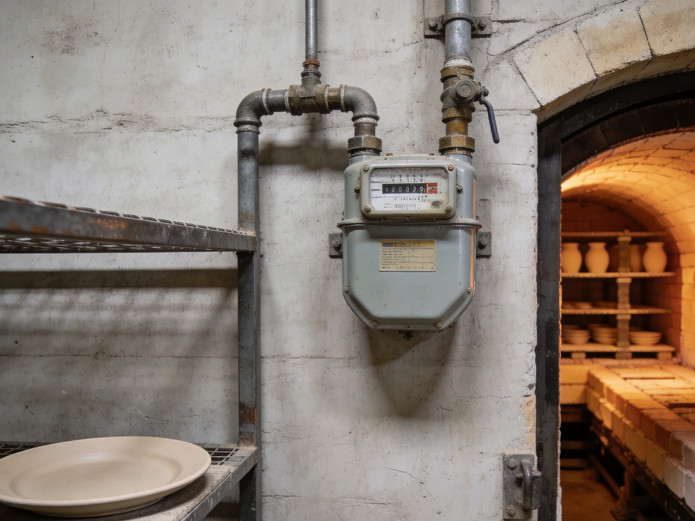
China measures daily-use ceramic plants against a specific energy consumption quota in kilograms of standard coal per tonne of qualified product, tiered by body and by new versus existing plant.
The conversion is fixed: one kilogram of standard coal carries 29,307.6 kJ under GB/T 2589-2020, so the 630 kgce/t existing-plant ceiling for ordinary porcelain is 18.46 MJ per kilogram of fired ware.
| Quota tier (ordinary porcelain) | kgce / tonne | MJ / kg fired ware |
|---|---|---|
| Advanced level | 420 | 12.31 |
| New or expanded line, access value | 500 | 14.65 |
| Existing plant, limit value | 630 | 18.46 |
| Bone china, existing plant limit | 1,270 | 37.22 |
Bone china carries roughly double the energy allowance of porcelain, so the same plate starts with a far larger firing cost before any material premium; earthenware sits lower, at 360 kgce/t for new lines.
Applied to fired mass, the ceiling quota gives these per-piece figures. Gas volume is energy divided by 35.6 MJ/m³, the midpoint of the 32.2–39.0 band in the same standard.
| Piece | Fired mass | Energy @ 630 kgce/t | Gas equivalent |
|---|---|---|---|
| 20 cm plate | 190 g | 3.51 MJ | 0.0985 m³ |
| 26 cm plate | 260 g | 4.80 MJ | 0.1348 m³ |
| 15 cm bowl | 300 g | 5.54 MJ | 0.1556 m³ |
| 320 ml mug | 330 g | 6.09 MJ | 0.1712 m³ |
At USD 0.50 per cubic metre the 26 cm plate carries USD 0.067 of firing energy and the mug USD 0.086 — ceiling figures: at the advanced 420 kgce/t level the same plate would show USD 0.045.
Cross-check the anchor first. A published sector study of small-scale tableware production in Thailand reports specific energy consumption averaging 19.6 GJ per tonne — roughly 669 kgce/t, close to the 630 ceiling and consistent with plants near the limit rather than the advanced tier. It splits energy 79% fuel to 21% electricity, the ratio you test a surcharge against.
Testing a gas surcharge before you accept one
The most common escalator request in tableware contracts is testable in one multiplication. Take the 26 cm plate at 4.80 MJ, or 0.1348 m³ of gas. If gas moves from USD 0.50 to USD 0.80 per cubic metre — a 60% rise, larger than most annual moves — the added energy cost is 0.1348 × 0.30 = USD 0.0404 per piece with electricity flat — the whole exposure on an all-gas kiln.
| Quoted price | Increase asked | USD per piece asked | Covered by a 60% gas rise | Covered if fuel is 79% of energy |
|---|---|---|---|---|
| USD 1.90 | 5% | 0.0950 | 42.6% | 33.7% |
| USD 1.90 | 8% | 0.1520 | 26.6% | 21.0% |
| USD 2.20 | 8% | 0.1760 | 23.0% | 18.2% |
| USD 2.20 | 15% | 0.3300 | 12.3% | 9.7% |
| USD 2.60 | 15% | 0.3900 | 10.4% | 8.2% |
An 8% request on a USD 2.20 quote is USD 0.176 per piece. Even if gas doubled and every joule came from gas, the energy line moves USD 0.067 — under a third of the ask. The honest reply to “gas has gone up” is a request for the other five lines.
The legitimate version: if the plant also faces higher labour, frit prices or a yield drop from a new mould, the increase is real and the gas framing is shorthand. A buyer who has done this multiplication can ask which line moved — and a seller who cannot answer has told you something.
The two multipliers: conversion and yield
Conversion covers pressing or casting, fettling, glazing labour, kiln furniture, overhead and in-process inspection. It is the largest line in a ceramic tableware manufacturing cost build and the least visible: on the 26 cm plate, the gap between a USD 0.73 material-plus-energy subtotal and something near USD 2.00.
There is no public anchor, so it is a declared assumption, not a fact. Set it, publish it on your card, and let the supplier correct it. Keeping it in one line gives the negotiation a target: you are not asking for a better price, you are asking whether the conversion charge matches the labour content.
Yield then multiplies the whole subtotal, and its effect is larger than most buyers expect.
| First-quality yield | Multiplier (1 / yield) | Cost increase over a clean run |
|---|---|---|
| 92% | 1.0870 | 8.7% |
| 85% | 1.1765 | 17.6% |
| 80% | 1.2500 | 25.0% |
| 70% | 1.4286 | 42.9% |
An 85% and a 70% line are not a 15-point quality difference: it is 21.4% more cost per first-quality piece for identical body, glaze and decoration, which is where a 15% quote gap frequently lives. It is the one input you ask for rather than derive — yield on the last three runs of a comparable item, and what the sort sheet counted as a defect.
Building the cost card on one plate

The full build for a 260 g stoneware dinner plate at the existing-plant energy ceiling, with every assumption labelled:
| Line | Basis | USD per piece |
|---|---|---|
| Body material | 260 g × USD 0.14/kg | 0.0364 |
| Glaze | 20 g × USD 0.90/kg | 0.0180 |
| Firing energy | 4.80 MJ ÷ 35.6 MJ/m³ × USD 0.50 | 0.0674 |
| Conversion (labour, kiln time, overhead, in-process QC) | Declared assumption | 0.5500 |
| Export packaging | Carton and divider share | 0.0550 |
| Subtotal | — | 0.7268 |
| Cost floor at 85% first-quality yield | 0.7268 ÷ 0.85 | 0.8551 |
Body and glaze prices are illustrative and conversion is declared. Energy is arithmetic from the quota, the yield divisor arithmetic once you have the number. Substitute your values and the structure holds.
| Quoted price | Implied gross margin | Gross USD per piece |
|---|---|---|
| USD 1.90 | 55.0% | 1.045 |
| USD 2.20 | 61.1% | 1.345 |
| USD 2.60 | 67.1% | 1.745 |
| USD 3.10 | 72.4% | 2.245 |
A 55% gross margin on decorated stoneware is not unusual: the arithmetic proves only that the quote is defensible at 85% yield and thinning at 70%. At 70% the same USD 1.90 quote has a floor of USD 1.038 and a 45.4% margin — where a seller looks for a reason to raise price or walk.
Fired mass moves the whole card silently: it scales body material and firing energy together, then adds freight at order level. A 260 g plate arriving at 300 g is a 40 g overrun most buyers would not raise.
| Effect of 40 g overrun | Per piece | Across 20,000 pieces |
|---|---|---|
| Extra firing energy | USD 0.0104 | USD 208 |
| Extra body material | USD 0.0056 | USD 112 |
| Combined | USD 0.016 | USD 319.46 |
| Extra shipped mass | 40 g | 800 kg (0.80 t) |
| Freight share at USD 2,200 per 40HC, 21 t payload | — | USD 83.81 |
USD 0.016 looks like noise; across 20,000 pieces it is USD 319 before the order ships 0.8 tonnes heavier. Weight belongs in the specification as a tolerance band with a weighing method and a sample count, not a single target figure.
Auditing the energy input against the factory's meter
The one input you can verify without a cost sheet is energy: the quota is public and the meter is theirs. Ask for annual gas in cubic metres and annual qualified output, then divide.
| Gas per year | Qualified output | SEC | kgce/t | Against 630 limit |
|---|---|---|---|---|
| 260,000 m³ | 480 t | 19.28 GJ/t | 658 | Above |
| 300,000 m³ | 600 t | 17.80 GJ/t | 607 | Below, close |
| 240,000 m³ | 560 t | 15.26 GJ/t | 521 | Below |
| 200,000 m³ | 520 t | 13.69 GJ/t | 467 | Below |
Two numbers most factories can answer from an energy bill with no costing disclosure. Near the limit means the kiln is not the constraint and energy is a thin line; well above it means the meter, the output or the kiln is not what the brochure says.
Two cautions. Output must be tonnes of qualified ware, not greenware — greenware tonnage looks far more efficient. And the quota spans body preparation through packing, so a plant buying in bisque and only glazing and firing reports differently. Ask which scope it covers.
Three mistakes, and the cost card to send
The first is treating the energy quota as a price: it is a ceiling on energy per tonne, not what any plant pays, and an advanced-tier factory sits well under it.
The second is presenting conversion as measured: once an assumption is shown as fact, the card becomes arguable and the supplier wins by default.
The third is building the card after the quote arrives. A card produced in response is a reaction; one sent with the RFQ is a requirement the supplier prices into.
RFQ COST CARD — [item / SKU]
1  Fired mass per piece (g), tolerance band, weighing method, pieces weighed per lot
2  Glaze mass per piece (g) and coat thickness range where stated
3  Firing energy per piece (MJ), or annual gas (m3) + annual qualified output (t)
4  Conversion charge per piece (USD), as its own line, not folded into price
5  First-quality yield (%) on the last three comparable runs, and the defect list used
6  Export packaging per piece (USD): carton, divider, and pieces per carton

DECLARATIONS
Quoted unit price (USD, FOB): ______   Trade term: ______
First-quality yield used to price this: ______ %
Gas price basis (USD per m3) and date: ______
Validity period and escalation basis (index, cap, dead band): ______
Six lines and four declarations. A seller who fills every field is costing the piece; one who returns a number and a validity date has given you a price with no structure to test — which answers whether they can run a custom program.
Once you hold these numbers, the four-layer rebuild in our ceramic tableware quotation comparison guide normalises competing bids onto one basis; for the date and escalator, see ceramic tableware quotation validity.
Want the energy input sanity-checked against your body type before you commit a line? Send the piece weight and annual output and we will run the figures against quota. Request a cost card review with your quote attached.
Frequently asked questions
Can I estimate a factory's cost without seeing their books?
You can bound it, not reconstruct it. Fired mass, glaze and firing energy are measurable or public, yield is asked, conversion assumed. That gives you a floor and a plausible range for the conversation — not the factory’s actual margin.
Why is the energy line so small if firing dominates manufacturing?
Firing dominates the plant’s energy bill and carbon footprint; studies put the two firing steps at the majority of tableware manufacturing emissions. But energy is a small share of a decorated piece’s price, because labour and conversion are larger.
Is 630 kgce/t a legal limit I can cite to a supplier?
It is a quota value from China’s energy consumption standard for daily-use ceramics, tiered by body and by new versus existing plant — not a price rule or a contractual term. Cite it as the benchmark the plant is measured against, and ask which tier and scope they report.
What if the factory will not disclose yield?
Then you cannot build the card, and that is the finding, not a gap to fill later. Yield explains most quote gaps, so a factory unwilling to state it across three comparable runs is asking you to accept it blind.
Does this work for bone china and earthenware?
The structure holds; the energy input changes. Bone china carries far more energy allowance than porcelain, earthenware less, so the firing line moves while body price moves the other way — which is why two bodies land at different prices out of one kiln.
Browse the plates we produce against these tolerances in our commercial plates and platters range, take the volume side of the same arithmetic in our guides to carton compression strength and ceramic tableware weight, or have a private-label program costed from the drawing up through our OEM and ODM service.