Ceramic MOQ is one of the most common barriers B2B buyers face when sourcing tableware from Chinese manufacturers. Whether you are a new importer testing the market or an established distributor expanding your product line, understanding how minimum order quantities work — and how to negotiate them — can save you thousands of dollars and significantly reduce your sourcing risk.
In this guide, we break down exactly how ceramic MOQ is calculated, what factors influence it, and five proven strategies to negotiate better terms with suppliers. By the end, you will have a clear framework for ordering ceramic tableware in bulk without overcommitting capital or warehouse space.
What Is Ceramic MOQ and Why It Matters for B2B Buyers
Ceramic MOQ (Minimum Order Quantity) is the smallest number of units a manufacturer is willing to produce or sell in a single order. In the ceramic tableware industry, MOQs typically range from 500 pieces for stock items to 3,000–5,000 pieces for custom designs.
Understanding ceramic MOQ matters because it directly impacts three critical areas of your business:
- Capital allocation — Higher MOQs mean more upfront investment in inventory before any revenue is generated
- Warehouse and logistics costs — Bulk ceramic orders require significant storage space and careful handling
- Market testing flexibility — Lower MOQs allow you to test new designs, colors, or product lines with less financial risk
For B2B buyers importing from China, ceramic MOQ is not a fixed number. It varies by manufacturer, product type, customization level, and even the time of year. Factories in ceramic production regions like Chaozhou, Jingdezhen, and Dehua each have different baseline requirements based on their production capacity and specialization.
How Ceramic MOQ Is Calculated by Manufacturers
Before you can negotiate ceramic MOQ effectively, you need to understand how manufacturers arrive at their numbers. The calculation is not arbitrary — it is based on real production economics:
Kiln Capacity and Firing Cycles
Ceramic kilns have fixed capacities. A typical tunnel kiln might hold 2,000–4,000 pieces per firing cycle. Manufacturers set their ceramic MOQ to match one full kiln load because partial firings waste energy and increase per-unit costs. If a kiln holds 3,000 pieces, that becomes the natural MOQ baseline.
Mold and Tooling Costs
Custom shapes require dedicated molds. A single plaster mold costs $200–$500 and has a lifespan of 300–500 casts. To amortize mold costs, manufacturers need sufficient volume. This is why ceramic MOQ for custom designs is typically 2–3x higher than for stock items.
Glaze Preparation and Color Matching
Each glaze color requires a separate batch preparation. Mixing small quantities is inefficient and may produce inconsistent results. Manufacturers prefer ceramic MOQ levels that allow them to prepare glaze in standard batch sizes, ensuring color consistency across the entire order.
Packaging and Shipping Minimums
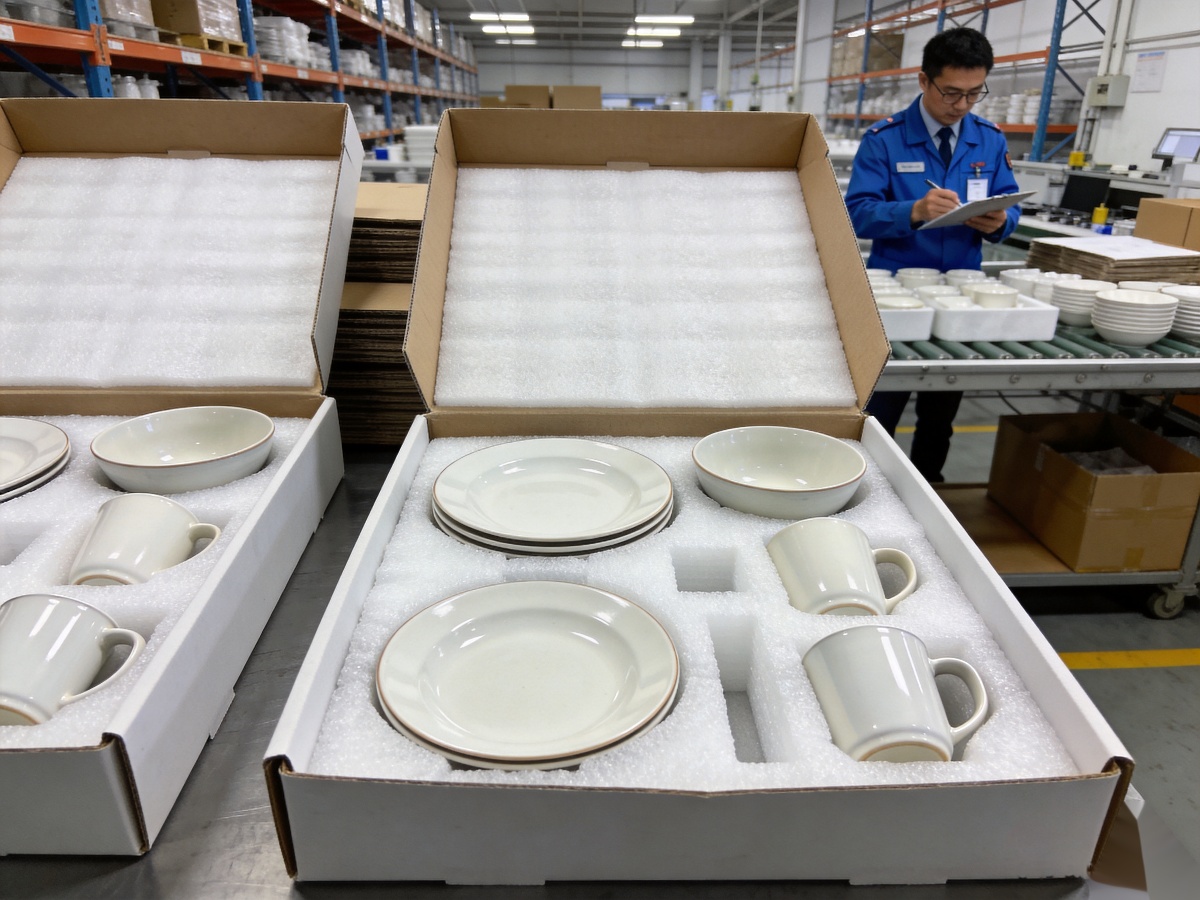
Export packaging materials — custom boxes, foam inserts, pallets — also have their own minimums from packaging suppliers. These upstream requirements cascade into the ceramic MOQ that manufacturers quote to buyers.

Ceramic MOQ Negotiation: 5 Strategies That Work
Negotiating ceramic MOQ is both an art and a science. Here are five battle-tested strategies that experienced B2B buyers use to secure more favorable terms:
1. Start with Stock Items to Build Trust
If you are a new buyer, start by ordering from the manufacturer’s existing catalog. Stock items have lower ceramic MOQ because the molds, glazes, and packaging are already set up. A successful first order at a modest volume builds trust and gives you leverage for future negotiations on custom items.
2. Commit to Annual Volume with Staggered Deliveries
Instead of negotiating each order independently, propose an annual purchasing agreement. For example, commit to 20,000 pieces per year but request delivery in four shipments of 5,000 pieces each. This approach gives the factory volume certainty while keeping your per-shipment ceramic MOQ manageable.
3. Offer to Pay a Surcharge for Smaller Batches
Manufacturers care about profitability per production run. If you need a lower ceramic MOQ, offer to pay a 10–15% surcharge to cover the factory’s fixed costs. This is often cheaper than holding excess inventory and paying storage fees. Many manufacturers will accept 50–70% of their standard MOQ with a reasonable surcharge.
4. Consolidate Multiple SKUs into One Production Run
If you need 1,000 dinner plates, 1,000 salad plates, and 1,000 bowls — all in the same glaze — propose combining them into a single 3,000-piece order that meets the factory’s kiln capacity. The ceramic MOQ per SKU drops dramatically when items share the same glaze and firing cycle.
5. Time Your Orders During Off-Peak Seasons
Ceramic factories in China experience seasonal demand fluctuations. During slower periods — typically February to April and August to September — kilns run below capacity. Manufacturers are more willing to accept lower ceramic MOQ during these windows because any production is better than idle kilns. Check our sourcing guides for a detailed seasonal sourcing calendar.
Ceramic MOQ for Small vs Large Buyers: A Practical Comparison
Your purchasing volume fundamentally changes how you should approach ceramic MOQ. Here is a practical framework for both buyer profiles:
Small Buyers (Under 5,000 Pieces per Order)
- Stick to stock items — Choose from existing molds and glazes to access the lowest ceramic MOQ
- Use trading companies — They consolidate orders from multiple buyers to meet factory minimums
- Focus on 2–3 SKUs — Spreading volume across too many items means none meets the ceramic MOQ threshold
- Negotiate trial orders — Most factories will accept a one-time trial at 50–70% of standard MOQ for first-time buyers
Large Buyers (Over 10,000 Pieces per Order)
- Demand custom designs — Your volume justifies dedicated molds and exclusive glazes at standard ceramic MOQ
- Negotiate tiered pricing — Request price breaks at 10K, 20K, and 50K piece thresholds
- Secure production priority — Large orders should come with guaranteed kiln scheduling and delivery dates
- Request exclusive molds — At sufficient volume, negotiate mold ownership so competitors cannot use your designs
How to Reduce Risk When Ordering Below Ceramic MOQ
Sometimes market conditions require you to order below the standard ceramic MOQ. Here is how to manage the associated risks:
- Use a sourcing agent — Professional agents maintain relationships with multiple factories and can combine your order with other buyers to meet minimum thresholds
- Accept higher per-unit costs — Paying 10–20% more per piece is often better than ordering excess inventory that ties up capital and may not sell
- Choose versatile designs — When ordering small quantities, select neutral colors and classic shapes that appeal to the broadest customer base
- Plan for reorder — Negotiate a two-phase order: a small initial batch for market testing, with a pre-agreed reorder at standard ceramic MOQ if sales targets are met
- Verify quality rigorously — Smaller orders leave less room for defects. Implement a thorough inspection process to ensure every piece meets your standards
Ceramic MOQ FAQ: Answers to Common Buyer Questions
What is the typical ceramic MOQ for stock tableware items?
For stock items that are already in the manufacturer’s catalog with existing molds and glazes, ceramic MOQ typically ranges from 500 to 1,000 pieces per SKU. Some factories with large inventories may accept orders as low as 200 pieces for popular items.
Can I mix different products to meet the ceramic MOQ?
Yes, in most cases. If the products share the same glaze color and can be fired in the same kiln cycle, manufacturers will usually allow you to combine SKUs to meet the ceramic MOQ. For example, you might order 1,000 dinner plates + 1,000 bowls + 1,000 mugs in the same white glaze to meet a 3,000-piece minimum.
Does ceramic MOQ change based on customization level?
Absolutely. Stock items have the lowest ceramic MOQ (500–1,000 pieces). Adding a custom logo increases it to 1,000–2,000 pieces. Fully custom shapes with exclusive glazes typically require 3,000–5,000 pieces minimum. The more customization you request, the higher the ceramic MOQ will be.
How can I verify that a factory’s stated ceramic MOQ is legitimate?
Ask the factory to explain their MOQ calculation. A transparent manufacturer will reference kiln capacity, mold costs, or glaze batch sizes. If they cannot explain the reasoning, the number may be negotiable. You can also cross-reference by requesting quotes from multiple factories — significant variation suggests at least one is using an inflated MOQ as a pricing strategy.
Is ceramic MOQ different for different types of ceramics?
Yes. Stoneware, porcelain, and bone china have different production processes and kiln requirements. Bone china typically has higher ceramic MOQ because it requires more precise temperature control and specialized kilns. Porcelain falls in the middle, while stoneware often has the most flexible MOQ due to simpler production processes and wider availability of standard molds.
Ready to Optimize Your Ceramic MOQ Strategy?
Whether you are placing your first trial order or scaling to container loads, getting the right ceramic MOQ terms is essential for profitable sourcing. At CeraSupply, we work with buyers at every stage — from startups testing new markets to established distributors managing complex multi-SKU orders.
Our team can help you navigate MOQ negotiations, identify the best manufacturers for your volume level, and structure orders that minimize risk while maximizing value. Contact us today for a free consultation and discover how flexible MOQ terms can accelerate your ceramic tableware business.