Ghost kitchen ceramic tableware is the most cost-effective dinnerware choice for virtual restaurants that wash and reuse plates across multiple brands under one roof. Unlike traditional restaurants, ghost kitchens face extreme dishwashing cycles, rapid thermal shifts, and the need for photo-ready presentation on delivery apps — all while operating on margins below 15 percent. This guide breaks down what operators actually need from their ceramic supplier, how to compare true cost-per-use against disposables, and the specific durability and design specs that keep a cloud kitchen running without constant reordering.
Why Ghost Kitchens Need a Different Tableware Strategy
Most ghost kitchens share a single prep and dishwashing station across three to six virtual brands. A plate might serve pad thai at noon, transition to a grain bowl by 2 p.m., and handle pasta by dinner. That means the same piece of ceramic endures:
- Temperature shocks from 180°F food to refrigerated staging within minutes
- Industrial conveyor dishwashers running 12 to 16 hours daily
- Stacking pressure in tight storage because square footage costs more than in suburban dining rooms
- Photography demands — every dish needs to look sharp on DoorDash, Uber Eats, and proprietary apps
Standard restaurant-grade ceramic often fails here. The glazing on budget hotelware crazes after six months of conveyor washing. Thin-rimmed porcelain chips when kitchen staff stack plates ten high in a rush. And matte finishes absorb grease stains that show up in every delivery photo.
What ghost kitchens need is a ceramic spec designed for abuse: thicker bodies, commercial-grade glazes, and rim profiles that resist chipping under stack pressure. The good news is that factories in Chaozhou and Dehua already produce this grade for European foodservice chains — you just need to know what to ask for.
Ceramic vs. Disposable vs. Melamine: Cost-Per-Use Breakdown
Most ghost kitchen operators start with disposables or melamine because the upfront cost is low. But the math changes when you factor in volume, waste removal fees, and replacement cycles. Below is a realistic cost-per-use comparison for a mid-size ghost kitchen processing 800 covers daily across four brands.
| Material | Unit Cost (FOB) | Lifespan (Cycles) | Cost Per Use | Annual Replacement Rate | Waste / Disposal Cost |
|---|---|---|---|---|---|
| Commercial Ceramic | $2.80 – $4.50 | 2,500 – 4,000 | $0.001 – $0.002 | 8 – 12% | None |
| Melamine | $1.20 – $2.00 | 800 – 1,200 | $0.001 – $0.003 | 25 – 35% | Landfill (non-recyclable) |
| Disposable (Bagasse) | $0.15 – $0.25 | 1 | $0.15 – $0.25 | 100% | $0.03 – $0.05 per unit |
| Disposable (PP/Plastic) | $0.08 – $0.12 | 1 | $0.08 – $0.12 | 100% | $0.02 – $0.04 per unit |
At 800 covers daily, ceramic pays back against bagasse within 45 to 60 days. Against melamine, the break-even is longer — roughly 120 to 150 days — but ceramic offers better food presentation, does not retain odors, and withstands oven reheating up to 250°C. For operators running brands that emphasize quality perception on delivery apps, ceramic is the only option that does not downgrade the visual experience.
The hidden cost most operators miss is storage and handling. A melamine plate scratches visibly after 200 cycles, meaning you need a par level of 1.5x your daily volume to cover defects. Ceramic holds its surface longer, so your par level drops to 1.2x — freeing cash and shelf space.
Key Durability Requirements for High-Turnover Operations
Not all ceramic survives a ghost kitchen. These are the specifications we validate before recommending a factory batch to any delivery-only operator.
Body Thickness and Weight
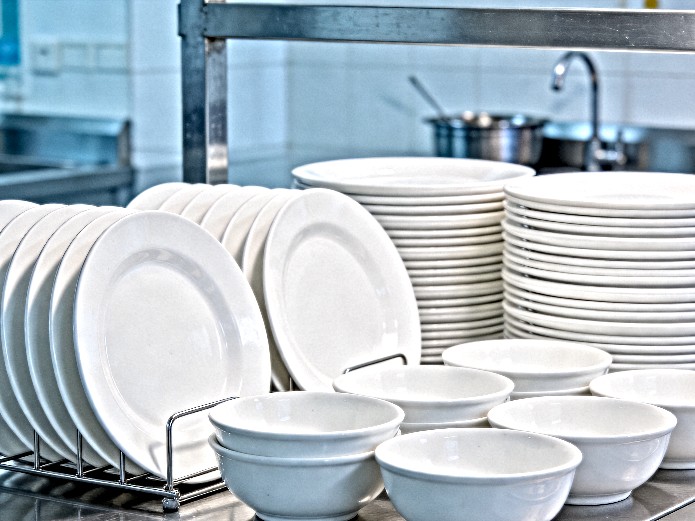
Dinner plates should weigh 650 to 900 grams. Anything below 550g chips at the rim under stack pressure. Soup bowls need 500 to 700 grams. Lighter pieces feel cheap to customers and warp under industrial dishwasher heat.
Glaze Hardness (Mohs Scale)
Demand a glaze hardness of 5.5 to 6.5 on the Mohs scale. Softer glazes scratch from metal utensils within three months. Harder glazes resist utensil marks and maintain their gloss through 2,000+ wash cycles. Ask your supplier for a glaze hardness test report — most reputable factories in Chaozhou can produce this on request. [CERTIFICATE REQUIRED]
Thermal Shock Resistance
Ghost kitchens move hot food directly from 180°F holding cabinets to cold staging. Ceramic rated for 150°C thermal shock (ASTM C1525 method) handles this without cracking. Standard household ceramic is only rated to 80°C — it will fail within weeks. [VERIFY BEFORE PUBLISHING: ASTM C1525 thermal shock testing standards]
Conveyor Dishwasher Compatibility
Specify dishwasher-safe ceramic tested at 82°C water temperature with alkaline detergent (pH 11–12) for 90-second cycles. Gold-rimmed or hand-painted decoration will degrade in this environment. Stick to underglaze or high-fire decal finishes.
Design Considerations for Delivery Presentation
In a ghost kitchen, the plate is not just a serving vessel — it is a prop for food photography that drives app conversions. The design choices below directly affect how your dishes look on a phone screen.
Color and Contrast
White or off-white bodies with a slight cream tone photograph best against colorful food. Matte white absorbs light and makes food look flat. Glossy pure white reflects too much, creating blown-out highlights. A satin or reactive glaze in warm ivory gives depth without glare.
Rim Profile
Wide-rimmed plates (2.5 to 3.5 cm rim width) frame food for overhead photography — the dominant angle on delivery apps. Plates with a defined rim lip also contain sauces better during transport from kitchen to photo station to packaging area.
Stackability
Choose plates with flat bases and minimal foot rings. Foot rings create unstable stacks and trap water in dishwashers. A flat base lets you stack 15 to 20 plates securely on a speed rack, which matters when four brands are pulling from the same dish pit.
MOQ, Lead Time, and Supplier Selection
For a ghost kitchen launching with three brands, your initial tableware investment typically runs 2,000 to 4,000 pieces. Here is what to expect from Chinese ceramic suppliers:
| Item Type | Typical MOQ | Sample Lead Time | Production Lead Time | Price Range (FOB) |
|---|---|---|---|---|
| Dinner Plate (10–11″) | 500 – 1,000 pcs | 10 – 14 days | 35 – 50 days | $2.80 – $4.20 |
| Salad Plate (7–8″) | 500 – 1,000 pcs | 10 – 14 days | 35 – 50 days | $1.80 – $3.00 |
| Soup Bowl (6–7″) | 500 – 1,000 pcs | 10 – 14 days | 35 – 50 days | $2.20 – $3.50 |
| Appetizer Plate (5–6″) | 1,000 – 2,000 pcs | 10 – 14 days | 30 – 45 days | $1.20 – $2.00 |
| Custom Glaze Color | 2,000 – 3,000 pcs | 14 – 21 days | 45 – 60 days | +$0.30 – $0.80 per piece |
Lead times assume you are working with a factory, not a trading company. If your supplier cannot show you kiln photos or glaze lab reports, you are likely talking to a middleman who adds 15 to 25 percent margin and stretches timelines by two weeks. For ghost kitchens that need to hit a launch date, those two weeks determine whether you open on time.
When evaluating a supplier, ask these three questions specifically:
- “What is your defect rate after 2,000 wash cycles?” A serious supplier has this data. Vague answers mean they have never tested durability.
- “Can you match a Pantone glaze sample with underglaze color?” This confirms they do custom color work in-house, not outsourcing decoration.
- “What is your maximum daily kiln output for this item?” If their capacity is below 500 pieces per day and you need 3,000 in six weeks, they will subcontract — and quality will vary.
Common Mistakes When Sourcing Ghost Kitchen Tableware
We have seen these errors repeatedly when advising cloud kitchen operators. Avoiding them saves both money and launch delays.
Mistake 1: Buying Restaurant-Grade Ceramic Without Checking Dishwasher Specs
Restaurant-grade and dishwasher-safe are not the same. A plate that survives hand washing in a fine-dining kitchen may craze or discolor in a 90-second conveyor cycle. Always request dishwasher compatibility data specifically for high-alkaline, high-temperature cycles — not just a generic “dishwasher safe” claim.
Mistake 2: Ordering Exact Quantities Without a Par Level Buffer
Ghost kitchens run multiple shifts with shared dishwashing. If your dishwasher breaks or a rush hits, you need backup stock. Order 1.25x your calculated daily need, not 1.0x. That 25 percent buffer prevents service shutdowns and covers the natural 8 to 12 percent annual breakage rate.
Mistake 3: Ignoring Packaging Compatibility
Your ceramic must fit inside your delivery containers. A 10.5-inch plate that looks beautiful in the kitchen is useless if it does not slide cleanly into a 10-inch clamshell. Measure your primary packaging first, then spec plate diameters 0.5 to 1 inch smaller. Also verify that plate height does not interfere with lid closure — a raised rim or deep well can crack container seals and cause leaks.
Ghost Kitchen Ceramic Tableware Checklist
Use this checklist when evaluating samples or negotiating your first order. Print it or save it — it covers the specs that separate usable ceramic from kitchen liabilities.
- [ ] Plate weight: 650–900g for dinner, 500–700g for bowls
- [ ] Glaze hardness: 5.5–6.5 Mohs (request test report)
- [ ] Thermal shock rating: 150°C minimum (ASTM C1525)
- [ ] Dishwasher safe at 82°C, alkaline detergent pH 11–12
- [ ] No gold rim, no hand-painted decoration (underglaze only)
- [ ] Flat base for stable stacking (15–20 pieces)
- [ ] Wide rim (2.5–3.5 cm) for food photography framing
- [ ] Plate diameter 0.5–1″ smaller than delivery container
- [ ] Warm ivory or cream tone glaze (not pure white or dark matte)
- [ ] MOQ under 1,000 per item for initial order
- [ ] Production lead time under 50 days
- [ ] Defect rate data available for post-2,000-cycle wear
- [ ] Supplier can show kiln photos and daily output capacity
- [ ] Pricing includes FOB, not just EXW
[FACTORY PHOTO REQUIRED: Kiln interior and glaze testing lab photos]
FAQ
Can I use the same ceramic across multiple virtual brands?
Yes, if you choose neutral colors and simple shapes. A cream-colored plate with a subtle rim works for an Italian brand at lunch and a Mediterranean brand at dinner. Avoid branded patterns or logo imprints unless each brand has its own dedicated dish stock.
How long does ceramic last in a ghost kitchen?
With proper commercial-grade specs, ceramic lasts 2,500 to 4,000 wash cycles — roughly 18 to 30 months at 800 covers daily. Melamine under the same conditions lasts 8 to 12 months. Your replacement cycle depends more on handling than material.
Is custom glaze color worth the extra cost for a ghost kitchen?
Only if brand differentiation is part of your strategy. For undifferentiated delivery brands competing on price, neutral ceramic is more cost-effective. For premium virtual brands with repeat customers who photograph their meals, a signature glaze color adds memorability and justifies the $0.30–$0.80 per piece premium.
What is the minimum viable order for a single-location ghost kitchen?
A single-location ghost kitchen running two to three brands needs approximately 1,500 to 2,500 pieces. At standard MOQs of 500 per item, you can cover dinner plates, salad plates, and soup bowls in one order. Plan for a second reorder at month six once you know your actual breakage rate.
Should I source ceramic from the same factory that makes my packaging?
No. Ceramic and food packaging require completely different manufacturing processes and compliance standards. A factory that excels at thermoformed clamshells will not have glaze labs or kilns. Keep your supply chains separate and coordinate diameters during the design phase.
Do I need FDA or LFGB certification for ghost kitchen tableware?
If you operate in the United States, FDA compliance for food contact is required. For EU or UK markets, LFGB and Regulation (EC) No 1935/2004 apply. [VERIFY BEFORE PUBLISHING: FDA 21 CFR 175.300 for ceramic coatings; EU Regulation 1935/2004 for food contact materials]. Certifications should come from accredited third-party labs — factory self-declarations are not sufficient for commercial foodservice operations.
If you are planning a ghost kitchen launch and need specific MOQs by product category — dinner plates, bowls, and serving pieces — contact our team for a production schedule that matches your opening date.