Fast Casual Ceramic Tableware: How Chain Restaurants Source Durable, Brand-Consistent Dinnerware at Scale
Fast casual ceramic tableware faces a brutal reality: plates and bowls in high-turnover chains must survive 500 or more dishwasher cycles per year while maintaining a consistent brand look across dozens of locations. Unlike full-service restaurants where presentation drives the buying decision, fast-casual procurement prioritizes three factors in this order — durability, cost-per-use, and brand consistency. After managing ceramic sourcing for multiple U.S. and European chain rollouts, I have seen the same pattern repeat: a buyer selects tableware based on sample appearance and unit price, then faces 15-25% annual replacement rates when the pieces hit the dishroom. The fix is not buying thicker plates. It is understanding what “commercial-grade” actually measures, how to align material selection with your operational model, and how to structure supplier agreements that protect consistency across reorders. This guide walks through the evaluation criteria, decision frameworks, and contract terms that keep fast-casual ceramic programs profitable.
What Makes Fast Casual Ceramic Tableware Different from Full-Service Ware
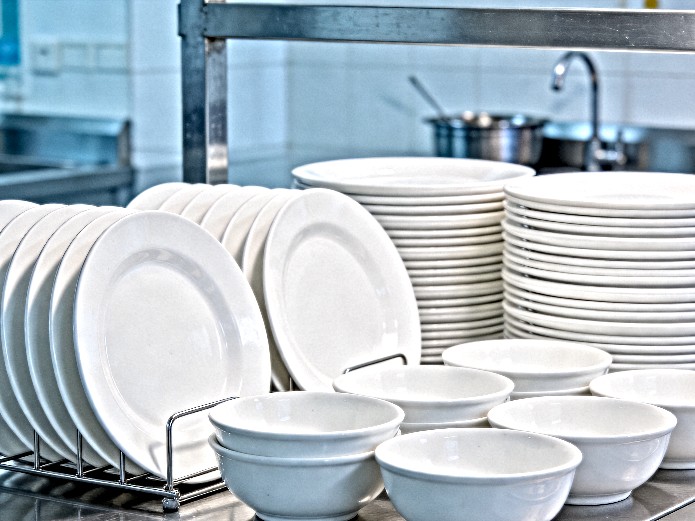
Full-service restaurants replace broken pieces as needed — often from a small inventory reserve kept on-site. Fast-casual chains operate differently. A 50-location brand running lunch and dinner rushes may cycle the same plate through service, bussing, and commercial dishwashing four to six times per day. That plate sees more mechanical stress in six months than a fine-dining equivalent sees in three years.
The procurement math also differs. A full-service buyer might budget $8-12 per cover and replace items individually. A fast-casual buyer typically budgets $3-6 per cover but must purchase in quantities that support consistent replacement across the entire chain. When a SKU is discontinued or a glaze shade shifts between production runs, the buyer faces a choice: mix mismatched tableware across locations, or replace the entire program early.
Three operational factors define fast-casual ceramic requirements:
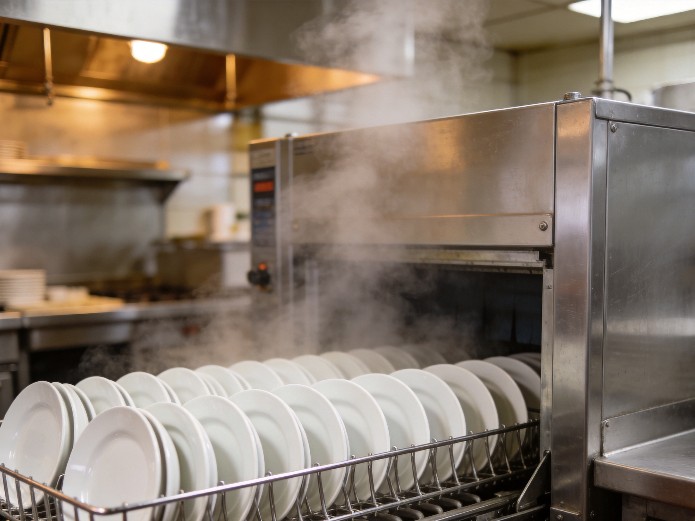
- Dishwasher intensity: Commercial conveyor dishwashers use higher temperatures (82-85C rinse) and stronger alkaline detergents than residential units. Not all ceramic glazes tolerate this without micro-crazing or dulling.
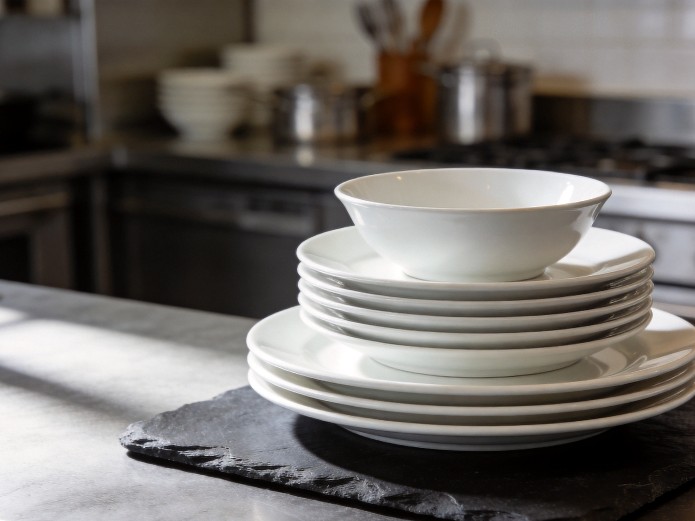
- Stacking density: Storage space behind the counter is limited. Bowls and plates must stack efficiently without chipping edges.
- Brand recognition: Customers expect the same plate shape, color, and weight in Location 1 and Location 50. Any visible variation signals inconsistency.
Durability Standards: What “Commercial-Grade” Actually Means for High-Turnover Chains
“Commercial-grade” is not a regulated term in the ceramic industry. Any supplier can print it on a spec sheet. What matters are the specific tests and performance thresholds the piece meets.
For fast-casual environments, focus on these four durability indicators:
Edge Chip Resistance (ASTM C368 or EN 12875-1)
This test measures how well a plate or bowl withstands edge impacts. A score of “no chip” after 50 impacts is the baseline for commercial use. For fast-casual chains, ask for test data showing performance at 100+ impacts. Pieces that chip at 30 impacts will not survive a year in your dishroom.
Thermal Shock Resistance
Plates move from hot holding cabinets to cold salad prep lines to hot dishwashers. A piece rated for 150C temperature differential is adequate for most kitchens. If your operation uses rapid temperature swings (e.g., pulled from freezer to oven), specify 200C+ rated vitrified ceramic.
Glaze Hardness (Mohs Scale)
Glaze hardness determines scratch resistance. A Mohs rating of 5+ is standard for restaurant ware. Ratings below 4 will show utensil marks within weeks of service. Ask your supplier for the glaze Mohs rating — not just the body rating.
Dishwasher Cycle Endurance
This is where most generic “commercial-grade” claims fail. A piece that looks perfect after 50 dishwasher cycles may show glaze degradation after 200. For fast-casual use, request documentation showing 500+ cycle testing with no visible glaze change, no edge chipping, and no body staining.
[VERIFY BEFORE PUBLISHING: Specific ASTM and EN test methods referenced above should be cross-checked against current standard editions at astm.org and cen.eu.]
Material Choices for Fast Casual: Porcelain, Stoneware, or Vitrified Ceramic?
Material selection drives cost, weight, durability, and appearance. Here is how the three primary options compare for fast-casual use:
Porcelain
- Body: Fine, white, translucent at thin edges
- Weight: Lightest of the three options
- Durability: Good chip resistance if fully vitrified; poor if low-fired
- Cost: Highest per piece ($4-8 for standard dinner plates)
- Best for: Brands emphasizing premium perception, lighter tableware for counter carry
- Risk: Low-fired porcelain absorbs water over time, leading to thermal shock failure and dishwasher staining. Always verify water absorption <0.5%.
Stoneware
- Body: Heavier, opaque, earthy tones
- Weight: Heaviest option
- Durability: Excellent chip and impact resistance due to thicker body
- Cost: Mid-range ($3-6 per standard dinner plate)
- Best for: Rustic or heritage-positioned brands, high-abuse environments
- Risk: Darker stoneware bodies can make food presentation less vibrant. Weight may increase server fatigue during peak hours.
Vitrified Ceramic (Fully Vitrified Porcelain or Stoneware)
- Body: Non-porous, fired above 1200C
- Weight: Comparable to porcelain
- Durability: Highest — vitrification eliminates water absorption, the primary cause of dishwasher degradation
- Cost: Mid-to-high ($4-7 per standard dinner plate)
- Best for: Chains prioritizing longevity over lowest first cost
- Risk: Higher MOQ from factories that produce vitrified ware, typically 2,000-5,000 pieces per SKU vs. 500-1,000 for standard stoneware.
Brand Consistency Challenges When Sourcing for Multiple Locations
The biggest hidden cost in chain ceramic programs is inconsistency. A bowl ordered in March and a replacement bowl ordered in November may look identical on the spec sheet but show visible differences in glaze shade, rim thickness, or weight. Customers notice.
Maintain consistency across reorders with these supplier controls:
1. Master Sample Protocol
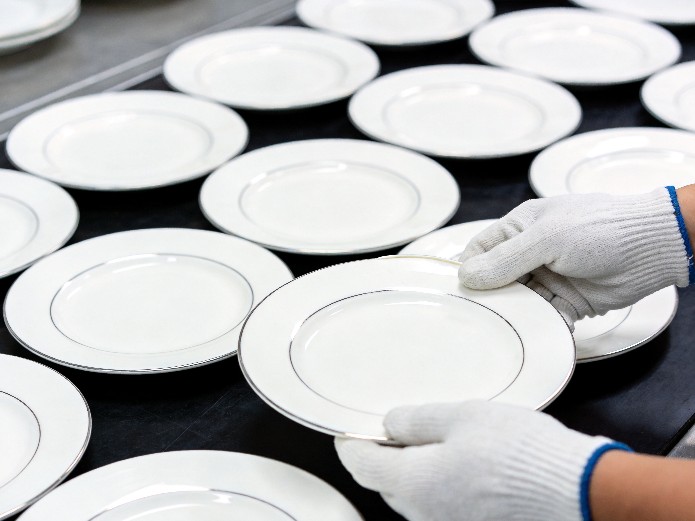
Before placing the first order, retain three sealed master samples: one for your quality team, one for the supplier’s production reference, and one for third-party inspection. Every subsequent production run is compared against the master sample under standardized lighting (D65 daylight simulator, 6500K).
2. Glaze Batch Control
Ceramic glazes are mixed in batches. Slight variations in raw material sources, milling time, or firing curve create shade differences. Require your supplier to: use the same glaze batch number for all pieces in a single chain rollout; provide glaze batch records with each shipment; notify you before switching glaze suppliers or reformulating.
3. Dimensional Tolerance Specifications
Specify acceptable tolerances: +/- 2mm on diameter, +/- 3% on weight, +/- 1mm on height. A plate that is 2mm wider will not stack correctly with the rest of your inventory.
4. Production Run Photographic Records
Request pre-shipment photos from the actual production batch, not catalog images. Compare against your master sample before authorizing shipment.
Cost-per-Use Analysis: Why the Cheapest Option Often Costs More
Fast-casual buyers often fixate on unit price. The smarter metric is cost-per-use: the purchase price divided by the number of service cycles before replacement.
Consider two dinner plate options for a 50-location chain:
| Factor | Economy Stoneware | Vitrified Ceramic |
|---|---|---|
| Unit Price (FOB) | $3.20 | $5.80 |
| Estimated Service Life | 18 months | 48 months |
| Annual Replacement Rate | 25% | 8% |
| Annual Replacement Cost (per 1,000 pcs) | $800 | $464 |
| 3-Year Total Cost (per 1,000 pcs) | $2,960 | $1,856 |
| Dishwasher Detergent Impact | Moderate glaze dulling after 12 months | Minimal change at 36 months |
| Stackability | Good | Excellent |
[INTERNAL DATA REQUIRED: The unit prices and replacement rates above are illustrative estimates based on typical market ranges. Replace with actual supplier quotes and historical replacement data from your program before using in commercial presentations.]
The vitrified option costs 81% more per piece upfront but delivers 37% lower total cost over three years. More importantly, it reduces the operational headache of managing replacement inventory across 50 locations.
Fast Casual Ceramic Tableware Sourcing Decision Matrix
Use this matrix to align material and supplier selection with your operational priorities:
| Your Priority | Best Material | Key Specification | Typical MOQ | Lead Time |
|---|---|---|---|---|
| Lowest first cost | Standard stoneware | Water absorption <3%, chip-resistant edge | 500-1,000 pcs/SKU | 45-60 days |
| Maximum durability | Fully vitrified porcelain | Water absorption <0.5%, 500+ dishwasher cycles | 2,000-5,000 pcs/SKU | 60-75 days |
| Lightest weight | High-fired porcelain | Body weight <280g for 10-inch plate | 1,000-2,000 pcs/SKU | 50-65 days |
| Custom color matching | Vitrified stoneware or porcelain | Pantone tolerances, batch consistency protocol | 3,000+ pcs/SKU | 75-90 days |
| Fastest delivery | Off-the-shelf stoneware | Standard white or ivory glaze, no customization | 200-500 pcs/SKU | 30-45 days |
Pre-Order Evaluation Checklist for Chain Procurement
Before committing to a supplier for a multi-location rollout, verify each item below:
Physical Testing
- Edge chip resistance test passed at 100+ impacts
- Thermal shock test: no cracks after 150C water quench
- Glaze hardness: Mohs 5+ confirmed
- Water absorption: <0.5% for vitrified, <3% for stoneware
- Stackability test: 20 pieces stack without wobble or edge contact
- Weight consistency: all samples within +/- 3% of target
Supplier Capability
- Factory audit completed within past 12 months
- Production capacity confirmed for your volume + 30% buffer
- Glaze batch control system documented
- Master sample retention policy in place
- Third-party inspection agreement signed (SGS, Bureau Veritas, or equivalent)
- Defect rate history provided for past 4 quarters
Contract Terms
- Price locked for 12 months or 2 reorder cycles
- Shade tolerance specified in contract (Delta E <1.5 or visual match to master)
- Replacement policy for defectives within 90 days of receipt
- Discontinuation notice: minimum 6 months advance notice
- Packaging specification approved for your freight method
MOQ, Lead Time, and Production Planning for Chain Rollouts
Fast-casual chain rollouts require production planning that balances inventory cost against stockout risk. Here are the typical parameters:
MOQ Structures
- Standard off-the-shelf designs: 500-1,000 pieces per SKU
- Custom glaze colors: 2,000-3,000 pieces per SKU
- Custom shapes or molded designs: 3,000-5,000 pieces per SKU
- Logo decal application: 1,000-2,000 pieces per SKU
Lead Time Breakdown
- Sample development and approval: 2-4 weeks
- First production run: 6-10 weeks
- Reorder production: 5-8 weeks
- Sea freight (China to U.S. West Coast): 3-4 weeks
- Customs clearance and inland delivery: 1-2 weeks
Planning Recommendation
For a 50-location rollout with 200 covers per location, order the full initial quantity plus a 15% replacement buffer. Schedule the first reorder when inventory at the central warehouse drops to 25% of the buffer level. This typically means placing reorders every 8-10 months for vitrified ware, every 4-6 months for standard stoneware.
Need a production schedule for your chain rollout? Get a production schedule estimate for your chain rollout and we will map lead times against your opening timeline.
Three Mistakes Chain Buyers Make When Sourcing Ceramic Tableware
Mistake 1: Evaluating Samples Without Dishwasher Testing
A plate that looks perfect on a conference table may degrade rapidly in a commercial dishwasher. Always run samples through at least 50 commercial dishwasher cycles before approving a supplier. Look for glaze dulling, edge micro-chipping, and body staining.
Mistake 2: Ignoring Stack Height and Storage Footprint
A bowl with a wide rim may look elegant but stack poorly, consuming 40% more shelf space than a straight-sided alternative. In a fast-casual back-of-house where every square foot matters, stack efficiency directly impacts labor costs.
Mistake 3: Ordering Exact Quantities Without Replacement Buffers
A chain that needs 10,000 plates orders exactly 10,000. Six months later, breakage and loss have consumed 8% of inventory, and the minimum reorder quantity is 2,000 pieces. Now the buyer has 1,200 surplus plates and a storage problem. Order the initial quantity plus a 15-20% replacement buffer stored at the central warehouse.
Frequently Asked Questions
How long should fast casual ceramic tableware last before replacement?
Vitrified ceramic should last 3-4 years in normal fast-casual use. Standard stoneware typically lasts 18-24 months. If your replacement rate exceeds 15% annually, your material specification or dishwasher settings need review.
Can I mix porcelain and stoneware across different locations?
Technically yes, but visually customers will notice weight and appearance differences. For brand consistency, use the same material family across all locations. If cost forces a split, use the premium material in flagship locations and the standard material in secondary markets — but never mix within the same location.
What is the minimum viable order for a 10-location fast-casual chain?
Assuming 150 covers per location, plan for 1,500 pieces per SKU for the initial rollout, plus a 15% buffer (225 pieces). Most factories accept 1,000-piece MOQs for standard designs, so a 1,725-piece order is viable. For custom colors or shapes, you may need to consolidate SKUs or accept higher per-unit costs at lower volumes.
How do I prevent glaze shade variation between orders?
Require the supplier to use glaze batch records, retain master samples, and specify Delta E <1.5 in your contract. Schedule orders so that each production run uses the same glaze batch. If your volume requires multiple batches per year, increase shade tolerance to Delta E <2.0 and accept minor variation.
Should I source directly from the factory or use a trading company?
For orders above $30,000 annually, factory-direct typically saves 12-18% and gives better control over production scheduling. Trading companies add value for smaller orders, multi-factory coordination, or buyers who need local QC representation. Evaluate based on your order size and your team’s ability to manage overseas production directly.
What packaging protects ceramic best for container shipping?
Corrugated dividers between pieces, double-wall outer cartons, and palletized loads with corner boards. Individual bubble wrap is unnecessary and increases freight cost. Specify carton gross weight under 18 kg to comply with most warehouse handling limits. [FACTORY PHOTO REQUIRED: Approved packaging specification photo.]
Ready to Source Fast Casual Ceramic Tableware for Your Chain?
Choosing the right ceramic tableware for a fast-casual chain is not about finding the lowest price — it is about matching material specifications to your operational reality. Start with a durability baseline, build in brand consistency controls, and structure supplier agreements that protect you across reorders.
Get a production schedule estimate for your chain rollout and we will align material recommendations, MOQ structures, and delivery timelines with your expansion plan.