Ceramic tea sets for restaurants require different specifications than the decorative pieces sold in gift shops. A restaurant-grade set must survive commercial dishwashers, resist thermal shock from boiling water, and maintain consistent appearance across hundreds of units. Whether you run a tea house, a dim sum restaurant, or a fine dining concept with a curated tea program, the sourcing decisions you make on material, style, and supplier will directly affect your operating costs and guest experience. This guide breaks down what procurement managers actually need to evaluate when sourcing ceramic tea sets for restaurants — from gongfu service setups to Western-style tea pots — with specific MOQs, lead times, and quality checkpoints you can use on your next factory visit.
What Separates Restaurant-Grade Ceramic Tea Sets from Retail Pieces
The tea sets you see in home decor stores are designed for occasional use, hand washing, and visual appeal. Restaurant-grade ceramic tea sets are engineered for the opposite priorities: durability, consistency, and operational efficiency.
Retail tea sets often use thinner walls, delicate handles, and decorative glazes that chip under thermal stress. Commercial sets use thicker porcelain or stoneware bodies, reinforced handles, and glazes formulated for dishwasher cycles. The difference shows up in your P&L: a retail-quality teapot might last three months in a busy restaurant. A commercial-grade piece should last two to three years with normal use.
Three structural differences matter most:
- Wall thickness: Restaurant teapots typically use 4-6mm walls versus 2-3mm for retail. Thicker walls retain heat longer and resist impact.
- Handle attachment: Commercial pieces use integrated or bolted handles rather than glued attachments. Glued handles fail under repeated thermal cycling.
- Glaze durability: Commercial glazes are tested for alkali resistance (dishwasher detergent) and thermal shock. Retail glazes prioritize visual effects over functional durability.
When evaluating samples, fill the teapot with boiling water, let it sit for five minutes, then transfer it to a cold water bath. A retail piece may crack. A restaurant-grade piece should survive this test repeatedly.
Gongfu Service vs Western Tea Service: Choosing the Right Format
Your tea service format determines every component in your order. The two dominant formats require completely different equipment, workflows, and staff training.
| Factor | Gongfu Tea Service | Western Tea Service |
|---|---|---|
| Teapot size | 100-200ml (individual) | 400-800ml (shared) |
| Tea-to-water ratio | High (7-10g per 150ml) | Low (2-3g per 250ml) |
| Serving style | Multiple short infusions, server-led | Single long steep, guest-led |
| Table space per setting | Compact (tray-based) | Spread out (individual pot + cup) |
| Staff training required | Extensive (timing, pouring technique) | Minimal |
| Typical price per setting | $8-18 (premium positioning) | $4-8 (casual positioning) |
| Best fit | Tea houses, upscale Chinese restaurants, specialty cafes | Hotels, brunch spots, casual dining |
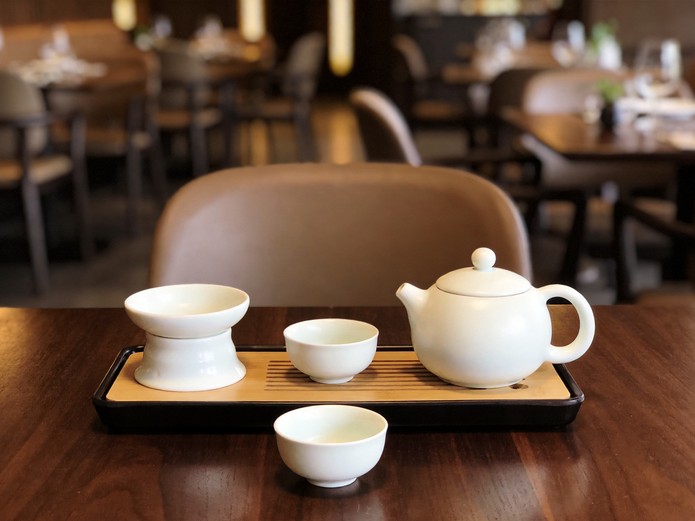
Gongfu service demands precision. You need fair cups (cha hai) for decanting, aroma cups for fragrance evaluation, and tasting cups sized for small sips. Western service prioritizes simplicity: a single teapot, a cup, and optionally a milk jug and sugar bowl.
The choice affects your supplier shortlist. Factories in Chaozhou and Dehua specialize in gongfu tea ware and understand the functional requirements of multiple small infusions. Western-style tea sets are more commonly produced in Jingdezhen and Liling, where factories have experience with larger-format hospitality ceramics.
The Core Components Every Restaurant Tea Set Needs
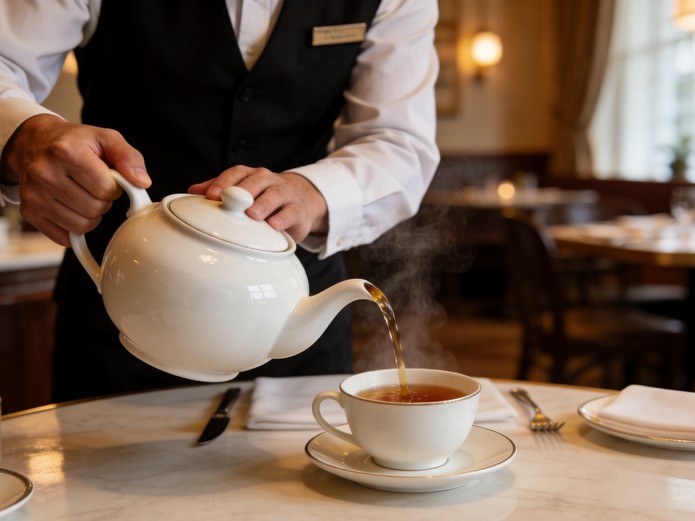
A complete restaurant tea service requires more than a teapot and a cup. Missing components create operational friction: servers scrambling for saucers, guests burning fingers, or tea cooling too fast.
For gongfu service:
- Teapot or gaiwan (lidded bowl)
- Fair cup (cha hai) for decanting
- Aroma cups (tall, narrow)
- Tasting cups (small, wide)
- Tea tray with drainage
- Tea picks and tongs
- Waste water bowl
For Western service:
- Teapot (400-800ml)
- Cup and saucer set
- Milk jug or creamer
- Sugar bowl with lid
- Tea strainer (if using loose leaf)
Most restaurants source components separately rather than as pre-bundled sets. This lets you mix suppliers — buying teapots from a specialist and cups from a generalist — and replace individual pieces as they break.
Order at least 20% spare pieces for high-usage items (tasting cups, saucers). These are the pieces most likely to chip, and a missing saucer at a table of four looks unprofessional.
Material Breakdown: Porcelain, Stoneware, and Yixing Clay
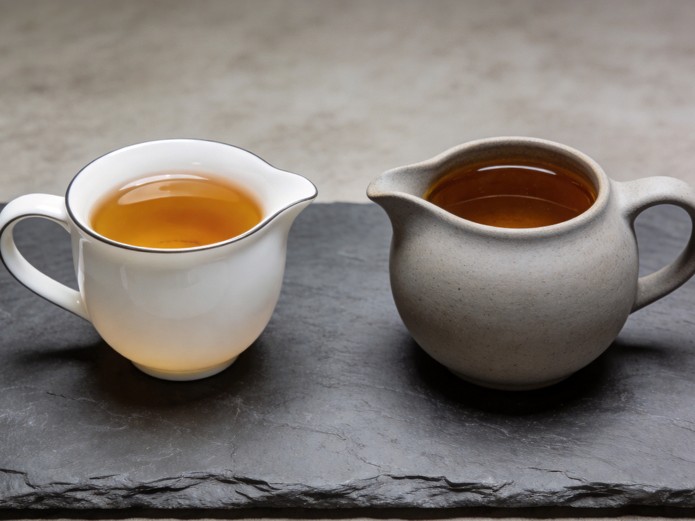
The material you choose affects heat retention, flavor neutrality, durability, and price. Here is how the three common options compare for commercial tea service.
Porcelain (recommended for most restaurants)
Porcelain is non-porous, flavor-neutral, and dishwasher-safe. High-fired porcelain (1280-1350°C) is dense and durable. It does not absorb tea oils, so you can serve green tea in the morning and black tea in the afternoon without flavor carryover.
Cost: $3.50-7.00 per complete gongfu setting; $5.00-12.00 per Western teapot.
Lead time: 45-60 days for standard designs.
Best for: Restaurants serving multiple tea types, high-volume service, dishwasher operations.
Stoneware
Stoneware is heavier and more chip-resistant than porcelain. It retains heat longer, which is useful for Western service where a teapot sits on the table for 20-30 minutes. Some stoneware glazes have a rustic aesthetic that fits farm-to-table or casual concepts.
Cost: $4.00-8.50 per complete gongfu setting; $6.00-14.00 per Western teapot.
Lead time: 45-60 days.
Best for: Casual concepts, outdoor dining, concepts where visual weight matters.
Yixing Clay (Zisha)
Yixing clay is porous and absorbs tea oils over time. In gongfu tradition, a Yixing teapot is dedicated to a single tea type. This creates flavor depth that porcelain cannot replicate. However, Yixing clay requires hand washing, cannot go in a dishwasher, and is significantly more expensive.
Cost: $15-50 per teapot (handmade); $8-20 per teapot (machine-pressed).
Lead time: 60-90 days.
Best for: High-end tea houses, concepts where tea is the central experience, private dining rooms.
Trade-off summary: Porcelain wins on operational efficiency. Stoneware wins on durability and heat retention. Yixing wins on flavor and prestige, but at a significant operational cost.
MOQ, Lead Time, and Pricing for Bulk Tea Set Orders
Understanding supplier pricing structures helps you negotiate from an informed position. Tea set pricing follows different logic than plate-and-bowl orders because of the component complexity.
Standard designs (existing molds):
- MOQ: 500-1000 pieces per component, or 200-500 complete sets
- Lead time: 45-60 days
- Sample cost: $50-150 per component (credited against first order at some suppliers)
Custom designs (new molds or glazes):
- MOQ: 2000+ pieces per component
- Mold development: $800-3000 per unique shape
- Lead time: 75-90 days (including mold creation and sample approval)
- Custom glaze matching: $200-500 per color for lab formulation
Pricing benchmarks (FOB China, porcelain, restaurant-grade):
- Gongfu teapot (150ml): $2.50-5.00
- Fair cup (200ml): $1.20-2.50
- Tasting cup (30ml): $0.40-0.80
- Western teapot (600ml): $4.00-8.00
- Cup and saucer set: $2.50-5.00
Most suppliers price by component, not by set. A “complete gongfu set” typically includes 1 teapot + 1 fair cup + 6 tasting cups + 1 tea tray, bringing the per-setting cost to $8-15 at factory price. Western service sets (1 teapot + 4 cups/saucers) run $12-25.
Packaging for tea sets requires individual foam sleeves for each piece, then master cartons with dividers. Expect packaging to add $0.50-1.50 per complete set. For international shipping, this matters: a poorly packed tea set shipment can see 5-10% breakage, wiping out your margin.
Three Common Mistakes Buyers Make When Sourcing Tea Sets
After reviewing hundreds of tea set orders, the same errors show up repeatedly. Avoiding these three mistakes will save you more money than any negotiation tactic.
Mistake 1: Ordering decorative tea sets meant for home use
Suppliers on Alibaba and trade shows often show beautiful tea sets with thin walls, delicate spouts, and hand-painted designs. These pieces photograph well but fail under commercial use. The teapot spout chips within weeks. The thin walls crack from thermal shock. Always confirm wall thickness, handle attachment method, and dishwasher compatibility before ordering. Ask for a written specification sheet, not just photos.
Mistake 2: Ignoring thermal shock resistance in teapots
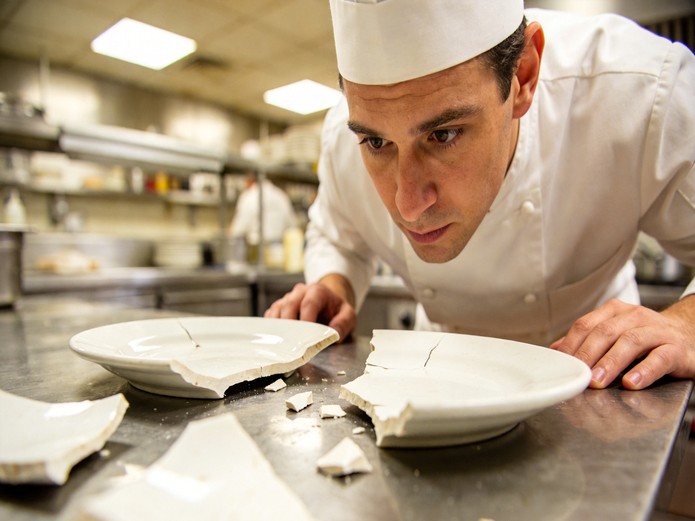
A teapot filled with boiling water and then placed on a cold metal tray will crack if the material or glaze is not thermal-shock rated. This is the most common failure mode in restaurant tea service. Request thermal shock test data: a restaurant-grade teapot should survive a 150°C temperature differential (boiling water to ice water) without cracking. [VERIFY BEFORE PUBLISHING: Confirm specific thermal shock standards for ceramic tea ware.]
Mistake 3: Underestimating the complexity of custom glazes on tea sets
Custom glaze colors on tea sets are harder to match than on plates because of the complex curves (spouts, handles, lids). Color consistency across a teapot body, lid, and matching cups requires tight kiln temperature control. If your brand requires a specific Pantone match, budget for 2-3 sample rounds and expect 20-30% higher rejection rates on the first production batch compared to standard glaze orders.
Pre-Production Quality Checklist for Ceramic Tea Sets
Use this checklist during sample evaluation and pre-shipment inspection. Each item has a pass/fail criterion you can verify without laboratory equipment.
Physical inspection:
- Wall thickness measured at 3+ points: minimum 4mm for teapots, 3mm for cups
- Handle attachment: no visible glue lines, no wobble when filled with water
- Lid fit: sits flush, does not rattle when pot is tilted 45 degrees
- Spout alignment: pours in a clean stream without dripping down the body
- Foot ring: flat, no wobble on a level surface
- Glaze coverage: complete, no bare spots on interior or exterior
Functional testing:
- Boiling water test: fill with 100°C water, let stand 5 minutes, no cracks or crazing
- Thermal shock test: boiling water to cold water bath (20°C), repeated 3 times
- Pour test: fills a standard cup in 3-5 seconds without splashing
- Stacking test: cups stack 6+ high without sticking or chipping edges
- Dishwasher test: 10 cycles in commercial dishwasher, glaze still glossy, no fading
Documentation:
- Lead and cadmium migration test report (FDA or LFGB compliant)
- Thermal shock resistance data from supplier
- Glaze composition sheet (confirm no toxic metals)
- Mold ownership agreement (if paying for custom molds)
FAQ
What is the typical lifespan of a restaurant ceramic tea set?
With daily commercial use and dishwasher cleaning, a high-fired porcelain tea set lasts 2-3 years. Yixing clay teapots can last decades with proper care but require hand washing. Replace tasting cups and saucers annually due to higher chip rates.
Can I mix gongfu and Western tea service in the same restaurant?
Yes, but keep the equipment separate. Gongfu pots are too small for Western service, and Western pots pour too slowly for gongfu timing. Many restaurants offer gongfu service as a premium option and Western service as the standard.
How do I prevent flavor carryover between different tea types?
Use porcelain for restaurants serving multiple tea types, since porcelain is non-porous. If using Yixing clay, dedicate each pot to a single tea category (oolong, puer, etc.) and label them clearly for staff.
What is the minimum order for custom-branded tea sets?
Most factories require 1000-2000 pieces per component for custom logo placement. For smaller quantities, consider laser engraving on existing stock (MOQ 200-500) rather than custom production.
Should I source tea sets from the same supplier as my dinnerware?
Not necessarily. Tea set specialists in Chaozhou and Dehua often deliver better quality and pricing than generalist dinnerware factories. However, sourcing cups and saucers from your dinnerware supplier can ensure color consistency across the table setting.
Ready to Source Restaurant-Grade Ceramic Tea Sets?
Building a tea program starts with the right equipment. Whether you need gongfu service sets for a tea house or Western-style teapots for hotel service, the specifications you set in your PO will determine whether your tea service runs smoothly or creates daily operational headaches.
Get the restaurant tea service catalog and review our standard gongfu and Western tea set configurations, complete with MOQs, lead times, and customization options.