

Hotel pre-opening ceramic tableware orders rarely fail on quality. They fail on arithmetic. Opening budgets get built outlet by outlet, each manager estimating covers from a menu nobody has cooked yet, and the numbers are consolidated into one order without checking what happens on the third weekend of service. The dining room opens beautifully and runs out of 27 cm plates in five weeks.
The approach that works is duller: build a par stock per SKU from peak covers, add a hold factor for the wash cycle, round to the case pack, then work backwards through a 115-day chain. That is 16.4 weeks before the first guest is seated.
Why the opening order is usually the wrong size
Opening teams order one number per item, and that number is negotiated, not calculated. The result is a hotel pre-opening ceramic tableware order with no relationship to how the kitchen cycles ware. Finance trims it, operations defends it, and the compromise lands with no relationship to how the kitchen cycles ware.
Two structural problems sit underneath. An outlet list counts what each restaurant needs in isolation and misses the shared back-stock serving banqueting, in-room dining and the replacement shelf. And nobody converts the wash cycle into a multiplier: a plate is out of service for the whole wash-return loop, not just the length of a meal.
Ordering per outlet also hides the shapes that drive volume: platters, sauce boats and deep plates get ordered in small numbers because they look like accessories, then constrain every banquet function through the longest wash cycle and highest chipping rate.
Build the par stock from covers and wash cycles
Start from peak simultaneous covers, not annual covers or seat count. Peak is the service the operation must survive and the moment a shortage becomes visible to guests.
The formula is par = peak covers × pieces per cover × (1 + hold factor), where the hold factor is wash-return cycle divided by the seating interval. On a 30-minute table turn with a 90-minute wash-return loop, each piece is out of service for three turns, so the multiplier is four: one on the table, three in transit, in the machine or on the shelf.
At 120 peak covers and one dinner plate per cover, that is 480 plates — the service requirement, not the order. The order adds an opening buffer for first-month breakage, then rounds to the case pack so the kitchen stores whole cartons, not loose pieces.
| SKU | Pieces per cover | Case pack | Par before buffer | With 12% buffer | Cases | Order quantity |
|---|---|---|---|---|---|---|
| Dinner plate 27 cm | 1.0 | 12 | 480 | 537.6 | 45 | 540 |
| Side plate 20 cm | 1.0 | 12 | 480 | 537.6 | 45 | 540 |
| Deep plate 23 cm | 0.5 | 12 | 240 | 268.8 | 23 | 276 |
| Bowl 15 cm | 0.6 | 12 | 288 | 322.6 | 27 | 324 |
| Cup 200 ml | 0.8 | 12 | 384 | 430.1 | 36 | 432 |
| Saucer 15 cm | 0.8 | 12 | 384 | 430.1 | 36 | 432 |
| Demi-tasse cup | 0.3 | 12 | 144 | 161.3 | 14 | 168 |
| Oval platter 30 cm | 0.25 | 6 | 120 | 134.4 | 23 | 138 |
| Total | 2,520 | 249 | 2,850 |
Base requirement 2,520 pieces, delivered order 2,850 — a 13.1% uplift. About 300 of the 330 extra pieces come from the 12% buffer and about 28 from case-pack rounding, which still has to be planned: the kitchen stores whole cartons, and a spreadsheet working in units hides it.
Work backwards from the opening date
Quantity is the easy half. The half that sinks openings is the calendar.
| Stage | Days | What happens |
|---|---|---|
| Sample and artwork approval | 25 | Body sample, glaze chips, decoration layout, one revision round |
| Production | 40 | Forming, glazing, decoration firing, sorting and QC |
| Ocean freight | 35 | Booking plus port-to-port transit on the booked sailing |
| Customs, drayage, devanning | 10 | Entry filing, container release, unpacking |
| Site delivery and racking | 5 | Delivery windows, receiving count, shelving per outlet |
| Total | 115 | 16.4 weeks from PO to shelf |
For a 1 June 2027 opening, a zero-buffer PO must be placed by 6 February 2027 — Chinese New Year. Factories in Chaozhou, Dehua and Jingdezhen close and restart at partial capacity, and the restart sequence is decided by who booked kiln time first. A three-week buffer moves the PO to 16 January 2027, before the shutdown, and those three weeks are worth more than any February discount.
Treat the holiday as a fixed constraint in the programme, not a risk to manage later. Ceramic production is kiln-scheduled: a factory two weeks behind cannot recover with weekend shifts, only by dropping another order or shipping yours incomplete.
What “hotel grade” has to mean in the purchase order
Vague performance language is the usual reason an order arrives technically compliant and operationally wrong. Name the standard and the article, not the adjective.
BS 8654:2015 covers ceramic tableware for domestic and hospitality use and specifies test methods for both where requirements differ. Its scope note is the sentence to put in front of a supplier: a higher performance specification is typically required for hospitality ware. A report issued against domestic criteria does not answer a hotel question, even when the standard number looks right.
ISO 5644:2024 gives specifications, test methods, sampling, marking and labelling for porcelain tableware used for the preparation and serving of foods, and references BS 8654 alongside the EN methods for water absorption, thermal shock and dishwasher resistance. Use it when one document must hold a porcelain range together across a multi-country opening.
Impact needs care. ASTM C368-88(2020) covers impact at the centre of flatware and hollow ware, at the rim of hollow ware, and chipping at the rim of flatware. Its notes state that initial centre fracture appears to be a function of the square of the thickness and is relatively independent of size or design, while chipping results are greatly affected by rim contour and to a lesser extent by rim thickness, leaf inclination and glaze fit. So an impact figure is only comparable between identical articles, and the PO must pin shape, rim profile and thickness.
For catering and industrial service, EN 12980:2000 sets a pendulum impact method for articles subject to substantial and frequent shocks, requires at least ten test specimens, and states in scope that results cannot be generalised to other utensils of the same material or other conditions. A passing report describes the tested article under the tested conditions and nothing wider.
Food-contact release is a separate track. ISO 6486-2:1999 remains the published permissible-limits document for lead and cadmium release and is flagged for revision, with a draft under development. Limits are set by article category and capacity, not one blanket number, so specify category and volume per article and ask for the result against that category.
So the PO instruction reads: BS 8654:2015 and ISO 5644:2024 for performance, ASTM C368 or EN 12980 for impact with the article described, ISO 6486-1 with the matching ISO 6486-2 category for release. Then attach the drawing. A standards list without a drawing produces reports you cannot compare.
Approve, pack, then run the ware before guests arrive
Approval is where the order is won: every later dispute is settled by reference to what was approved. Approve a physical set, keep one sealed unit per SKU, and record glaze colour against a reference chip rather than a photograph taken in the supplier’s lighting.
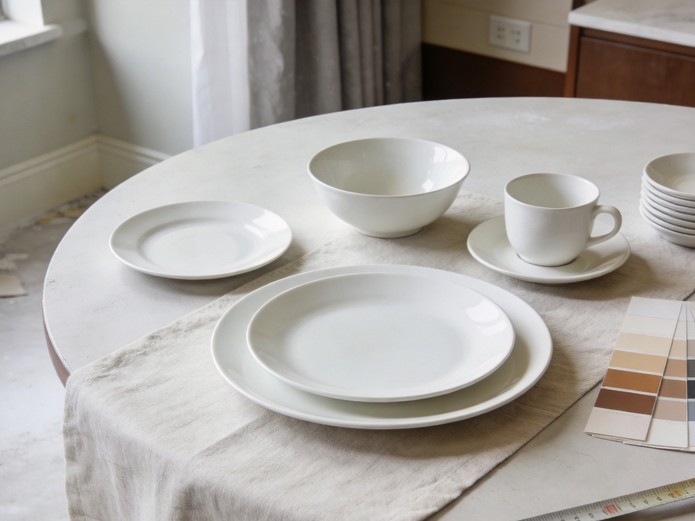
Packing decisions belong in the PO, not a shipping email. Specify case pack, inner protection, carton burst strength, pallet pattern and maximum stack height, then test it: a drop and vibration protocol on a production carton is the only evidence that survives a container hop and a tired receiving bay.

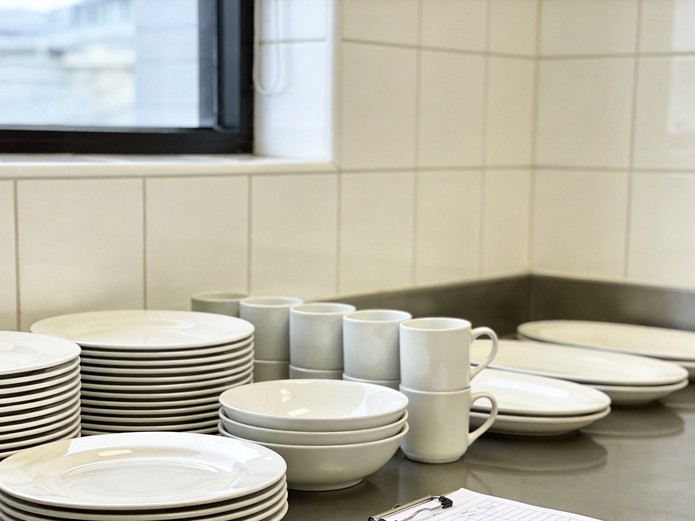
Then run the ware at volume for two weeks with the real machine and detergent. It answers what no lab can: whether the piece fits rack and pass, whether the glaze survives your chemistry, and what breakage per hundred covers looks like.
- Count in and out of every outlet for five days and reconcile against the receiving count.
- Record breakage by SKU and location, not as one total, so reorders go to the item failing.
- Run cups and saucers at the outlet’s rack configuration, not the supplier’s.
- Check stack height in the pass and on the shelf; a plate 2 mm too wide for the rack is broken by staff, not guests.
- Confirm glaze colour under the outlet’s lighting; warm dimming shifts a white visibly.
- Photograph the approved set on site with a scale and file it with the PO and inspection report.
Five mistakes that leave a hotel pre-opening ceramic tableware order short
1. Ordering per outlet instead of a shared par. Each manager protects their own count, totals are added, and back-stock is either double-counted or missing. Every outlet borrows from its neighbour by week three.
2. Building quantity from annual covers. Averages smooth away the Saturday the operation must survive. Peak simultaneous covers is the only input that reflects the failure you are insuring against.
3. Approving a photograph instead of a physical set. Glaze colour, rim profile and weight are approval decisions and none survive a JPEG. Without a sealed reference unit, the first substitution argument has no evidence on either side.
4. Treating Chinese New Year as a supplier problem. It is a calendar fact. A PO placed during the holiday sits behind every order already booked into the kiln, and the slip is measured in production cycles, not days.
5. Specifying “hotel grade” with no standard and no drawing. The supplier tests against whichever document is easiest to pass, and the report looks clean while describing a different article.
The worksheet, the reserve, and the trade-offs behind both
One row per SKU, columns in this order, so the rounding step stays visible to whoever signs the PO.
SKU | peak covers | pcs/cover | wash min | turn min | hold | par | buffer % | raw need | case pack | cases | order qty
Dinner plate 27 cm | 120 | 1.0 | 90 | 30 | 3 | 480 | 12 | 537.6 | 12 | 45 | 540
Oval platter 30 cm | 120 | 0.25 | 90 | 30 | 3 | 120 | 12 | 134.4 | 6 | 23 | 138

hold      = wash min / turn min
par       = peak covers * pcs/cover * (1 + hold)
raw need  = par * (1 + buffer)
cases     = ROUNDUP(raw need / case pack)
order qty = cases * case pack
The order quantity column goes to the supplier, the par column to outlet managers. Keeping them apart stops the habit of treating a purchase quantity as a stock target.
Then hold a reserve. A hotel pre-opening ceramic tableware order is sized for the first service and quietly expected to last a year. On the 2,850-piece order above, 2% monthly breakage implies about 57 pieces a month, so a six-month reserve is roughly 342 pieces; at 3%, about 85 a month and roughly 513 pieces. Use your measured rate, not these illustrations, and keep the reserve as unopened cartons.
The reserve is also schedule insurance, because a second order re-enters the full lead time. A hotel reordering in month four of a 16-week cycle runs dry before the container lands, and substitution then means a mixed tabletop in front of guests.
Three levers move together. Thicker bodies and stronger rim profiles raise impact resistance and freight weight, so a heavier article costs more per piece landed and per container. A denser case pack with pulp cradles cuts transit damage but adds carton volume, cutting pieces per container. A shorter window exists only via air freight, which usually costs more than the breakage it prevents.
The work does not end at delivery. Reconcile the receiving count against the PO, post the per-SKU par sheet in each outlet, and keep trial-run breakage as the baseline for the reserve. A hotel that knows consumption per hundred covers reorders on schedule; one that only knows annual spend reorders after it runs out.
Our hotel and catering dinnerware range centres on the shapes opening orders most often under-count: deep plates, platters and stackable bowls. If you are sizing an opening now, send us the outlet list and peak covers and we will return a per-SKU par sheet against real case packs. For the range-level view, the hotel ceramic tableware guide covers body choice and glaze durability, and the specification sheet shows how to write the technical annex behind the PO.
Frequently asked
How far ahead should a hotel place its opening tableware order?
Allow 115 days, about 16.4 weeks, from purchase order to shelf on sea freight: sample approval, production, ocean transit, customs and devanning, then site delivery. Add weeks if the PO falls near Chinese New Year, because the shutdown is a fixed date.
What is a reasonable opening buffer on ceramic tableware?
10% to 15% above calculated par is normal on a first order, because the early months carry the highest breakage while staff learn the ware. The buffer is secondary to case-pack rounding, which on an eight-line order adds comparable volume. Measure real breakage in the trial and size the reserve from that rate.
Is a domestic test report acceptable for hotel ware?
Usually not on its own. BS 8654:2015 covers domestic and hospitality use and states that a higher performance specification is typically required for hospitality ware, with separate methods where requirements differ. Ask which set of requirements the report addresses and which drawing it was tested against.
Can impact results be compared between two suppliers’ plates?
Only if article and test conditions match. The notes to ASTM C368-88(2020) make initial centre fracture largely a function of the square of the thickness, while chipping depends greatly on rim contour. EN 12980:2000 states its results cannot be generalised to other utensils or conditions.
What minimum order quantity should an opening expect?
MOQ is normally set per SKU by decoration method and body, not by order total, so plain white often runs lower than decorated or custom-moulded ware. Ask for MOQ per SKU and per decoration before fixing the range, because a low total MOQ can still leave three accessories below their own minimum. The OEM and ODM service page explains the mould and sampling sequence for custom shapes.


