

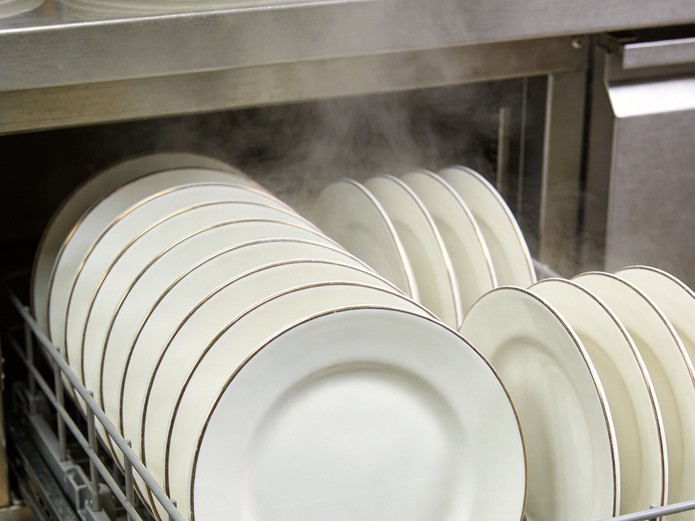
EN 12875 dishwasher resistance is a cycle count, not a pass mark, and that difference decides whether your tableware survives a commercial kitchen or clouds over inside the first quarter. Every part of the series says the same thing in its scope clause: it does not define how many cycles a product must withstand. The standard tells you how to stress a glaze against detergent and heat. It does not tell you what number to require. That figure is yours to set, and most buyers never set it — which is why a spec sheet reading “EN 12875 tested” can sit beside a plate that fails in seven weeks of restaurant service.
Below: what the four parts measure, how to convert a cycle claim into service life, the PO clause that makes it enforceable, and the fields to read before you accept a lot.
What the EN 12875 Series Measures, and What It Leaves Open
The series comes from CEN/TC 194, utensils in contact with food, in four parts buyers routinely conflate. Only one produces a figure you can contract on, and it sits in an evaluation document rather than a test document.
| Part | What it does | Scope limit that matters |
|---|---|---|
| EN 12875-1:2005 | Reference test method, 11 pages | Domestic articles only. “Does not define the number of dishwashing cycles which any given product shall withstand.” |
| EN 12875-2 | Inspection and evaluation | The only part that yields a claimable cycle figure. Currently under revision (prEN 12875-2 in CEN enquiry). |
| EN 12875-4:2006 | Rapid test, domestic ceramic | Shortened route to the same question. No cycle requirement. |
| EN 12875-5:2006 | Rapid test, ceramic catering, 7 pages | Glaze surface only. “Does not define the number of dishwashing cycles that any given product should withstand.” |
What counts as one cycle is defined tightly, and it matters later. A cycle runs a pre-wash, an alkaline cleaning step, an intermediate rinse, and a final rinse dosed with rinse aid, then drying — (6.0 ± 0.5) litres of water softened to 0.3–0.6 mmol/l divalent hardness, detergent A and acidic rinse agent formula II as specified in IEC 60436, basket fully loaded, specimens spaced so none touch. A cycle is a fixed laboratory event, not a rehearsal of your dish room.
The Only Number in the Series Is a Floor, Not a Promise
EN 12875-2 is being revised by CEN/TC 194, with AFNOR holding the secretariat. Its draft adds a dedicated section on the number of test cycles, having previously set none. The evaluation mechanics are unchanged and unglamorous, which is why they are hard to fake:
- At least three unused specimens of identical shape, size and surface finish, preferably from different lots, plus a fourth retained untouched as the reference.
- At least two inspectors with normal colour vision, grading independently.
- Viewing at 30 ± 10 cm while the angle changes, under diffuse daylight at 6,000–6,500 K and about 1,000 lx, against a neutral grey surround specified as RGB 146/142/133.
- Nine graded criteria: colour, gloss, clouding or hazing, resistant deposits, iridescent layers, corrosion products, deformation, cracking including crazing, and delamination or loss of adhesion.
Each criterion scores 0 for no visible change, 1 for the first discernible change visible only against the reference held side by side, and 2 for a clear visible change. If any criterion averages above 1.0, testing stops. If every inspector scores any criterion a 2 on any one sample, that sample has failed outright. The output is a cycle count, not a grade: the highest number at which nothing averaged above 1.0.

The floor is 100 cycles, with higher claims in multiples of 50, and the draft carries a note worth reading twice:
“100 cycles refers to a guarantee time of 2 years and a usage once a week.”
That is the most misquoted line in the series and it defines a domestic use case. One unresolved point for the laboratory: the draft sets a general 100-cycle floor, while its Table 2 is described as setting material-specific minimums — ceramic 300, glass or glass-ceramic 200, decorated glass or ceramic 100, plastic 100, rubber or silicone 200, uncoated metallic 300. The two readings do not reconcile cleanly and the text is still in enquiry, so ask which table applies and get the answer written on the report. Either way, where an article combines materials — a porcelain body with a gold band, a cup with a bonded handle — the lowest cycle result governs the whole article.
What a Cycle Count Buys You, by Outlet Type
Two years assumes 52 cycles a year. Loads per day is the only other input you need.
| Outlet profile | Cycles / year | 100 cycles lasts | 300 cycles lasts | 500 cycles lasts |
|---|---|---|---|---|
| Domestic, one wash a week | 52 | 23.1 months | 69.2 months | 115.4 months |
| Hotel room service, 1 load/day | 365 | 3.3 months | 9.9 months | 16.4 months |
| Mid-market restaurant, 2 loads/day | 730 | 1.6 months | 4.9 months | 8.2 months |
| Staff canteen, 4 loads/day | 1,460 | 0.8 months | 2.5 months | 4.1 months |
| Airport lounge, conveyor at 6 loads/day | 2,190 | 0.5 months | 1.6 months | 2.7 months |
A restaurant at two loads a day puts 730 cycles a year on a plate — fourteen times the domestic assumption in the 2-year note. The 100-cycle floor buys about 50 days, or seven weeks, before a criterion first becomes visible against its reference. A hotel on one daily load gets roughly 100 days. Neither is a warranty period any chef would recognise.
Run this arithmetic before arguing about unit price: at 730 cycles a year, the gap between 100 and 500 cycles is the gap between replacing a stack every other month and once a year. Set the count by outlet, not product category: the same 27 cm coupe can be 300 cycles for a hotel breakfast room and 750 for a hospital ward on four trolley loads a day. Keep it consistent across a collection — a range where the dinner plate claims 500 and the side plate 150 will draw complaints about side plates long before the dinner plates show wear, and the buyer reads that as a supplier fault rather than a specification error.

Why a Domestic Result Cannot Stand In for a Catering Line
Parts 1 and 4 are domestic-scope documents. Part 5 exists because catering ware meets something else, and the chemistry is why. Since 1 January 2017, consumer automatic dishwasher detergents placed on the EU market must not contain 0.3 grams or more of total phosphorus in the standard dosage, under Regulation (EU) No 259/2012, Annex VIa. The recital explains why the limit stops there: extending it to industrial and institutional detergents was judged inappropriate at Union level because feasible phosphate-free alternatives were not yet available for those products.
The reading is blunt: the detergent behind a domestic reference result has been phosphate-restricted for the better part of a decade, the detergent in a commercial warewasher has not. A count produced against a domestic regime measures a milder stress cycle than your plates will meet, and no cycle arithmetic repairs that. When a supplier presents a Part 1 or Part 4 result for commercial-bound ware, ask for the Part 5 route as well — in the specification, not in a later complaint.
Water matters the same way. The method softens its supply to 0.3–0.6 mmol/l divalent hardness, roughly 1.7–3.4 °dH or 30–60 mg/l as calcium carbonate. A site running hard water without a working softener is not testing the article the laboratory tested; the gap surfaces as resistant deposits and hazing, two of the nine criteria. If your dish room sits well above that band, treat the lab figure as an upper bound.
The Clause to Paste Into Your Purchase Order
A test report is evidence about a specimen lot. A clause is what makes it evidence about your lot. This version forces the part, the count, the sample and the remedy onto one line, so a short delivery carries a remedy rather than an argument.
Dishwasher resistance.
The article shall achieve a minimum of [300] dishwasher cycles without any
inspection criterion averaging above 1.0, evaluated to EN 12875-2 against
a reference specimen retained from the same lot. Testing shall be performed
to EN 12875-1 [domestic-destination ware] / EN 12875-5 [catering ware], or
to EN 12875-4 where a rapid method is agreed in writing in advance.

Specimens: not fewer than [10] articles from not fewer than [3] kiln cars
or production lots, plus [2] retained references shipped with the order.
For multi-material articles (decoration, applied handles, metallic trim) the
lowest cycle result governs the whole article, and decoration shall be
tested as part of the article, not separately.

Report: the report shall name the method applied, the laboratory, the
specimen and lot counts, the inspectors and their number, the criteria
graded, and the maximum cycle count at which no criterion averaged above
1.0. A report naming a method without a cycle count is not evidence.

Remedy: where the report shows a count below the stated minimum, or where
verification on arrival produces a lower count, the Buyer may reject the
lot, require replacement at the Seller's cost, or accept it at an agreed
price adjustment.
Four parts do the work. It names a part, because “EN 12875” alone means nothing. It names a count, because the series never supplies a verdict. It requires specimens across several lots, because one kiln car cannot represent a run. And it attaches a remedy, because a clause without a remedy is only a description.
The Receipt Check: Five Fields to Read Before You Accept the Lot
The draft’s report clause lists what a report must carry: method, article identification, sampling date, inspectors, maximum cycle count, criteria averages. Use it as a receiving document. Five fields carry most of the risk.
- Which part, and which count. A report naming EN 12875-1 with no figure has measured something and concluded nothing.
- Specimen count and lot spread. Three is the minimum for one article, preferably from different lots. Three pieces from one kiln car describe a kiln car.
- Which criteria were graded. A report covering gloss and colour but not crazing or delamination skipped the two most likely to fail on decorated ware in a hot alkaline machine.
- Inspectors and viewing conditions. Two independent graders with normal colour vision, the specified light and grey surround. One inspector under office lighting is not the method.
- Whether decoration was in the article tested. Delamination is a named criterion because decoration fails by a different mechanism than glaze. A white-body result presented for a decorated article is a result about a different article.
Run those five at goods-in against the retained references. Two plates from the delivery held against the shipped reference under neutral light tell you in a minute whether the glaze on arrival matches the glaze that was tested. For the wider receiving routine, our ceramic quality inspection checklist covers the sequence, and the specification sheet guide covers the fields that make a result traceable to a SKU.
Three Mistakes That Cost Real Money
1. Accepting a method name where a number belongs
The commonest line on a Chinese quotation is “dishwasher safe, EN 12875 tested.” It resolves to nothing. The series is a set of measuring instruments; the requirement is the reading you demand from them. “EN 12875 tested” buys an activity. “300 cycles” buys a standard, and a basis for rejecting a lot.
2. Carrying a domestic count into a catering contract
A 100-cycle result is compliant and genuinely useless in a restaurant. Where the count was produced under a domestic-scope part against phosphate-restricted detergent, it measures a milder process than the ware will live in. Specify the catering route for catering destinations and set the count from loads per day. This is the decision that separates a specification from a wish.
3. Budgeting the test as a formality
EN 12875-1 calls its own method “time consuming and expensive,” and explains why no cheap substitute has displaced it: no single accelerated test gives comparable results across the variety of materials cleaned in dishwashers. Every distinct article is its own test — a body change, a glaze change, a decoration over the glaze, a new handle. A twelve-SKU collection is a twelve-article programme, three specimens plus a reference each. A supplier offering counts for a dozen SKUs without a specimen or queue discussion did not generate them per SKU.
Three things to do instead:
- Rationalise the range before you test it. Consolidate to the smallest set of bodies, glazes and decorations that covers your service needs, and test that set. Every SKU you retire is a test you do not pay for and a count you do not have to defend.
- Agree specimen ownership inside the MOQ conversation. Specimens and references come out of the production run and ship with the order. Settling who pays for the tested pieces before the PO prevents the usual dispute over whether they were sold or sampled. If the collection is a custom programme, the same sequencing applies to the OEM and ODM development track.
- Decide whether you are buying a development run or a per-lot charge. Development cost belongs on the first order; per-lot verification belongs on every order. A per-lot laboratory fee silently changes the landed cost of a small first order, so choose before quotations are compared.
One note on packaging: transit packaging has no influence on dishwasher resistance, but transit damage does. A rim chipped in transit reads as criterion failure at grading whatever its glaze rating. The durability testing overview covers the adjacent mechanical tests, and glaze crazing before shipment covers a criterion this method grades but cannot prevent.
EN 12875 Dishwasher Resistance: Questions Buyers Ask
Does EN 12875 define how many cycles tableware must survive?
No. Parts 1, 4 and 5 each state in their scope that they do not define the number of cycles a product should withstand. The claimable figure sits in Part 2, which sets a 100-cycle floor with higher claims in multiples of 50 and whose draft revision carries material-specific minimums. A supplier quoting “EN 12875” without a number has quoted a method, not a performance.
Is 100 cycles enough for a restaurant?
At two loads a day, 100 cycles is about 50 days of service; the 2-year note in the standard assumes one wash a week. For commercial ware, specify from loads per day: 300 cycles covers roughly five months at two loads daily, 500 cycles roughly eight. The count should scale with the machine schedule, not the product category.
Which part applies to catering ware, Part 4 or Part 5?
Part 5, the rapid test for ceramic catering articles. Its scope is limited to glaze surface durability, and it sets no cycle count either. Part 4 is the domestic rapid method. For a commercial dish room, specify the catering route and pair it with a Part 2 evaluation to obtain a figure.
Can the glaze be tested on samples I already approved?
No. The method requires unused specimens, at least three of identical shape, size and surface finish, plus a retained reference. Approvals that have been handled, washed or shipped are no longer valid specimens: what you signed off is the design record, not the test record. Ask for specimens from the production lots.
What does the laboratory need before it can quote?
Four inputs: the article list, with each body, glaze and decoration treated as a separate article; the cycle count you want demonstrated; the destination use, so the domestic or catering route can be chosen; and your required report fields, including inspector count and criteria graded. That turns a vague enquiry into comparable quotations across two or three laboratories.
If you are specifying a collection for a hotel, restaurant group or catering operation, we can set the cycle count against your machine schedule rather than a generic figure. Browse the hotel and catering dinnerware range, the commercial plates and platters, or the wholesale ceramic bowls where glaze stress shows first, then send us your specification for a feasibility review.


