

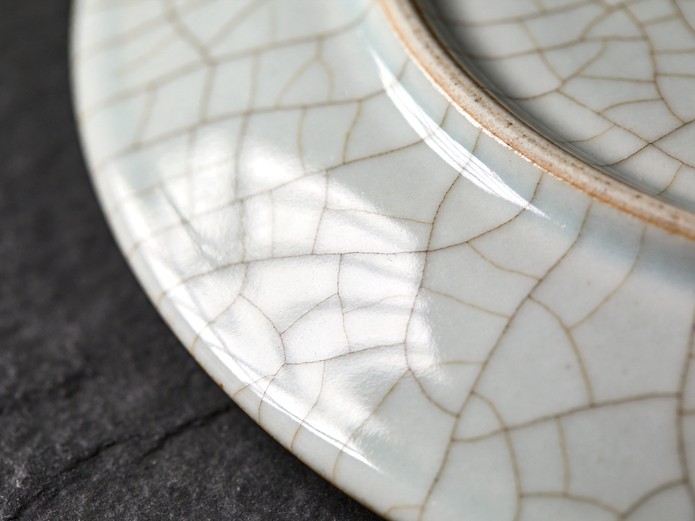
Ceramic glaze crazing is the failure buyers discover three months after the container lands — a spiderweb of hairline cracks that was not there at inspection, cannot be polished out, and starts showing up in complaint photos from your own customers. On vitrified porcelain it comes from a glaze-to-body expansion mismatch rather than a handling accident, which means a factory can prove or disprove it in about twenty minutes with a bottle of ink. If you are not running that check before releasing the balance payment, you are accepting a defect you can only see once the goods are yours.
What follows: which ASTM method fits your product, how to read the report a factory hands you, and the clause deciding who pays.
Why Crazing Is a Sourcing Problem, Not a Cosmetic One
Glaze and body expand at different rates as a piece cools out of the kiln. If the glaze has the higher coefficient of expansion it ends up in compression and the piece is stable. If the body’s expansion is higher the glaze is left in tension, and once stress exceeds what the glass can carry the only release is a crack. The crack network is the release valve.
ASTM puts it plainly: without a proper match between glaze and body expansions, all glazed whitewares may carry residual stress from the firing that bonded the glaze, and where resistance to repeated abrupt thermal change is inadequate the usual result is a craze pattern. Three consequences make that a purchasing problem:
- It develops after firing. A piece clean at final inspection can craze weeks later — during the sea voyage, or in the first month of commercial dishwashing. Your QC pass date is not a guarantee.
- It is nearly invisible under flat light. Overhead lighting on a white glaze hides a fresh pattern. Inspectors who only look straight down will pass lots that fail an ink test.
- It is a food-contact defect. Once the glaze cracks through, the body beneath is exposed. On a decorative piece that is aesthetic; on a dinner plate it is hygiene.
Factories will raise one counterpoint, so settle it early. A study published in Ceramics Monthly contaminated crazed and non-crazed glaze tiles with Lactococcus lactis: wiping, tap water and warm soapy water left recoverable bacteria on the crazed tiles, while one dishwasher run at about 167°F (75°C) cleared them to the detection limit — and wiped non-crazed surfaces retained bacteria too. So the position is not that crazed ware is poisoned. It is that ceramic glaze crazing makes a surface harder to clean and pushes the burden onto the wash cycle, which you can argue with data instead of alarm.
Two Tests, and Only One Fits Your Product
ASTM publishes two separate methods, and quoting the wrong one is the most common technical error in a supplier’s report. They provoke different mechanisms and are not interchangeable.
| Method | Scope in Plain Terms | Mechanism It Provokes | Fits |
|---|---|---|---|
| ASTM C554 (C554-93, reapproved 2024) | Thermal shock: repeated abrupt heating and quenching, then inspection for a craze pattern under oblique light with ink or dye | Residual stress left after glost firing — not moisture expansion | Vitreous whitewares with negligible moisture expansion: porcelain, high-fired hotel china |
| ASTM C424 (now C424-26) | Autoclave: steam pressure cycling, described by ASTM as particularly useful for porous materials that exhibit moisture expansion, and usable as a referee method in purchasing agreements | Moisture expansion of the body | Nonvitreous and semivitreous bodies: earthenware, higher-absorption stoneware |
The scope wording settles it. C554 states it is not intended to induce moisture expansion, and that for vitreous and impervious ware — negligible moisture expansion — thermal shock is generally preferred. It directs nonvitreous and semivitreous products to C424, whose bodies are subject to that expansion.
Practically: for porcelain hotel plates, a report citing C424 is a warning sign — a moisture-expansion test on a body engineered not to absorb moisture says little about thermal cycling in your dish machine. For earthenware, a C554-only report is equally incomplete. A supplier quoting both ranges should supply both results.
What a C554 Report Must Show
The result is not a pass or fail — it is how many cycles a specimen survived at what temperature. A report saying only “passed” gives you nothing to compare against a second supplier. Check five things: method matches the body; cycle count and endpoint temperature stated; samples drawn from production, not the sample room; test date inside your production window, since glaze batches change and kiln profiles drift; and photo evidence under oblique light with dye applied — a flat-lit picture of a clean white plate proves nothing.
The Dye Test You Can Run on a Factory Table
You do not need a laboratory to find out whether a lot is crazing today. Oblique light plus a dye that wicks into open cracks is reproducible with locally bought items, and it belongs in pre-shipment inspection and again on arrival — the comparison between the two readings is your evidence.
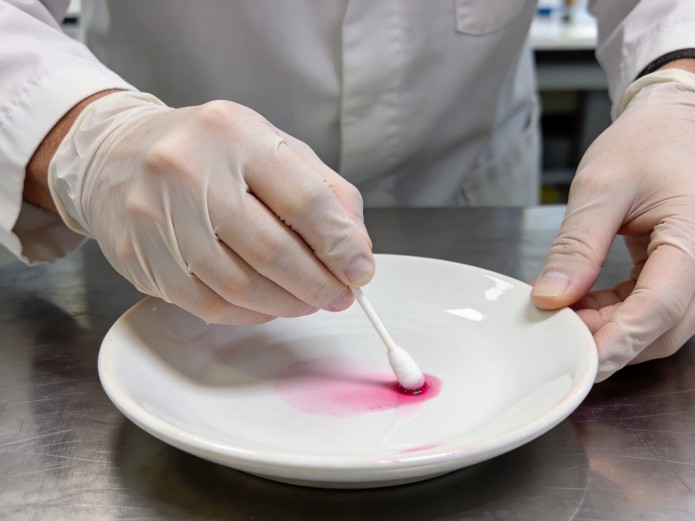
| Step | What You Do | What Goes Wrong If You Skip It |
|---|---|---|
| 1. Prepare | Wash and degrease the piece, then dry it completely. | Grease blocks dye uptake and you read a false pass. |
| 2. Apply | Wipe water-based ink or food-grade dye over the whole food-contact surface — interior and rim, not a patch. | Craze starting at the rim or foot goes unseen until it propagates. |
| 3. Wait | Let it sit 30–60 seconds so capillary action pulls dye into open cracks. | Reading too early under-reports fine craze. |
| 4. Remove | Wipe clean in one direction with a damp cloth, then dry. | Circular wiping pushes dye back into cracks and creates false positives. |
| 5. Read | Inspect under oblique light — source low and to one side, roughly 45° to the surface. | Overhead light kills the contrast and the crack map vanishes. |
| 6. Record | Photograph every reject with a scale reference and carton number in frame. | Without carton traceability the factory calls your sample unrepresentative. |
Two calibration points decide whether the test holds up in a dispute. Sample at least ten pieces from three or more cartons — one plate proves nothing, and factories know it. Keep an accepted control beside you: a piece from an approved earlier order, tested identically. If the control stays clean and the new lot lights up, you have a comparison, not an opinion. Keep the light angle identical.
Acceptance Limits That Match How the Ware Is Used
There is no industry-wide crazing tolerance, so the limit must come from your own specification. What follows is a defensible starting position by product type — not a published standard you can cite. Write your actual numbers into the PO.
| Product Type | Service Reality | Defensible Position | What to Test Before Release |
|---|---|---|---|
| Hotel and restaurant porcelain plates, bowls | Daily commercial wash, heavy stacking, 165–180°F final rinse under NSF/ANSI 3 | Zero craze on food-contact surfaces; reject any detected crack network | C554 cycle count, plus dye check on samples from every carton group |
| Mugs and cups (liquid contact) | Constant hot liquid, repeated washing, rough handling | Zero craze on interior and lip; treat the lip and rim band as highest-risk | C554, plus lead and cadmium migration on interior and any lip or rim decoration |
| Oven-to-table and bakeware | Direct thermal cycling, oven to bench — a wider swing than any dishwasher | Zero craze; specify thermal shock performance as a separate requirement | C554 at a higher endpoint temperature, plus oven-to-freezer cycling |
| Earthenware and high-absorption stoneware | Moisture uptake through the body across service life | Zero craze in year one; specify water absorption and the C424 result, not only a visual criterion | C424 autoclave result, and water absorption by the applicable test method |
| Decorative, non-food-contact pieces | Display only; no washing regime | Cosmetic tolerance permitted, defined by crack density and visibility at a stated viewing distance | Visual reference board only; no performance test required |
The line to hold firm on is food contact. Cosmetics have a legitimate AQL; a crack that opens the body to moisture and food residue does not. Keep three document types apart: a crazing report is a mechanical test; a lead and cadmium migration report is a chemical extraction test — FDA Compliance Policy Guide 545.450 sets 3 µg/mL for ceramic flatware against 0.5 µg/mL for cups and mugs, CPG 545.400 sets cadmium at 0.5 µg/mL for flatware and small hollowware and 0.25 µg/mL for large hollowware, and EU Directive 84/500/EEC applies 0.8 mg/dm² lead and 0.07 mg/dm² cadmium below 25 mm internal depth, 4.0 mg/L lead and 0.3 mg/L for other fillable articles — and a dishwasher durability report is a service simulation. A piece can pass all three and still craze in month four; each is an accelerated version of a process still running in real time.
The Clause That Decides Who Pays
Crazing that appears in a customer’s kitchen six weeks after a clean inspection is the hardest claim to win — unless the PO anticipated it. Generic wording such as “glaze must be free from defects” loses: the factory’s position is that the goods were defect-free on the inspection date and something happened afterward. The clause has to address time and mechanism, not appearance.
- A named test and method. Cite C554 for vitreous bodies or C424 for semivitreous, and require the pre-shipment report from a lot-representative sample, with cycle count and endpoint temperature stated.
- A development window. State that the warranty covers ceramic glaze crazing developing within a defined period from arrival, and name the mechanism as glaze-to-body expansion mismatch. That shift moves the argument from handling damage to a manufacturing property — the difference between a claim and a conversation.
- A scoped remedy. Specify replacement, credit or price adjustment applying to the affected cartons rather than the whole order. Factories resist open-ended liability but routinely accept a scoped one.
- An agreed determination protocol. Name the dye-and-oblique-light procedure as the method both sides accept, so a dispute on arrival is not a debate about whose inspector is right.
Then add the number that makes the clause live: how much of the lot must show craze before a claim triggers. A rate-based trigger — craze above a stated percentage of sampled pieces — is easier to administer than a per-piece argument and easier for a factory to accept than absolute zero. Get MOQ and lead time quoted per item against your own specification, not a catalogue average, and treat sample approval as the clock start. Require the same carton and dunnage on the test lot as on production.
Three Mistakes That Cost a Container
Treating a migration report as a crazing report. Different tests, different measurements. A clean lead and cadmium result on a glossy white glaze is routine and says nothing about whether that glaze will crack under thermal cycling. File the two as one document and the gap surfaces on reorder.
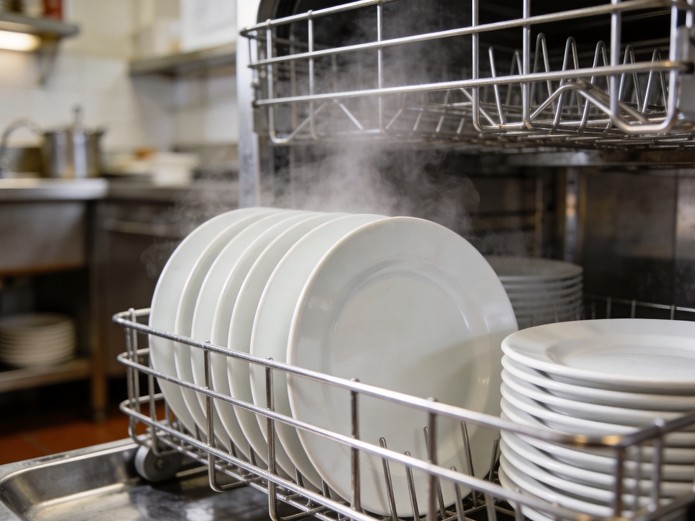
Approving a lot that never saw a real wash cycle. Under NSF/ANSI 3, stationary rack single-temperature commercial machines must reach a 165°F final rinse and other commercial styles 180°F; residential machines certified to NSF/ANSI 184 must reach 150°F on the sanitizing cycle. A plate that survives a hand wash can craze in that environment, so foodservice acceptance testing has to include repeated commercial cycles, not one trip through a lab oven.
Judging under the wrong light. The most common inspection error of all: a bright bay with overhead lighting, where fresh ceramic glaze crazing on white porcelain is close to invisible. Inspectors never told to work at a low angle with dye pass crazed lots all day while honestly believing they did the job — the report is sincere and wrong at once.
Frequently Asked Questions
Is crazed ceramic glaze safe to eat from?
Not automatically unsafe, but not something to accept on new commercial ware. Crazed tiles in the study retained recoverable bacteria after wiping and soap washing, while one dishwasher run at about 167°F cleared them. Crazing makes cleaning harder and more wash-dependent, and a crack network on a dinner plate is a food-contact defect, not a cosmetic one.
Which ASTM method applies to porcelain plates?
ASTM C554, the thermal shock method. Its scope covers fired glazed whitewares where residual firing stress drives crazing, and it is not intended to induce moisture expansion. C424, the autoclave method, suits porous bodies that exhibit moisture expansion and is generally confined to nonvitreous and semivitreous ware.
Can crazing be detected before the goods ship?
Craze that already exists can be found reliably with dye and oblique light, which is why the check belongs in pre-shipment inspection. Craze that has not yet developed needs an accelerated test to surface, and even then the result is a probability statement about a sample, not a guarantee for the lot. Expect to catch most of it, not all.
Is crazing the same as crackle glaze?
No, and settle it before a dispute. Crackle is decorative, made by deliberately mismatching expansion so the pattern forms uniformly at firing, and is normally sealed and stable. Craze appearing in service on a glaze specified as uniform and uncracked is a failure. The test is history and regularity: crackle exists before the piece is sold and looks even; crazing appears later and follows the stress pattern.
Related Reading
For the physics, see how ceramic thermal shock resistance is measured and specified — crazing is the visible outcome of the same expansion mismatch. Setting tolerances across a defect list? The ceramic defect classification framework shows where a food-contact crack sits against cosmetic allowances, the guide to reading ceramic test reports covers document verification, and the certification standards guide explains which report proves what. Plates sit under ceramic plates and platters, hospitality programmes start from hotel and catering dinnerware, and custom glaze or body development runs through the OEM and ODM programme.
If you would rather not build the protocol from scratch, send us the product specification and intended wash environment; we will reply with the crazing test plan, the acceptance limits we would hold a production lot to, and a sample you can test yourself before ordering.
Test methods and regulatory limits cited here come from ASTM International, the US Food and Drug Administration, the European Union and NSF International. Acceptance limits by product type are the author’s sourcing recommendations, not published standard values — confirm them against your own channel requirements before writing them into a purchase order.


