Ceramic tableware durability is the single most important factor that separates a profitable bulk order from a costly replacement cycle. Whether you operate a hotel chain, restaurant group, or wholesale distribution network, understanding ceramic tableware durability under real-world stress directly impacts your bottom line. This comprehensive guide covers every durability test, material comparison, and international standard that B2B buyers need to evaluate before placing large orders.
At CeraSupply, we test every product line against rigorous durability benchmarks before it reaches our clients. This article shares the same framework we use internally, helping you make informed sourcing decisions with confidence.
Understanding Ceramic Tableware Durability: Why It Matters for B2B Buyers
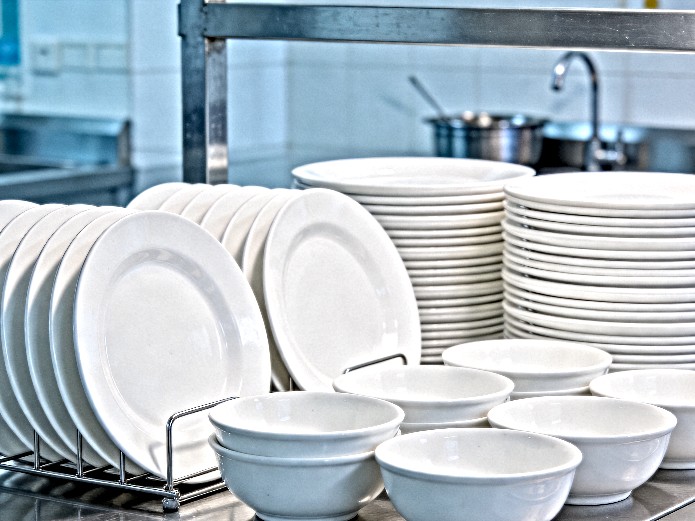
In commercial environments, ceramic tableware durability faces conditions that home-use products never encounter. Industrial dishwashers cycle at 82°C or higher, staff stack hundreds of plates per shift, and temperature swings from freezer to oven happen daily. A plate that chips after 50 washes in a home kitchen might fail after just 10 cycles in a hotel banquet operation.
For B2B buyers, ceramic tableware durability translates directly into total cost of ownership (TCO). Consider these industry benchmarks:
- Average restaurant plate replacement rate: 20-30% annually with low-grade ceramics
- High-durability commercial tableware replacement rate: 5-8% annually
- Cost difference per piece: 15-25% premium for commercial-grade, offset within 12-18 months
- Breakage-related downtime: estimated $2,000-$5,000 per location per year for mid-size restaurants
Understanding the science behind ceramic tableware durability allows buyers to specify precise requirements in their supplier contracts. For a complete evaluation framework, see our Bulk Ceramic Tableware Supplier Selection Checklist.
The Three Main Ceramic Materials and Their Durability Profile
Not all ceramics are created equal. The three primary material categories used in commercial tableware each have distinct durability characteristics that buyers must understand.
Bone China
Bone china contains 30-50% bone ash (calcium phosphate) blended with kaolin and feldspar. Despite its delicate appearance, bone china offers exceptional ceramic tableware durability thanks to its high firing temperature (1200-1300°C) and crystalline structure.
- Bending strength: 80-120 MPa (highest among the three)
- Thermal shock resistance: Excellent (withstands 180°C differential)
- Chip resistance: Very high due to fine-grained microstructure
- Translucency: High — prized for fine dining aesthetics
- Typical use: Luxury hotels, fine dining restaurants, premium retail
Porcelain (Hard-Paste)
Porcelain is fired at 1280-1400°C, creating a fully vitrified, non-porous body. Porcelain offers the best balance of ceramic tableware durability and cost-effectiveness for most commercial applications.
- Bending strength: 60-90 MPa
- Thermal shock resistance: Good (withstands 150°C differential)
- Water absorption: Less than 0.5% (critical for dishwasher safety)
- Chip resistance: High — dense glaze body resists edge damage
- Typical use: Hotels, restaurants, catering, institutional dining
Stoneware
Stoneware fires at lower temperatures (1100-1250°C) and retains some porosity. While it offers a rustic aesthetic popular in casual dining, its overall ceramic tableware durability falls below porcelain and bone china in most measurable categories.
- Bending strength: 40-65 MPa
- Thermal shock resistance: Moderate (withstands 100°C differential)
- Water absorption: 1-3% (higher risk of glaze cracking over time)
- Chip resistance: Moderate — thicker walls compensate partially
- Typical use: Cafes, casual dining, artisan retail brands
Ceramic Tableware Durability Testing: The 6 Critical Tests Explained
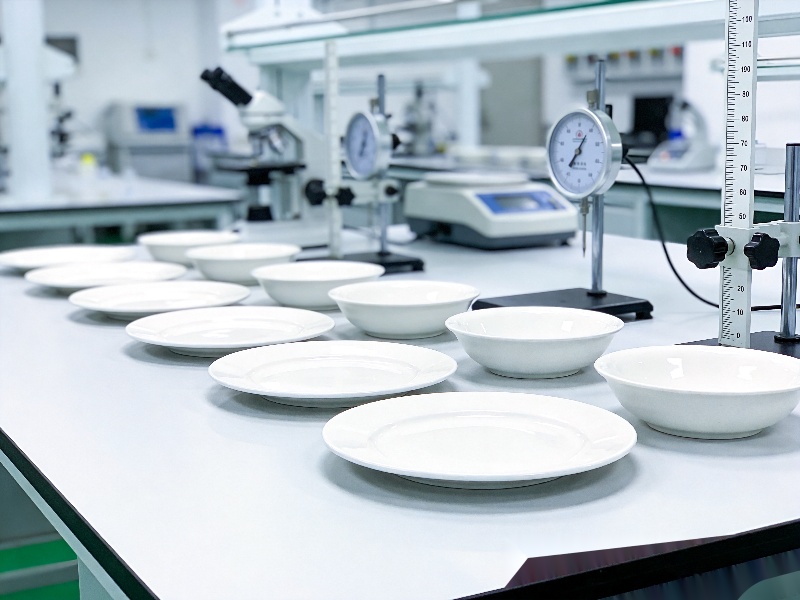
Professional buyers should require suppliers to provide test reports for each of these six durability assessments. Reputable manufacturers conduct these tests in-house and can produce certification from third-party labs like SGS, Intertek, or TÜV.
1. Thermal Shock Resistance Test
This test measures a ceramic piece’s ability to withstand rapid temperature changes without cracking. The standard procedure involves heating a sample to a specified temperature (typically 150-200°C), then immediately immersing it in cold water (5-10°C).
The key metric is the maximum temperature differential (ΔT) the piece can withstand without visible cracking or structural failure. Commercial-grade porcelain should pass ΔT ≥ 150°C, while premium bone china should exceed ΔT ≥ 180°C.
This ceramic tableware durability test is critical because commercial dishwashers expose tableware to rapid temperature transitions multiple times daily. Understanding thermal shock performance is essential alongside other quality control measures.
2. Chip Resistance Test (Edge Impact)
Chipping is the most common threat to ceramic tableware durability in commercial settings. The edge impact test uses a standardized pendulum or drop-weight apparatus to strike the rim of a plate at controlled force levels.
Results are measured by the minimum impact energy (in joules) required to produce a visible chip. High-quality commercial tableware should withstand 0.5-1.0J without chipping. Factors that influence chip resistance include glaze thickness, body density, rim profile design, and firing temperature.
3. Mechanical Strength Test (Bending and Impact)
Mechanical strength determines how much load a ceramic piece can bear before fracture. The three-point bending test places a flatware sample across two supports and applies increasing force at the center point until failure.
For commercial applications, minimum bending strength requirements are:
- Bone china: ≥ 80 MPa
- Hotel porcelain: ≥ 60 MPa
- Standard stoneware: ≥ 40 MPa
These values correlate directly with stacking safety — a critical consideration for banquet operations that stack 30-50 plates per rack.
4. Water Absorption Test
Water absorption is a proxy for vitrification quality. Lower absorption means a denser, more durable ceramic body. The test involves weighing a dry sample, boiling it in water for a specified duration, then re-weighing to calculate the percentage increase.
Industry standards require less than 0.5% water absorption for vitreous (fully dense) tableware. Higher absorption leads to several durability issues: moisture penetration causes glaze crazing over time, freeze-thaw damage in cold storage environments, and bacterial growth in microscopic pores.
5. Glaze Hardness and Scratch Resistance
The Mohs hardness scale measures glaze surface resistance to scratching. Commercial tableware should achieve Mohs 6-7, meaning it resists scratching from stainless steel cutlery (Mohs 5-5.5). Scratched glaze surfaces not only look worn but also harbor bacteria and resist cleaning.
The pencil hardness test (ASTM D3363) provides a more practical measure, with commercial grades requiring 6H-8H ratings. Suppliers should provide both Mohs and pencil hardness data in their quality documentation.
6. Microwave and Dishwasher Safety Testing
Ceramic tableware durability in modern commercial kitchens depends on microwave and dishwasher resilience and industrial dishwashing. Durability testing must verify that tableware withstands repeated exposure to both without degradation.
Standard dishwasher testing involves 500+ cycles at commercial wash temperatures (65-82°C) with alkaline detergents. The evaluation criteria include glaze surface integrity, color stability, metallic decoration retention, and structural soundness after the full cycle count.
International Durability Standards for Ceramic Tableware
Different markets enforce different ceramic tableware durability standards. B2B buyers exporting to multiple regions must ensure compliance with all applicable standards. For a complete overview of food safety certifications, see our Ceramic Certification Standards Guide.
ISO 6486 (Lead and Cadmium Release)
While primarily a food safety standard, ISO 6486 also addresses glaze integrity after repeated use. Glaze degradation accelerates heavy metal migration, making durability and safety inseparable concerns.
BS EN 12980 (Non-Metallic Materials in Contact with Food)
This European standard specifies test methods for ceramic articles, including durability assessments under simulated use conditions. It is widely referenced in UK and EU procurement specifications.
ASTM C927 (Glass and Ceramic Tableware)
The American standard covers thermal shock resistance, impact resistance, and rim chip resistance for ceramic tableware sold in North American markets. Many hospitality chains in the US require ASTM compliance as a baseline qualification.
Chinese National Standard GB/T 3532
As the world’s largest ceramic tableware manufacturing hub, China’s domestic standard GB/T 3532 sets requirements for daily-use ceramics including thermal shock resistance, water absorption limits, and mechanical strength. Products from major Chinese ceramic production regions are tested against this standard as a baseline.
Durability Comparison: Bone China vs Porcelain vs Stoneware
The following ceramic tableware durability comparison helps B2B buyers select the optimal material based on their specific durability requirements and budget constraints.
Thermal shock resistance (ΔT max): Bone china ≥180°C | Porcelain ≥150°C | Stoneware ≥100°C
Chip resistance (impact energy): Bone china 0.8-1.2J | Porcelain 0.5-0.9J | Stoneware 0.3-0.6J
Bending strength: Bone china 80-120 MPa | Porcelain 60-90 MPa | Stoneware 40-65 MPa
Water absorption: Bone china <0.3% | Porcelain <0.5% | Stoneware 1-3%
Estimated commercial lifespan: Bone china 5-8 years | Porcelain 3-5 years | Stoneware 2-3 years
Cost per piece (FOB China): Bone china $3-8 | Porcelain $1-4 | Stoneware $0.80-2.50
For detailed pricing analysis across different shipping terms, refer to our Ceramic Pricing Breakdown Guide.
How to Specify Ceramic Tableware Durability Requirements in Your Purchase Order
Vague specifications lead to inconsistent quality. Here is a template framework for embedding ceramic tableware durability requirements into your purchase contracts:
- Material specification: Clearly state bone china, porcelain, or stoneware with minimum firing temperature requirements
- Thermal shock rating: Specify minimum ΔT value (e.g., ≥150°C for hotel porcelain)
- Chip resistance threshold: Define minimum impact energy in joules for edge chip testing
- Water absorption limit: Set maximum percentage (e.g., ≤0.5% for vitreous ware)
- Dishwasher cycle requirement: State minimum cycles (e.g., 500 commercial cycles) with evaluation criteria
- Glaze hardness: Specify Mohs or pencil hardness minimum rating
- Third-party testing: Name acceptable testing laboratories (SGS, Intertek, TÜV, Bureau Veritas)
- Sample approval process: Define pre-production and production sample testing protocols
For a comprehensive approach to supplier evaluation beyond durability testing, our Ceramic Factory Audit Checklist covers the full assessment framework including production capacity, quality management systems, and compliance verification.
If your operation requires branded or customized tableware, durability requirements should also cover decoration methods — underglaze printing offers superior longevity compared to overglaze or decal applications. Learn more in our Custom Ceramic Tableware Guide.
Ceramic Tableware Durability FAQ
Q: How many dishwasher cycles should commercial ceramic tableware withstand?
A: Industry-standard commercial tableware should withstand a minimum of 500 industrial dishwasher cycles (at 65-82°C with alkaline detergents) without glaze degradation, color fading, or structural weakening. Premium bone china products often exceed 1,000 cycles.
Q: Is thicker ceramic always more durable?
A: Not necessarily. While thicker walls can improve impact resistance, they also increase weight (raising shipping costs) and can create thermal stress points during firing. Proper vitrification and glaze quality matter more than wall thickness alone for ceramic tableware durability.
Q: Can stoneware be used in commercial dishwashers?
A: Yes, but with caveats. Stoneware’s higher water absorption (1-3%) means it is more susceptible to glaze crazing over extended dishwasher use. For high-volume commercial operations, porcelain or bone china is recommended. Stoneware works well for lower-volume casual dining with moderate wash cycles.
Q: How do I verify a supplier’s durability claims before placing a bulk order?
A: Request third-party test reports from accredited laboratories (SGS, Intertek, TÜV). Order evaluation samples and conduct your own in-house testing. For a systematic approach, see our Ceramic Sample Evaluation Guide which covers how to assess samples methodically before committing to large orders.
Q: Does ceramic tableware durability affect food safety?
A: Absolutely. Damaged glaze surfaces expose the ceramic body, which can harbor bacteria and potentially increase heavy metal migration (lead, cadmium). Maintaining ceramic tableware durability is not just an economic concern — it is a food safety imperative. For more on glaze safety, see our Ceramic Glaze Types and Food Safety Guide.
Start Sourcing Durable Ceramic Tableware Today
Ceramic tableware durability ceramic tableware durability is not a single test result — it is a comprehensive property shaped by material selection, manufacturing precision, and quality control at every production stage. By understanding the tests, standards, and material comparisons in this guide, you can specify precise requirements that protect your investment and ensure long-term performance in commercial environments.
Whether you need high-durability bone china for luxury hospitality or cost-effective porcelain for high-volume restaurant operations, CeraSupply provides factory-direct pricing with full test documentation and third-party certification.
Get a free quote today — tell us your durability requirements, target market, and order volume, and our team will recommend the optimal material and testing package for your needs.