

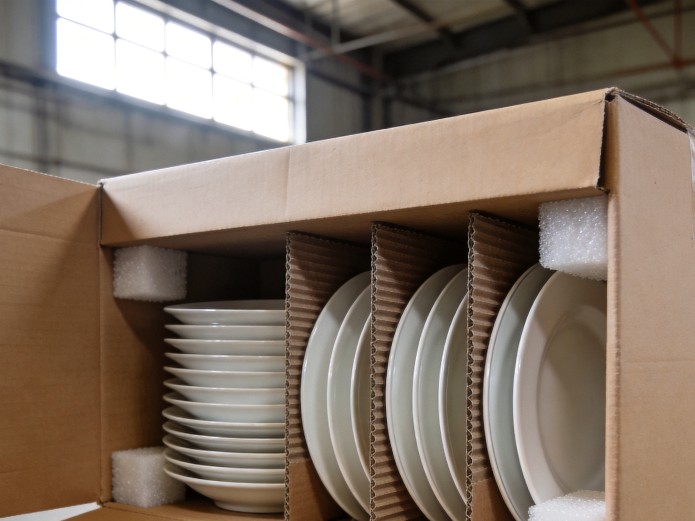
A ceramic tableware packaging test only protects a shipment when the procedure matches the route the carton actually travels, and for most importers it does not. ISTA 3A is the right instrument for a single parcel carton up to 70 kg moving through a courier network. ASTM D4169 is the right instrument for a pallet or a container load, but only if the buyer names the distribution cycle and the assurance level instead of accepting whatever the lab proposes. The two are not interchangeable, and neither defines a failure until someone writes it down. This article covers the decisions to settle before a lab touches your carton, the numbers a credible report must show, and the fields to check before you sign off on a pass.
Which Procedure Your Ceramic Tableware Packaging Test Should Use
Two facts decide the procedure: how the carton moves, and what it weighs packed. A single carton going through a courier or postal network is a parcel. A pallet, slip sheet, or container load is a unitized shipment, and parcel procedures were never built for it. Get that split wrong and the rest of the report is decoration.
ISTA’s own taxonomy explains why this matters more than the logo on the certificate. The 1-Series protocols are described by ISTA as screening tests “not designed to simulate environmental occurrences.” The 2-Series is “not intended to be predictive of shipping performance.” Only the 3-Series is presented as a predictive tool for understanding damage risk, and 3A is its parcel member. A supplier showing you an ISTA 1A certificate as proof that your carton will survive an export lane is handing you a benchmark, not a forecast.
The mapping is short: cartons up to 70 kg by courier, ISTA 3A; palletized or containerized loads, ASTM D4169 with a named cycle. A line reading “packaging tested to international standards” covers neither case.
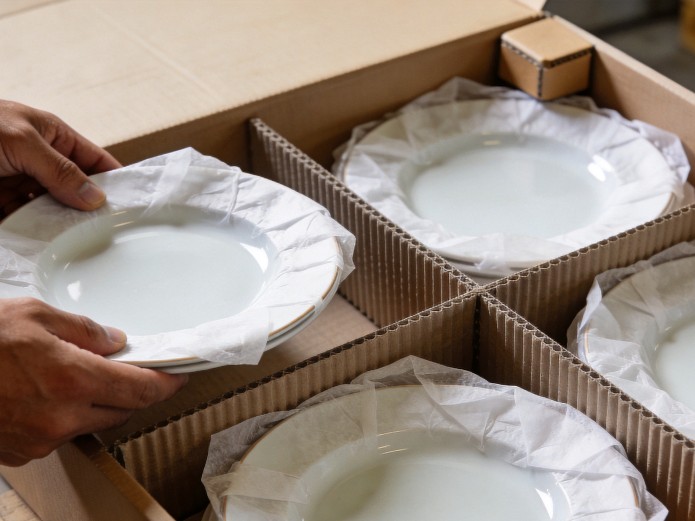
ISTA 3A: What a Ceramic Tableware Packaging Test Report Must Show
3A covers individual packaged-products of 70 kg (150 lb) or less prepared for parcel carriage, in four package types: standard, small, flat and elongated. Ceramics are not an edge case here. ISTA’s definition of fragile products in 3A names them explicitly, with glass, porcelain and clay, and that classification drives sample count.
The procedure requires one sample, recommends two or more for fragile and liquid products, and encourages five or more with fresh samples for statistical significance. A one-carton ceramic tableware packaging test is compliant with the letter of 3A and thin as evidence, a distinction worth making before you argue about breakage three months later.
The sequence runs unchanged through the carton: twelve hours ambient pre-conditioning, nine drops, random vibration with and without top load at overall Grms levels of 0.53 and 0.46, an optional low-pressure stage at 60 kPa for truck and air or 70 kPa for truck only, then eight more drops including one onto a hazard block. Flat packages add a rotational edge drop and a concentrated impact, elongated ones add a bridge impact.
Drop heights are where supplier documents and the procedure drift apart. These are the levels printed in 3A’s own test blocks for the first nine drops:
| Packed weight | Drops 1–7 and 9 | Drop 8, most damage-prone face |
|---|---|---|
| Under 32 kg (70 lb) | 460 mm (18 in) | 910 mm (36 in) |
| 32–70 kg (70–150 lb) | 300 mm (12 in) | 600 mm (24 in) |
That table has two bands, not five. The five-band ladder circulating in supplier datasheets and lab marketing pages, 762, 610, 457, 305 and 203 mm as the carton gets heavier, matches the height table used in ISTA’s 1-Series procedures. It is a real table and a real test, just not this one. A report titled ISTA 3A showing those five heights against a 10 kg carton contradicts the procedure it claims to follow.
One more line matters when packaging changes mid-program. 3A states that the basis weights of the corrugated papers should be determined and documented, and that if nominal basis weights change, even when the board still carries the same performance rating, a retest is appropriate. Downgrading a liner to hold a price keeps a report valid on paper and invalid in a container.
ASTM D4169: A Framework, and Why DC13 Often Fits the Wrong Shipment
D4169 is the other standard buyers name, and it is routinely reported as if it were a single pass-or-fail gate. It is not. The current edition, D4169-23e1, builds a test plan from three choices: one of eighteen distribution cycles, one of three assurance levels setting intensity, and a sequence drawn from ten schedules lettered A to J. The schedules run in order on the same units, which stay unopened until the sequence finishes.
Distribution Cycle 13 is the one buyers reach for when they mean courier delivery, because its description reads like it: air intercity plus local motor freight, single package up to 150 lb. The standard pushes back twice. Scope 1.2 says to consider Practice D7386 for packages shipped as single parcels, and the DC13 entry repeats it. A lab quoting DC13 without saying so is answering the question you asked rather than the one you meant.
For a pallet or container load the cycle is a different row entirely. A report reading “ASTM D4169, passed” without the cycle, the assurance level and the edition cannot be checked by anyone, including the lab that issued it six months later. Note also that D4169 treats its inch-pound values as standard and its SI figures in parentheses as information only.
Four Decisions to Settle Before a Lab Touches the Carton
Most packaging test disputes trace back to a decision nobody recorded, not to a carton that failed. Settle these four in the purchase order and the report becomes auditable.
| Decision | What it changes | Where it must appear |
|---|---|---|
| Route: parcel, LTL or unitized | Selects ISTA 3A, D7386 or a D4169 cycle | Procedure plus cycle and assurance level |
| Packed weight and package type | Sets the drop band and orientation set | Weighed gross weight and outside dimensions |
| What counts as failure | Separates product damage from package condition | Acceptance criteria agreed before testing |
| Sample count and configuration | Decides whether one carton proves anything | Number of units and the BOM of each |
The third row is the one buyers skip, and 3A writes it as an obligation on the shipper rather than the lab. Before testing, the shipper must state what constitutes damage, what tolerance is allowable, how product condition will be determined at the end, and what package condition is acceptable. If nobody wrote those down, the lab’s pass is opinion, not a criterion your supplier agreed to.
| Procedure | Route it models | Predictive? | What it cannot tell you |
|---|---|---|---|
| ISTA 1A | Screening benchmark | No | How the carton behaves on a real lane |
| ISTA 2A | Partial simulation | No | Shipping performance, by ISTA’s own wording |
| ISTA 3A | Single parcel, ≤70 kg | Yes | Anything about a palletized load |
| D4169 DC13 | Air plus local motor freight | Yes, with criteria | Parcel handling; D7386 is the closer fit |
| D4169 unitized cycle | Pallet or container | Yes, with criteria | Parcel handling of individual cartons |
Reading the Report: Fields That Decide Acceptance
A packaging test report runs a few pages, and most of the risk sits in what is missing rather than what is printed. This checklist is meant to be forwarded to a supplier as-is.
- Procedure, edition and year, for example ISTA 3A 2018 or ASTM D4169-23e1. An undated procedure cannot be verified.
- For D4169, the distribution cycle number and assurance level. For ISTA, the series and procedure letter.
- Laboratory name, accreditation body, and whether the procedure sits inside the accredited scope.
- Number of units tested, and whether they were production cartons or hand-built prototypes.
- Packed gross weight and outside dimensions per unit, weighed rather than calculated.
- Board grade with basis weight, ECT or burst value, including any liner change during the run.
- Conditioning temperature, humidity and duration actually held, not just the target.
- Drop heights used, orientation per drop, and whether the carton was opened between sequences.
- Vibration profile, Grms level, duration, and whether a top load was applied.
- Acceptance criteria as written before the test, the pass or fail call against each, and photos of any failure.
Two fields catch more problems than the rest. The weighed gross weight, because the drop band is chosen from it and a carton that gains 2 kg of filler between quote and production can cross from 460 mm to 300 mm unnoticed. And whether the tested units were production cartons: 3A asks for an untested actual package, with substitutes only where the real item is unavailable.

Three Ways a Packaging Test Report Misleads
1. The right procedure name over the wrong levels
The header says ISTA 3A and the height table shows five bands. Or the header says ASTM D4169 and no cycle appears anywhere. Both survive a casual read because the standard’s name is correct. Check the levels against the procedure text and treat any mismatch as a document defect, not a rounding issue.
2. One prototype carton, then a production change
A hand-built sample passes, then the factory switches divider grade, trims corner protectors, or drops liner basis weight to hit a price. ISTA’s position is that a basis weight change makes a retest appropriate even when the board rating is unchanged. For ceramics the practical rule is tighter: test the configuration you will ship, and re-test when the bill of materials moves.
3. A pass with no criteria behind it
The report says no breakage observed. It does not say which pieces were inspected, whether glaze crazing counted, whether the carton was opened at the end, or what package condition was acceptable. On dinnerware that sentence can coexist with rim chipping that only shows after three washes. Set the acceptance language first, then let the lab test against it; our guide to defect classification and acceptance standards is what we point buyers to when writing it.
What to Write Into the Purchase Order
Three changes turn a packaging test from a document you receive into a gate you control. Name the procedure, edition, cycle, level and acceptance criteria in the order itself, because email threads do not survive staff turnover, and make the pre-production test a condition of the deposit. A custom-printed carton, molded pulp insert or bespoke divider set is a different configuration and needs its own test. Then tie the tested unit to the production bill of materials, with notification required before any substitution. When several SKUs share one carton, test the heaviest and most fragile combination as the worst case.
The cost and lead-time trade-off is straightforward once you compare like with like. A 1-Series run is fast and cheap and yields a benchmark, not a prediction, so it belongs early in development. A 3A run costs more, needs a lab slot, and is the first result you can defend to a customer. A full D4169 plan costs most and takes longest, because cycle and criteria must be agreed before the sequence starts. Choosing the cheapest option shifts cost from the test budget to the claim budget.
The clause below is short enough to paste into a supplier agreement. Adapt the cycle and criteria, keep the rest.
Packaging qualification: the seller shall test the production packaging configuration to [ISTA 3A 2018 / ASTM D4169-23e1, Distribution Cycle [ ], Assurance Level [ ]] at an accredited laboratory, using [n] production-representative units at the packed gross weight stated in this order. Acceptance criteria: no product damage beyond [criterion], outer carton intact and closure functional. The report shall state procedure edition, cycle and level where applicable, laboratory accreditation scope, conditioning held, drop heights and orientations, vibration profile and top load, and the pass or fail call against each criterion, with photographs of any failure. Any change to board grade, basis weight, divider or corner protection requires retesting at the seller’s cost before shipment.
If you want the packaging side of that clause filled in against your own carton, request our export packaging specification with the packed weight and outside dimensions of the carton you ship most often. Buyers consolidating several SKUs usually find a single worst-case test covers the family. Our test report review guide, specification sheet and defect classification standards cover the adjacent ground, the hotel and catering range and commercial plates and platters show the carton configurations we build most often, and the damage claim process is worth reading before you ever need it.
Questions Buyers Ask Before Booking a Test
Is ISTA 3A enough for a pallet shipment?
No. 3A is scoped to individual packaged-products of 70 kg or less through a parcel delivery system and does not model a unitized load. For a pallet or container, use ASTM D4169 with a unitized distribution cycle, or an ISTA procedure written for unitized loads. A 3A report on a palletized program answers a question nobody asked.
How many cartons should a ceramic tableware packaging test cover?
3A requires one and recommends two or more for fragile products, with ceramics named in that definition, and encourages five or more with fresh samples. One carton meets the requirement and is thin evidence. Two is the practical minimum we suggest for a dinnerware program, at the packed weight you actually ship.
What drop height applies to a 12 kg carton of plates?
Twelve kilograms sits in the under-32 kg band, so the first seven drops and the ninth run at 460 mm, with the eighth drop on the most damage-prone face at 910 mm, and the second sequence repeating those bands. The five-band 762/610/457/305/203 mm ladder often quoted as 3A is the 1-Series height table.
Must a D4169 report name the distribution cycle?
Yes, or it cannot be checked. D4169 combines eighteen cycles, three assurance levels and ten schedules, and the cycle and level turn the framework into a specific test. A report citing only the standard number leaves the reader unable to tell which hazards were simulated or at what intensity.
Can a supplier reuse an old packaging test report?
Only if the procedure edition, the packaging configuration and the board grade are unchanged. ISTA states that a change in nominal basis weight makes a retest appropriate even when the board keeps the same rating. Treat any change in divider, corner protection or carton supplier as a trigger to re-test.


