

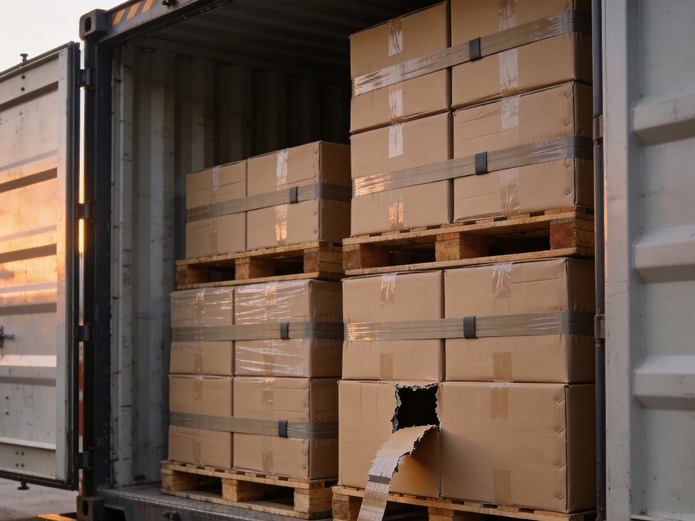
Ceramic tableware damage claims are won or lost in the first 72 hours after the container door opens, long before anyone argues about fault. Photograph the seal before cutting the bolt, count cartons before opening them, and serve written notice on the carrier inside the clock that applies to your route. Do that and a claim has a chance. Unpack first and photograph afterwards, and you are arguing against your own delivery receipt.
This guide is for importers, hospitality buyers and private-label brands receiving glazed ceramic from Asia: the deadlines that bind you, what the carrier and policy each pay, the evidence a surveyor accepts, and the four routes to recover money.
Three clocks start when the container door opens
Buyers lose claims by working to the wrong deadline. There is no single notice period: it depends on which convention governs the damaged leg, and the shortest clock governs the shipment.
| Regime | Apparent damage | Concealed damage | Long stop |
|---|---|---|---|
| CMR (road, Europe and much of Asia) | Reservations at delivery | Seven days, Sundays and holidays excluded, in writing (Art. 30(1)) | One year, three for wilful misconduct (Art. 32(1)) |
| Hague-Visby (sea, most non-US bills) | Notice before or at removal | Three days (Art. III r.6) | One year |
| COGSA (sea, US trades) | Notice at or before removal | Three days (Sec. 3(6)) | One year; suit must be filed |
| Bill of lading terms | As printed | As printed | Often shorter contractually |
The consequence catches importers constantly. A container that discharges at a seaport and travels inland by truck is on the sea clock for the ocean leg, and three days can expire while the cartons are still on it. Serve notice at discharge naming the container and the general nature of suspected damage, then follow up after the count. A general indication is enough under CMR Art. 30(1); you do not need the full picture.
Signing a clean delivery receipt is the most expensive signature in this process. CMR Art. 30(1) makes taking delivery without checking condition, and without sending reservations, prima facie evidence that you received the goods as described. You are not merely missing evidence; you are holding it against yourself.
What the carrier owes, and why the cap is rarely your problem
Most buyers assume the carrier’s liability limit is why the claim is worthless; for glazed tableware that is usually wrong. Take 100 cartons at 12 kg gross, so 1,200 kg gross, at 1 SDR = USD 1.35611 (IMF, 30 April 2025; the rate moves, so re-convert when you file).
| Route | Limit basis | On 100 cartons / 1,200 kg | Approximate USD |
|---|---|---|---|
| CMR | 8.33 units per kg gross short (Art. 23(3)) | 9,996 SDR | 13,556 |
| Hague-Visby | Higher of 666.67 SDR per package or 2 SDR per kg (Art. IV r.5(a)) | 66,667 SDR, per package | 90,408 |
| COGSA | USD 500 per package (Sec. 4(5)) | USD 50,000 | 50,000 |
Compare with the invoice. A 1,200 kg consignment at USD 8/kg FOB is about USD 9,600. Every statutory cap sits at or above cargo value, so the cap is not what kills ceramic tableware damage claims; notice deadlines, causation and the packing clause are.
The Hague-Visby test is lopsided here. A 12 kg carton carries roughly USD 904 per package against USD 32 per kg, so the package route wins about 27x: generous for light cartons, nearly irrelevant at dinnerware value density, reversed for dense stoneware in heavy crates. Confirm in writing which unit your bill of lading counts as a package.
The bigger obstacle is the carrier’s own defence. Under CMR Art. 17(4)(d) the carrier is relieved of liability where loss arises from goods particularly exposed to breakage, and Art. 18(2) then presumes that cause. Tableware sits squarely inside the clause. Rebut it with origin evidence: an AQL record showing the goods left in specification, photographs of intact cartons at loading, and a breakage pattern pointing at a handling event rather than ordinary fragility.
Why CIF cover usually pays nothing for breakage
This part costs more than the carrier claim ever does. Under Incoterms 2020 a CIF seller arranges only minimum cover, Institute Cargo Clauses (C); broader cover, Clauses (A) or all risks, is the CIP obligation. Buyers who accept CIF believing breakage is insured are insured against almost nothing that happens to tableware.
Clauses (C) covers a closed list: fire or explosion, vessel stranded, grounded, sunk or capsized, overturning or derailment of a land conveyance, collision with an external object other than water, discharge at a port of distress, general average sacrifice and jettison. Crushed cartons from a bad stack, a dropped pallet, or handlers standing on dinnerware are not on that list. Documentation cannot change it, because the loss never fell inside the cover.
Clauses (A) is necessary but still not sufficient. Clause 4.3 excludes loss caused by insufficiency or unsuitability of packing to withstand the ordinary incidents of the insured transit, where that packing was done by the assured or their employees or before cover attached. Then comes the sentence that decides ceramic claims: packing is deemed to include stowage in a container. When a floor-loaded container arrives with the bottom layer crushed, the insurer can argue container loading was the deficient packing.
Two clauses do quiet work. Clause 16.2 requires the assured to preserve all rights against carriers, bailees and other third parties, which is why an insurer can reduce a claim when you never served carrier notice. Clause 8.1.4 ends cover 60 days after discharge, so a container left at port while paperwork is sorted can fall outside cover before anyone inspects it.
So the carton specification in your purchase order, divider thickness, layers per carton, drop height the carton must survive, is not a packaging preference. It is the document your insurer reads when you claim. “Export carton, suitable for sea freight” opens the door; stated construction and a tested drop height close it. For the format we quote with, request our export packaging specification.
The 72-hour evidence pack
A surveyor does not decide whether you are honest. A surveyor decides whether the file supports the cause of loss you asserted. Build it in this order; the order is itself part of the evidence.
- Seal and door, before cutting. Container and seal number, seal intact, one wide shot. This separates a carrier event from a terminal or warehouse event.
- Container interior, before unloading. Load distribution, collapsed stacks, a shift line. This is the image that wins causation arguments.
- Carton count against the packing list, with the delivery receipt in frame. Count and paper in one photograph.
- Each damaged carton individually, carton mark legible. Crushed corner, puncture, water line, compression band. Not a pile; one carton, one frame.
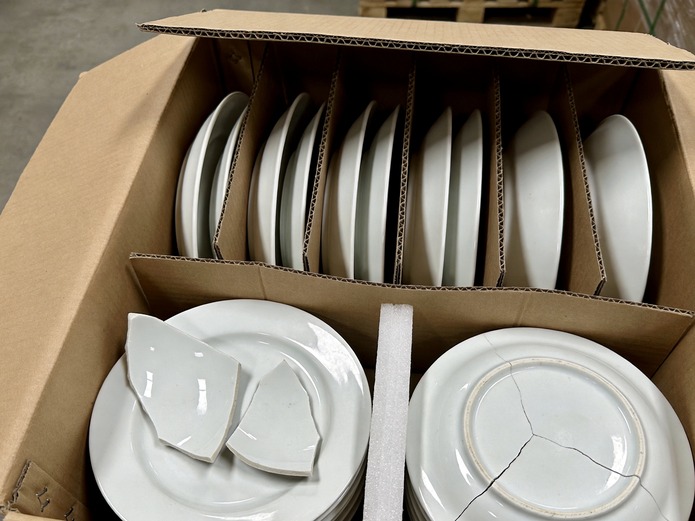
- Open one carton at a time and photograph contents in place before removing anything, then keep the broken pieces and count them per carton. A surveyor counts, and a count matching your notice beats a description.
- Record the breakage pattern: bottom layer only means compression, one face only means impact, scattered means handling.
- Serve the written reservation the same day, naming container, bill of lading, carton range and general nature. Do not wait for the count.
- Photograph the pallet or floor under the load, and preserve the origin file: AQL record, loading photographs, signed packing specification. That rebuts the fragility defence.
Then get the survey moving, because it changes the legal position. Hague-Visby Art. III r.6 removes the notice requirement where condition was jointly surveyed at the port of discharge, converting a deadline problem into an evidence problem, and evidence can be argued later while a missed deadline usually cannot. Under CMR the effect is narrower: Art. 30(2) admits evidence contradicting a joint check only for damage that is not apparent, and only if written reservations were sent within seven days.
Book the surveyor before the container is released and ask the carrier and forwarder in writing for a joint inspection. If they decline, keep the refusal in writing; it undermines any later argument that you failed to cooperate. If they attend, you hold a record signed on both sides. Loading is the upstream half, and how many pieces actually fit in a container explains why floor loading and stack height drive the bottom-layer failures.

Four routes to recover, and what each costs
Once the file exists, the question is commercial: which route returns the most money per hour of attention. The four are not mutually exclusive, but most buyers test only one. Exposure scales with mix, so price the decision against your programme, whether hotel and catering dinnerware with fixed service dates or commercial plates and platters sold by the case.
| Route | Best when | Pace | Recovery | Hidden cost |
|---|---|---|---|---|
| Replacement or credit | Damage traces to the carton spec | Next production run | Piece count, no depreciation | Freight and duty paid twice |
| Carrier claim | Seal intact, container-level event | Weeks to months | Capped, often a fraction | Causation plus fragility presumption |
| Cargo insurance | Clauses (A) or (B), insured peril | Four to twelve weeks | Insured value less deductible | Clause 4.3 exclusion, 16.2 duty, 60-day window |
| Write-off | Low value or unsellable decoration | Immediate | Nothing | Full cash loss, carried to your customer |
Custom-decorated SKUs deserve a note. A house logo on a rim means broken pieces have no resale value and no salvage, so a write-off is total. That asymmetry is your strongest argument for a remake rather than a credit, and the claim process belongs inside the contract, which is why the clauses a ceramic purchase contract should carry include a damage and remedy section.
On MOQ and lead time, a replacement rarely needs a standalone order. Ask for it to ride the next scheduled run for that SKU, avoiding a small-lot surcharge and separate setup. If the shortage is urgent, a partial air shipment is often cheaper than losing a hotel opening.
The notice that survives a first rejection
First rejections are normal and usually about form, not merit. The claims desk looks for a notice that identifies the shipment, states a general nature of loss, reserves rights, and asks for something specific. Write it once and reuse it.
Subject: Notice of damage and reservation of rights, container [number], bill of lading [number], delivered [date]
- We received the above consignment on [date] at [place], [number] cartons against packing list [reference].
- On opening, [number] cartons show [crushed bottom-layer corners / broken pieces / water staining]. The count is not yet complete.
- This notice reserves rights under [CMR Art. 30 / the bill of lading / applicable convention] and is not a final statement of loss, including as to full goods value, replacement freight and survey costs.
- We request a joint survey at [address] and propose [surveyor] on [date]. Please confirm attendance or nominate your surveyor within [number] days.
- Attached: seal, interior, carton count, delivery receipt and carton photographs. Further particulars follow within [number] days, without prejudice.
Two lines do most of the work. The reservation of rights stops the notice being read as a closed claim at zero value; the joint survey request puts a dated obligation on the carrier and creates a record if it declines. Do not replace either with an email asking what happens next.
Three mistakes, and three fixes before the next container
Unpacking before documenting. Once cartons are opened and pieces moved, container-level evidence is gone for good: no second visit, no way to reconstruct which layer a piece came from.
Claiming against the wrong party. The forwarder you booked is frequently not the carrier named on the bill of lading, and the terminal is neither. A notice served on the party who merely arranged the move leaves the real carrier’s clock running while you believe you have complied.
Accepting a credit without pricing the alternative. A percentage credit arrives quickly because it closes the conversation. On custom decoration, or a SKU with a booked launch, the credit may be worth less than a remake plus air freight. Price both first.
Three fixes, in order of return on effort. Put a claim protocol into the purchase order: photograph sequence, notice deadline per leg, right to a joint survey, who bears replacement freight. Name a surveyor at destination before the first container ships, since arranging one inside 72 hours is where files stall. And require a documented carton drop test at your stated height, then keep the record, because that document moves a claim from fragility to handling. For private-label orders, write these terms into the OEM and ODM programme brief rather than appending them later.
None of this makes damage less likely; it changes what happens afterwards, the part a buyer controls. Before the next run, compare carton specifications against our export packaging and shipping guide and the defect dispute documentation workflow for the pre-shipment half of the file, and fix the claim terms during custom ceramic tableware development, the cheapest moment to do it.
Frequently asked questions
How long do I have to report damaged ceramic tableware?
It depends on the leg. Under CMR, seven days from delivery for damage that is not apparent, Sundays and holidays excluded, plus reservations at delivery for visible damage. Under Hague-Visby and COGSA the concealed-damage window is three days. Where sea and road legs combine, assume three days governs and serve notice at discharge.
Does CIF insurance cover broken plates?
Usually not. CIF requires only Institute Cargo Clauses (C), a closed list of named perils such as fire, stranding and collision. Breakage from stacking, dropping or handling is not on that list. Even Clauses (A) can be defeated by Clause 4.3, which treats container stowage as part of packing.
Can I claim if I already signed the delivery receipt?
Much harder, but not impossible. A clean receipt is prima facie evidence that you received the goods as described. You can still argue concealed damage and file written reservations inside the window, but the burden shifts onto your own file rather than the carrier’s conduct.
Why should I keep the broken pieces?
Because a surveyor counts them. A per-carton count matching your notice and the packing list establishes scale of loss without argument. Discarded pieces cannot be counted later, and a photograph of a pile is not a count.
Who pays freight on replacement goods?
Whoever the purchase order says. Many buyers assume the supplier absorbs it and find out at the invoice. State replacement freight, duty on replacement value and survey costs in writing before the run, and say who bears each.
Is a supplier credit faster than a carrier claim?
Almost always, and that is the trade-off. A credit closes in weeks and preserves the relationship, while ceramic tableware damage claims against a carrier need causation evidence and can run months against a capped limit. Test the remake option before accepting either.


