

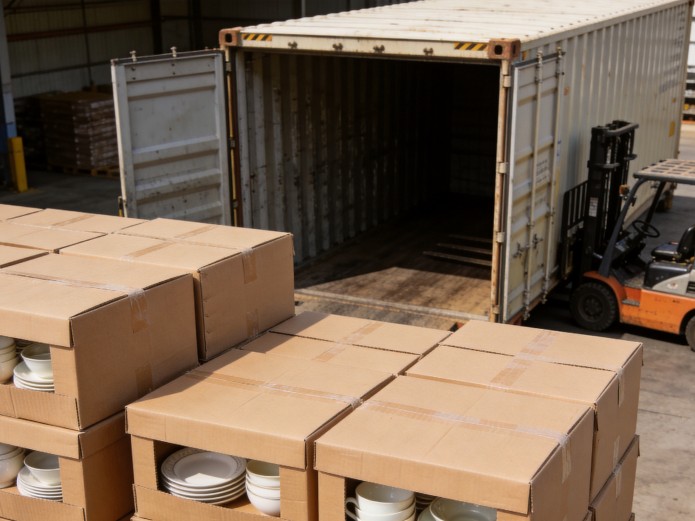
Ceramic tableware container loading is set by carton geometry, not by the payload rating painted on the container. A standard 40ft carries a payload rating of 28,750 kg, yet a full grid of dinnerware cartons in our worked examples came to between 5,472 kg and 22,680 kg across the three container sizes, because the cartons run out of space long before they run out of weight. Payload use ranged from 19% to 79%.
That gap is where freight money leaks. Buyers compare FOB prices per piece, then find freight per piece differs by 26% between two suppliers packing the same plate in 44 cm and 48 cm cartons. What follows is the arithmetic to check a supplier’s loading quantity, and the thresholds at which a small carton change moves a whole container.
Why payload rarely limits ceramic tableware container loading
Weight binds only when cargo is dense relative to volume. Ceramic packs the opposite way: plates and bowls trap air between rims, and dividers protect them while adding no saleable weight. Take a 40ft rated for 28,750 kg whose grid fits 945 cartons of 10.5-inch plates. To reach the payload limit, each carton would need to average 30.42 kg gross. Real cartons in that size class run near 17 kg, leaving 44% of the payload unused. On a 600-carton bowl grid, the payload would permit 47.92 kg per carton — a weight no 36-piece carton of 6.5-inch bowls approaches.
So a supplier’s answer to “how many pieces fit in a 40ft container” tells you nothing until you know the carton it assumes. Any figure built from payload rather than from a carton grid is overstated. The check you need is geometric, and it takes four steps.
Four steps from carton size to pieces per container
Measure the carton as it ships: closed, taped, dividers and inner wrap in place. Specification sheets often quote the empty carton or a retail shelf pack, and 15 mm in any direction can change the count.
- Carton volume. Multiply length, width and height in centimetres, divide by 1,000,000 for cubic metres. A 44 × 44 × 34 cm carton is 0.0658 CBM.
- Cartons per container. Divide each internal container dimension by the matching carton dimension, round each down to a whole number, multiply the three. Try all six carton orientations and keep the highest result.
- Pieces. Cartons × pieces per carton. This is the number you compare across suppliers.
- Binding constraint. Cartons × gross carton weight against payload. Over payload means weight-bound; under means volume-bound and the piece count stands.
As a spreadsheet formula for a standard 40ft:
cartons = FLOOR(12032/a) * FLOOR(2352/b) * FLOOR(2395/c)
pieces = cartons * pcs_per_carton
weight_used = cartons * kg_gross_per_carton
binds = IF(weight_used > 28750, "weight", "volume")
For the 44 × 44 × 34 cm plate carton at 24 pieces, that gives 27 × 5 × 7 — 945 cartons, 22,680 pieces, 62.2 of 67.7 CBM used. The same carton in a 20ft gives 455 cartons, 10,920 pieces. That 2.08× ratio decides whether a second container is a growth step or a rounding error.

Instead of recomputing per carton, keep these thresholds: the largest carton dimension, in millimetres, that still reaches a given number of tiles in each direction inside a standard container. A carton just above a threshold is a container you cannot fill.
| How cartons tile | 3 / 4 / 5 / 6 / 7 across | 20 / 24 / 25 / 26 / 30 along (40ft) |
|---|---|---|
| Max carton dimension | 783 / 588 / 470 / 391 / 335 mm | 601 / 501 / 481 / 462 / 401 mm |
| Layers, standard 2,395 mm | 5 ≤ 479 mm · 6 ≤ 399 mm · 7 ≤ 342 mm · 8 ≤ 299 mm | |
| Layers, high cube 2,700 mm | 5 ≤ 540 mm · 6 ≤ 450 mm · 7 ≤ 385 mm · 8 ≤ 337 mm | |
Two thresholds matter most in tableware. Up to 470 mm wide gives five across a 2,352 mm floor; at 471 mm you drop to four and lose a fifth of the floor. Up to 445 mm long gives 27 positions along 12,032 mm; at 446 mm, 26.
20ft, 40ft or 40HC: what each container actually returns
Internal dimensions, capacity and payload below are one published carrier equipment example, attributed by iContainers to Hapag-Lloyd. Treat them as reference, not a universal specification, and confirm the assigned unit before committing a loading plan.
| Container | Internal L × W × H | Capacity | Max payload | 10.5″ plates, 24/carton | 350 ml mugs, 36/carton | When it wins |
|---|---|---|---|---|---|---|
| 20ft standard | 5.900 × 2.352 × 2.395 m | 33.2 CBM | 28,130 kg | 455 ctns / 10,920 pcs | 686 ctns / 24,696 pcs | First orders, mixed SKUs, low MOQ |
| 40ft standard | 12.032 × 2.352 × 2.395 m | 67.7 CBM | 28,750 kg | 945 ctns / 22,680 pcs | 1,421 ctns / 51,156 pcs | Repeat volume, single-SKU depth |
| 40ft high cube | 12.032 × 2.350 × 2.700 m | 76.3 CBM | 28,600 kg | 1,050 ctns / 25,200 pcs | 1,624 ctns / 58,464 pcs | Stackable cartons, tall items |
The high cube carries 8.6 CBM more than the standard 40ft — 12.7% — but slightly less payload, and extra volume never implies extra weight capacity. What does constrain it is the door: 2,597 mm against 2,292 mm on a standard container, so any palletised load must clear the door before the internal height counts. Whether you can spend that extra 305 mm depends on whether the carton stack takes another layer. On the plate carton it buys one layer, 105 cartons or 2,520 plates; on the bowl carton it also changes orientation, lifting the count from 600 to 750.

Where the 85% rule breaks, and the 10 mm that moves 25%
The usual shortcut multiplies container CBM by 0.85 and divides by carton CBM. It is a fair first estimate and a poor purchase-order basis, because it ignores the rounding cartons force in every direction.
| Carton (assumed example) | 85% estimate, 40ft | Carton grid | Gap | Gap in pieces |
|---|---|---|---|---|
| 10.5″ plate, 24 pcs, 44×44×34 cm | 874 cartons | 945 cartons | −8.1% | −1,704 |
| 350 ml mug, 36 pcs, 41×31×31 cm | 1,460 cartons | 1,421 cartons | +2.7% | +1,404 |
| 6.5″ bowl, 36 pcs, 48×48×36 cm | 693 cartons | 600 cartons | +13.4% | +3,348 |
| 14″ oval platter, 12 pcs, 42×36×40 cm | 951 cartons | 900 cartons | +5.4% | +612 |
The gap runs both ways, which is the point: the 85% rule is neither systematically conservative nor generous. On one carton it understates capacity by 8%, on another it overstates by 13%. Either error sends a buyer back to renegotiate freight after the booking is fixed.
Now the counter-intuitive part. Take the 6.5-inch bowl carton at 48 × 48 × 36 cm: 25 × 4 × 6 on a 40ft, 600 cartons. Narrow it 10 mm to 47 cm and the width tile moves from four to five — 25 × 5 × 6, 750 cartons. That is 25% more product and 22.4% more loaded volume in the same container, from a change no buyer would notice on a spec sheet.
The effect runs in reverse too. The plate carton at 44 × 44 × 34 cm fits 27 along the container’s length. Ask for 45 × 45 cm — a normal request when a supplier adds heavier edge protection — and the length tile falls to 26: 910 cartons, 35 fewer, 840 fewer plates, against only 4.6% more carton volume.
This is why carton dimensions belong in the purchase contract, not only in a packing note: dimensions with a tolerance, plus a loading quantity both parties computed from them, keep a shipment from arriving 25% short of what the order implied.
Container load-planning checklist before you accept a quote
- Carton measured, not read. Shipped carton, taped with dividers, in centimetres, for every SKU.
- Grid run in all six orientations. The obvious upright orientation is sometimes not the best one.
- Binding constraint named. Volume-bound or weight-bound, with the number that proves it.
- Door clearance checked if palletised. A 2,292 mm door rejects a 2,350 mm stack that fits the internal height.
- Efficiency stated honestly. If grid and 85% estimate diverge by more than 5%, trust the grid.
- Verified gross mass arranged. SOLAS chapter VI, regulation 2 requires the shipper to verify the packed container’s gross mass before loading, by one of two prescribed methods, on a document signed by an authorised person.
- Stack height tested against carton compression strength. Seven layers is a load the bottom carton must survive, not just a number.
- Loading quantity written into the order. Carton size with tolerance, pieces per carton, cartons per container, and the basis of the calculation.
Three mistakes that inflate your per-unit freight
Accepting a loading quantity without carton dimensions. A supplier quoting “1,000 cartons per 40ft” may be right, may be quoting a carton they no longer use, or one sized for a lighter product. Without three dimensions you cannot tell. Ask in centimetres and run step two; it takes a minute and turns a claim into a number someone can be held to.
Optimising the carton for the shelf instead of the container. A carton built to divide evenly into a pallet or a display-ready bay is often a poor fit for a 2,352 mm floor. The freight cost lands on the buyer while the merchandising benefit lands on the retailer. If you need both, price the container loss against the shelf gain before approving artwork.
Assuming a high cube solves a capacity problem. It adds height, not floor. A non-stackable load — shallow platters, or a divider set that cannot take another tier — gains little and still pays the high cube rate. Check that the carton accepts an extra layer. On the platter example the high cube does deliver 20% more pieces; on a load that cannot stack it delivers nothing.
FCL or LCL: the trade-off you are actually making
No universal cubic-metre figure separates FCL from LCL. Anyone quoting “switch at 15 CBM” is quoting a rule of thumb that depends on lane, season, carrier and commodity. LCL prices the space you use, so cost per cubic metre is higher, but you pay only for what ships.
Three trade-offs matter. On cost, FCL fixes freight per container and rewards filling it, so per-piece freight falls as the grid fills; a half-empty 40ft is worse than a well-planned LCL booking. On lead time, LCL adds consolidation and deconsolidation at both ends, a real scheduling cost for a fixed launch date. On quality, every extra handling of a palletised ceramic load is another chance to break it, and co-loaded LCL freight is handled more often than a sealed container.
The decision that actually matters is whether your order rounds to a container you can fill. At an MOQ of 8,000 pieces against a 20ft that holds 10,920, you can fill it. At the same MOQ against a lane offering only a 40ft that holds 22,680, you are paying for empty slots or moving to LCL — and that belongs at the quoting stage, not after the container is stuffed. Customisation sits in the same calculation: a carton resize means new artwork, new dielines and new packaging validation, so treat it as a packaging change with a test attached — the same discipline that applies to any OEM or ODM tableware project. A drop test to ASTM D5276, or the ISTA procedure matching your distribution channel, is the evidence that a narrower carton still protects the ware.
Send us the carton dimensions, pieces per carton and gross carton weight per SKU, and we will return the grid for 20ft, 40ft and 40HC side by side with the binding constraint named. If you are still choosing between commercial plates and platters and wholesale ceramic mugs, we can run both so freight per piece is visible before you commit to a mix. Request a container loading estimate for your product mix.
Questions buyers ask before booking
How many 10.5-inch plates fit in a 40ft container? On an assumed 44 × 44 × 34 cm carton of 24 plates, 945 cartons, or 22,680 pieces, using 91.9% of the cubic capacity and 56% of the payload. Change any of those three assumptions and the answer changes, which is why the dimensions belong in the question.
Why is my container half empty when the weight is nowhere near the limit? Because the load is volume-bound. Dividers and rims trap air, so cartons exhaust the space at 19% to 79% of payload in the examples here. Weight binds only on dense, tightly packed small items.
Is a 40ft high cube always better than a standard 40ft? Only when the extra 305 mm converts into another layer. It holds 12.7% more volume and slightly less payload, and its advantage disappears on a load that cannot stack.
Does a smaller carton always mean more pieces per container? No. Capacity moves in steps. Going 48 to 47 cm wide moved a bowl carton from 600 to 750 per 40ft; going 44 to 45 cm on a plate carton cost 35 cartons and 840 pieces. The step is what you buy, not the volume.
What weight do I declare for the container? The verified gross mass. The guidelines implementing SOLAS prescribe two methods: weigh the packed container, or weigh all packages and cargo with the tare added by a certified method. There is no third route, so a figure calculated from carton counts is not a verified gross mass.
Can I mix SKUs in one container? Yes, but the grid gets harder. Mixed cartons rarely tile evenly and the last row is the expensive one. Compute each SKU separately, then test whether the remainder still fits.
Where these figures come from. Container figures are iContainers’ published equipment examples, attributed there to Hapag-Lloyd: 20ft dimensions, 40ft dimensions, 40ft high cube dimensions. ISO 668:2020 classifies series 1 containers by external dimensions and ratings and leaves internal dimensions to the ISO 1496 series, which is authoritative for them. The verified gross mass requirement and its two methods are from the IMO guidelines implementing SOLAS chapter VI, regulation 2 (MSC.1/Circ.1475, sections 5.1 and 6.2). Packaging references are ASTM D5276, which states it fulfils ISO 2206 and ISO 2248 for containers up to 50 kg, and the ISTA procedure series, where the right procedure depends on the distribution channel. All carton dimensions in the worked examples are assumed for illustration, not taken from a live production specification.
On the buying side of the same decision: how to specify the packing fields on a ceramic tableware specification sheet, what drives shipping costs and Incoterms once the container is booked, how piece weight changes freight and breakage, and how MOQ tiers and production lead time interact with container rounding. For packing practice, see ceramic packaging and shipping.


