

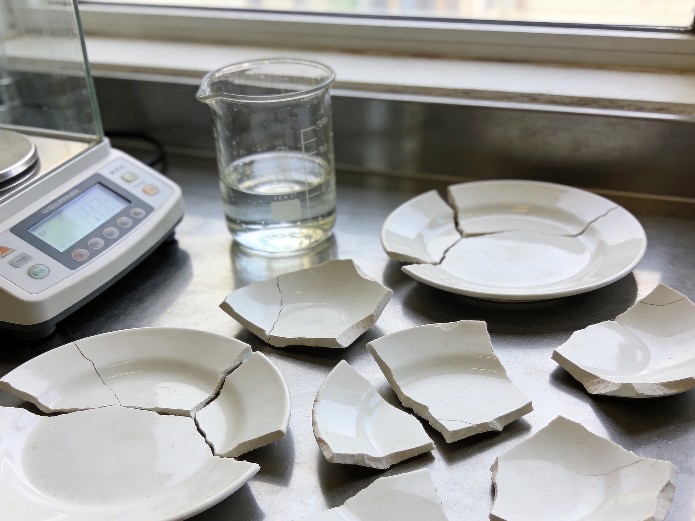
Ceramic tableware water absorption is the one number that decides whether a body may be described as porcelain, and it is the number most often reported without the information needed to trust it. Two suppliers can both send a certificate reading 0.3% while one measured a freshly fractured unglazed shard under ASTM C373 and the other measured a whole glazed plate under a tile method never written for dinnerware. The figure looks identical; the claim behind it is not. What follows is which standard governs your ware, which method branch gives a defensible result, and the seven fields that decide whether a report is worth accepting.
What Ceramic Tableware Water Absorption Actually Measures
Ceramic tableware water absorption is a property of the body, not the glaze, and it measures one thing: the volume of interconnected pores water can reach under the test conditions. EN 1217 defines it through the open porosity of the body and treats the result as an indication of how far the body has vitrified. Low absorption means a well-matured body; it does not by itself mean a strong one, or one that survives a commercial dishmachine.
The two quantities are not interchangeable. Absorption is water mass divided by dry mass; open porosity is the same water volume divided by exterior volume. They differ by bulk density, so identical pore structure reads differently on light and dense bodies: at 1.0% open porosity, a body of 2.60 g/cm3 reads 0.385% absorption while a body of 1.40 g/cm3 reads 0.714%. Run the identity the other way and two bodies both reporting exactly 0.5% can differ by nearly a factor of two in open pore volume.
Which document governs the claim depends on the ware, and the governing texts are not the ones most certificates cite. ISO 5644:2024, Porcelain Tableware, written by ISO/TC 166 for ware used in preparing and serving food, defines porcelain as glazed, vitrified, impervious, white or artificially coloured, translucent and resonant, with body absorption below 0.5% by EN 1217:1998 Test Method A. Hard paste, soft paste, china, bone china and vitreous china inherit that ceiling. Bone china adds a floor of at least 35% by mass of the fired body as tricalcium orthophosphate, introduced as bone ash.
Two details there are commercially useful. Resonance is named as a defining property alongside translucency, which gives the ring test a documentary basis instead of leaving it as workshop folklore. And because 0.5% is shared by every porcelain family, a certificate offering 0.1% or 0.05% for bone china promises something tighter than any standard requires; treat that as the supplier’s own target, which still has to be demonstrated. The Chinese route differs, as the material types comparison notes: GB/T 3532-2022 sets fine porcelain at or below 0.5%, ordinary porcelain at 1.0% and stoneware at 5.0%, tested per GB/T 3299, which is a non-equivalent adoption of ASTM C373-88.

The Method Branch That Decides Whether the Number Is Valid
Every standard here contains more than one way to saturate a specimen, and the branches are not interchangeable. EN 1217 describes three. Method A boils specimens under defined conditions and requires specimens with not more than one glazed surface. Method B uses the same principle with a longer boil. Method C evacuates the specimen before immersion and boiling, permits specimens glazed on both faces, and draws them from different parts of the article so uneven firing shows up. The note prefers Method C for very low absorption, and the introduction records that Method A exists because European customs classification of vitreous and semi-vitreous china was built on it.
The apparatus clauses are where most reports quietly fail. Methods A and B specify a balance accurate to 0.05 g and state no minimum specimen mass. Method C specifies 0.001 g for specimens of 5 g to 20 g and a vacuum pump holding 2.5 kPa plus or minus 1.5 kPa. ASTM C373 goes the other way: five unglazed, freshly fractured, crack-free specimens of at least 50 g each, dried at 150 C to constant mass, boiled five hours then soaked 24 hours, weighed to 0.01 g. Its title is the most instructive sentence in the field, naming a vacuum method for pressed tiles and glass tiles and a boil method for extruded tiles and non-tile fired ceramic whiteware.
Set those apparatus specifications side by side and the arithmetic explains much supplier behaviour. A 0.05 g balance read on a 10 g shard moves the reported ceramic tableware water absorption by 0.5 percentage points in a single increment, which is the entire porcelain tolerance; on a 20 g shard the increment is 0.25 points. Under ASTM C373, a 50 g specimen on a 0.01 g balance moves 0.02 points. A report quoting 0.42% from a small specimen weighed to 0.05 g is not evidence of tight kiln control; it is evidence the method could not see the difference it claims.
ASTM C373 also warns that excessive blotting withdraws water from the pores, and states precision of about 0.2 points between laboratories and 0.1 points for one experienced operator. A supplier presenting a 0.05 point margin against a 0.5% limit is therefore presenting less than the method’s own reproducibility. That is not fraud; it is a claim the cited test cannot support.
Which Standard Sets Which Limit
The limits compare more easily than the methods, provided each stays attached to the ware it was written for. Read the table as a map of which number a supplier may quote, not as a ranking.
| Ware claim | Governing document | Method branch | Absorption limit |
|---|---|---|---|
| Porcelain, china, hard or soft paste, vitreous china | ISO 5644:2024, clause 3.3 | EN 1217:1998 Test Method A | Below 0.5% of body mass |
| Bone china | ISO 5644:2024, clause 3.3.2.2 | EN 1217:1998 Test Method A | Below 0.5%, plus at least 35% tricalcium orthophosphate in the fired body |
| Fine porcelain, ordinary porcelain, stoneware | GB/T 3532-2022, clause 5.1 | GB/T 3299, non-equivalent adoption of ASTM C373-88 | At or below 0.5%, 1.0% and 5.0% |
| Ceramic versus pottery by absorption | GB/T 5001, domestic ceramics classification | Same national method family | Pottery above 5.0%, porcelain at or below 5.0% |
| Ceramic tile groups | ISO 13006:2018, tested per ISO 10545-3:2018 | Vacuum impregnation only since 2018 | Tile bands, lowest band at or below 0.5% |
A limit is meaningful only paired with the method that produced the figure, which is why the third column is not decoration. The last row exists to be recognised and refused: tile classification describes fired floor and wall product, not dinnerware, and answers a different question even when the percentage looks familiar. The customs classification guide shows why this matters commercially, since the tariff categories for ceramic tableware are themselves split by body absorption.
Why a Glazed Plate Cannot Be Measured Like a Tile
A finished dinner plate is glazed on both faces, and that single fact disqualifies several methods buyers assume are universal. EN 1217 Method A requires specimens with not more than one glazed surface, so an intact glazed plate cannot be its specimen; either a face is ground free of glaze or Method C is used. ASTM C373 asks for unglazed pieces with freshly fractured surfaces, which is why a compliant ceramic tableware water absorption test consumes ware rather than inspecting it.
The tile route is the more expensive mistake because it arrives looking official. ISO 10545-3:2018 states that its method applies to the classification of tiles and product specifications, and its foreword records that impregnation is now by vacuum only and the boiling method has been removed. A report dated after 2018 citing ISO 10545-3 and describing a boil has either mislabelled its method or described something the standard no longer contains.
How far apart the branches sit is documented in the Chinese revision work that aligned GB/T 3810.3 with ISO 10545-3:2018. That drafting explanation states vacuum fills open pores more effectively, boiling relies on natural penetration and may leave closed pores incompletely filled, vacuum therefore reads slightly higher, and the difference runs roughly 0.1 to 0.5 percentage points depending on the material, widening on bodies with more closed porosity. Against a 0.5% ceiling, that gap is the entire decision.
Seven Fields to Check Before You Accept the Report
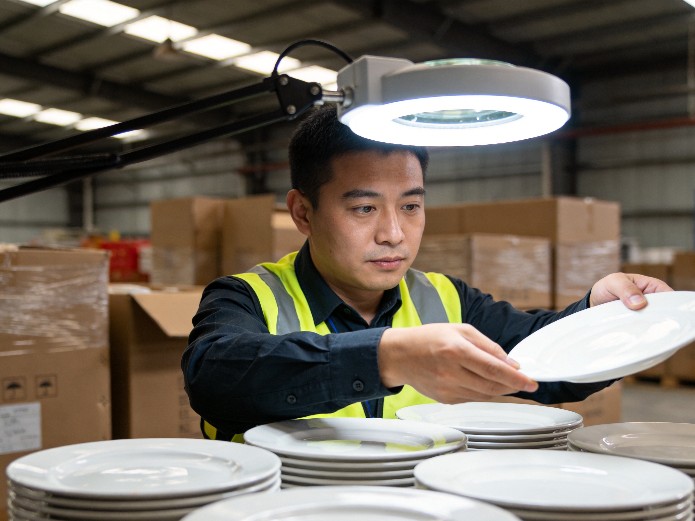
A report can be genuine, from an accredited laboratory, and still useless if it omits the fields that make the number reproducible. Check these before the paperwork reaches accounts payable.
- The standard, edition and method letter, written as text rather than implied by a logo. EN 1217 Method A and Method C are different tests.
- Specimen description: glazed or unglazed, how many faces carried glaze, whether the surface was freshly fractured, and from which part of the article.
- Dry mass of every individual specimen, which is what lets you compute the resolution the balance could actually achieve.
- Balance readability and oven temperature, since 0.05 g and 0.001 g make the same specimen two different measurements.
- Individual results beside the average. ASTM C373 asks for both, and a tight average over scattered singles is usually a transcription, not a measurement.
- Boil and soak duration where a boil branch was used, as five hours plus 24 hours is the ASTM shape and a shorter soak belongs to a different procedure.
- A statement of which face was measured on glazed ware, or confirmation that glaze was removed, otherwise the figure describes glaze and body together.
You cannot repeat a destructive test on every lot at goods receipt, and should not try. Retain a fracture set from each production run, confirm the retained pieces match the report’s specimen description, and send one set to a laboratory of your own choosing when the order value justifies it. Pair that with the dimensional and visual checks in the tableware specification sheet, keeping the two records separate: a dimensional pass says nothing about body maturity. Our guide to test reports covers the accreditation questions that come after the arithmetic.
Three Ways a Valid Number Becomes a Bad Acceptance
Comparing a vacuum figure to a boil limit. Carrying a vacuum result into an ISO 5644 or GB/T 3532 limit without saying so can move a body across the line by the full 0.1 to 0.5 point gap. Ask which branch produced the number before comparing it to anything.
Accepting a whole-plate result as a body result. If the certificate describes the article as delivered, the specimen was glazed on both faces and Method A’s own scope was breached. The reading then describes glaze permeability plus water that reached the rim or foot, and runs low for the wrong reason. This is the commonest defect in supplier packs we review, and it is invisible unless you read the specimen clause.
Treating absorption as a durability proxy. A low ceramic tableware water absorption figure means a well-vitrified body, and vitrification is one property among several. Impact, thermal shock, handle attachment and dishmachine resistance each have their own methods inside ISO 5644 and the BS 8654 specification it references. A 0.2% body that crazes in the dishmachine is not saved by its absorption figure; read the durability testing overview before letting one number stand for a specification.
What to Write Into the Purchase Order
Name the standard, edition and branch in the clause. “Porcelain, water absorption below 0.5% per EN 1217:1998 Method A, on specimens with a maximum of one glazed surface” settles three arguments at once and costs nothing to write. If your supplier works to GB/T 3532, accept that 0.5%, 1.0% and 5.0% describe three grades, not one product at three quality tiers.
Require individual specimen masses and balance readability on every report. This is the cheapest audit available: it needs no extra laboratory work, and with the arithmetic above it tells you whether the claimed margin sits inside the method’s resolution. For the same discipline across a whole run, the bulk order consistency guide traces sample-to-bulk divergence, and porcelain versus stoneware sets out what the grade names commit you to.
Budget the destructive sample and agree who supplies it. A compliant test consumes fired ware, so samples must come from the production run rather than a development batch, and enough must survive being broken. Agree at order stage how many pieces per run are set aside, whether charged, and whether retained for a second opinion. On a custom or OEM development project fix the body grade and its evidence before decoration; a body change after tooling costs far more than a test at sampling.
The trade-offs are predictable. A tighter declared grade costs more firing control and more seconds, so a 0.1% quote on stoneware pricing describes either an unusually well-controlled kiln or a number that will not repeat. Stating a looser grade honestly and proving it beats claiming a tight one and losing the argument at receipt. To have the grade and its evidence written against a specific shape, pattern and order quantity, send item data through our contact form; the range we produce is in the plates and platters category.
Frequently Asked Questions
Is 0.5% the same as porcelain in every standard?
The number recurs, the meaning does not. ISO 5644 applies it to defined porcelain families tested by EN 1217 Method A, GB/T 3532 to its fine porcelain grade, and tile classification to the lowest band of a different family. Always attach standard and method to the percentage.
Can a supplier test a finished glazed plate?
Not by EN 1217 Method A, which permits at most one glazed surface on the specimen, and not by ASTM C373, which calls for unglazed freshly fractured pieces. Either glaze is removed from a test face or Method C is used, and the report must say which.
Does low ceramic tableware water absorption guarantee a durable plate?
No. It indicates a well-vitrified body, one property among several. Impact resistance, thermal shock, handle strength and dishmachine resistance are tested separately, and a plate can pass on absorption and still fail in service.
What if the report gives only an average?
Ask for individual values and each specimen’s dry mass. An average without its spread hides whether one piece was far off, and without specimen mass you cannot judge whether the balance resolves the claimed margin.


