
Ceramic quality consistency between your approved sample and the first mass production batch is the single most common source of disputes between B2B buyers and ceramic suppliers. A sample that took three weeks to perfect can be undermined by kiln temperature drift, glaze batch variation, or a shift in factory QC attention during bulk production. Most buyers discover this gap only when the container arrives at their warehouse.
This article explains why sample-to-bulk divergence happens, how to set realistic acceptance criteria before production starts, and what to do when your shipment does not match the sample you approved. You will get a batch evaluation decision table, a pre-shipment inspection checklist, and a negotiation framework you can use in your next supplier conversation.
Why Samples and Bulk Orders Diverge in Quality
Samples and bulk production are not made the same way. Understanding the difference is the first step to preventing quality gaps.
Master craftsmen versus production line workers. The sample you approve is often produced by a senior technician who has made thousands of pieces and knows how to compensate for clay moisture, glaze viscosity, and kiln hot spots. Bulk production shifts to line workers who follow standardized procedures but lack the tacit knowledge to catch subtle variations. [INTERNAL DATA REQUIRED: CeraSupply sample versus bulk defect rate comparison]
Kiln variation. Industrial kilns have temperature zones. The center may run 20-30 degrees Celsius hotter than the edges. A sample placed in the optimal zone comes out perfect. Bulk loads fill the entire kiln, so pieces on the periphery may be underfired or overfired. This causes color variation, warping, and differences in water absorption.
Glaze batch variation. Suppliers mix glaze in batches. A sample approved in March may use a glaze batch with slightly different mineral content than the batch mixed in June for your bulk order. Even within specification, these variations can shift color, gloss level, and surface texture.
Clay lot differences. Ceramic clay is a natural material. Clay sourced from different quarries—or even different sections of the same quarry—varies in plasticity, shrinkage rate, and mineral content. A supplier who switches clay lots mid-production may not inform you unless you specify lot consistency in your contract.
QC attention shift. Sample production gets individual inspection. Every sample is checked, measured, and often re-fired if imperfect. Bulk orders are spot-checked at a rate of 2-5% unless you specify and pay for higher inspection coverage.
Setting Realistic Acceptance Criteria Before Production
Most quality disputes arise because the buyer and supplier never agreed on what “acceptable” means. A purchase order that says “must match approved sample” is not a specification. It is a dispute waiting to happen.
Define your AQL. AQL is the maximum percentage of defective units you will accept in a batch. For ceramic tableware, typical AQL levels are:
- Critical defects (food safety, structural cracks): AQL 0.0% (zero tolerance)
- Major defects (visible glaze flaws, dimensional errors over 2 mm, color mismatch): AQL 1.0-2.5%
- Minor defects (slight surface texture, barely visible pinholes): AQL 4.0%
[VERIFY BEFORE PUBLISHING: Confirm AQL standards with ISO 2859-1 or equivalent sampling procedure standard]
Document specifications numerically. Do not rely on visual matching alone. Specify diameter tolerance (plus or minus 1-2 mm), weight tolerance (plus or minus 5%), water absorption limits (under 0.5% for vitrified stoneware, under 3% for standard stoneware), glaze color reference (Pantone or RAL with lighting condition), and thermal shock resistance (200 degrees Celsius differential if applicable).
Reference standards in your contract. Cite relevant testing standards so both parties agree on measurement methods. ASTM C373 covers water absorption, ASTM C704 covers abrasion resistance, and ISO 6486 covers lead and cadmium migration. [VERIFY BEFORE PUBLISHING: Confirm current standard numbers and validity]
Batch Quality Decision Table: Accept, Rework, or Reject
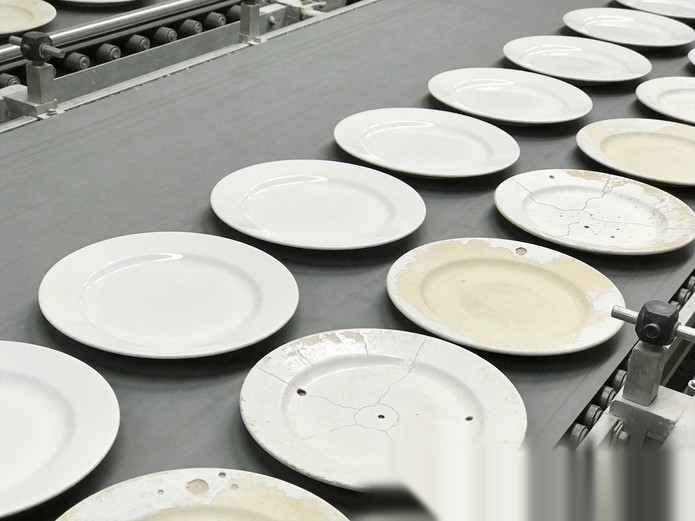
Use this table when your pre-shipment inspection reveals defects. The recommended action depends on defect type, severity, and percentage of affected units.
| Defect Category | Example | Under 2% Affected | 2-5% Affected | Over 5% Affected | Recommended Action |
|---|---|---|---|---|---|
| Critical | Food-contact cracks, sharp edges | Reject | Reject | Reject | Full rejection; request replacement |
| Major (visual) | Glaze crawling, color mismatch, warping over 2 mm | Accept with discount | Rework or reject | Reject | Negotiate price reduction or replacement |
| Major (functional) | Incorrect diameter, unstable foot ring | Accept if usable | Rework | Reject | Request rework or partial replacement |
| Minor | Pinholes, slight gloss variation, minor scratches | Accept | Accept with discount | Rework | Document for future improvement |
| Packaging | Carton damage, wrong label, missing dividers | Accept with repackaging | Rework packaging | Reject | Request repackaging at supplier cost |
Cost-quality trade-off. Rejecting a batch sounds like the right answer, but it triggers 30-60 days of replacement production plus shipping delays. For minor defects under 2%, a negotiated discount (typically 3-8% of order value) often makes more financial sense than waiting for replacement. For major defects over 5%, rejection is usually the only viable option because rework rates at that scale are unreliable.
Lead time impact. A full batch replacement adds 30-45 days production plus 15-25 days shipping. Partial replacement of only defective SKUs can reduce this to 20-30 days total if the supplier has capacity. Rework (re-firing, re-glazing) takes 10-15 days but risks damaging good pieces in the process. For lead time planning guidance, see our production lead time guide.
The Pre-Shipment Inspection Checklist
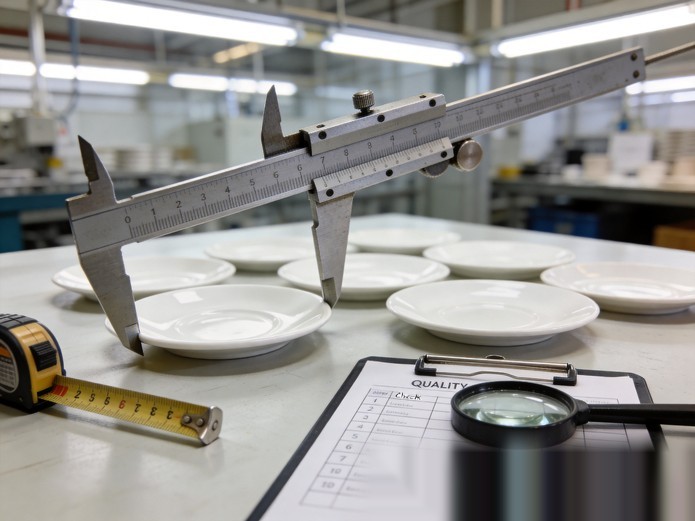
Use this checklist during your pre-shipment inspection or third-party QC review. Mark each item before the container seals.
- Sample comparison: Randomly select 10-20 units and compare each directly against your approved sample under consistent lighting.
- Dimensional check: Measure diameter, height, and weight of 5-10 units per SKU. Verify against specification tolerance.
- Visual defect scan: Inspect each sampled unit for glaze crawling, pinholes, color variation, and surface scratches under bright light.
- Foot ring stability: Place each unit on a flat surface and check for wobble or rocking.
- Stacking test: Stack 5-10 units of the same SKU. Check for sticking, excessive gap, or instability.
- Rim strength test: Apply gentle pressure to the rim. Chips or cracks indicate insufficient thickness.
- Water absorption (spot check): Place a drop of water on the unglazed base. Absorption in under 30 seconds indicates a porous body. [VERIFY BEFORE PUBLISHING: Confirm test method with ASTM C373]
- Food-contact surface: Verify the interior is fully glazed and smooth. No bare clay or rough patches.
- Packaging inspection: Check carton strength, foam divider placement, and labeling accuracy.
- Drop test: Drop a filled carton from 80 cm onto concrete. Open and inspect internal damage. [VERIFY BEFORE PUBLISHING: Confirm ISTA 3A or equivalent standard]
- Documentation review: Verify that certificates (FDA, LFGB, EU 1935/2004) cover the specific glaze batch used in production. [CERTIFICATE REQUIRED]
Cost, Quality, and Timeline Trade-offs in Defect Resolution
When defects appear, you face three variables: cost recovery, quality restoration, and timeline pressure. You can optimize two, rarely all three.
Option 1: Accept with discount. For minor-to-moderate defects, negotiate a 3-10% price reduction and sell the batch through discount channels. This preserves your timeline and cash flow but may damage brand perception if the defects are visible.
Option 2: Partial replacement. The supplier remakes only the defective SKUs or quantities. You ship the good portion immediately and wait 20-30 days for the replacement. This maintains most of your timeline while preserving quality but requires the supplier to accept responsibility and allocate production capacity.
Option 3: Full rejection and reproduction. Return or scrap the entire batch and start over. This ensures perfect quality but adds 45-75 days to your schedule and may incur shipping costs for the return. Use this only for critical defects or when the entire batch is compromised.
Negotiation leverage. Your strongest leverage is a documented purchase order with clear AQL levels and specification references. Suppliers are more likely to accept responsibility when the defect is measurable against an agreed standard rather than subjective “it does not look right.”
Three Common Mistakes Buyers Make with Batch Quality
These three errors account for the majority of quality disputes that could have been prevented.
Mistake 1: Approving Samples Without Documenting Numerical Specifications
A photo of the approved sample is not a specification. Buyers who approve based on visual impression alone have no objective basis for rejecting a bulk batch. Always document diameter, weight, color reference, glaze type, and tolerance limits in writing before approving the sample. For a structured approach, see our ceramic sample evaluation guide.
Mistake 2: Omitting AQL from the Purchase Order
If your purchase order does not specify an AQL level, the supplier defaults to their internal standard—which is almost always more lenient than what a B2B buyer needs. Specify AQL 1.0 for major defects and AQL 0.0 for critical defects in every purchase order. Reference ISO 2859-1 sampling tables to determine how many units to inspect based on batch size. [VERIFY BEFORE PUBLISHING]
Mistake 3: Skipping Pre-Shipment Inspection
Some buyers trust long-term suppliers and skip pre-shipment inspection to save $200-400 in inspection fees. This is a false economy. One undetected batch of defective plates can cost $5,000-15,000 in lost sales, customer complaints, and replacement orders. Third-party inspection services cost a fraction of a defective batch. For more on quality standards, refer to our defect classification standards.
Three Actionable Steps to Improve Ceramic Quality Consistency
If you are preparing for your next order, follow this sequence to reduce sample-to-bulk quality gaps.
Step 1: Create a Sample Specification Document
For every approved sample, create a one-page specification document that includes product photo with dimensional annotations, weight and tolerance, color reference (Pantone or RAL) with lighting condition, glaze type and finish, water absorption requirement, and approved supplier QC stamp with date. Share this document with your supplier and reference it in the purchase order. This document becomes your legal and technical baseline for dispute resolution.
Step 2: Build a Pre-Shipment Inspection Protocol
Decide before production starts who will inspect, when, and how. Your options are your own team, a third-party inspector, or the supplier’s internal QC (least independent). The optimal timing is after 80% of production is complete but before packaging finishes. Use the checklist above plus any SKU-specific tests. Budget $250-500 per inspection for a standard container load. For orders over $20,000, the inspection cost is 1-2% of order value—a reasonable insurance premium.
Step 3: Negotiate a Quality Agreement Clause
Add a quality clause to your standard supplier agreement that specifies AQL levels for critical, major, and minor defects; inspection method and third-party inspector acceptance; remediation options (discount, rework, replacement) based on defect category; timeline for remediation (replacement within 30 days of claim); and cost responsibility for return shipping if the batch is rejected. A signed quality agreement reduces disputes because both parties know the rules before production starts.
Downloadable tool: Use the Ceramic Batch Acceptance Worksheet to record inspection results, calculate defect percentages, and document supplier responses. [URL REQUIRED — Contact our team for the worksheet template.]
Frequently Asked Questions
What is a realistic defect rate for ceramic tableware bulk orders?
For mid-tier suppliers producing vitrified stoneware or porcelain, a realistic overall defect rate is 2-5% for major defects and 5-10% for minor defects. Premium suppliers with ISO-certified QC systems may achieve 1-2% major and 3-5% minor. Entry-level suppliers may run 5-8% major defects. Your AQL should reflect both supplier capability and your market tolerance.
How much does a third-party pre-shipment inspection cost?
For a standard ceramic tableware order (one container, 5-10 SKUs), inspection costs $250-500 all-inclusive in major ceramic production regions like Chaozhou or Jingdezhen. Express service (24-hour turnaround) adds 30-50%. Full container loading supervision adds $150-250. [INTERNAL DATA REQUIRED: CeraSupply inspection partner rates]
Can I request the supplier to use the same kiln zone for my bulk order as they used for the sample?
Yes, but it is impractical for large orders. Kiln zone requests work for small batches (under 500 pieces) where the supplier can load your order in the optimal center zone. For bulk orders, specify kiln-loading protocol instead—require that pieces are rotated between zones across firing cycles to average out temperature variation.
What should I do if the supplier refuses to accept responsibility for a defective batch?
First, present your documented specification and inspection report with photos and measurements. Second, reference your signed quality agreement or purchase order terms. Third, offer a compromise—partial replacement or discount—before demanding full rejection. If the supplier still refuses, engage a local trade mediation service or consider switching suppliers for future orders. Prevention through clear contracts is always cheaper than dispute resolution.
How do I prevent glaze color variation between sample and bulk?
Specify that the supplier must use glaze from the same batch lot as the approved sample, or provide a new color sample from the bulk glaze batch before production starts. For critical color matches, request a “first-off” sample from the bulk production line before the full run begins. This adds 3-5 days but catches color drift early.
Should I inspect at the factory or after arrival at my warehouse?
Factory inspection is strongly preferred. You can reject the batch before it ships, saving return shipping costs and time. Warehouse inspection is a last resort for small orders or trusted suppliers. For first-time orders or orders over $10,000, always inspect at the factory.
Ready to prevent quality disputes before they start? Download our ceramic batch acceptance checklist or submit your current specification for a feasibility review. For hospitality-specific ranges, explore our hotel and catering dinnerware collection.