Ceramic outdoor dining tableware is one of the fastest-growing segments in hospitality procurement, but most buyers underestimate the durability requirements for patio, rooftop, and poolside service. Standard indoor porcelain and stoneware crack under thermal shock, glazes fade under UV exposure, and lightweight pieces blow over in wind. This guide explains the material specifications, design features, and testing standards you need to specify when sourcing ceramic for outdoor dining. You will learn how to evaluate durability claims, what MOQ and lead time to expect, and how to avoid the three most common mistakes buyers make with outdoor ceramic orders.
Why Standard Indoor Ceramic Fails Outdoors
Indoor ceramic tableware is engineered for stable climates. When you move it outside, three forces attack it simultaneously.
Thermal shock is the biggest killer. A plate left in full sun can reach 60°C (140°F). A cold salad or iced drink dropped onto that surface creates an instant temperature differential of 40°C or more. Standard stoneware with high water absorption cracks because moisture trapped in the body expands rapidly. Porcelain fares slightly better, but thin-walled hotel-grade porcelain still fails after repeated cycles.
UV degradation breaks down organic pigments in colored glazes. Bright cobalt blues, warm terracottas, and matte blacks fade noticeably within one summer season. Reactive glazes are especially vulnerable because their crystalline structures are less stable under prolonged UV exposure.
Wind and handling abuse complete the triangle. Outdoor service involves more stacking, carrying across uneven surfaces, and exposure to gusts. Lightweight plates designed for elegant indoor dining flip off trays and chip on concrete floors.
Material Requirements for Outdoor Ceramic Tableware
Not all ceramic is equal for outdoor use. The table below compares the three material categories you will encounter when sourcing.
| Property | Standard Stoneware | Vitrified Stoneware | High-Fired Porcelain |
|---|---|---|---|
| Water absorption | 3–7% | <0.5% | <0.1% |
| Thermal shock resistance | Poor | Good | Moderate |
| UV glaze stability | Moderate | Good | Variable |
| Weight (per dinner plate) | 450–600g | 550–750g | 300–450g |
| Typical MOQ per design | 500–1,000 pcs | 1,000–2,000 pcs | 1,000–3,000 pcs |
| Price range FOB (dinner plate) | $1.80–$3.50 | $3.00–$5.50 | $2.50–$4.50 |
| Best use case | Covered patios | Open rooftops, poolside | Upscale covered terraces |
Vitrified stoneware is the clear winner for fully exposed outdoor dining. The firing process melts silica into a glass-like matrix, closing pores and locking out moisture. This eliminates thermal-shock cracking and reduces stain absorption from food acids and pool chemicals. [INTERNAL DATA REQUIRED: CeraSupply vitrified stoneware absorption test results]
High-fired porcelain works only in covered or semi-covered outdoor spaces. Its low weight is an advantage for poolside tray service, but the thin walls transmit heat quickly and the material is more brittle when cold.
All outdoor ceramic must comply with food-contact safety standards. In the United States, FDA 21 CFR 170–189 governs lead and cadmium leaching limits for ceramic foodware [VERIFY BEFORE PUBLISHING]. In the European Union, Regulation (EC) No 1935/2004 and Resolution AP(2004)1 set specific migration limits [VERIFY BEFORE PUBLISHING]. Request third-party test reports from your supplier before placing volume orders.
Design Features That Matter for Alfresco Dining
Material is only half the equation. Design details determine whether your outdoor collection survives a full season or needs replacement after three months.
Weight and base diameter. Outdoor plates need a lower center of gravity. A 26 cm dinner plate should weigh at least 550g and have a base diameter of at least 14 cm to resist tipping in wind. Bowls should have slightly wider rims than their indoor equivalents to prevent sliding on wet tables.
Glaze finish. Matte and satin glazes hide scratches better than high-gloss finishes, which show every abrasion from stacking and tray sliding. Avoid reactive glazes for outdoor use unless the supplier provides UV-stability test data.
Rim and foot ring reinforcement. The rim is the most vulnerable edge. A slightly thickened rim (2.5–3.0 mm versus the standard 2.0 mm) reduces chipping when plates collide during transport. The foot ring should be unglazed and slightly wider to grip table surfaces.
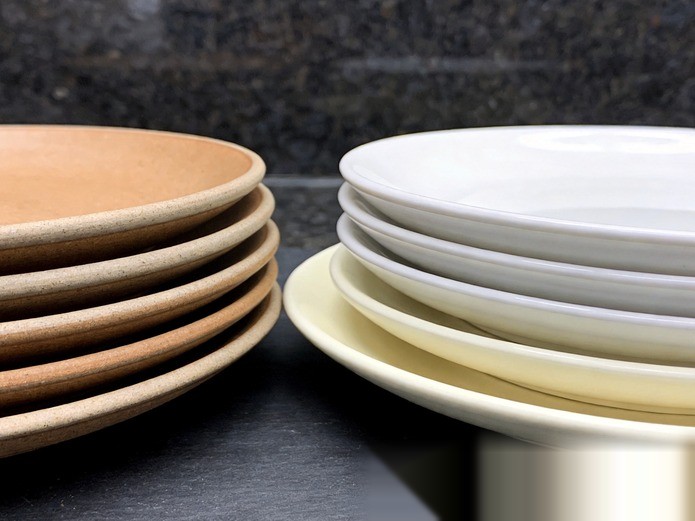
Stackability. Outdoor storage is often limited. Plates that nest efficiently reduce storage footprint by 20–30%. Specify that your supplier designs the curvature so plates of the same size stack without rocking.
Sourcing Checklist: What to Specify to Your Supplier
Use this checklist when requesting quotations or evaluating samples. Mark each item as confirmed before approving production.
- Water absorption rate: Specify <0.5% for fully exposed areas; <3% acceptable for covered patios only. Request ASTM C373 test report [VERIFY BEFORE PUBLISHING].
- Thermal shock resistance: Require documentation of 200°C differential survival (oven-to-ice-water test) or equivalent industry standard.
- UV stability: Ask for accelerated UV testing data (QUV exposure, 500+ hours) for colored glazes. White and cream glazes generally pass without special formulation.
- Food-contact compliance: Confirm FDA, LFGB, or EU 1935/2004 certificates are current and cover the specific glaze chemistry used.
- Weight per piece: Specify minimum weights: dinner plate 550g, salad plate 400g, soup bowl 450g, mug 350g.
- Base design: Require unglazed foot ring, minimum 14 cm base diameter for 26 cm plates.
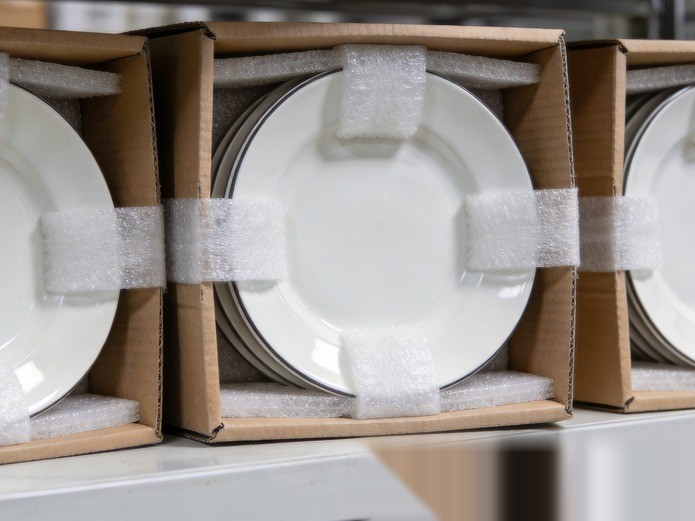
- Packaging: Double-corrugated export cartons with PE foam dividers. Specify drop-test standard (ISTA 3A recommended) [VERIFY BEFORE PUBLISHING].
- Customization: Confirm whether color matching, logo embossing, or rim color options are available and at what MOQ.
- Lead time: New designs typically require 45–60 days for mold development plus 30–45 days production. Reorders of existing designs run 30–40 days.
- MOQ: Expect 1,000–2,000 pieces per design for vitrified stoneware from mid-size factories. Smaller MOQs may be negotiable for reorders.
[FACTORY PHOTO REQUIRED: Sample outdoor ceramic stack with packaging carton]
Cost, Quality, and Lead Time Trade-offs
Outdoor ceramic commands a 15–30% premium over equivalent indoor pieces. Understanding where that premium goes helps you negotiate and budget accurately.
Cost drivers. Vitrified stoneware requires higher kiln temperatures (1,280–1,320°C versus 1,200–1,250°C for standard stoneware), which increases fuel costs and reduces yield. UV-stable glaze formulations use more expensive mineral pigments. Heavier pieces require more raw clay per unit.
Quality tiers. Entry-level outdoor ceramic ($1.80–$2.80 per dinner plate FOB) uses standard stoneware with basic glazes. It works for seasonal or covered use but will show wear within 12–18 months. Mid-tier ($3.00–$4.50) offers vitrified bodies and tested glazes suitable for year-round exposed service. Premium ($4.50–$6.00+) adds custom colors, reinforced rims, and brand-specific packaging.
Lead time impact. Custom color matching adds 7–14 days for glaze formulation and sample approval. Logo embossing requires new molds (+10–15 days). If you need delivery before spring patio season opens, place orders by November to allow buffer for delays.
The smart compromise. Many buyers start with a core collection in white or cream vitrified stoneware (fastest production, lowest MOQ) and add accent pieces in custom colors for the second reorder. This splits risk and cash flow while building supplier confidence. Compare this approach with our stoneware versus porcelain comparison to understand material differences before committing.
Common Mistakes Buyers Make with Outdoor Ceramic Orders
These three errors account for the majority of quality complaints and cost overruns we see in outdoor ceramic sourcing.
Mistake 1: Assuming Indoor Specs Transfer Outdoors
Buyers often send their indoor ceramic specification sheet to a supplier and ask for “the same thing in a darker color.” Indoor specs rarely mention water absorption, thermal shock, or UV stability because those properties are not critical in climate-controlled dining rooms. Without explicit outdoor requirements, the supplier defaults to their standard body and glaze formulas. Six months later, the buyer has cracked plates and faded colors.
Mistake 2: Skipping Pre-Production Testing
Outdoor ceramic demands more rigorous sample testing than indoor pieces. Buyers who approve samples based only on visual inspection miss thermal-shock vulnerabilities. The correct process is: visual approval → thermal shock test (freezer to boiling water, 5 cycles) → UV exposure test (72 hours direct sun or QUV chamber) → stack-and-carry durability test. Each test takes 2–5 days. Skipping them to save two weeks on lead time often costs two months in reorder delays. For a structured approach, refer to our defect classification standards.
Mistake 3: Ignoring Storage and Seasonal Handling
Even the best outdoor ceramic degrades if stored incorrectly between seasons. Stacking wet plates traps moisture and promotes glaze crazing. Storing in unheated sheds during winter exposes pieces to freeze-thaw cycles that standard ceramic cannot survive. Buyers should specify storage instructions with their orders and train staff on proper end-of-season handling.
Three Actionable Steps to Start Your Outdoor Collection
If you are planning outdoor service for the first time, follow this sequence to minimize risk and cost.
Step 1: Audit Your Current Inventory for Dual Use
Before ordering new outdoor-specific pieces, test your heaviest existing plates and bowls under outdoor conditions for two weeks. Weigh them, check water absorption (place a drop on the unglazed base; if it absorbs in under 30 seconds, the body is too porous), and observe glaze behavior after sun exposure. This tells you whether you need a completely new collection or just supplemental pieces. Browse our ceramic plates and platters collection to see weight and specification options.
Step 2: Start with a Limited Test Collection
Order one design in one color for one outdoor location. Run it through a full season including your highest-volume service periods. Document breakage rates, customer feedback, and staff handling observations. Use this data to refine specifications before scaling to your full portfolio. A test collection of 200–500 pieces typically costs $1,500–$3,500 FOB — far less than replacing a full collection that fails.
Step 3: Build Your Outdoor Ceramic Testing Protocol
Create a standardized testing document that every future sample must pass before approval. Include weight checks, thermal shock cycling, UV exposure observation, and stack stability measurements. Share this document with your supplier upfront so they understand your acceptance criteria. Over time, this protocol becomes a competitive advantage: suppliers who consistently meet your standards earn larger orders and longer contracts. For lead time planning, see our production lead time guide.
Downloadable tool: Use the Outdoor Ceramic Sample Evaluation Worksheet to record test results, compare samples, and track supplier performance across multiple shipments. [URL REQUIRED — Contact our team for the worksheet template.]
Frequently Asked Questions
Can I use regular porcelain for outdoor dining if it stays under umbrellas?
Covered patios reduce UV exposure and wind but do not eliminate thermal shock from sun-heated surfaces and cold food. Standard porcelain with water absorption above 1% will eventually crack. If your patio has solid roofing and walls, high-fired porcelain may last 18–24 months. For open-sided pergolas or retractable awnings, use vitrified stoneware.
How much more does outdoor ceramic cost compared to indoor ceramic?
Expect a 15–30% premium per piece. A standard indoor stoneware dinner plate at $2.50 FOB becomes $3.25–$3.75 for a vitrified outdoor equivalent. The premium covers higher firing temperatures, specialized glazes, and additional testing. Over a three-year lifespan, the cost-per-use is typically lower because outdoor-grade pieces last 2–3x longer under exposure.
What is the typical lead time for a custom outdoor ceramic collection?
First orders require 75–105 days: 10–15 days for mold preparation, 15–20 days for sample production and approval, and 30–45 days for bulk production plus 10–15 days shipping. Reorders of approved designs run 40–55 days total. Plan your procurement calendar so samples arrive before your peak booking season for patio openings.
Do outdoor ceramic plates need special dishwashing procedures?
Vitrified stoneware is generally dishwasher-safe, but high-alkaline industrial detergents can etch matte glazes over time. Rinse plates promptly after service to remove acidic food residue (tomato sauce, citrus dressings) before dishwashing. Avoid thermal shock in the dishwasher: do not place sun-heated plates directly into a cold wash cycle. Allow 10–15 minutes of ambient cooling first.
Can I get outdoor ceramic in custom colors for my brand?
Yes, but with constraints. White, cream, and earth-tone glazes (terracotta, sage, sand) are standard formulations with low MOQ. Bright or unusual colors require custom glaze development, which raises MOQ to 3,000–5,000 pieces per color and extends lead time by 2–3 weeks. Request glaze stability data for any custom color, and plan for color variation between batches.
What packaging protects outdoor ceramic best during shipping?
Outdoor ceramic is heavier than indoor equivalents, so packaging must account for higher carton weight. Use double-wall corrugated cartons rated for 20+ kg gross weight. Each piece should sit in a molded PE foam pocket. Cartons need 5-layer stacking strength for container loading. Specify that the supplier performs a drop test from 80 cm onto concrete. [CASE STUDY REQUIRED: CeraSupply packaging test results]
Ready to source outdoor ceramic that survives the season? Request our outdoor ceramic specification sheet with detailed material requirements, glaze options, and testing protocols tailored to your climate and service style. For hospitality-specific ranges, explore our hotel and catering dinnerware collection.