Prop 65 ceramic tableware questions arrive as a laboratory report, and that report answers a question the regulation never asked. It states how much lead leached into a fixed volume of dilute acid, in micrograms per millilitre. Proposition 65 asks how much a person absorbs in one day, in micrograms. No report converts one into the other on its own, which is why a dinnerware set can pass every federal limit on the page and still need a California warning.
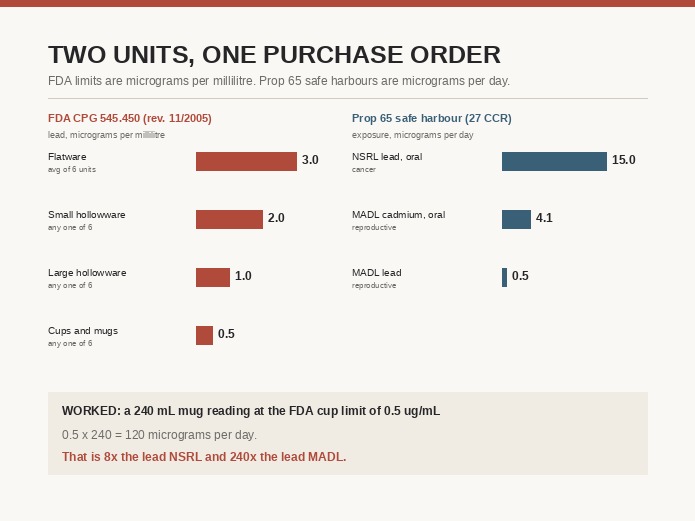
A 240 mL mug leaching at exactly the FDA cup limit of 0.5 micrograms per millilitre delivers 120 micrograms per day when fully consumed, against a 15 microgram cancer safe harbour and a 0.5 microgram reproductive one. Same mug, same report, three numbers two orders of magnitude apart.
Two Units That Never Meet
Federal limits for ceramic foodware are concentration limits: the strength of the leaching solution after a standard extraction, per millilitre. California’s safe harbours are dose limits: total daily intake by a person, per day. Concentration times volume gives dose, so a conversion exists in principle, but it needs a volume assumption the report does not contain.
FDA guidance accepts that a plate and a pitcher do not deliver lead the same way, so it sets five categories. The definitions are mechanical and easy to misapply: flatware is any article whose internal depth, from the lowest point to the plane of the upper rim, does not exceed 25 mm; deeper is hollowware; under 1.1 L is small, at or above is large.
Read the category first. A shallow pasta bowl at 24 mm is flatware, judged on the average of six units. Two more millimetres makes it small hollowware, judged on any single unit, and the lead limit falls from 3.0 to 2.0 micrograms per millilitre while the criterion tightens from a mean to a worst case. A mixed salad-bowl range sent on one test line comes back split across two categories and two criteria.
Which Prop 65 Ceramic Tableware Limit Applies to Your SKU
Lead and cadmium are governed by separate guidances. Lead recognises five categories; cadmium recognises three, folding cups, mugs and pitchers into hollowware. Every SKU therefore has two category answers, and the cadmium one is sometimes the stricter.
| Article category | Depth or capacity test | Lead, ug/mL | Cadmium, ug/mL | Units that decide |
|---|---|---|---|---|
| Flatware | depth 25 mm or less | 3.0 | 0.5 | average of 6 |
| Small hollowware, not cups or mugs | over 25 mm, under 1.1 L | 2.0 | 0.5 | any one of 6 |
| Cups and mugs | over 25 mm, under 1.1 L, beverage use | 0.5 | 0.5 | any one of 6 |
| Large hollowware, not pitchers | 1.1 L or more | 1.0 | 0.25 | any one of 6 |
| Pitchers | 1.1 L or more, acidic drinks, handle and lip | 0.5 | 0.25 | any one of 6 |
The last column changes how you negotiate. Four of five lead categories are worst-case tests: one bad unit fails the lot. Flatware alone is an average, which explains most procurement surprises here.
The Conversion That Decides the Order
Start with vessel volume, the only honest way to turn a leach reading into daily intake for anything drunk from. A 240 mL mug at 0.5 micrograms per millilitre delivers 120 micrograms per day: 8 times the cancer safe harbour of 15, 240 times the reproductive one at 0.5.
Across hollowware it gets worse, because larger vessels hold more liquid at a limit only marginally lower. A 500 mL piece at 2.0 delivers 1,000 micrograms per day; a 1.2 L piece at 1.0 delivers 1,200.
| Vessel volume | Lead limit applied | Daily intake if fully consumed | Multiple of lead NSRL (15) | Multiple of lead MADL (0.5) |
|---|---|---|---|---|
| 240 mL cup or mug | 0.5 ug/mL | 120 ug/day | 8x | 240x |
| 500 mL small hollowware | 2.0 ug/mL | 1,000 ug/day | 67x | 2,000x |
| 1,200 mL large hollowware | 1.0 ug/mL | 1,200 ug/day | 80x | 2,400x |
To sit inside the cancer safe harbour at 240 mL the reading would need to stay at or below 0.0625 micrograms per millilitre; for the reproductive harbour, roughly 0.002, which is 240 times under the FDA cup limit and past what a standard glaze test resolves. So almost no conventional decorated mug clears Proposition 65 by arithmetic alone.
Flatware needs another route, and buyers should not let a supplier talk them into volume multiplication here. A plate is not drunk from, so intake runs through the surface-area-to-food-mass ratio and the food that contacts glaze. This is where an exposure assessor earns the fee, and where a supplier’s back-of-envelope conversion is a red flag, not reassurance.
Three Ways a Passed Report Still Fails an Order
The average of six hides the unit that matters
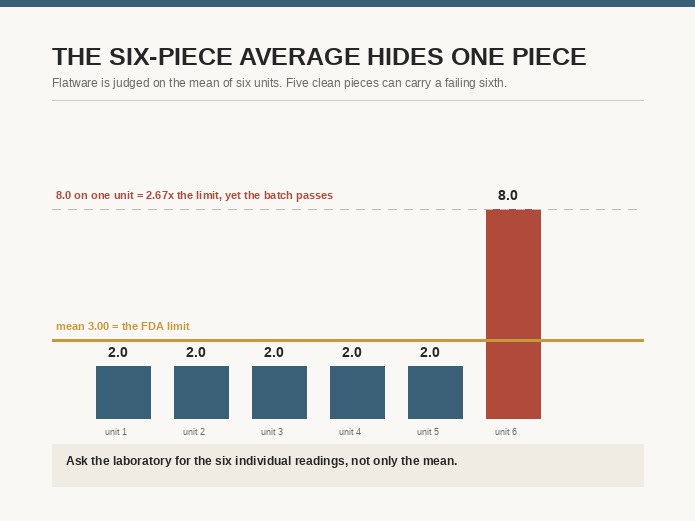
Flatware is the only lead category decided by a mean. Five units at 2.0 and one at 8.0 average exactly 3.00 and pass, though the failing unit sits at 2.67 times the limit: to hold the mean at one unit of 8.0 the other five must average 2.0, and at 10.0 they must average 1.60. Every step in that outlier is paid for by cleanliness elsewhere in the sample.
That is not a loophole but a reason to demand raw data. A report printing only the mean discards the number showing whether glaze is uniform across a cavity or drifting in one corner of a kiln. Ask for six individual readings on every flatware line.
Cadmium’s safe harbour is not the number usually quoted
The cadmium figure quoted in supplier emails is 0.05 micrograms per day, the inhalation NSRL for cadmium in air, not cadmium swallowed from a glaze. For food contact the operative number is the reproductive MADL of 4.1 micrograms per day oral. The two differ by a factor of 82.
Buyers see the error in both directions: one supplier rejects a saleable glaze by comparing oral exposure to an inhalation threshold, another waves through a high-cadmium decoration because the test came in under a figure labelled the Prop 65 limit. Both rest on the same misreading of endpoint.
An FDA pass is not a Proposition 65 defence
The regimes run under different statutes and answer different questions. A CPG-compliant mug meets the federal food-additive provisions; it has not thereby been shown to pose no significant risk under California law. A compliance file holding one FDA report and a line reading Prop 65: compliant holds a federal result and an assertion. The assertion is what a 60-day notice tests.
Reformulate, Warn, or Walk Away
Once the arithmetic is on the table, Prop 65 ceramic tableware becomes a commercial rather than legal question. Four routes cost differently at different volumes.
| Route | What it requires | Where it costs money | Best fit |
|---|---|---|---|
| Reformulate glaze or decoration | Glaze trial, re-test of every colour, possible mould trial if the foot changes | One-off trial and re-test, 3 to 5 weeks of schedule | Volume lines where a warning would block a retail listing |
| Warn on the labelled product | Short-form warning on base or label, warning on the product page | Per-unit label and labour, artwork approval | Small and mid volumes, private label |
| Written notice to the retailer | Notice to the retailer’s authorised agent with warning materials, renewed annually | Administration and evidence of receipt | Selling through a retailer who applies the warning at shelf and online |
| Do not sell into California | Channel segmentation, plus a real check on marketplace sellers | Lost market and leakage you do not control | Categories where a warning is commercially fatal and California volume is small |
Label and reformulation cross over at a computable volume. On a worksheet, a label at USD 0.03 plus USD 0.01 labour against a USD 2,800 glaze switch costs USD 120 at 3,000 pieces, USD 2,000 at 50,000 and USD 20,000 at 500,000. Break-even is 70,000 pieces: below it printing is cheaper, above it reformulating is. Those unit costs are assumptions, not quotations, but the curve has the same shape everywhere.
Three things to write down before the next PO. Test per colour and per decoration, not per shape, because a cobalt rim and a clear glaze on one body are two exposure questions. Price the warning route at the quantity you are buying, not the MOQ, because label cost scales and reformulation does not. And write the chosen route into the purchase contract, naming who holds the reports, who owns the artwork, and who pays for a re-test after an unannounced glaze substitution.
Label Engineering: Two Floors, Not One
Short-form warnings have a type-size floor of 6 point, and the specification sheet for any decorated piece should carry it. That is California’s floor. A piece handled instead as ornamental ceramicware not for food use falls under a federal rule measuring letters in millimetres: 3.2 mm on the temporary label and 3.2 mm on the permanent base statement, reducible to 1.6 mm only where the base cannot hold the larger size.
The floors do not line up. Six point type has an em near 2.12 mm; at a cap height of 0.70 em letters stand about 1.48 mm, which clears no California floor and falls under the 1.6 mm reduced federal one. The 3.2 mm requirement works out near 13 point. One artwork block cannot satisfy both at one size, so the first question is which regime the piece is in.
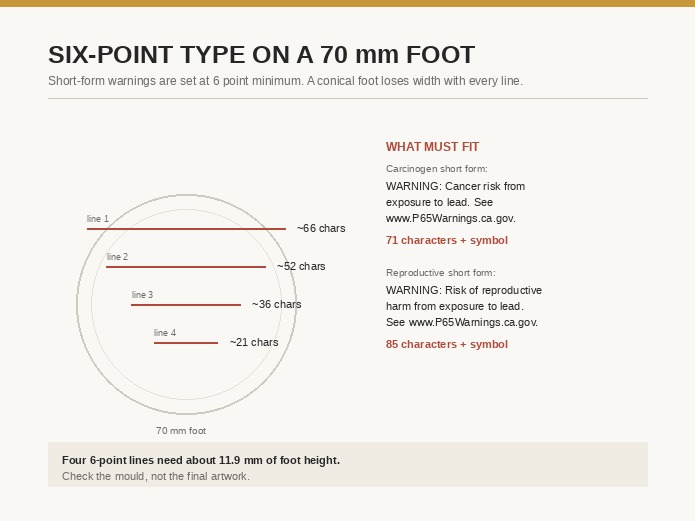
Then check geometry, where artwork approved on a flat proof fails on a real mug. A 70 mm foot gives roughly 66 characters on the first line at 6 point, and a conical foot narrows with every line down: about 52, then 36, then 21. The carcinogen short form runs 71 characters before the symbol, the reproductive form 85. Four lines occupy roughly 11.9 mm of vertical space, on a foot ring that also has to sit flat.
Two dates shape the artwork brief. A short-form warning on product manufactured and labelled before 1 January 2028 may keep the older, shorter content regardless of sale date. For internet sales before that date a retailer gets 60 calendar days after receiving an updated warning before it must display it online.
The warning must be conspicuous relative to everything else on the base, and a warning given in another language must appear in that language as well as English. On a base that already carries a maker’s mark, capacity stamp and country of origin, that leaves little room, so fix element order at artwork stage. Export buyers can cross-check country of origin marking separately.
The Notice Chain, and What a Miss Costs
Enforcement rarely begins with an inspection. It begins with a 60-day notice of alleged violation served on the Attorney General, the relevant district or city attorney, and the alleged violator. A private action may then proceed, and a warning claim needs a certificate of merit from the noticing party’s attorney. The ceiling is USD 2,500 per day per violation, with the court weighing seven statutory factors including nature and extent, good-faith measures and willfulness.
The ceiling is not a forecast, but the order of magnitude matters because intuition usually runs an order low. At the ceiling, one SKU for 60 days is USD 150,000; one SKU for a year is USD 912,500; twenty SKUs for 60 days is USD 3,000,000.
Most buyers never use the cheapest route available. A manufacturer, producer, packager, importer, supplier or distributor may satisfy the article by giving written notice to the retailer’s authorised agent instead of labelling every unit, provided it states the possible exposure, identifies the product precisely, includes the warning materials, and is renewed annually while sold in California. A further notice is due within 90 days if a chemical or endpoint is added. Receipt must be confirmed in writing or electronically; the retailer then owns placement, online included.
That route also settles who carries the risk. A retailer is responsible only in five enumerated situations: selling under its own brand, knowingly introducing a listed chemical, obscuring an affixed warning, receiving materials but not displaying them, or having actual knowledge where no upstream party is subject to the statute. A private-label buyer who owns the brand is inside the first and cannot pass the obligation upstream; a reseller of someone else’s brand with the chain intact usually is not. Worth reading alongside a ceramic purchase contract before allocation is agreed.
Two exemptions are worth checking rather than assuming: a business employing fewer than 10 employees falls outside the definition of a person in the course of doing business, and an exposure within twelve months of a chemical’s listing is exempt. Neither is a plan; both are facts about a counterparty.
Pre-order checklist
- Category assigned per SKU, depth measured and capacity checked, cadmium category noted separately from lead.
- Six individual readings per line, not only the mean, and the method named on the report.
- Every colour and every decoration tested, not just the plain body.
- Leach value converted to daily intake for each drinking vessel, using its actual volume.
- Endpoint fixed before any comparison: oral for food contact, reproductive MADL for cadmium.
- Decision recorded as reformulate, warn, notice or exclude, with the volume break-even shown.
- Warning artwork checked at 6 point minimum against the real foot diameter, not a flat proof.
- Food-contact versus not-for-food-use status settled, because the type floors differ.
- Written notice chain in place with evidence of receipt, and a diary entry for annual renewal.
- Contract clause naming who holds the reports and who pays for a re-test after an unannounced glaze substitution.
A tool you can reuse: the exposure screening sheet
One row per SKU with six columns: category, lead reading in micrograms per millilitre, vessel volume in millilitres, computed daily intake, the applicable safe harbour and its endpoint, and the ratio between them. The ratio is the decision column: at or below 1.0 the piece sits inside that harbour; above it you need a lower reading or a warning decision. For flatware, swap volume for surface area and food mass and let the assessor fill that row.
Keep the sheet with the test reports, not the marketing file. When a notice arrives, the sheet and the six readings turn a supplier’s assertion into evidence you hold. Ask for a test report sample with individual unit readings and we will show what a complete file looks like before a production slot is committed. The wider skill is reading a ceramic test report: the report is raw material, and the decision sits one step on, where concentration becomes dose.
Questions buyers ask before signing
Does passing FDA limits make my Prop 65 ceramic tableware compliant? No. Federal limits are concentrations in a leaching solution; California safe harbours are daily doses. A piece can sit inside both federal limits and exceed a safe harbour once converted to intake; the burden of proving no significant risk rests on the defendant.
Which cadmium number should I compare against? For food-contact ceramicware, the oral reproductive MADL of 4.1 micrograms per day. The widely quoted 0.05 is the inhalation NSRL for cadmium in air. Using it for an oral exposure misstates the risk by a factor of 82.
Why does flatware pass when one unit is far over the limit? Because flatware is judged on the average of six units, while cups, mugs and hollowware are judged on any single unit. One high reading is absorbed by five low ones. Ask for six individual readings and check the spread, since a wide spread signals uneven glaze or kiln position.
Can a written notice replace labelling? Yes, if it is in writing to the retailer’s authorised agent, identifies the product precisely, includes the warning materials, is renewed annually, and you hold confirmation of receipt. The retailer then handles placement, online included. If you own the brand, retailer-liability carve-outs will not protect you.
What does reformulation add to a schedule? Budget 3 to 5 weeks for a glaze trial plus re-testing every colour and decoration, longer if foot geometry changes. The warning route is faster but adds per-unit cost that scales with volume, so the crossover is a volume question. Lead times and mould work are covered in the classification and duty notes and the certification standards overview.
Before the next PO: send us the category, the six readings and the vessel volume, and we will run the conversion with you and say plainly whether the piece needs a reformulation, a warning, or nothing at all. Start with the OEM/ODM feasibility review if the answer is a new glaze, and compare the hotel and catering range against commercial plates and platters.