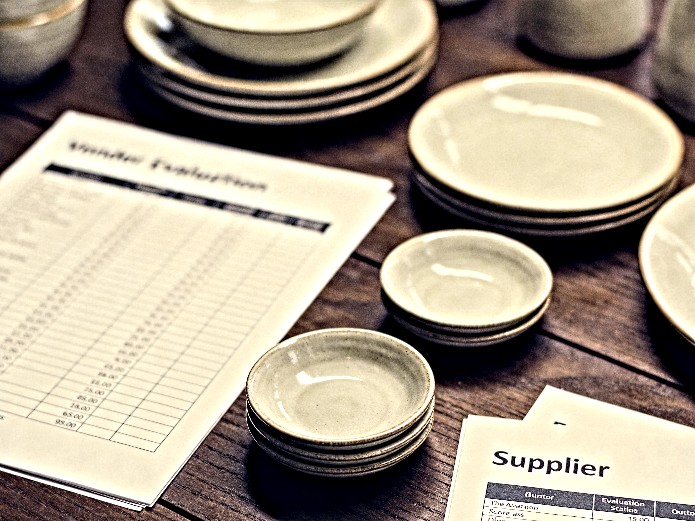
A ceramic tableware vendor scorecard is the single most effective tool for converting a pile of supplier quotes into a ranked shortlist you can defend to your CFO. In fifteen years of managing ceramic procurement for restaurant groups and hospitality brands, I have watched buyers lose money repeatedly because they compared suppliers on price alone. A scorecard forces you to evaluate every vendor across the same six dimensions — price, quality consistency, communication, lead time flexibility, customization capability, and post-shipment support — so the final ranking reflects total cost and risk, not just the unit price on the first page of a quotation.
This article gives you a ready-to-use scoring framework, explains how to weight each criterion for your business model, and shows you how to spot red flags that should disqualify a supplier before you ever place a trial order. You will also get a downloadable vendor comparison template you can paste into a spreadsheet and use during your next sourcing round.
Why Most Buyers Pick the Wrong Supplier (And How a Scorecard Fixes It)
The typical ceramic sourcing process looks like this: send RFQs to eight suppliers, receive four quotes back, pick the one with the lowest FOB price, and move to sampling. Six months later the buyer discovers that the “cheap” supplier quoted basic white glaze while the competitor included dishwasher-safe overglaze decoration, that mold amortization was hidden in the unit price, or that the quoted forty-five-day lead time stretches to seventy days during peak season.
A ceramic tableware vendor scorecard prevents these surprises by making every vendor answer the same questions before you commit. Instead of scanning PDF quotations side by side, you extract standardized data into a single grid and score each supplier from 1 to 5 on dimensions that actually predict long-term performance. The result is not just a better supplier — it is a procurement record you can reference when the same vendor bids on your next collection.
The 6 Dimensions Every Ceramic Vendor Scorecard Needs
Every scorecard should evaluate suppliers across the following six categories. Assign 1–5 points per category, then multiply by the weight you assign in the next section.
| Dimension | What to Evaluate | Data Source | Typical Weight |
|---|---|---|---|
| Unit Economics | FOB unit price, mold/amortization fees, MOQ, payment terms, Incoterms clarity | Quotation breakdown | 25% |
| Quality Consistency | Defect rate history, AQL inspection results, sample-to-shipment variance, glaze batch stability | Third-party inspection reports, sample records | 25% |
| Lead Time Reliability | Quoted vs. actual production time, peak-season buffer, shipping schedule adherence, contingency planning | Past order tracking, references | 20% |
| Communication & Transparency | Response time, English proficiency, willingness to share production photos, problem escalation speed | Direct interaction during quoting | 15% |
| Customization Capability | Mold development speed, color matching accuracy, decal/logo precision, packaging design support | Sample turnaround and revision cycles | 10% |
| Post-Shipment Support | Claim response time, replacement policy, warranty terms, ongoing quality monitoring | Contract terms, reference checks | 5% |
How the math works: A supplier scoring 4 on Unit Economics (weight 25%) earns 1.0 weighted point. A supplier scoring 5 on Quality Consistency (weight 25%) earns 1.25 weighted points. The vendor with the highest total weighted score is your top candidate — even if their FOB price is 8% higher than the cheapest quote.

How to Weight Each Criterion for Your Business Model
Not every buyer should use the default weights above. A hotel chain reordering the same white coupe plate for three hundred properties cares more about quality consistency and lead time reliability than customization. A boutique brand launching a seasonal collection with unique glazes and custom packaging weights customization and communication far more heavily.
Use these adjusted weight profiles based on your role:
| Buyer Profile | Unit Economics | Quality Consistency | Lead Time | Communication | Customization | Post-Shipment |
|---|---|---|---|---|---|---|
| Chain Restaurant / Hotel Group | 20% | 30% | 25% | 10% | 5% | 10% |
| Boutique Brand / Private Label | 15% | 20% | 15% | 20% | 25% | 5% |
| Distributor / Wholesaler | 30% | 20% | 15% | 15% | 10% | 10% |
| First-Time Importer | 20% | 25% | 20% | 20% | 10% | 5% |
If you are sourcing your first container from China, increase Communication & Transparency to 20%. You will need more hand-holding on documentation, inspection scheduling, and shipping coordination than an experienced importer. If you are a distributor competing on price, Unit Economics rises to 30% — but never let it exceed 35%, or you will sacrifice the quality consistency that protects your reputation with end customers.
A Ready-to-Use Vendor Scoring Template
Copy this structure into a spreadsheet before your next quoting round. Rate each supplier 1–5 on every row, then multiply by your chosen weight.
Scoring scale:
- 5 = Exceeds expectations, documented proof available
- 4 = Meets requirements, minor concerns
- 3 = Acceptable with conditions
- 2 = Below standard, significant risk
- 1 = Unacceptable, disqualify
| Criteria | Supplier A | Supplier B | Supplier C | Weight | Your Business |
|---|---|---|---|---|---|
| FOB price competitiveness | 25% | ||||
| Mold / tooling fee transparency | (part of above) | ||||
| Payment terms flexibility | (part of above) | ||||
| Historical defect rate < 3% | 25% | ||||
| AQL 2.5 pass consistency | (part of above) | ||||
| Quoted lead time accuracy | 20% | ||||
| Peak season buffer communicated | (part of above) | ||||
| Response time < 24 hours | 15% | ||||
| Production photo updates provided | (part of above) | ||||
| Color matching precision | 10% | ||||
| Packaging design support | (part of above) | ||||
| Claim resolution < 14 days | 5% | ||||
| Weighted Total | 100% |
After filling the grid, any supplier scoring below 3.0 overall should be removed from consideration. A score between 3.0 and 3.5 is a conditional candidate — acceptable only if they agree to written improvement commitments before the trial order. Above 3.5 is a viable partner; above 4.0 is a strong recommendation.
Red Flags That Should Disqualify a Supplier Immediately
Some signals are severe enough that they override a decent scorecard total. If a supplier exhibits any of the following, remove them from your shortlist regardless of price:
- Refuses third-party inspection. A factory that will not allow SGS, Bureau Veritas, or your appointed inspector onsite has something to hide. This is non-negotiable for food-contact ceramics.
- Cannot produce a current test report. FDA, LFGB, or California Prop 65 compliance certificates should be dated within the last twelve months. A supplier who says “we had them last year” without providing copies is asking you to assume legal risk.
- Quotes a lead time without explaining the breakdown. “Forty-five days” means nothing if the supplier cannot tell you how many days are mold making, biscuit firing, glazing, decoration, and kiln scheduling. Opaque timelines almost always slip.
- Changes pricing between sample and mass-production quote without justification. A 15% price increase after sampling is sometimes valid — raw material costs shift, glaze formulas change — but the supplier must explain exactly what changed. Silent price jumps predict future surprises.
- Has no quality claim process documented. Ask how they handle a container arrival with 8% chipped plates. If the answer is “we will discuss case by case,” you have no protection. Look for written defect thresholds, photo documentation requirements, and replacement or credit terms.
How to Run a Side-by-Side Comparison with Real Data
Here is how the scorecard works in practice with three hypothetical suppliers bidding on a 5,000-piece stoneware dinner set order:
| Criteria | Supplier A (Lowest Price) | Supplier B (Mid-Range) | Supplier C (Premium) |
|---|---|---|---|
| FOB price / piece | $2.80 | $3.10 | $3.45 |
| Mold fee | $800 (amortized over 10K) | $600 (one-time) | $500 (waived at 5K+) |
| Payment terms | 30% T/T, 70% before shipment | 30% T/T, 70% against B/L | 30% T/T, 70% against B/L |
| Defect rate (last 12 mo) | 4.2% | 1.8% | 1.1% |
| Quoted lead time | 42 days | 50 days | 48 days |
| Actual lead time (tracked) | 58 days | 52 days | 49 days |
| Response time | 36 hours | 8 hours | 6 hours |
| Color matching revisions | 4 rounds | 2 rounds | 1 round |
| Claim resolution | “Case by case” | 10-day replacement | 7-day credit or replace |
Scored on the Chain Restaurant profile (Unit Economics 20%, Quality 30%, Lead Time 25%, Communication 10%, Customization 5%, Post-Shipment 10%):
- Supplier A: 3.0 weighted total — low price but high defect rate and unreliable lead time make total cost unpredictable.
- Supplier B: 4.1 weighted total — balanced across all dimensions, best overall value.
- Supplier C: 4.0 weighted total — excellent quality and service, but 23% price premium only justified if brand positioning demands near-zero defect tolerance.
The buyer who picks Supplier A based on FOB price alone saves $0.30 per piece on 5,000 units — $1,500 — but absorbs a 4.2% defect rate. At replacement cost including shipping, that defect rate typically costs $3,500–$5,000 per container. Supplier B is the rational choice.
When to Walk Away: Making the Final Cut
After scoring, you should have two or three viable suppliers. Before placing a trial order, run this final checklist:
- The top-scoring supplier has provided a sample that matches your spec sheet within acceptable tolerance.
- You have verified at least one reference customer in your target market (hotel, restaurant, or retail) who has reordered from this supplier within the last eighteen months.
- The supplier has confirmed in writing that they can hold the quoted price for ninety days from sample approval to production order.
- You have agreed on inspection timing (pre-shipment, during production, or both) and who pays if the lot fails.
- The supplier has provided a production schedule with named milestones: mold confirm, biscuit sample, glaze sample, mass production start, kiln schedule, packing completion.
- You have reviewed shipping terms and confirmed whether the quote is FOB, CIF, or DDP — and you understand who handles customs clearance and duties at destination.
- The contract or purchase order includes a written quality claim clause with specific defect thresholds, documentation requirements, and remedy terms.
If any item above is missing, the supplier is not ready for production. Go back to your second-ranked vendor or request the missing documentation before proceeding.
Frequently Asked Questions
How many suppliers should I score before making a decision?
Score at least three, ideally four. Fewer than three gives you no comparison baseline; more than five consumes time without adding proportional insight.
Should I share my scorecard with suppliers?
No. Share the criteria you care about — MOQ, lead time, defect rate, payment terms — but keep the weighting private. If suppliers know you value quality consistency at 30%, they may fabricate inspection records.
What if my top-scoring supplier has the highest price?
Recalculate using a Distributor profile (Unit Economics 30%). If they still win, the premium is justified by quality, reliability, or service. If they drop below second place, the price gap is too wide for your business model.
How often should I re-score existing suppliers?
Re-run the scorecard annually or after any major incident: a delayed shipment, a quality claim, or a price renegotiation. Track score trends over time — a vendor whose score drops from 4.2 to 3.1 in two years is a supplier in decline.
Can I use this scorecard for non-ceramic suppliers?
Yes. Replace the ceramic-specific criteria — glaze batch stability, kiln scheduling — with equivalents for your category. The framework works for any vendor evaluation where price alone is insufficient.
What score is good enough for a first order?
A weighted total of 3.5 or higher with no red flags. Below 3.5, the risk of delays, defects, or communication failures exceeds the benefit of the quoted price.
Note: FDA and LFGB compliance requirements cited in this article should be verified against current regulatory standards before making sourcing decisions. [VERIFY BEFORE PUBLISHING]