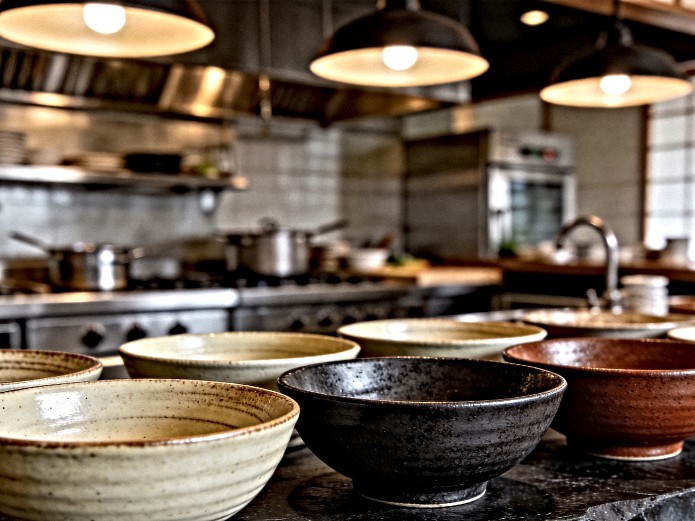
Ceramic ramen bowls need deeper walls, thicker bases, and more forgiving glaze chemistry than standard soup bowls because they face 200°F+ broth, rapid thermal cycling, and heavy stacking daily. Most restaurant buyers waste money ordering generic ceramic bowls that crack under thermal shock or do not stack in their existing dish racks. This guide shows you exactly what specifications to request, what tests matter, and how to structure your first order without overcommitting inventory.
Get MOQ by product category if you already know your volume and want a fast production estimate.
Why Ceramic Outperforms Melamine and Stainless for Ramen Service
Melamine bowls dominate budget ramen shops because they are lightweight and cheap. The problem shows up around month six: surface scratches trap broth oils, the material softens above 180°F, and health inspectors in some jurisdictions flag heavily worn melamine for replacement. Stainless steel survives forever but transfers heat instantly to the customer’s hands and looks out of place in traditional or modern-Japanese interiors.
Ceramic ramen bowls hit the middle ground. A well-made bowl with 6–8 mm wall thickness holds heat for 15–20 minutes (long enough for a full ramen service), presents broth and toppings with visual depth, and survives 500+ dishwasher cycles if the glaze is properly formulated. The trade-off is weight: a 20 cm ceramic ramen bowl weighs 450–700 grams versus 150 grams for melamine. Your servers and dishwashing workflow need to account for that.
Key Specifications to Request in Your RFQ
Suppliers will send you generic catalog sheets unless you specify these five dimensions. Copy this table into your RFQ to eliminate back-and-forth.
| Specification | Recommended Range | Why It Matters |
|---|---|---|
| Bowl diameter (rim) | 18–22 cm | 18 cm fits standard tonkotsu portions; 22 cm accommodates extra toppings and wider noodle spreads |
| Bowl depth | 8–10 cm | Shallow bowls spill during carry; deeper than 10 cm make broth hard to photograph for menu marketing |
| Wall thickness | 6–8 mm | Below 5 mm cracks under thermal shock; above 9 mm becomes too heavy for service staff |
| Weight per bowl | 450–650 g | Lighter bowls chip; heavier bowls fatigue servers and crack dish racks |
| Foot ring diameter | 7–9 cm | Must match your existing dish rack slot spacing; measure before ordering |
| Glaze type | Food-safe lead-free, high-fire (≥1200°C) | Low-fire glazes craze and trap bacteria; lead-based glazes violate FDA and EU food contact regulations [VERIFY BEFORE PUBLISHING] |
| Stacking height (per 10 bowls) | ≤28 cm | Taller stacks destabilize in transit and during dishwashing |
Send your supplier a physical sample bowl from your current inventory and request that the foot ring and rim diameter match within 2 mm. Mismatched diameters create wobbly stacks and broken rims during transport.
Thermal Shock and Heat Retention: What the Broth Test Reveals
Boiling broth straight from the pot hits 205–212°F. A thin-walled ceramic bowl with poor thermal shock resistance will spider-crack within the first month of service. You cannot afford to discover this after a 1,000-piece shipment arrives.
Request these two data points from your supplier:
- Thermal shock differential: The bowl should survive a 150°C (302°F) temperature swing without cracking per ASTM C1525 test methods [VERIFY BEFORE PUBLISHING]. In practical terms, pouring boiling broth into a room-temperature bowl should not produce stress fractures.
- Heat retention at 5 minutes: Broth temperature should drop no more than 15°F in the first 5 minutes after pouring. This keeps noodles at optimal texture through the entire meal.
If the supplier cannot provide test data, order a 12-piece sample set and run your own test: fill six bowls with boiling water, leave six at room temperature, then pour boiling water into the cold bowls. Inspect for hairline cracks after 24 hours. Any crack disqualifies the supplier.
Stackability and Kitchen Storage Density
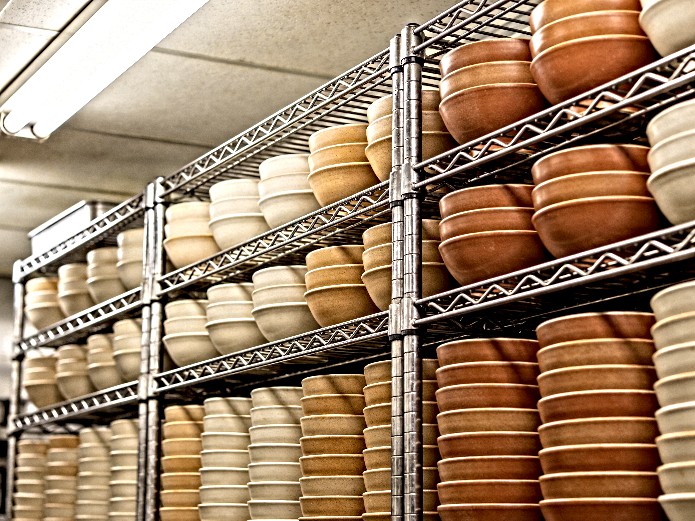
A typical ramen shop runs 200–400 covers per day. At 1.5 bowls per cover (some customers order kaedama refills), you need 300–600 bowl turns daily. Storage space is limited. Here is the math most buyers skip:
If your current dish rack holds bowls with an 8 cm foot ring and the new supplier sends 9.5 cm foot rings, your stackable count per shelf drops by 30–40%. Multiply that across a 1,000-piece order and you may need to buy new shelving.
Before placing any bulk order, measure:
- Your dish rack slot width (must exceed bowl foot diameter by ≥5 mm)
- Your dish cart interior height (must accommodate your tallest stack + 5 cm clearance)
- Your dishwasher rack grid spacing (bowls must sit stable without tilting)
Request a stacking test video from the supplier: 20 bowls nested together, then lifted as a single unit. If the stack leans or separates, the bowl geometry is poorly designed for commercial use.
MOQ, Lead Time, and Cost Breakdown by Volume
Ceramic ramen bowls are slip-cast or jiggered in molds. Mold costs are fixed regardless of order size, so per-unit economics change dramatically with volume.
| Order Tier | Typical MOQ | Lead Time | Est. FOB Unit Price | Best For |
|---|---|---|---|---|
| Sample/test | 12–24 pcs | 2–3 weeks | $8–15 | Quality verification and menu photography |
| Small batch | 300–500 pcs | 4–6 weeks | $3.50–5.50 | Single-location ramen shops, pop-ups |
| Medium batch | 1,000–2,000 pcs | 6–8 weeks | $2.80–4.00 | Multi-location chains, seasonal refreshes |
| Large batch | 3,000+ pcs | 8–10 weeks | $2.20–3.20 | National rollouts, private-label programs |
These prices assume standard stoneware with a single-color glaze. Custom colors add $0.30–0.80 per piece and extend lead time by 2–3 weeks for color-matching and trial firings. Logo printing via decal or screen adds setup fees of $150–400 per design.
Packaging matters at volume. A 1,000-piece order typically ships in 8–10 cartons with molded pulp dividers. Request that each carton weigh under 25 kg for single-person handling. Heavier cartons increase unloading labor and damage risk.
Three Sourcing Mistakes That Waste Money
After ten years of walking factory floors and receiving complaint calls from clients, these three mistakes show up more often than any others:
Mistake 1: Ordering Based on Photos Alone
Suppliers send studio-lit catalog photos that hide glaze inconsistencies, rim warping, and foot ring irregularities. A bowl that looks perfect in a 1200×1200 pixel image may wobble on your table. Always request a 12-piece physical sample before committing to any order over 500 pieces.
Mistake 2: Ignoring the Dishwasher Compatibility Test
Commercial dishwashers run 180°F rinse cycles with alkaline detergents. Some reactive glazes and low-fire bodies develop a chalky haze or micro-crazing after 50 cycles. Run your sample set through 100 actual dishwasher cycles before approving mass production. One client skipped this step and had to replace 800 bowls after three months.
Mistake 3: Buying Exact Counts Without a Breakage Buffer
Restaurants typically lose 8–15% of ceramic inventory annually to chips, cracks, and customer theft. If you need 200 bowls in service, order 230–240. The per-unit savings from ordering “just enough” vanish when you pay air freight for a 50-piece emergency reorder.
Supplier Vetting Checklist for Ramen Bowl Orders
Use this checklist before sending a deposit. Print it, score each supplier, and keep the record for your procurement files.
- ☐ Provides thermal shock test data (ASTM C1525 or equivalent) [VERIFY BEFORE PUBLISHING]
- ☐ Confirms glaze is lead-free and cadmium-free with third-party lab report
- ☐ Offers 12-piece sample order at sample-tier pricing
- ☐ Provides stacking video showing 20+ bowls nested without leaning
- ☐ Confirms dishwasher-safe claim with 100-cycle test documentation
- ☐ Lists exact dimensions with ±2 mm tolerance
- ☐ Offers mold ownership or guarantees exclusivity for custom shapes
- ☐ Provides carton weight and packing diagram for shipping planning
- ☐ Accepts 30/70 payment terms (30% deposit, 70% before shipping)
- ☐ Has produced for restaurant or hospitality clients (ask for references, not catalog claims)
Suppliers who push back on providing test data or samples are not worth your time. Reliable ceramic manufacturers for the foodservice sector keep these documents ready because hotel and restaurant buyers request them routinely.
Saveable Tool: Ramen Bowl Order Calculator
Copy this formula into a spreadsheet to calculate your optimal first order:
Required Bowl Count = (Daily Covers × Bowls per Cover × Days Between Washing Cycles) + Breakage Buffer
Example: 250 daily covers × 1.3 bowls per cover × 2 days between full washing = 650 bowls in circulation. Add 15% breakage buffer = 748. Round to 750 for order simplicity.
If you run multiple locations, calculate per location and consolidate into a single order. Suppliers offer better pricing at 2,000+ pieces, and you avoid color-matching inconsistencies between separate batches.
FAQ
What is the minimum order for custom-colored ramen bowls?
Most factories require 1,000–2,000 pieces for a custom glaze color because they need to mix a full batch of glaze and run trial firings. Below that volume, choose from the supplier’s existing color catalog.
Can ceramic ramen bowls go in a commercial microwave?
High-fire stoneware and porcelain bowls with no metallic glaze are generally microwave-safe. However, rapid heating of cold broth can create thermal stress. Warm bowls to room temperature before microwaving, or limit microwave use to reheating only.
How do I prevent bowls from sticking together when stacked?
Sticking happens when glaze surfaces are too glossy or when bowls are nested while still damp. Specify a satin or matte interior glaze, and train staff to dry bowls fully before stacking. A 0.5 mm difference between rim and foot diameter also reduces vacuum-locking.
What is the typical defect rate I should expect?
A well-run factory should deliver under 3% major defects (cracks, chips, glaze holes) and under 5% minor defects (color variation, small glaze inconsistencies). Request an AQL 2.5 inspection standard and reserve the right to reject shipments exceeding these thresholds.
Should I order matching small plates for toppings and side dishes?
Yes, and order them from the same supplier in the same production batch. Glaze colors vary slightly between kiln loads. Matching your ramen bowls with companion plates ensures table presentation consistency. Typical companion pieces: 15 cm sauce dishes, 20 cm appetizer plates, and 12 cm condiment bowls.
How long does a commercial ceramic ramen bowl last?
With proper handling, 3–5 years in a high-volume ramen shop. The rim is usually the first failure point. Specifying a rounded or “rolled” rim rather than a sharp-cut rim extends lifespan by reducing chip initiation points.
Ready to Source Your Next Batch?
Ceramic ramen bowls are a long-term investment in your customer experience. The right bowl holds heat, photographs well for social media, and survives years of daily abuse. The wrong bowl cracks in month two and costs you more in replacements than you saved on the initial price.
Get MOQ by product category and receive a production timeline based on your volume, glaze preference, and custom requirements.