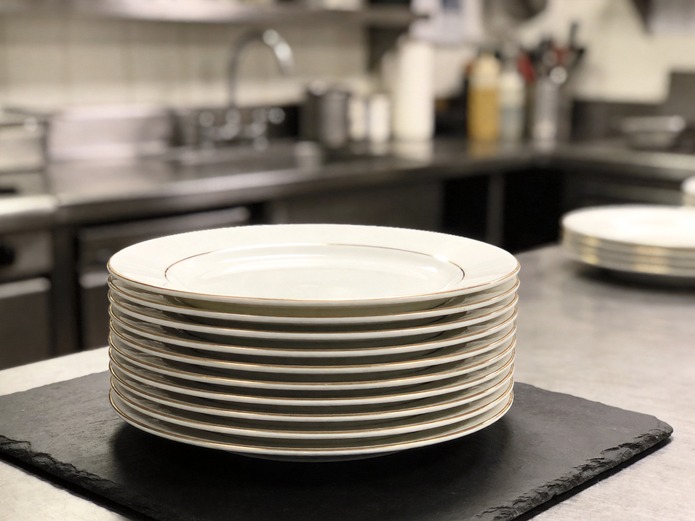
Gold rim ceramic tableware looks like a styling decision until the first dishwasher cycle or the first compliance question. The band is roughly 0.1 micron of metal fired onto the glaze: thin enough that ordinary wet abrasion removes it, thin enough that regulators treat it as a separate material from the body beneath it, and thin enough that no report about the body tells you anything about the band. Buyers who file it under finish options discover the difference in one of three places: a re-order that no longer matches the first shipment, a rejection at receipt nobody can adjudicate, or an inspector asking for a migration test on the decorated zone.
This guide is written from the position of someone who has specified these bands and then had to defend them two years later. It covers the legal identity of a metal-decorated piece, the physics of what actually wears off, the dishwasher arithmetic that makes a passed test meaningless in a hotel, and the clauses worth writing into the purchase order before the mould is cut.
The Band Is a Separate Material, and the File Has to Say So
A gold rim is not a surface treatment in the sense paint or glaze is. It is a metallic preparation applied over the fired glaze and refired at lower temperature, so the finished piece has three materials at the food-contact surface: body, glaze, metal. Migration limits are written against the article as tested, and the decorated zone falls inside the sampled area whenever the band sits on a rim that food touches.
Under 84/500/EEC the categories that matter are flat articles at 0.8 mg/dm² lead and 0.07 mg/dm² cadmium, hollow articles under three litres at 4.0 mg/L lead and 0.3 mg/L cadmium, and hollow articles above three litres at 1.5 mg/L lead and 0.1 mg/L cadmium. The condition is 4% acetic acid held 24 hours at 22 °C. In the United States the operative numbers are enforcement levels rather than statutory limits: FDA CPG 545.450 puts flatware at 3.0 µg/mL averaged across six units, small hollowware at 2.0, cups and mugs at 0.5, large hollowware at 1.0; CPG 545.400 sets cadmium at 0.5 for flatware and small hollowware, 0.25 for large hollowware.
None of those thresholds change because the piece is gold. What changes is whether the decorated area was sampled. A report for an undecorated control plate has tested a different article than the one on your shelf. Ask which surface area was exposed, whether the rim band fell inside it, and whether the laboratory took a decorated piece or a plain one. The difference between the two answers is what food safety documentation should record, and it is the first thing to check in a test report. That question separates a compliant gold rim ceramic tableware file from one about a different product.
Decorative Ware Has a Statutory Identity in the United States
A second regulatory path catches buyers who assume a gold rim means food use. 21 CFR 109.16 governs decorative ceramic ware: pieces not intended for food contact that carry a lead-bearing glaze or decoration. Such an article must carry a conspicuous removable label stating that it is not for food use and may poison food, in letters at least 3.2 mm high, with the same statement permanently marked on the underside. The regulation allows an alternative where labelling is impractical: the piece may be perforated so it cannot hold food.
This is where a sourcing conversation goes wrong most often. Chargers, wall plates and display pieces are legitimately decorative ware and should arrive labelled or perforated. A gold-rimmed dinner plate sold into restaurant service is food-contact ware and needs the migration file instead. If a supplier ships chargers as food-use ware, the importer has a mislabelling problem; if a supplier ships food-use plates as decorative ware to skip the migration file, the importer has a worse one. Put the intended use in the specification and make the supplier confirm which regime they ship under; the declaration of conformity should then name the regime explicitly. Declaration of conformity covers the fields that have to match.
What Actually Wears: The 0.1 Micron Arithmetic
Gold decoration is fired, not plated or sprayed. On earthenware bodies the preparation is typically fired around 690–700 °C; on porcelain the range rises to roughly 750–850 °C, corresponding to Orton cone SSB 017–018. The resulting film is about 0.1 micron, roughly one seven-hundredth the thickness of a human hair.
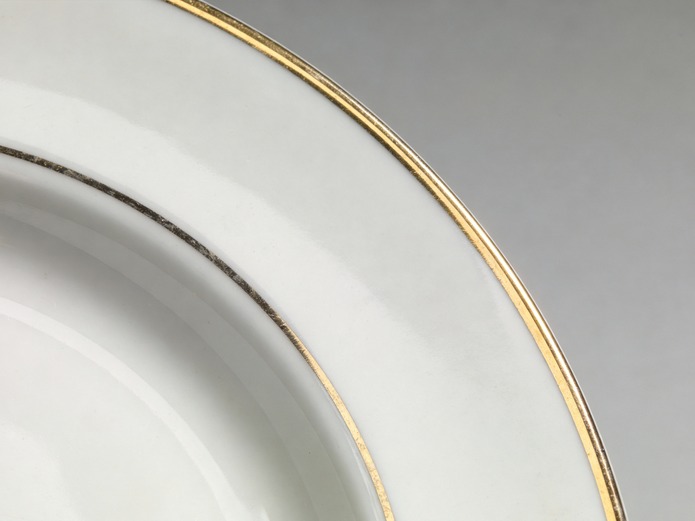
That number decides which test kills the band. A 26 cm plate with a 3 mm band carries about 24.5 cm² of decorated surface and roughly 4.7 mg of gold. There is no meaningful reserve behind the film: once it is breached the glaze is exposed and the piece reads as worn though the body is perfect. Glaze condition matters here too: crazed glaze gives the film a place to fail, as set out in glaze crazing testing. Abrasion and dishwasher tests are not measuring durability in the abstract; they measure how fast a 0.1 micron layer is consumed where cutlery, stacking and detergent concentrate energy.
Dishwasher Maths Most Buyers Skip
EN 12875 is the reference suppliers cite when they say a decoration is dishwasher resistant, and its scope is domestic dishwashing. The distinction is not pedantic. A household machine sees a few cycles a week; a hotel or contract-catering operation runs rack or conveyor machines at several cycles an hour during service, then again during breakdown.
Take a modest three cycles a day: 1,095 a year, 2,190 across a two-year replacement interval. Against a 100-cycle floor expressed in the standard’s household terms, the hotel asks the decoration to survive about twenty-two times the reference exposure. A supplier reporting "passes EN 12875" has answered a question about domestic use, not about your account.
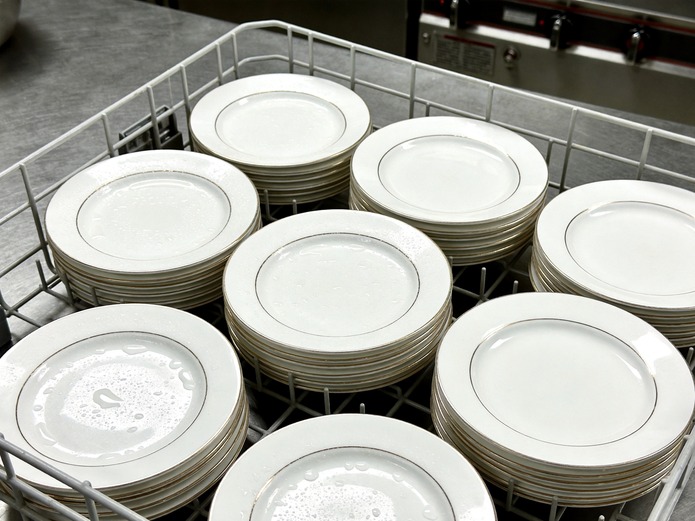
The honest way is to treat the standard as a protocol with a count you choose, not a pass/fail gate. Write the cycle count, name the detergent class, and state acceptance as a retained-area percentage of the band rather than a subjective "no visible wear." Then ask which machine the laboratory used, because a bench machine and a commercial rack machine are different environments. The same discipline applies to microwave claims, where microwave and dishwasher safety standards separate a functional limit from a durability one.
Decision Table: Match the Decoration to the Service Model
| Service model | Band placement and type | What to specify | Expected failure mode |
|---|---|---|---|
| Fine dining, hand-wash or low-cycle machine | Narrow real-gold band on outer rim, above the well | Migration report on the decorated piece; detergent class stated | Edge chipping takes the band with it |
| Hotel banqueting, high cycle count | Band on shoulder or outer wall, clear of cutlery path | Cycle count in the PO; retained-area criterion | Gradual film loss at the shoulder |
| Cafe and casual, stacked hard | Band below the rim, or body decoration instead | Stacking test with interleaving; band position on drawing | Rim-to-rim abrasion in the stack |
| Display, charger, decorative only | Any metallic decoration, no food-contact claim | 21 CFR 109.16 label or perforation; intended use in writing | Mislabelling, not wear |
| Takeaway and delivery | No metallic decoration at food-contact surfaces | Microwave statement; metal-free confirmation | Arcing and consumer complaint |
Two rows are traps. Banqueting plate formats usually come from the commercial plates and platters range. The charger row is the one buyers get wrong most often, because a charger looks like a plate and is ordered like one. The takeaway row generates the fastest complaint volume, because a gold rim in a microwave is an electrical problem rather than a durability one. Note also that gold rim ceramic tableware bought for banqueting and gold rim ceramic tableware bought for display are, functionally, two different products sharing one photograph. Defect classification standards are where those two products get separated on paper.
What to Write in the Purchase Order
The clauses below are written to be pasted into a PO and edited, not admired.
Decoration specification
1. Decoration type: [real gold preparation / lustre / printed metallic ink], refired at [   ] deg C.
2. Band location: [outer rim / shoulder / outer wall], nominal width [   ] mm, tolerance +/-0.3 mm.
3. Free of pinholes, skips and exposed glaze at 300 lux, viewed from 25-35 cm.
4. Migration: decorated article, 4% acetic acid, 24 h, 22 deg C, exposed area stated.
5. Dishwasher: [   ] cycles to [protocol], detergent class [   ], retained band area >= [   ]%.
6. No detachment of decoration after the regime in clause 5 (sensory check).
7. Intended use: [food contact / decorative only]. Decorative pieces carry 109.16 labelling.
8. Band position and decoration type marked on the golden sample, retained by buyer.
Clause 4 gets argued about, because a supplier can produce a compliant report for a plain plate and call it evidence for the decorated one. Clause structure for the rest of the agreement sits in a tableware purchase contract, and the receiving side is covered by a quality control checklist. Clause 8 gets you through a dispute two years later, because a retained sample with the band position marked is the only artefact that settles whether the second shipment drifted.
Receipt checklist, eight items
- Band position matches the marked golden sample, measured on a flat bed rather than held in the hand.
- Band width within tolerance at four quadrants; one measurement hides an eccentric band.
- No pinholes or skips at 300 lux from 25–35 cm, checked on the decorated zone specifically.
- Migration report names the decorated article, exposed area and test conditions.
- Dishwasher report states machine type and cycle count, not only a pass verdict.
- Decoration adhesion checked after the dishwasher regime, not before it.
- Decorative-only pieces: label height and underside marking present, or perforation present.
- Packaging separates rim from rim; interleaving present, stack height stated on the carton.
The packaging item is not housekeeping. Plates stacked rim to rim with grit between them abrade the band in transit, and that loss is indistinguishable at receipt from decoration that was under-fired.
Three Risks Worth Pricing In
The first is under-specification at quotation. A band quoted as "gold rim, as photo" leaves the supplier free to choose preparation, film build and firing temperature, and those choices set service life. The gap between a properly fired real-gold preparation and thin printed metallic ink is real, but smaller than the cost of a mid-contract re-order that cannot match. Decoration techniques sets out what each method actually commits to.
The second is the sample-to-production gap. A decorated sample approved from a specially fired trial piece often represents the best the line can do, not the mean. Require the production sample to come from the same line, firing and decoration batch.
The third is the arithmetic of a marginal reject rate. On 5,000 pieces, a decoration passing at 92% rather than 98% is 400 rejects against 100: 300 extra pieces to replace, re-pack, re-test and re-ship, and if the loss is found at destination it carries freight and duty on goods you cannot sell. The difference between those rates is usually one process control, not one material.
Cost, quality and lead time move together
The metal is a small part of unit cost; the decoration step is not. It adds a second firing, a handling pass and a rejection gate that plain ware does not need. That is why the same body can be quoted at two very different prices with both quotes honest, and why comparing them on unit price alone usually selects the wrong one.
Lead time moves for the same reason: a decorated order is scheduled around a decoration batch, so minimum run length is set by the kiln and the preparation batch rather than your carton count. Ask both MOQ numbers before accepting either.
For gold rim ceramic tableware, money spent on correct band placement and a stated cycle count buys service life; money spent on a heavier gold look buys appearance. They are not the same purchase, and a specification that does not distinguish them will be filled at the cheaper of the two.
Three recommendations
- Fix band placement on a drawing before tooling. Placement drives service life more than preparation type, is free to change at the drawing stage and expensive after the mould.
- Specify the dishwasher regime by cycle count and detergent class rather than by standard name. The name answers a domestic question; the count answers yours.
- Keep the golden sample with band position marked, in your archive. It adjudicates a second-shipment dispute without a laboratory.
If volume justifies it, add a fourth: request the decoration batch record. For custom decoration programmes, OEM and ODM development covers how the band is fixed at tooling stage. Firing temperature and film build are recorded by any decorator working to a specification, and a supplier who cannot produce that record for your order is telling you how the order was controlled.
If you want the band specified before tooling rather than after the first complaint, send us the intended use and cycle count and we will return a decoration specification to edit.
Questions That Come Up at Quotation
Is a gold rim safe for food contact?
Safety is a property of the tested article, not the colour. A decorated piece that passes the applicable migration limit for its category, with the decorated zone inside the exposed area, is compliant. The question is whether the report covered that zone, not whether gold is permitted.
Can gold rim ceramic tableware go in a microwave?
No, and that is a functional limit rather than a regulatory one. Metallic decoration couples with microwave energy and can arc at the band. Pieces for microwave use should be specified metal-free, and the statement should sit on the piece or the packaging rather than in a catalogue footnote.
How long will the band last in a hotel?
Long enough that nobody can answer from a photograph. It depends on band placement, cycle count, detergent class and how plates are stacked. That is exactly why the cycle count belongs in the PO: without it, "how long" has no anchor and the answer defaults to whatever the supplier last heard.
What does decoration do to the MOQ?
It usually adds a batch minimum separate from the body minimum, set by the decoration preparation and kiln load. Two numbers, not one, and they should be quoted together.