Korean restaurant ceramic tableware requires specifications that most generic dinnerware guides overlook. From dolsot bowls that withstand direct flame to small banchan plates that stack efficiently in cramped dish pits, the pieces you source determine both operational efficiency and diner experience. This guide covers the exact ceramic types, thermal ratings, and dimensions that Korean BBQ chains, bibimbap specialists, and full-service Korean restaurants specify when placing bulk orders from overseas suppliers.
By the end of this article, you will have a procurement-ready checklist for Korean restaurant ceramics, a decision table comparing stoneware and porcelain for specific Korean dishes, and three sourcing mistakes that delay openings by weeks.
The Essential Korean Restaurant Ceramic Pieces
A full-service Korean restaurant typically runs six to ten distinct ceramic SKUs. Buying the wrong mix creates operational headaches: plates that do not fit under heat lamps, bowls that crack under broilers, or cups that tip on narrow bar rails. Here is what experienced Korean restaurant operators actually order.
Dolsot Bowls (Stone Bowls)
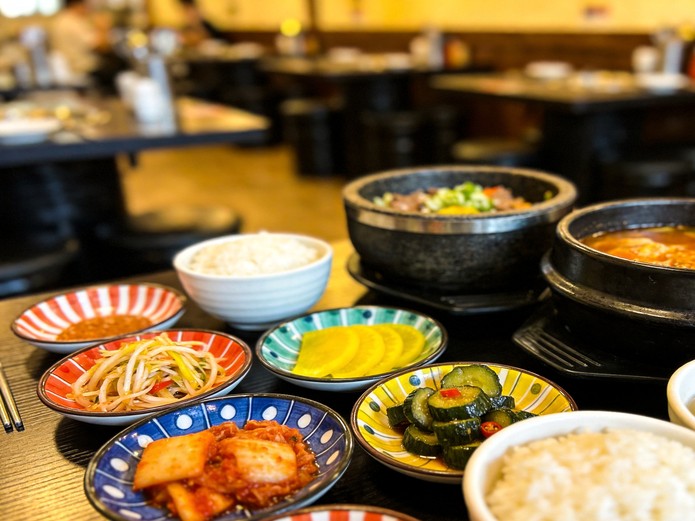
These are not decorative serving pieces. A genuine dolsot bowl must survive direct gas flame or induction heat at 350°C to 450°C for three to five minutes without cracking. Most operators specify stoneware with 8% to 12% porosity — enough thermal mass to retain heat, but not so porous that oil seeps into the body and turns rancid. Interior diameter typically runs 16 to 18 cm, with a wall thickness of 8 to 12 mm. Capacity ranges from 800 ml to 1.2 L depending on whether the bowl serves rice-only bibimbap or a protein-heavy version.
One detail buyers frequently miss: the base must be flat and unglazed. A glazed base on a dolsot bowl creates a thermal barrier that causes uneven heating and increases crack risk. Specify an unglazed foot ring in your purchase order.
Banchan Plates (Side Dish Plates)
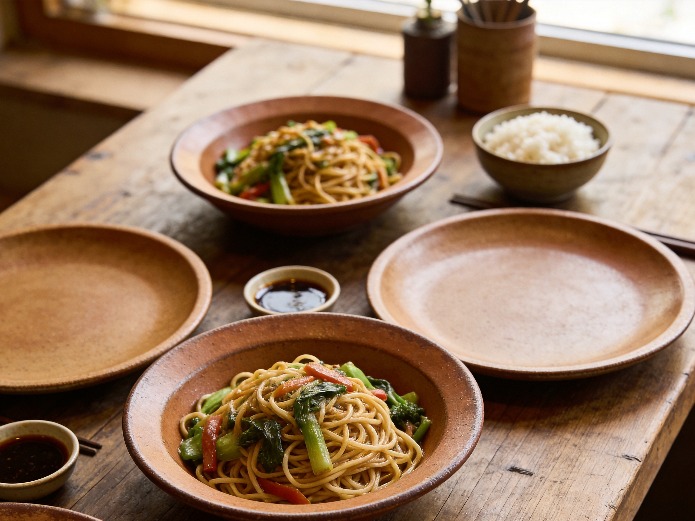
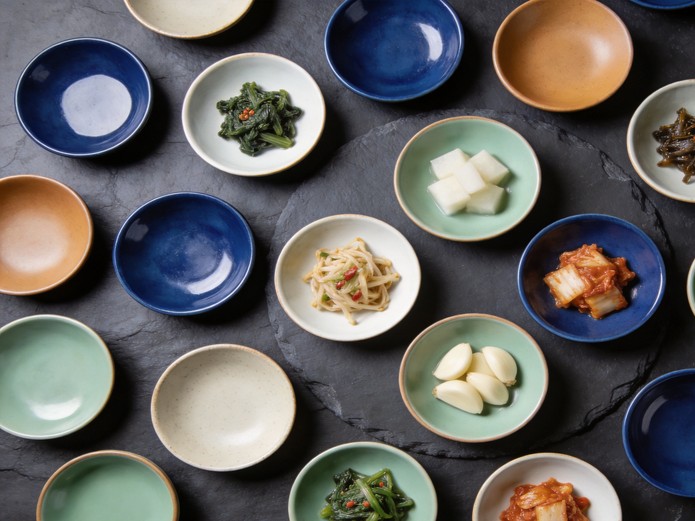
Banchan service defines Korean dining. A single table may receive six to twelve small plates simultaneously. The ceramics must be small (10 to 14 cm diameter), lightweight, and stackable to thirty-plus units high. Most Korean restaurants source banchan plates in mixed color sets — five to eight glaze colors per table — to help staff track which plate belongs to which diner when plates are passed family-style.
From a sourcing standpoint, banchan plates are where customization adds the most value. A restaurant group ordering 5,000+ units can specify custom glaze colors that match brand guidelines for roughly the same per-unit cost as standard glazes, since the color change does not require new molds.
Rice Bowls and Soup Bowls
Korean rice bowls (gonggi-bap) are deeper than Japanese donburi bowls and narrower than Chinese rice bowls. The standard specification is 11 to 13 cm diameter, 6 to 7 cm depth, with a capacity of 300 to 400 ml. The shape matters: a slightly tapered profile prevents rice from cooling too quickly while allowing easy grip for diners who lift the bowl while eating.
Soup bowls for Korean service (guk-tang) run larger — 14 to 16 cm diameter, 7 to 9 cm depth — because Korean soups often contain noodles or substantial solids. These bowls face less thermal stress than dolsot bowls but still need to handle temperatures up to 120°C from boiling broth.
Soju Cups and Tea Cups
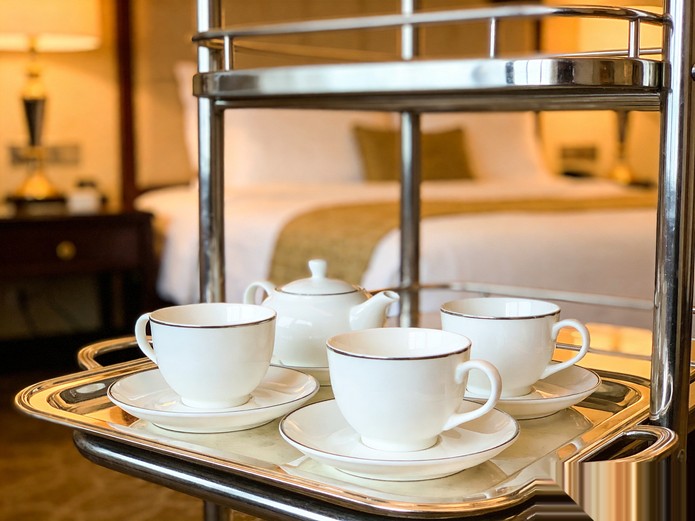
Soju cups are small — 40 to 60 ml capacity — and usually unhandled. The ceramic must be thin-walled (3 to 5 mm) to keep the drink at serving temperature. Tea cups (for Korean barley tea or corn tea service) are slightly larger at 120 to 180 ml. Both items break frequently in high-volume service, so most operators budget a 15% to 20% annual replacement rate and order accordingly.
Dolsot Bowls: Thermal Shock Requirements Most Buyers Miss
The dolsot bowl is the highest-risk item in Korean restaurant ceramic procurement. A cracked bowl in service means spilled hot food, potential burns, and a kitchen that has to comp a meal. The failure mode is almost always thermal shock, not impact.
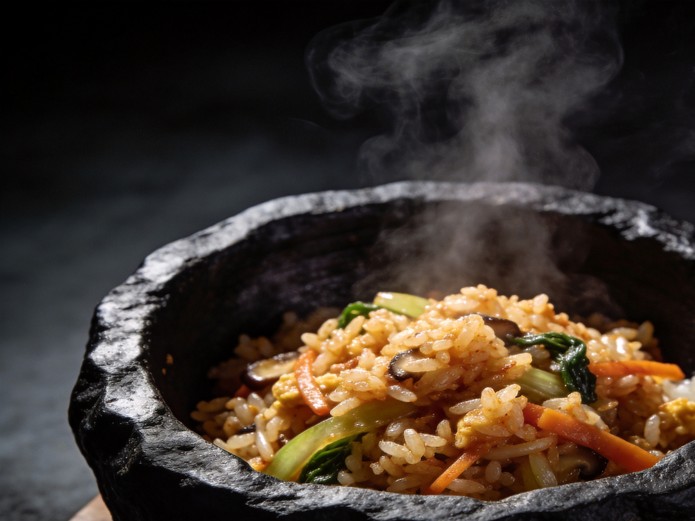
Here is what to specify in your technical requirements:
- Coefficient of thermal expansion (CTE): Below 4.0 x 10⁻⁶/°C. Stoneware with high cordierite content achieves this. Standard earthenware at 5.5+ x 10⁻⁶/°C will crack within weeks of flame service.
- Thermal shock differential: Must survive a 300°C temperature drop without cracking. Test method: heat bowl to 350°C, plunge into 20°C water. Any visible crack after three cycles is a reject.
- Wall thickness uniformity: Variation should not exceed ±1.5 mm. Uneven walls create stress concentrations during heating.
- Unglazed foot ring: Already mentioned, but worth repeating — this is non-negotiable for flame-safe service.
Lead time implication: dolsot bowls require a longer clay conditioning period before forming. Standard ceramic bowls cure for 24 to 48 hours; high-thermal-shock stoneware needs 72 to 96 hours. Add one week to your production timeline if you are sourcing dolsot bowls alongside standard dinnerware.
Procurement Decision Table: Stoneware vs Porcelain for Korean Dining
| Ceramic Type | Best For | Cost per Unit (500+ MOQ) | Lead Time | Thermal Shock Rating | Weight |
|---|---|---|---|---|---|
| High-firing stoneware (dolsot grade) | Dolsot bowls, flame-safe serveware | $4.50 – $7.00 | 45 – 55 days | 350°C+ direct flame | Heavy (800g+ for 18cm bowl) |
| Standard stoneware | Banchan plates, rice bowls, soup bowls | $1.80 – $3.20 | 35 – 45 days | 120°C (hot food service) | Medium (200–350g) |
| Vitrified porcelain | Soju cups, tea cups, dessert plates | $1.20 – $2.50 | 30 – 40 days | 100°C (hot beverage) | Light (80–150g) |
| Reactive glaze stoneware | Accent pieces, branded tableware | $3.50 – $6.00 | 50 – 65 days | 150°C (display/service) | Medium (250–400g) |
The cost gap between dolsot-grade stoneware and standard stoneware is substantial — roughly 2x to 3x per unit. For a 100-seat Korean BBQ restaurant opening with twelve dolsot bowls per table (to cover peak turn rates), that difference translates to $3,000 to $5,000 in ceramic costs alone. The decision is not whether to buy dolsot-grade — it is mandatory for flame service — but how many tables actually need live-cooking bibimbap versus pre-plated versions that can use standard bowls.
Quality Checklist for Korean Restaurant Ceramics
Use this checklist during factory inspection or when evaluating supplier samples. Mark each item pass or fail. Any single fail on dolsot bowl criteria should reject the entire dolsot lot.
| Item | Check | Pass Criteria |
|---|---|---|
| Dolsot bowl | Flame test (3 cycles) | No cracks, chips, or glaze crazing after heating to 350°C and air-cooling |
| Dolsot bowl | Wall thickness | 8–12 mm, variation ±1.5 mm max |
| Dolsot bowl | Base flatness | Unglazed foot ring, sits stable on flat surface without rocking |
| Banchan plate | Stack height | 30 units stack under 25 cm total height |
| Banchan plate | Glaze consistency | Color variation within ΔE < 3.0 across 50-unit sample |
| Rice bowl | Capacity | 300–400 ml at rim level |
| Soup bowl | Broth temperature hold | Internal surface does not exceed 85°C when 100°C broth is added |
| All items | Lead and cadmium | Pass FDA 21 CFR 175.300 or LFGB § 30 and 31 [VERIFY BEFORE PUBLISHING] |
| All items | Dishwasher durability | 100-cycle commercial dishwasher test with no glaze degradation |
Common Sourcing Mistakes When Buying Korean Tableware
Mistake 1: Ordering Dolsot Bowls from a Standard Stoneware Line
Some suppliers will offer to produce dolsot-style bowls using their standard stoneware clay body to hit a lower price point. The bowls look identical in photos. In service, they crack within two to four weeks. The only way to verify is a flame test on production samples — not just the pre-production sample, which may be made from a different batch. Insist on testing samples pulled from the actual production lot.
Mistake 2: Specifying Banchan Plates That Are Too Large
Western buyers often assume banchan plates should be 15 to 18 cm — similar to bread plates. In practice, Korean tables are crowded. A 12 cm plate holds the correct portion of kimchi or pickled radish and leaves room for the main dish, rice bowl, and soup bowl. Oversized banchan plates force awkward rearrangement by diners and slow table turns.
Mistake 3: Ignoring Color Consistency Across Reorders
Korean restaurants often use color-coded banchan plates to distinguish vegetarian, spicy, and standard options. If your first order uses a specific cobalt blue and your reorder three months later arrives in a noticeably different shade, the front-of-house system breaks. Specify a color reference system — Pantone, RAL, or a physical master sample — and include a tolerance (ΔE < 3.0) in your purchase contract.
MOQ, Lead Time, and Customization Options
Most Chinese ceramic factories structure MOQs by mold, not by total order value. For Korean restaurant ceramics, here is what to expect:
- Dolsot bowls: 500 to 1,000 units per mold size. New mold development adds 7 to 10 days and $300 to $800 in tooling cost.
- Banchan plates: 1,000 to 2,000 units per color. Mixed-color orders within the same mold typically qualify for a single MOQ if the total hits 2,000+ units.
- Rice and soup bowls: 1,000 to 1,500 units per size. These are high-volume SKUs for most factories, so MOQs are negotiable downward if you are ordering multiple sizes from the same facility.
- Soju and tea cups: 2,000 to 3,000 units. Thin walls require precise forming; smaller factories may quote higher MOQs for these.
Lead times break down as follows for a typical mixed order:
- Sample approval and mold preparation: 10 to 14 days
- Clay preparation and forming: 7 to 14 days (longer for dolsot-grade clay)
- Drying and bisque firing: 7 to 10 days
- Glazing and glaze firing: 7 to 10 days
- Quality inspection and packing: 5 to 7 days
- Total production: 35 to 55 days depending on order complexity
- Shipping (FOB China to US West Coast): 14 to 21 days by sea
Customization options that do not require new molds — and therefore do not extend lead time — include glaze color changes, logo decal application, and matte versus glossy finish selection. Custom shapes, embossed patterns, or unique rim profiles require new molds and add 7 to 14 days.
For restaurant groups planning a multi-location rollout, the most cost-effective approach is to place one large opening order covering all locations, then schedule smaller replenishment orders quarterly. The initial order secures mold investment across all units; subsequent orders pay only the per-unit production cost.
Korean Restaurant Ceramic Procurement Calculator
Use this formula to estimate your opening ceramic budget. Adjust the seat count and table-turn assumptions for your specific concept.
Opening Ceramic Budget Formula:
- Dolsot bowls: (Seats × 1.2) × unit cost — the 1.2 multiplier covers peak turn rate when tables reset before washing
- Banchan plates: (Seats × 8) × unit cost — eight plates per seat covers a full banchan spread plus breakage reserve
- Rice bowls: (Seats × 1.5) × unit cost
- Soup bowls: (Seats × 1.3) × unit cost
- Soju cups: (Seats × 2.5) × unit cost — higher multiplier due to breakage rate
- Tea cups: (Seats × 1.2) × unit cost
- Add 15% for shipping, customs, and inland freight
Example — 60-seat Korean BBQ:
- Dolsot bowls: 72 × $5.50 = $396
- Banchan plates: 480 × $2.00 = $960
- Rice bowls: 90 × $2.20 = $198
- Soup bowls: 78 × $2.80 = $218
- Soju cups: 150 × $1.50 = $225
- Tea cups: 72 × $1.80 = $130
- Subtotal: $2,127
- Plus 15% logistics: $2,446
This is a baseline. Fine-dining Korean concepts with custom glazes or branded pieces will run 30% to 50% higher. Fast-casual concepts using standardized colors and simpler shapes may land 10% to 15% below this estimate.
FAQ
Can I use regular stoneware bowls for bibimbap if I do not flame them tableside?
Yes. If your kitchen preheats bibimbap in the bowl under a salamander and serves it sizzling — without the customer seeing live flame — standard high-firing stoneware rated to 200°C is sufficient. The key is confirming the bowl is preheated empty, not loaded with cold ingredients, which creates thermal shock.
How do I verify a supplier actually makes dolsot-grade stoneware?
Ask for a CTE test report from a third-party lab. Reputable suppliers will have this on file. If they cannot provide one, request a flame test video showing three heat cycles on a production sample. Be cautious of suppliers who offer dolsot bowls at standard stoneware prices — the material cost difference is real and unavoidable.
What is the typical lifespan of Korean restaurant ceramics in commercial service?
Dolsot bowls last 2 to 4 years with daily flame service. Banchan plates and rice bowls typically last 3 to 5 years in commercial dishwasher cycles. Soju and tea cups need replacement every 12 to 18 months due to breakage. Budget your reorder cycle accordingly.
Should I source all Korean ceramics from one factory or split across specialists?
For orders under 5,000 total units, one factory is usually more efficient — lower combined shipping, simpler QC, and one point of contact for defects. For larger rollouts, splitting dolsot bowls to a thermal-shock specialist and decorative pieces to a glaze-focused factory can improve quality, but coordination overhead increases. Most 100-seat openings are better served by a single qualified supplier.
Can I get custom Korean characters or restaurant logos on the ceramics?
Yes. Logo decals and Korean character printing are standard services. Underglaze printing — where the design is applied before the final glaze firing — is more durable than overglaze decals for items that see daily dishwasher service. Underglaze adds no per-unit cost beyond the artwork setup (typically $150 to $300 per design). Overglaze decals are cheaper upfront but may fade within 12 to 18 months of commercial washing.
Do Korean restaurant ceramics need different certifications than standard tableware?
No. The same FDA 21 CFR 175.300 and LFGB § 30 and 31 requirements apply. However, because dolsot bowls experience higher temperatures in service, some buyers request additional testing at elevated temperatures (120°C for two hours) to confirm glaze stability beyond standard room-temperature leach tests. [VERIFY BEFORE PUBLISHING]
Ready to source Korean restaurant ceramic tableware for your next opening? Request our Korean restaurant tableware catalog with thermal shock specifications, MOQs by piece type, and sample lead times. We can also review your seating plan and recommend the optimal SKU mix and quantities for your concept.
Need help comparing stoneware and porcelain options for your specific menu? Read our ceramic material types comparison guide for a detailed breakdown of durability, weight, and cost across clay bodies. For import compliance requirements, see our ceramic certification standards guide.