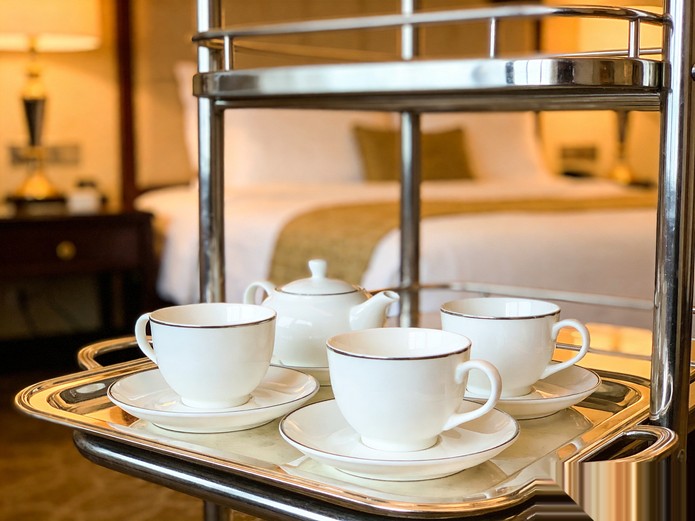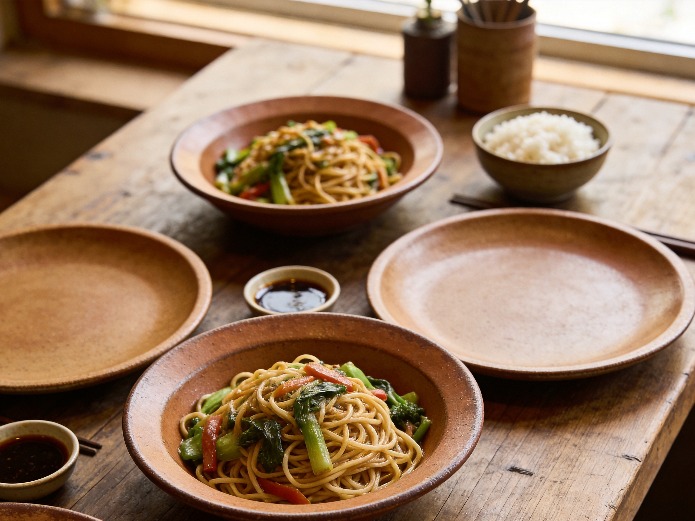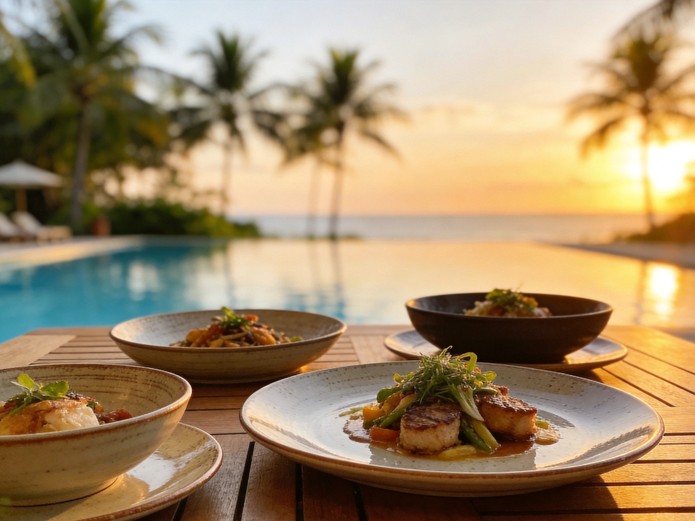
Ceramic tableware for resorts must survive conditions that would destroy standard hotel porcelain within a season. Salt air corrodes unprotected rims. Chlorinated pool water leaves permanent white marks on low-fired glazes. Sand scratches surfaces that look pristine in a showroom. And UV exposure fades reactive glazes within months of daily sun exposure. After sourcing ceramic collections for properties from Phuket to Cancun, I have learned that resort buyers who treat their tableware procurement like a city hotel order end up replacing 30 to 40 percent of their inventory within the first operating year. This guide explains what specifications actually matter for resort environments, how to select one cohesive collection that works across five different dining venues, and where to invest versus where to save.
Why Resort Ceramic Tableware Needs Different Specifications Than City Hotels
City hotel dinnerware lives indoors. Climate control, soft water, padded storage racks, and trained staff keep standard porcelain looking new for years. Resort tableware faces a completely different stress profile.
Beachfront properties deal with salt air that accelerates metal oxide corrosion in glazes. Poolside service exposes plates to chlorinated water splashes that etch low-fired surfaces. Outdoor dining creates thermal shock risk when hot plates meet cool evening breezes or when frozen desserts sit on sun-warmed surfaces. And sand, whether carried on guest feet or blown by wind, acts as an abrasive that scratches matte finishes and wears down raised rims.
Then there is the operational pace. Resort kitchens often run 18 to 20 hours during peak season. Dishwashing cycles are shorter and hotter to handle volume. Staff turnover is higher, which means less careful handling. And storage space is typically tighter because back-of-house areas are sacrificed to maximize guest-facing square footage.
The result is that a resort needs dinnerware with higher abrasion resistance, better thermal shock tolerance, and more forgiving edge profiles than an equivalent city property. The good news is that these properties are achievable without premium pricing, provided you know which specifications to request.
The Five Resort Dining Environments and Their Tableware Demands
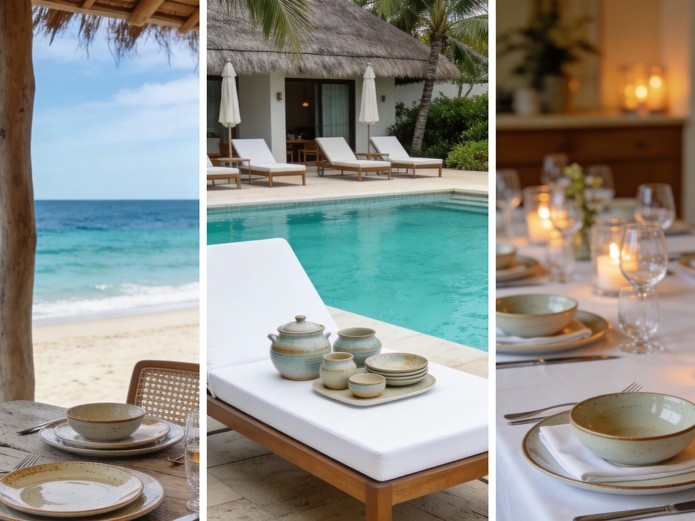
Most resorts operate at least three dining venues, and larger properties may have five or more. Each venue has distinct tableware requirements. Sourcing one collection that works across all of them saves storage space, simplifies reordering, and protects brand consistency.
| Venue | Primary Risk | Recommended Material | Glaze Priority | Edge Profile |
|---|---|---|---|---|
| Beachfront restaurant | Salt air, sand abrasion | High-fired stoneware or vitrified porcelain | Hard, fully vitrified glaze | Flat or gently rolled rim |
| Poolside bar and grill | Chlorine etching, thermal shock | Vitrified porcelain or alumina-enhanced stoneware | Chemical-resistant glaze | Wide, stable foot ring |
| Fine dining room | Presentation, guest perception | Porcelain or bone china | Consistent color, smooth surface | Refined, thin rim |
| In-room dining | Stacking durability, tray stability | Stoneware or mid-weight porcelain | Chip-resistant glaze | Moderate rim with stacking lip |
| Breakfast buffet | High turnover, heat retention | Thick stoneware or heat-retaining porcelain | Thermal shock resistant | Wide rim for handling |
The critical insight from this table is that no single material wins across every venue. Vitrified porcelain works for fine dining and poolside but may chip too easily in buffet service. Thick stoneware handles buffet heat retention but looks heavy at a beachfront dinner table. The solution most successful resort buyers use is a two-material strategy: one primary collection in a versatile stoneware or porcelain body that covers 70 to 80 percent of venues, supplemented by a smaller premium collection for fine dining only. Browse our hotel and catering dinnerware for pieces designed for high-volume hospitality environments.
Material and Glaze Selection for Outdoor and Chlorinated Environments
The material decision drives every other specification. For resort environments, the three viable options are high-fired stoneware, fully vitrified porcelain, and alumina-enhanced stoneware. Each has a different cost, durability, and aesthetic profile.
High-fired stoneware (fired above 1,200 degrees Celsius) offers the best abrasion resistance for the price. The dense body resists sand scratching and handles minor impacts well. It is also the most forgiving of thermal shock because the body and glaze expand at similar rates. The trade-off is weight. Stoneware plates are 15 to 25 percent heavier than equivalent porcelain, which affects staff handling and guest perception at fine dining venues.
Fully vitrified porcelain has near-zero water absorption, which makes it highly resistant to chlorinated water and salt air penetration. It is also lighter and more refined-looking than stoneware. The weakness is edge chipping. Porcelain rims are thinner and more brittle, especially if the glaze does not wrap fully over the foot ring. For poolside and beachfront service, always request full glaze coverage including the foot and rim edge.
Alumina-enhanced stoneware sits between the two. Aluminum oxide added to the clay body increases hardness and reduces chipping without the premium price of fully vitrified porcelain. It is increasingly popular for resort buyers who want one collection across multiple venues. Lead time is typically two to three weeks longer than standard stoneware because fewer factories stock alumina clay bodies in volume.
Glaze selection matters as much as body material. For outdoor and chlorinated environments, request a fully vitrified glaze with a hardness rating of at least 5 on the Mohs scale. Reactive and matte glazes are popular for resort aesthetics but are more porous and softer than glossy glazes. If your design calls for a matte finish, confirm the glaze is still fully vitrified. Some factories achieve matte effects through controlled cooling rather than porous formulation, which preserves chemical resistance.
Sizing, Stacking, and Storage: What Works in Resort Back-of-House
Resort back-of-house space is expensive. Every square meter given to storage is one taken from guest revenue. Most resort kitchens I have visited have 30 to 50 percent less dry storage per cover than an equivalent city hotel. This means your tableware must stack efficiently and store safely in tight spaces.
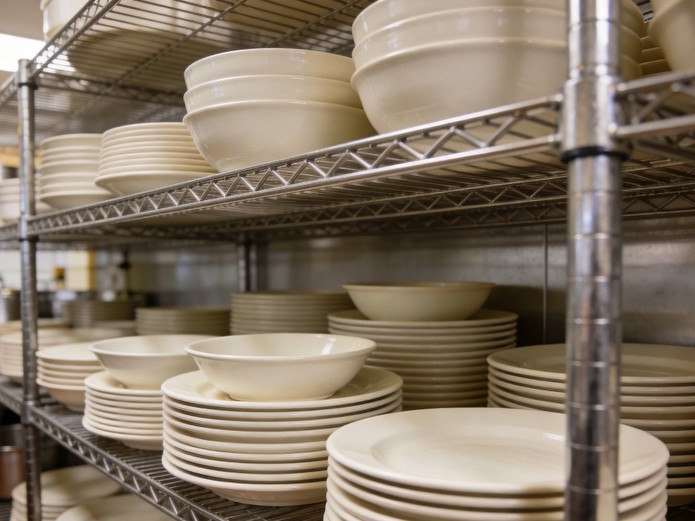
The most efficient dinnerware for resort storage uses nested stacking profiles. Plates with a defined stacking lip or a slightly recessed center nest securely without surface contact. Bowls with graduated diameters stack inside each other. Mugs with straight-sided walls rather than flared rims stack five to six high in the same footprint as three flared mugs.
For sizing, I recommend standardizing on four core pieces for 80 percent of service: a 26 to 28 centimeter dinner plate, a 19 to 21 centimeter side plate, a 400 to 500 milliliter bowl, and a 280 to 350 milliliter mug. This covers breakfast buffet, poolside lunch, in-room dining, and casual dinner. Fine dining venues can supplement with specialized pieces: a 30 centimeter presentation plate, a 15 centimeter bread plate, and a 200 milliliter espresso cup. Our commercial plates and platters and wholesale ceramic bowls include resort-appropriate sizes in both stoneware and vitrified porcelain.
Storage temperature is often overlooked. Resort storage rooms in tropical climates can reach 35 degrees Celsius with 80 percent humidity. Standard cardboard packaging absorbs moisture and collapses within weeks. Request plastic-wrapped pallet packaging with moisture-barrier film. If you must use cardboard, ensure it is wax-coated or laminated. I have seen entire shipments of resort tableware arrive with water-damaged boxes and mold-stained rims because this detail was missed.
Brand Consistency Across Beach Bars, Pool Decks, and Fine Dining Rooms
Brand consistency is harder at a resort than at a single-concept restaurant. A beach bar wants relaxed, earthy tones. A fine dining room wants crisp whites or subtle pastels. A poolside grill wants bright, photogenic colors for social media appeal. If each venue sources independently, the property ends up with five unrelated collections, fragmented reordering, and no bulk pricing leverage.
The most effective approach is to define a core color and finish palette of three to four tones that all venues draw from. For example: one neutral base (warm white or sand), one accent earth tone (terracotta or sage), one dark contrast (slate or charcoal), and one optional seasonal color that changes twice a year. Every venue uses the same base, but the proportions differ. The beach bar might use 70 percent earth tone and 30 percent base. The fine dining room might use 90 percent base and 10 percent dark contrast.
This approach requires planning during the design phase. Work with your supplier to produce color samples in your actual lighting conditions, not just under factory fluorescent tubes. Salt air and UV light shift color perception. A warm white that looks perfect in a Jingdezhen showroom can read cold and clinical under tropical sun. Always request pre-production samples and evaluate them outdoors at the actual property before approving the full order. If you need custom color development, our OEM and ODM services include color matching for resort collections.
Logo placement is another consistency point. Most resorts want subtle branding: an embossed base mark, a tone-on-tone decal, or a small rim pattern. Avoid anything that competes with food presentation. And confirm that your logo application method is dishwasher-safe and UV-stable. Some low-temperature decals fade or crack after three months of resort dishwashing cycles.
MOQ, Lead Time, and Budget Planning for Resort Orders
Resort orders are large but not always as large as buyers expect. A 200-room resort with three dining venues typically needs 2,500 to 4,000 pieces for initial setup, depending on service style and par levels. This sounds like a massive order, but in ceramic factory terms it is mid-sized. Most Chinese factories set MOQ at one 20-foot container equivalent, which holds roughly 8,000 to 12,000 dinner plates or 15,000 to 20,000 mugs. A standard resort order rarely fills a full container with one SKU, so buyers usually combine multiple SKUs to reach container MOQ.
Lead time for a custom resort collection is typically 45 to 65 days from sample approval, plus 20 to 35 days for ocean freight. Air freight is rarely economical for resort orders because the weight penalty exceeds the cost of delaying opening by two weeks. If you need pieces faster, some suppliers stock neutral white or ivory stoneware in common sizes that can ship within 10 to 14 days. These are useful for emergency replacements but rarely match a custom brand palette.
Budget planning should account for a 15 to 20 percent replacement rate in year one, even with proper specifications. This is not a quality failure. It is the reality of resort operations: dropped plates, guest theft, and unexpected breakage. Build this into your initial order by adding a 20 percent spare stock allocation, or negotiate a scheduled reorder at six months with the same pricing. Most suppliers will agree to a follow-on order at the original FOB price if it is placed within 12 months and meets the same MOQ threshold.
For cost structure, resort tableware typically falls in the 2.50 to 6.00 dollar FOB range per piece for stoneware and 3.50 to 8.00 dollars for vitrified porcelain, depending on size, glaze complexity, and decoration. Alumina-enhanced stoneware adds roughly 10 to 15 percent over standard stoneware. These are landed cost estimates before import duties, which vary by destination country and are marked [VERIFY BEFORE PUBLISHING] for your specific jurisdiction.
Resort Tableware Sourcing Checklist
Use this checklist when evaluating samples or visiting a factory for a resort tableware order. Save it, print it, or share it with your procurement team.
- Body material is high-fired stoneware, fully vitrified porcelain, or alumina-enhanced stoneware
- Glaze is fully vitrified with Mohs hardness of 5 or higher
- Glaze covers the entire piece including foot ring and rim edge
- Reactive or matte glaze is achieved through controlled cooling, not porous formulation
- Thermal shock test passed for temperature differential of at least 150 degrees Celsius
- Stacking lip or nesting profile confirmed for stable storage
- Color samples evaluated under natural outdoor light at the destination property
- Logo application is dishwasher-safe and UV-stable
- Packaging uses moisture-barrier film or wax-coated cardboard for tropical climates
- Supplier provides pre-shipment inspection report with AQL 2.5 standard
- Spare stock allocation of 15 to 20 percent included in initial order
- Follow-on order pricing locked for 12 months at same FOB rate
- Lead time confirmed in writing: 45 to 65 days production plus 20 to 35 days ocean freight
For a broader quality framework that applies beyond resort environments, see our ceramic quality control checklist for bulk tableware manufacturing.
Three Mistakes Resort Buyers Make
Mistake 1: Choosing Aesthetics Over Durability
Matte glazes, reactive finishes, and hand-painted details photograph beautifully for marketing materials. They also scratch, stain, and fade faster than hard glossy glazes in resort environments. I have seen properties replace entire collections after six months because the Instagram-worthy matte plates became visibly worn. If you want a matte look, invest in a controlled-cooling vitrified matte glaze rather than a porous decorative finish. It costs 10 to 15 percent more per piece but lasts three times as long.
Mistake 2: Ignoring the Dishwasher Chemistry
Resort dishwashers use harsher chemicals and higher temperatures than standard commercial machines to handle volume and local water conditions. Alkaline detergents at 80 degrees Celsius will etch low-fired glazes within weeks. Before placing a large order, send samples to your actual dishwasher provider for a 50-cycle test. Any clouding, dulling, or edge degradation after 50 cycles indicates the glaze is not compatible with your washing protocol. This test costs nothing and saves thousands in premature replacement.
Mistake 3: Ordering One Collection for All Venues
A single collection across beach bar, fine dining, and buffet sounds efficient. In practice, it forces compromise at every venue. The beach bar gets plates that are too refined for casual service. The fine dining room gets pieces that look heavy and utilitarian. And the buffet gets rim shapes that do not stack well in heated cabinets. The better approach is a primary collection covering three venues plus a smaller premium collection for fine dining. The incremental cost is 5 to 10 percent, but the guest experience improvement and operational efficiency gains are significant.
Three Recommendations Before You Place Your First Resort Order
Recommendation 1: Run a 90-Day Pilot at One Venue
Before committing to a full-property order, purchase a 90-day stock for one venue only. Run it through peak season with your actual staff, dishwasher, and service style. Track breakage rates, guest feedback, and staff handling preferences. Use this data to refine specifications before scaling to the full property. The cost of a pilot is 3 to 5 percent of the total project but eliminates the risk of a full-property mismatch.
Recommendation 2: Negotiate a Sample-to-Production Color Lock
Color variation between sample and production is the most common complaint in resort orders. Natural light, glaze batch chemistry, and firing curve differences all shift color. Negotiate a written agreement that production must match the approved sample within a defined Delta E tolerance, typically 2.0 to 3.0 for resort tableware. Request that the factory retains a master sample and uses it for every production batch comparison. Without this, you risk receiving three subtly different shades across a 12-month rollout.
Recommendation 3: Build Spare Stock Into the Initial Order
Do not plan to reorder individual pieces within the first year. Custom resort collections have 45 to 65 day lead times, and suppliers often require full-container MOQs for reorders. A single broken dinner plate should not require a 4,000-piece reorder. Include 15 to 20 percent spare stock in your initial order, stored in original packaging. This gives you two years of replacement coverage without emergency air freight or mismatched substitute pieces.
Frequently Asked Questions
Can standard hotel porcelain work at a resort?
Standard hotel porcelain works for indoor fine dining at a resort but fails quickly at beachfront, poolside, and buffet venues. The rim chips faster, the glaze etches in chlorinated water, and UV exposure fades decorative finishes. For outdoor or high-abrasion venues, switch to high-fired stoneware or fully vitrified porcelain with full glaze coverage.
How long should a resort ceramic collection last?
A well-specified resort collection should last three to four years in fine dining and two to three years in high-traffic venues like poolside and buffet. Premature replacement is usually caused by incorrect material selection or dishwasher incompatibility, not normal wear. Budget for 15 to 20 percent annual replacement in year one, dropping to 5 to 10 percent by year three.
What is the minimum order for a custom resort collection?
Most factories require one 20-foot container equivalent, which translates to roughly 8,000 to 12,000 dinner plates or a mixed container of multiple SKUs. A typical 200-room resort initial order is 2,500 to 4,000 total pieces, so buyers usually combine tableware with other hotel supplies or negotiate a reduced MOQ with a price premium of 5 to 10 percent.
Should resort tableware be microwave-safe?
Microwave safety is less critical for resort tableware than for home or casual restaurant use. Most resort food is held in warming cabinets or plated fresh from the kitchen. However, in-room dining pieces should be microwave-safe because guests expect to reheat room service items. Confirm microwave compatibility for mugs, bowls, and in-room plates only.
How do I prevent color fading in outdoor resort venues?
Color fading is caused by UV degradation of organic pigments in low-fired glazes. Prevention requires two steps: first, specify fully vitrified glazes with inorganic mineral pigments, which are UV-stable. Second, avoid reactive and crystalline glazes for outdoor venues unless the supplier can confirm UV stability testing. When in doubt, choose glossy white or ivory for poolside and beachfront, and reserve reactive glazes for shaded indoor venues.
What packaging prevents damage during tropical shipping?
Moisture is the primary risk. Standard cardboard absorbs humidity and collapses, allowing pieces to shift and chip. Request individual foam or corrugated dividers between pieces, outer cartons wrapped in moisture-barrier stretch film, and pallet-level desiccant packs. For high-value collections, consider wooden crate packaging for the top 20 percent of SKUs.
Get the resort dinnerware specification sheet and share your property details. We will recommend the right material, glaze, and sizing for your specific venues and climate.