Hotel room service ceramic tableware differs from restaurant dinnerware in three ways: it must stay level on moving trays, survive elevator rides and hallway transport, and complement the room’s design aesthetic. Most procurement teams source room service ceramics using the same specs as their restaurant ware, then discover that standard plates slide on trays, chip at the edges during transport, and clash with the room’s interior design.
This guide explains the sourcing specifications that actually matter for in-room dining programs. You will learn which base designs prevent tray tipping, what weight range works best for transport durability, how to maintain brand consistency across standard rooms and suites, and what MOQ and lead time expectations are realistic for hotel orders. The checklist at the end is designed to save or copy directly into your procurement workflow.
What Makes Room Service Ceramics Different from Restaurant Ware
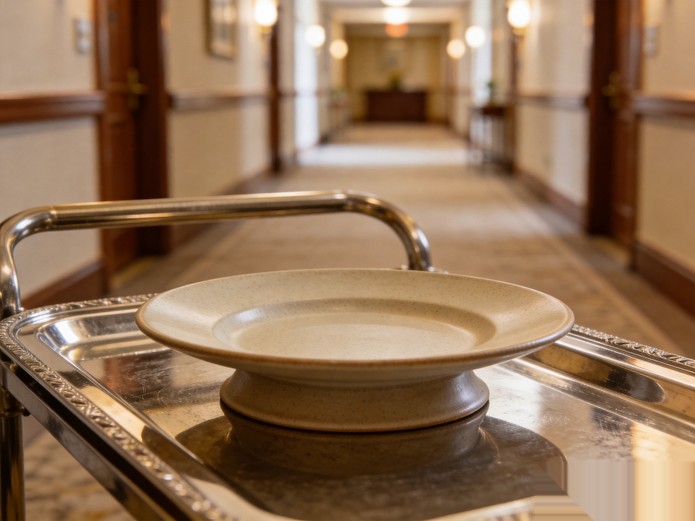
Restaurant ceramics are designed for table settings that remain stationary. Room service ceramics must perform while in motion. A plate that sits beautifully on a dining table may slide on a polished tray the moment a server turns a corner. A bowl with a narrow foot ring may look elegant under restaurant lighting but will rock on a room service trolley crossing carpeted hallways.
The differences break down into four functional categories:
| Factor | Restaurant Ware | Room Service Ware |
|---|---|---|
| Base design | Decorative foot ring, visual priority | Wide, flat base for tray grip |
| Weight | Lighter for server handling | Moderately heavy for transport stability |
| Rim profile | Varied for presentation | Reinforced rim to resist edge chips |
| Finish compatibility | Matches restaurant decor | Matches room interior and bed linens |
These differences mean that sourcing room service ceramics as an afterthought — or simply ordering the same line as your restaurant — creates operational problems within the first month of service.
Tray Stability: Dimensional and Base Design Requirements
The most common complaint from room service staff is not breakage. It is tipping. A plate that shifts on a tray forces the server to walk slowly, limits how many covers they can carry, and increases spill risk.
For tray stability, the base diameter should be at least 55-60% of the overall plate diameter. A 26 cm dinner plate needs a base of at least 14.5 cm. Bases smaller than 50% of the plate diameter will rock on standard room service trays, which are typically 40-45 cm wide and have slightly curved edges.
The base should also be unglazed or have a matte-fired surface. Fully glazed bases slide on polished tray surfaces. Some manufacturers offer a fine grit finish on the base specifically for hospitality applications. If your manufacturer does not offer this, request a sample with an unglazed foot ring and test it on your actual tray surfaces before placing a bulk order.
Bowl stability is equally important. Soup bowls and breakfast cereal bowls for room service should have a base diameter of at least 7.5 cm for bowls under 15 cm diameter, and at least 9 cm for bowls 15-20 cm diameter. Tapered bowls with narrow bases look attractive on restaurant tables but are impractical for tray transport.
Material and Weight Specifications for Transport Durability
Room service ceramics travel farther than restaurant ceramics. A plate used in the hotel restaurant may travel 20 meters from kitchen to table. A room service plate travels from kitchen to service elevator, up multiple floors, down a hallway, and onto an unstable cart or trolley. That distance multiplies the impact of every bump and vibration.
The optimal material for room service durability is mid-fired stoneware or fully vitrified porcelain. Bone china, while elegant, has lower chip resistance and higher replacement rates in room service applications. Earthenware absorbs moisture over time and is unsuitable for commercial dishwashing cycles.
Weight specifications vary by piece type:
- Dinner plate (26-28 cm): 650-850 grams — heavy enough to resist sliding, light enough for servers to handle multiple covers
- Side plate (17-19 cm): 280-380 grams
- Soup bowl (450-550 ml capacity): 420-550 grams
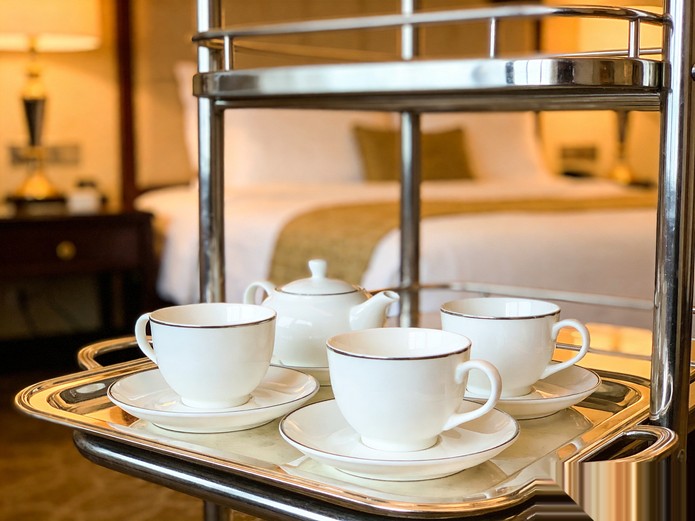
- Cup and saucer set: cup 220-300 grams, saucer 180-250 grams
- Cover or cloche (if used): 400-600 grams
Plates under 500 grams slide too easily on trays. Plates over 900 grams fatigue servers during peak breakfast and dinner rushes. The 650-850 gram range for dinner plates is the practical balance that most 4- and 5-star properties settle on after testing.
Rim thickness matters for chip resistance. A reinforced rim of 3.5-4.5 mm thickness reduces edge chipping by approximately 40-50% compared to thin 2-2.5 mm rims, based on hospitality industry testing data [VERIFY BEFORE PUBLISHING]. Request rim profile samples from your manufacturer and conduct a drop test from tray height (90 cm) onto carpet and hard surfaces before approving production.
Brand Consistency Across Room Categories
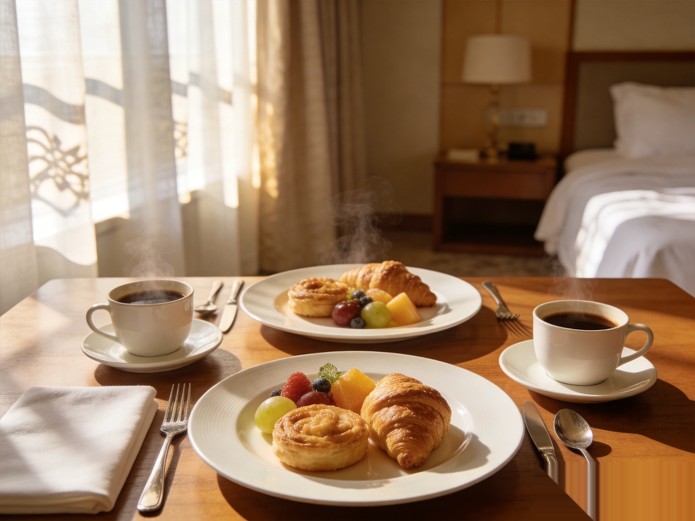
Hotels with multiple room categories — standard, deluxe, suite, presidential — often want differentiated tableware for each tier. The procurement challenge is maintaining brand consistency while creating visual distinction.
The most cost-effective approach is to use a single body shape across all categories and differentiate through glaze color, rim detail, or decal accents. This keeps mold costs low and simplifies replacement ordering. A hotel group ordering 5,000 dinner plates can use one mold with three glaze variations rather than three completely different plate designs.
Practical differentiation options by room tier:
- Standard rooms: Classic white glaze, simple rim line, standard weight
- Deluxe rooms: Warm ivory or soft grey glaze, subtle textured rim
- Suites: Custom color-matched glaze, branded inner rim decal, heavier body feel
- Presidential / VIP: Hand-finished accent, gold or platinum rim detail, presentation cover
The key constraint is dishwasher compatibility. Metallic rim details require lower-temperature dishwasher cycles or hand washing. If your property runs a single high-temperature commercial dishwasher for all F&B outlets, metallic accents will degrade within 6-12 months. Test dishwasher compatibility with samples before committing to metallic finishes.
MOQ, Lead Time, and Packaging for Hotel Orders
Hotel room service orders are typically smaller than restaurant chain orders but require more SKUs. A single hotel may need 12-18 different piece types — dinner plates, side plates, soup bowls, cereal bowls, cups, saucers, butter dishes, serving platters, and covers — each in quantities of 50-200 pieces depending on room count and par levels.
Typical MOQ structures from ceramic manufacturers:
- Off-the-shelf catalog items: 500-1,000 pieces per SKU, 4-6 week lead time
- Custom glaze on standard mold: 1,000-2,000 pieces per SKU, 6-8 week lead time
- Custom mold + custom glaze: 3,000-5,000 pieces per SKU, 10-14 week lead time
- Branded inner rim decal: 2,000-3,000 pieces per SKU, 8-10 week lead time
For a 150-room hotel launching a new room service program, the realistic first order might include 6-8 piece types at 100-150 pieces each, totaling 800-1,200 pieces. Most manufacturers will accept a mixed-SKU order at 1,000 total pieces if you negotiate during the quotation phase. Do not accept per-SKU minimums of 1,000 for a hotel launch unless you have storage space for 8,000-10,000 pieces.
Packaging for room service ceramics should use individual foam or corrugated separators rather than bulk stacking. Stacked plates without separators develop surface scratches during ocean freight that are visible under room lighting. Request VCI (volatile corrosion inhibitor) foam for sea shipments if your warehouse has humidity concerns.
Three Common Mistakes When Sourcing Room Service Ceramics
After reviewing procurement decisions at over 40 hotel properties, three mistakes recur consistently. Each one adds 15-30% to the first-year cost of a room service program.
Mistake 1: Ordering restaurant ware for room service without tray testing
Restaurant plates are designed for stationary table settings. When placed on a room service tray and carried at walking speed, standard restaurant plates slide 3-5 cm with every turn. Servers compensate by carrying fewer covers per trip, which slows service during peak periods. The labor cost of slower service typically exceeds the cost of sourcing proper tray-stable ceramics.
Mistake 2: Choosing aesthetic finish over dishwasher durability
Matte glazes, reactive glazes, and hand-applied accents photograph beautifully for hotel marketing materials. They also stain more readily under commercial dishwasher chemicals and show wear patterns within 3-6 months of daily service. A glossy white or ivory glaze with a durable fired finish will last 2-3 times longer than a trendy matte finish in a high-turnover room service environment.
Mistake 3: Ignoring replacement par levels in the initial order
Hotels typically calculate initial orders based on room count multiplied by covers per room. They forget breakage, guest theft (souvenir-taking), and the 6-10 week reorder lead time. A realistic par level for room service ceramics is 2.5x the daily room count — 1x in service, 0.5x in dishwashing, 0.5x in storage, and 0.5x as buffer for breakage and loss. Ordering only 1.5x par level means you will run out of specific pieces within 4-6 months and face rush reorder premiums.
Room Service Ceramic Tableware Procurement Checklist
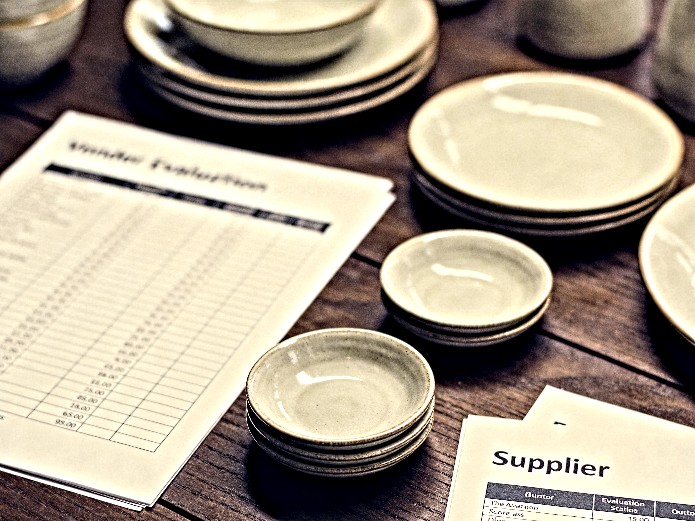
Use this checklist during supplier evaluation and sample approval. Copy it into your procurement system or save it for your next sourcing project.
| Check Item | Specification | Verified (Y/N) |
|---|---|---|
| Base diameter vs plate diameter | Base ≥ 55-60% of plate diameter | |
| Base surface | Unglazed or matte-fired foot ring | |
| Dinner plate weight | 650-850 grams | |
| Rim thickness | 3.5-4.5 mm for chip resistance | |
| Drop test from 90 cm | No chips or cracks on carpet and hard surface | |
| Tray slide test | No movement > 2 cm during 20-meter walk | |
| Dishwasher cycle test | 100 cycles with no glaze degradation | |
| Material specification | Mid-fired stoneware or fully vitrified porcelain | |
| Glaze type | Glossy or satin finish, not reactive or unsealed matte | |
| MOQ negotiation | Mixed SKU minimum ≤ 1,000 total pieces | |
| Lead time commitment | 6-10 weeks for custom, 4-6 weeks for catalog | |
| Packaging specification | Individual separators, no bulk stacking | |
| Replacement guarantee | 2% defect allowance or free replacement | |
| Par level calculation | 2.5x daily room count |
Frequently Asked Questions
Can hotels use the same ceramics for room service and the hotel restaurant?
Only if the restaurant ware already has wide, flat bases and weights in the 650-850 gram range for dinner plates. Most fine-dining restaurant plates have narrow decorative foot rings and lighter bodies, making them unsuitable for tray transport. Test your existing restaurant ware on room service trays before assuming compatibility.
What is the typical lifespan of room service ceramic tableware?
With proper specifications and commercial dishwasher maintenance, room service ceramics last 18-30 months in daily service. Budget properties with high turnover see 12-18 month lifespans. Luxury properties with lower turnover and careful handling achieve 30-36 months. The first pieces to fail are usually cups and small bowls due to higher handling frequency.
Should hotels order branded ceramics with the hotel logo?
Branded inner rim decals add 8-12% to unit cost and extend lead time by 2-3 weeks. They also create a theft deterrent, as guests are less likely to take home a plate with a visible hotel logo. For properties where guest souvenir-taking is a known issue, the branding cost is recovered through reduced replacement orders. For most mid-market hotels, unbranded ceramics with distinctive color or shape provide adequate brand presence at lower cost.
How do hotels handle seasonal demand spikes in room service?
Peak seasons — holiday periods, conference weeks, local events — can increase room service volume by 40-60%. The solution is maintaining buffer inventory at your 2.5x par level and placing reorder forecasts 10-12 weeks before known peak periods. Do not attempt to cover seasonal spikes with rush orders; ceramic production does not accommodate rush timelines.
Is bone china suitable for hotel room service?
Bone china is suitable for presidential suites and VIP in-room dining where presentation priority exceeds durability. For standard and deluxe rooms, bone china has higher chip and crack rates during transport and generates replacement costs 2-3x higher than stoneware or vitrified porcelain. Most properties reserve bone china for suite service only.
What packaging prevents scratches during freight?
Individual corrugated or foam separators between each piece prevent the surface-to-surface contact that causes scratching. Bulk-stacked plates — even with paper interleaving — will show surface marks after ocean freight. Specify “individual separator packaging” in your purchase order, not just “export packaging.”
Get the hotel dinnerware catalogue — browse our hospitality ceramics collection or submit your room service specifications for a tailored quotation.
Last updated: October 2026. Specifications are based on industry-standard practices. Verify material test reports and certifications with your supplier before placing bulk orders.