


Ceramic tableware for restaurant chains requires a sourcing approach that balances brand consistency, operational durability, and cost control across dozens or hundreds of locations. Unlike independent restaurants, chain operators must ensure every plate, bowl, and cup looks identical whether a guest walks into a location in Dallas or Denver. This guide breaks down how multi-unit operators build a standardized tableware program, negotiate favorable bulk terms, and maintain quality consistency at scale.
Why Standardization Matters More for Chains Than Independents
A guest at a national chain expects the same experience in every location. That expectation extends to the tabletop. If one location serves steak on a matte black plate and another uses glossy white, the brand suffers. Standardization also affects operational efficiency: identical dishware means uniform rack configurations in dish rooms, consistent replacement costs, and simplified staff training.
The financial impact compounds quickly. A chain with 100 locations running 200 covers per day moves roughly 7.3 million plates per year. A $0.50 per-plate price difference across the system equals $3.65 million annually. Conversely, a poorly specified plate that chips twice as fast as expected can inflate replacement budgets by 40-60%.
The Three-Tier Tableware System for Multi-Unit Operations
Most successful chains organize their ceramic tableware into three tiers based on use frequency and replacement risk:
- Core Tier (70% of inventory): Daily-use items like dinner plates, salad plates, and bowls. These need maximum durability and the tightest quality tolerances.
- Secondary Tier (20% of inventory): Serveware, bread plates, and dessert dishes. These see moderate use and can tolerate slightly wider color variation.
- Accent Tier (10% of inventory): Specialty pieces like tasting spoons, butter dishes, and display platters. These are often seasonal or location-specific.
This tiering system lets procurement teams allocate budget strategically. Core tier items justify premium specifications and longer lead times because their per-unit cost is amortized across millions of uses. Accent tier items can be sourced faster with looser tolerances since replacement volume is low.
Procurement Model Comparison: How Chains Source at Scale
Chains typically use one of three sourcing models. Each has distinct cost, quality, and flexibility trade-offs:
| Model | Best For | MOQ | Lead Time | Cost Impact | Risk Level |
|---|---|---|---|---|---|
| Single Source (One Factory) | Chains with 50+ locations and stable SKUs | 20,000-50,000 pcs per SKU | 90-120 days | -15% to -25% vs. multi-source | High (supply disruption) |
| Dual Source (Two Factories) | Chains with 20-100 locations needing redundancy | 10,000-25,000 pcs per SKU per factory | 75-100 days | -5% to -10% vs. spot buying | Medium (color matching challenge) |
| Regional Sourcing (3-4 Factories) | International chains or rapidly expanding brands | 5,000-15,000 pcs per SKU per region | 45-75 days | Spot market pricing | Low (distributed risk) |
Single-source models deliver the lowest unit cost but require rigorous supplier qualification. A factory fire, labor strike, or raw material shortage can halt your entire supply. Dual-source is the most common approach among U.S. chains because it splits risk while keeping color matching manageable with two reference samples. Regional sourcing works well for chains operating across continents but requires a centralized quality lab to verify consistency.
MOQ, Lead Time, and Pricing Structure for Chain Orders
Chain orders reshape the standard factory negotiation. Here is what to expect at different volume tiers:
- Under 10,000 pieces per SKU: You are buying at standard export pricing. Factories treat you like a regular wholesale buyer. Expect 60-90 day lead times and limited customization.
- 10,000-50,000 pieces per SKU: You enter volume pricing territory. Factories will offer 5-12% discounts and may waive mold fees for standard shapes. Lead times drop to 45-75 days because your order justifies a dedicated production slot.
- Over 50,000 pieces per SKU: You have negotiating leverage. Request fixed pricing for 12-month contracts, dedicated QC staff at the factory, and custom packaging with your SKU codes. Lead times can compress to 30-60 days with proper planning.
Pricing structure typically breaks down as follows: raw material and forming (35-45%), glazing and firing (25-35%), decoration and finishing (10-20%), packaging (5-10%), and factory overhead plus margin (15-25%). On orders over 50,000 pieces, the overhead portion shrinks proportionally, which is where your savings come from.
Lead time starts the day you confirm the purchase order, not the day you send it. Allow 3-5 days for PO processing, 7-14 days for raw material preparation, 14-21 days for production, 7-10 days for QC and packing, and 21-35 days for ocean freight to U.S. West Coast ports. Total: 52-85 days under normal conditions. Add 2-3 weeks during Chinese New Year and peak Q4 seasons.
Common Mistakes When Sourcing for Multiple Locations
After reviewing sourcing programs for over 30 chain operators, these three mistakes appear most frequently:
Mistake 1: Letting Individual Locations Specify Their Own Tableware
Franchisees or regional managers sometimes insist on “localizing” the tabletop. The result is a fragmented brand experience and inflated procurement costs. One operator we reviewed had 14 different plate SKUs across 60 locations because each franchisee picked their own style. Consolidating to three SKUs saved $180,000 in the first year.
Mistake 2: Ignoring Dishwasher Compatibility at Scale
A plate that survives hand washing may not survive 500 industrial dishwasher cycles per month. Chains with centralized dish rooms using high-alkaline detergents and 180-degree rinse temperatures see accelerated glaze degradation. Always request dishwasher cycle testing data from your supplier and validate it against your actual detergent chemistry and water hardness.
Mistake 3: Ordering the Full Annual Volume in One Shipment
Single large shipments minimize freight cost per piece but create inventory risk. If a defect is discovered after delivery, you are stuck with 50,000 flawed plates. Smart operators split annual volume into 2-4 shipments, accepting slightly higher freight costs in exchange for the ability to catch and correct issues early.
Quality Control and Consistency Across Locations
Consistency is the hardest part of chain tableware sourcing. A factory can produce 50,000 identical plates in March and a slightly different shade in September because clay moisture, kiln temperature curves, or glaze viscosity shifted. To control this:
- Master Sample Lock: Seal a signed master sample from your first approved production run. Every subsequent shipment gets compared against this physical reference, not a photo.
- Delta-E Tolerance: Specify a maximum Delta-E color difference of 1.5 or less between production batches. Delta-E measures perceptible color variation; values under 1.0 are nearly indistinguishable to the human eye.
- Third-Party Pre-Shipment Inspection: Hire an independent inspector to check 5-10% of cartons from each container. Focus on: glaze uniformity, edge chipping, dimensional tolerance, and water absorption rate.
- Container Loading Supervision: Have the inspector verify proper palletizing and container loading to prevent breakage during transit.
[VERIFY BEFORE PUBLISHING: Reference ASTM C373 for water absorption testing and ISO 10545 for ceramic tile color measurement standards.]

Storage, Distribution, and Replacement Planning
Once tableware arrives, how you store and distribute it affects lifespan as much as the manufacturing quality. Ceramic is hygroscopic to a small degree; prolonged storage in humid warehouses can weaken the body and cause delayed cracking. Keep inventory in climate-controlled environments below 60% relative humidity.
For distribution, most chains use one of two models:
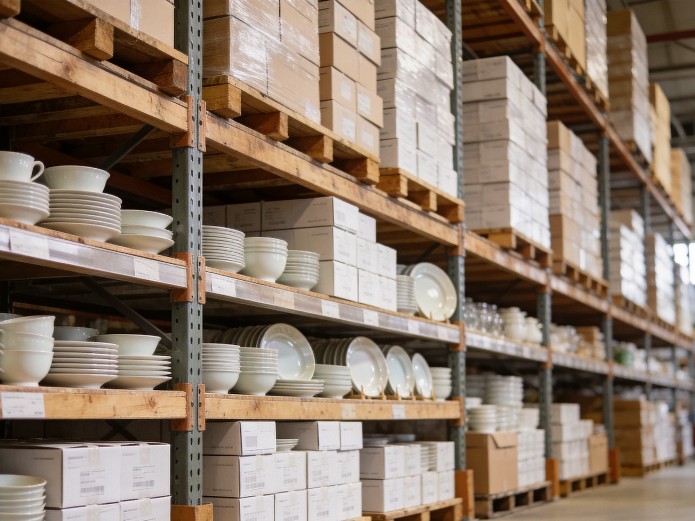
- Central Warehouse Model: All tableware ships to a central distribution center and gets allocated to locations. Best for chains with 20+ locations in one region. Allows quality checking before dispatch but adds handling cost.
- Direct-to-Location Model: Factories ship containers directly to regional hubs or individual restaurants. Faster for new openings but harder to catch defects before they reach the table.
Replacement planning should be data-driven, not reactive. Track breakage rate by location and item type. A well-run chain targets 2-4% annual breakage on dinner plates and 4-6% on cups and bowls. If one location consistently exceeds these rates, investigate: dish machine settings, staff training, storage practices, or supplier quality drift. For more on calculating optimal reorder timing, see our reorder strategy guide.
Actionable Steps to Launch Your Chain-Wide Tableware Program
If you are building or refreshing a chain-wide tableware program, follow this sequence:
- Step 1: Audit Current State (Week 1-2): Inventory every SKU currently in use across all locations. Photograph, measure, and note breakage rates. Identify consolidation opportunities.
- Step 2: Define Specifications (Week 3-4): Create a technical specification sheet for each retained SKU. Include dimensions, weight, glaze type, color reference, dishwasher compatibility, and food safety requirements.
- Step 3: Shortlist Suppliers (Week 5-6): Request samples from 3-5 factories. Evaluate against your specifications using the checklist below.
- Step 4: Pilot Program (Week 7-14): Deploy samples to 2-3 locations for real-world testing. Collect feedback from kitchen managers, servers, and dish room staff.
- Step 5: Negotiate and Contract (Week 15-18): Lock in pricing, MOQ, lead times, and quality tolerances. Include penalty clauses for color drift outside Delta-E 1.5.
- Step 6: Roll Out and Monitor (Week 19+): Phase in new tableware by region. Monitor breakage rates and guest feedback. Adjust specifications as needed.
Multi-Unit Tableware Supplier Evaluation Checklist
Use this checklist when evaluating factories for chain-level supply. Score each item as Pass, Conditional, or Fail.
| Checklist Item | Pass Criteria |
|---|---|
| Production Capacity | Can produce your full annual volume within 90 days |
| Color Consistency Record | Provides Delta-E data from last 3 production runs |
| Dishwasher Test Data | Has 1,000+ cycle industrial dishwasher test results |
| Quality Certification | Holds valid FDA, LFGB, or CA Prop 65 compliance documentation |
| Packaging Standards | Uses corner protectors and double-wall cartons for export |
| Lead Time Commitment | Commits to 75 days or less for repeat orders |
| Replacement Terms | Agrees to replace defective pieces within 2% of order value |
| Communication | Responds to inquiries within 24 hours during business days |
| Scale Experience | Has supplied 2+ restaurant chains or hotel groups previously |
| Customization Capability | Can match custom colors from Pantone or physical samples |
Cost, Quality, and Lead Time: The Chain Buyer’s Triangle
Every chain procurement decision sits at the intersection of three forces:
- Push for lowest cost and you risk thinner walls, lower firing temperatures, and faster breakage. A $0.30 cheaper plate that lasts half as long actually costs more over its lifetime.
- Push for highest quality and you may overspecify. A 12-hour kiln firing produces marginally stronger ware than 10-hour firing but adds 20% to production cost. For core tier items the premium is justified; for accent tier items it is usually not.
- Push for fastest lead time and factories rush QC or skip drying cycles, which causes delayed cracking months after delivery. Plan your calendar so you are not ordering during peak factory seasons.
The optimal position on this triangle depends on your brand positioning. A fast-casual chain prioritizes cost and lead time over boutique-grade quality. A fine-dining group does the opposite. Most operators land somewhere in the middle: specifying commercial-grade durability for core items and accepting standard production for secondary and accent pieces. If you need help calculating total cost of ownership across your chain, our TCO guide walks through the math.
Frequently Asked Questions
How many plate styles should a restaurant chain standardize on?
Most successful chains use 3-5 core plate styles: one dinner plate, one salad or appetizer plate, one bowl, and optionally one bread or dessert plate. Additional accent pieces bring the total to 8-12 SKUs. More than 15 SKUs creates unnecessary inventory complexity without improving the guest experience.
What is the typical replacement cycle for chain restaurant ceramic tableware?
Core tier dinner plates typically last 18-24 months in high-volume chains before visible wear affects presentation. Cups and bowls last 12-18 months. Accent pieces often last 3+ years because they see lighter use. Track breakage and wear rates by SKU to set data-driven replacement schedules rather than calendar-based ones.
Can a chain use different factories for the same SKU?
Yes, but with caution. Dual-sourcing the same SKU requires identical clay bodies, glaze formulations, and firing curves. Even then, subtle color differences may appear. The safer approach is to dual-source at the category level: Factory A makes all dinner plates while Factory B makes all bowls, with each factory holding its own master sample.
How do chains handle new location openings?
Most chains maintain a 3-6 month safety stock at their central warehouse or 3PL. New openings draw from this buffer. For rapid expansion brands opening 10+ locations per quarter, some negotiate “new store kits” with suppliers: pre-packed containers with the exact SKU mix for one restaurant, delivered direct to the construction site.
Should chains buy all tableware from one country?
China dominates commercial ceramic tableware manufacturing due to scale and cost. For most chains, single-country sourcing from 1-2 Chinese factories is optimal. However, chains with European market presence sometimes source accent pieces from Portugal or Spain for regional appeal. The key is maintaining centralized specification control regardless of origin.
What packaging prevents breakage during chain distribution?
Export-grade packaging for chain orders should include: individual foam or paper sleeves, corrugated dividers between layers, double-wall master cartons, corner protectors on pallets, and stretch-wrapping. For high-value items, some chains specify wooden crates. Breakage in transit should be under 2% of total order value.
Ready to standardize your chain’s tableware program? Contact our team for a multi-unit sourcing consultation. We work with restaurant groups across North America and Europe to build consistent, cost-effective tabletop collections that hold up under real commercial pressure.


