

A ceramic tableware specification sheet is the document that decides whether your factory quotes are comparable at all. Most buyers open with a reference photo and a target price, then spend six weeks discovering that three suppliers priced three different products. A written spec settles that before sampling starts, and it costs one afternoon with a caliper and a kitchen scale. What follows covers the nine fields that genuinely move unit price, tolerance and freight, explains how two of them determine the legal category your ware falls into, and finishes with a template you can paste into your next inquiry.

The nine fields, in the order they affect a quote: rim diameter with its measurement point, internal depth, brimful and usable capacity, body and firing range, glaze family, decoration method and the surface it sits on, the tolerance band for diameter, height, weight and warpage, the acceptance criteria with sampling plan, and the packing and carton configuration. Everything else on the sheet supports one of those nine.
Why the first document you send sets the whole negotiation
A factory prices what it can measure. When an inquiry says “white round plate, 10 inch”, the quotation desk pulls whatever mould in the rack sits closest to that description, prices it, and moves on. That is not bad faith; it is the only sensible response to an under-specified request. The bill arrives later, when the plate lands with a 254 mm rim and a 12 mm well, and your kitchen wanted a 25 mm well for pasta service.
The cost of a thin spec is not one bad order. It is a lost quarter: one sampling round to correct the mould, another to correct the glaze, a production slot missed, and a container three weeks behind. Buyers who source repeatedly keep a master sheet for every SKU and amend it rather than rewrite it, which is why their second and third orders negotiate far faster than the first.
Two habits do most of the work. Specify functions and measurements rather than adjectives. And specify them at the measurement points the factory’s own inspection bench uses, so the approved sample and the production run are checked against identical numbers.
Diameter, depth and capacity: the three numbers buyers confuse
These three fields generate more disputes than the rest of the sheet combined, because each has more than one defensible definition. Fix the definition in writing before you fix the value.
Diameter needs a measurement point
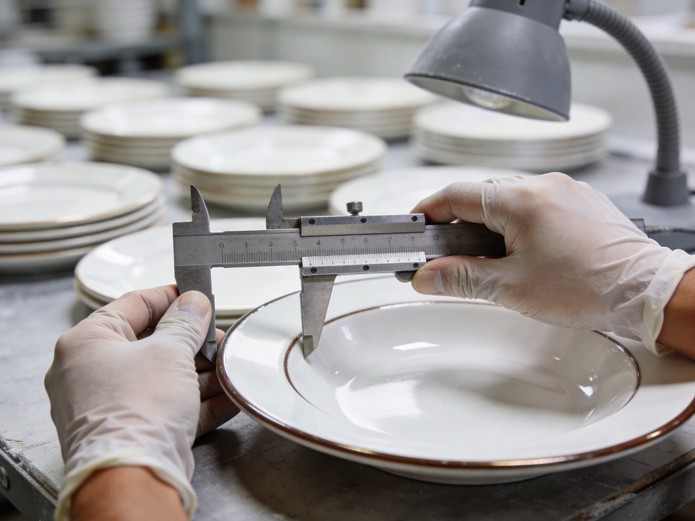
Rim outside diameter, rim inside diameter and foot diameter can differ by 15 mm or more on the same piece. A coupe flares, a rimmed plate turns up, and an organic shape has no single diameter at all. Write the figure and the point: “rim OD, measured across the widest point of the glazed rim, 254 mm ± 3 mm”. For non-round shapes, give length and width at the widest axis and put a tolerance on the pair, not on each dimension separately.
Internal depth is a legal category, not a styling choice
This is the field most often left blank and the one with the highest consequence. Both major food-contact regimes classify ceramic ware by internal depth, measured from the lowest point of the well to the horizontal plane passing through the upper rim. Under the US Food and Drug Administration’s compliance guidance for ceramicware, articles whose internal depth does not exceed 25 mm are treated as flatware, and anything deeper is hollowware [1]. EU Council Directive 84/500/EEC draws the same 25 mm line between its category 1 and category 2 articles [2].
That single millimetre figure moves a plate from one test method and one limit to another, which means the laboratory report you paid for may not cover the article you actually shipped. Specify depth to the nearest millimetre and state which surface the measurement starts from.
Capacity: brimful or usable?
The same FDA guidance splits hollowware again by capacity, treating small hollowware as under 1.1 litre and large hollowware as 1.1 litre or more [1]. Your kitchen, though, cares about usable capacity: the volume you can serve without spilling over the rim on a moving tray. Those two numbers can differ by 20 to 30 percent. Put both on the sheet and say which one the supplier confirms at final inspection.
Material, glaze and firing: the fields that lock in price
Body and glaze decisions set the cost floor before decoration is discussed, and they also determine which test limits apply. Write them as process parameters, not as marketing language.
| Field | What to write on the sheet | Why it moves the quote |
|---|---|---|
| Body | Porcelain, stoneware or bone china, with firing range | Firing temperature drives energy cost, warpage rate and translucency |
| Glaze system | Gloss, matte, reactive or satin, and number of glaze applications | Reactive and matte glazes carry higher reject rates and narrower colour windows |
| Decoration method | On-glaze, in-glaze or under-glaze, and on which surface it sits | Under-glaze survives dishwasher chemistry; decoration inside the well changes the compliance scope |
| Food-contact surface | Glazed or unglazed; if decorated, where relative to the well | Determines whether the decorated area is subject to migration testing |
| Edge and foot finish | Glazed rim, raw foot or polished foot | A polished foot adds a handling step and a kiln loading consideration |
Two notes from repeat orders. Name the glaze family rather than the colour, because colour names are internal marketing terms: “matte sand, reactive” is a process instruction, “dune beige” is not. And if your brand needs one colour to match across several SKUs, attach a physical standard or a measured colour value and get the factory to confirm it can hold that window before you pay for samples.
Tolerances and defect acceptance you must write before sampling
A tolerance table is the difference between a claim you can win and an argument you cannot. Every ceramic piece is a fired object: it shrinks, it warps, and it varies from mould to mould. If your sheet does not say how much variation you accept, you have by default accepted whatever the factory’s own standard is.
Write minimum and maximum values for rim diameter, height and piece weight, and add a separate warpage limit expressed as the maximum gap under a straightedge laid across the rim. Then add a visual acceptance section: defect categories, photographs of the worst acceptable example in each category, and the sampling plan you both use. Agreeing defect categories in detail before the first inspection matters, because the same dark speck is a minor blemish to one QC manager and a rejection to another. The ceramic defect classification and acceptance standards guide covers how to structure those categories, and the test report walkthrough explains how to read the paperwork that follows.
On sampling plans: a common starting position is an AQL-based plan with separate levels for major and minor defects, but the specific numbers are a commercial decision. State the levels, the sample size and the acceptance number in the sheet instead of assuming the factory applies your expectation. If buyer and supplier are reading different sampling tables, the inspection result is evidence of nothing.
Packing, carton and container figures that prevent claims
Breakage claims almost always trace back to a packing format nobody wrote down. The factory packs the way it packs, the forwarder assumes a carton weight, and the first you hear of it is a photograph of crushed corner posts at destination.
Specify units per inner box, units per master carton, the divider or moulded pulp specification, carton internal dimensions, gross weight per carton, and the pallet configuration including whether cartons are stacked or interlocked. If you sell in retail packaging, add the retail box dimensions and the barcode position, because a factory that has not been told will pack bulk.
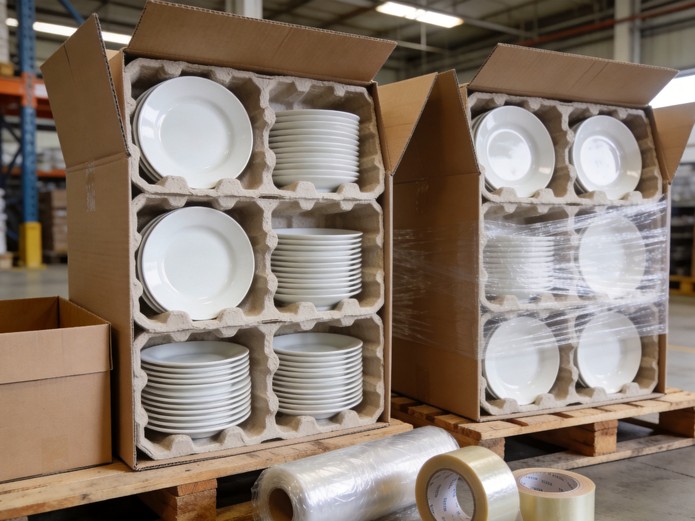
Then state the loading assumption you are planning against. A 40-foot high cube holds a fixed volume, and the gap between a well-engineered carton and a loose one can be several hundred cartons of freight you pay for either way. Ask the supplier to quote loading quantity per container for the specified carton, not for an unspecified “standard export packing”.
MOQ, lead time and sample schedule in one block
Commercial terms belong on the same sheet as the measurements, because they interact. A tighter diameter tolerance reduces yield per kiln load, which raises the effective minimum order. A reactive glaze with a narrow colour window may force a dedicated batch, which moves the lead time.
| Commercial field | What the sheet should state |
|---|---|
| MOQ per SKU | Quantity, and whether it applies per colour, per size or per decoration |
| MOQ for a new mould | Whether a mould charge applies and how many pieces amortise it |
| Sampling | Rounds included, who pays freight, and the approval turnaround in working days |
| Production lead time | Counted from deposit or from approved sample, stated explicitly |
| Testing | Which standard, which laboratory, who pays, and when the report is due |
| Payment terms | Deposit percentage, balance trigger, and the document set released against balance |
Two details that save weeks. Separate sample lead time from production lead time; a factory can produce a sample in ten days and still need forty-five for a container. And fix the trigger date: “lead time 35 days” means nothing until it reads “35 days from receipt of deposit and signed-off sample, whichever is later”. The production lead time and delay guide goes further into building a schedule you can hold a supplier to, and the MOQ strategy guide covers how to move the quantity step without losing the price break.
The copy-paste specification template
Paste this into your inquiry email or attach it as a sheet. It carries the nine fields above plus the marking, testing and commercial lines that belong on the same page; fill every line or mark it not applicable, and never leave a blank, because a blank invites the factory to decide for you.
- Item reference and use case — internal SKU, and how the piece is used (dinner service, banqueting, retail).
- Shape and construction — round, coupe, rimmed or organic; single or two-piece.
- Diameter — rim OD at the widest glazed point, with tolerance; length and width for non-round shapes.
- Internal depth — millimetres from the lowest point of the well to the rim plane.
- Capacity — brimful millilitres and usable millilitres, both stated.
- Piece weight — grams per piece, with a tolerance band.
- Body and firing — material family and firing range.
- Glaze and decoration — glaze family, decoration method, and which surface carries it.
- Tolerances — diameter, height, weight, and warpage limit under a straightedge.
- Acceptance — defect categories with photo references, sampling plan, AQL levels, acceptance number.
- Packing — units per inner box, units per master carton, divider type, carton dimensions, gross weight, pallet configuration.
- Marking — backstamp position, retail barcode, country-of-origin marking requirement.
- Testing — standard and laboratory, with the report due date.
- Commercial — MOQ per SKU, mould charge, sample rounds, lead time and its trigger, payment terms.
Keep the completed sheet as the master for that SKU. On a reorder you send the same document with a new quantity and delivery window, and the quote returns in a day rather than a fortnight, because nothing needs re-interpreting.
Three mistakes that cost buyers money
Quoting against a photograph. A rendering hides the two things the factory actually prices: wall thickness and rim geometry. Two plates that look identical in a mockup can differ by 90 grams of body weight and a full firing step. The fix is a physical sample, or a fully dimensioned drawing, for every SKU you intend to have quoted.
Leaving the food-contact surface undefined on decorated ware. If a pattern sits inside the well and the sheet does not say so, the compliance scope may not match the product. The applicable lead limit changes with article category: the FDA guidance sets one figure for flatware, another for small hollowware, and a tighter one for cups and mugs, with pitchers and large hollowware again distinct; Directive 84/500/EEC expresses its limits per unit area for shallow articles and per litre for fillable ones, and adds a separate category for cooking ware and storage vessels over three litres [2]. A report that does not state its basis maps to neither. [VERIFY BEFORE PUBLISHING — confirm applicable category and test basis with your laboratory for each SKU.]
Approving a hand-picked sample and inspecting the run against a number. Sample approval often compares a specially chosen piece with a figure on a sheet, while production is checked against a carton. Specify that final inspection measures a random sample drawn from the packed cartons, using the same instrument and the same measurement points as sample approval, and records the readings instead of a bare pass or fail.
What to do next
- Measure three pieces of each SKU you already sell at the points defined above, and write the range you observe. That range is your realistic tolerance, not a guess.
- Send the completed sheet with your inquiry and ask for a costed quote against it, including loading quantity per container.
- Get the test standard and laboratory in writing before sampling, and confirm which category your depth and capacity figures place the product in.
If you would rather start from a working document, the sourcing team will send a filled specification sheet for a comparable article in your range and quote against your amendments. Send the shape, the depth and the intended use to the CeraSupply sourcing team, or look through the commercial plates and platters range and the wholesale ceramic bowls range to see which formats are already tooled. Custom tooling from drawing to approved sample is set out under OEM and ODM ceramic tableware, and the sample evaluation guide shows how to check the first round against the sheet you sent.
Frequently asked questions
Does every SKU need its own specification sheet?
Yes, wherever SKUs differ in diameter, depth, capacity or decoration. Group products only when body, mould and glaze are genuinely identical and the only difference is colour. Photographing a range and treating it as one line item is the most common reason a reorder arrives in the wrong proportion.
How much detail is too much?
There is no such thing as too much measurement detail. The failure mode is inconsistency, not volume: the same field defined two different ways in two documents. One master sheet per SKU, amended rather than rewritten, prevents that.
Who should set the tolerance figures?
The buyer proposes, the factory confirms capability, and the agreed numbers go in writing before sampling. A factory that cannot hold your proposed tolerance is useful information at quotation stage and expensive information after production.
Can one test report cover several SKUs?
Only where the articles share body, glaze, decoration and category. Because the applicable limits shift with internal depth and capacity, a report issued for a shallow plate does not automatically cover a deep bowl from the same range. Confirm the scope with the laboratory.
What is the single most useful field to add to an existing sheet?
Internal depth in millimetres. It fixes the legal category, it drives the well geometry customers notice, and it is the one figure a factory cannot infer from a photograph.


