An AQL inspection level decides how many pieces you open, not how many defects you accept. That distinction explains most of the arguments that start after a pre-shipment report lands: a buyer reads PASS on 200 pieces from a 5,000-piece order and assumes the lot was cleared to 2.5%, when the plan actually tolerated anything up to 5% in the sample and would still accept a lot running near 7.6% about one time in ten. This article works through the lookup for a normal ceramic order, the numbers a pass does and does not support, where ceramic lot formation breaks the arithmetic, and the clause to put in the purchase order so the report means what everyone thinks it means.
What the AQL inspection level sets, and how to read it
Three inputs drive attributes sampling decisions: how the lot is formed, which inspection level is named, and which AQL is attached to each defect class. The level touches only the middle input. Move a 5,000-piece order from Level I to Level III and the AQL stays where it was; what changes is how many pieces leave the carton — 80, 200, or 315 — and how much of the lot you see.
Worth stating plainly: the AQL is not a per-lot defect ceiling. ISO 2859-1:2026 indexes its schemes to a quality limit describing a continuing series of lots from one producer and one process. A supplier running a process average of exactly 2.5% should expect most lots to pass and an occasional lot to be rejected — the design working, not the inspection misbehaving.
The lookup takes five steps: state the lot size, read the code letter off the lot-size band at the chosen AQL inspection level, read the sample size off the code letter, read the acceptance and rejection numbers off the AQL column, decide. Level II is the default; Level I reduces the sample, Level III increases it. A 5,000-piece lot lands on code letters J, L and M.
| Inspection level | Code letter | Sample n | AQL 2.5: Ac / Re | Passing a lot at exactly 2.5% | Lot quality at 10% chance of passing | Share of lot inspected |
|---|---|---|---|---|---|---|
| Level I | J | 80 | 5 / 6 | 98.5% | 11.3% defective | 1.6% |
| Level II (default) | L | 200 | 10 / 11 | 98.7% | 7.6% defective | 4.0% |
| Level III | M | 315 | 14 / 15 | 98.6% | 6.3% defective | 6.3% |
The sixth column decides purchasing arguments. At Level II with AQL 2.5, a lot that is 7.6% defective still passes about one time in ten. At Level I it sits at 11.3%; at Level III, 6.3%. Read the acceptance number as a ratio: 5 of 80 is 6.25%, 10 of 200 is 5.0%, 14 of 315 is 4.44%. The plan tolerates a sample defect rate two to two-and-a-half times the AQL it is named after. Smaller bands follow the same logic: 501–1,200 pieces at Level II is code J, n=80, Ac 5; 1,201–3,200 is code K, n=125, Ac 7. An order shipping as several pallet lots hits all of these in one season, so the clause must name the band structure, not just the AQL.
What a pass on 200 pieces proves
A pass proves one thing: the sample did not contain enough defects to reject — not the lot defect rate. With 200 pieces and a clean result, the 95% upper confidence bound on the lot is still about 1.5% — a lot could carry 1.5% defects and produce a spotless 200-piece sample nineteen times out of twenty. At five defects in 200 the bound is 4.5%; at the acceptance limit of ten, 7.8%.
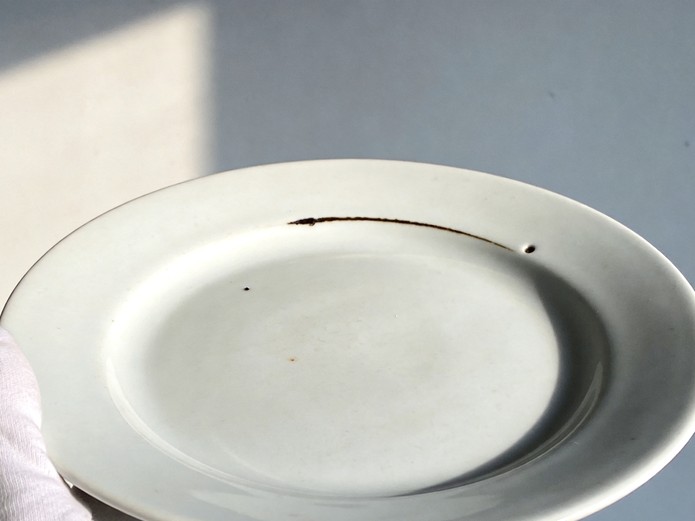
Worth showing a buyer who wants to skip inspection because three clean shipments: a clean sample never proves zero, only “probably below 1.5%” — adequate for a dinner plate, inadequate for a rim hotel guests will judge.
The other side belongs to the supplier. At a true defect rate of 1.0% the Level II plan rejects essentially no lots; at 2.5%, about 1.3%. A supplier asked to hold 2.5% is not being set up to fail. False-reject risk gets painful only when the buyer miscalculates the acceptance number.
Where ceramic lots break the arithmetic
Sampling assumes a homogeneous lot: one product, one process, one production window. Ceramic orders rarely arrive that way. A 5,000-piece order split across eight glazes and four shapes is not one lot, and the specification sheet most buyers send never says how to divide it. Split into eight lots of 625 and each drops to code J, n=80 — 640 pieces in total, 3.2 times the work of a single lot at one AQL inspection level.
The split changes what the scheme can see. At a 4% true defect rate a single 200-piece lot passes 82.0% of the time; eight 80-piece lots all passing drops to 42.6%, and at 6% from 34.1% to 3.3%. Smaller lots are individually more forgiving and collectively far more revealing — the right trade for a buyer.
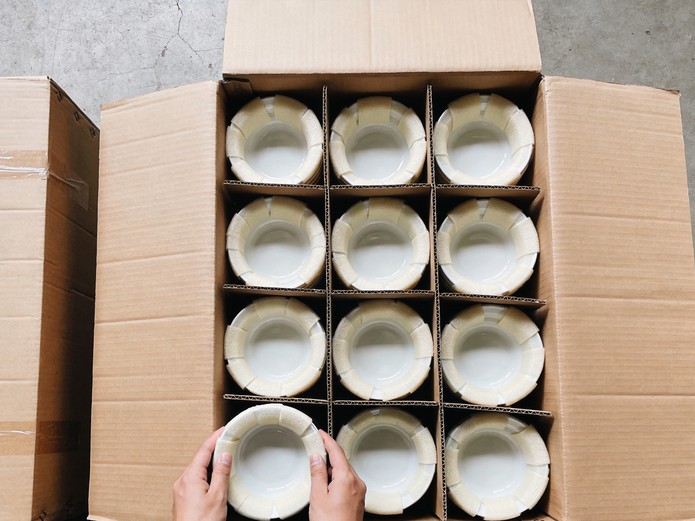
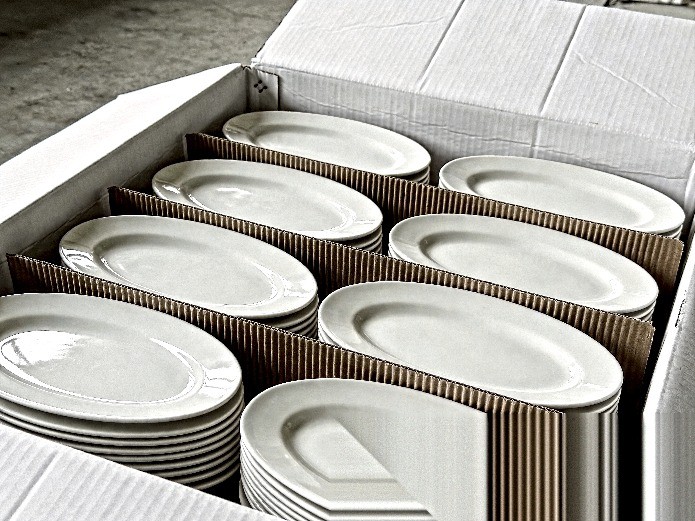
Cartons add a second distortion. Two hundred pieces from a 5,000-piece order packed 100 to a carton is four per carton across 50 cartons — a genuinely random draw; two hundred pulled from the cartons nearest the door is a sample of those cartons, not of the lot. Consistency across a bulk order is exactly what a lazy draw cannot measure, because the variation worth finding lives between cartons.
Defect classes need separate columns, and one needs a different number. Most ceramic POs carry AQL 2.5 for major and 4.0 for minor and leave critical unstated. Critical — lead or cadmium migration, sharp glaze shards, a handle that will not carry a full cup — belongs on its own line with an acceptance number of zero and its own test. A plan that folds a food-contact failure into a 4.0 minor bucket has stopped being a quality plan.
Three order details move the plan more than most buyers expect. An MOQ of 5,000 pieces sets the lot band and therefore the sample size; an MOQ small enough to ship as one 600-piece lot drops the buyer to code J and an 80-piece sample whatever the AQL says. Export packaging sets the draw unit: 100 pieces to a carton means the sample must be pulled per carton, while bulk-packed pieces on a pallet give no carton structure to sample against. And testing sits outside the plan entirely — lead and cadmium migration on a food-contact surface is a laboratory result, not an attribute an inspector can score by eye, so it needs its own acceptance criterion on its own line.
The switching rules your purchase order never invokes
The plans are only half the system. ISO 2859-1:2026 keeps switching rules in clause 9, discontinuation in 9.4. The mechanics fit in a contract: normal shifts to tightened when two of five consecutive lots are rejected on original inspection; tightened returns to normal after five consecutive lots accepted; reduced inspection needs ten consecutive lots accepted on normal with the cumulative defect count under a stated limit number; five cumulative rejections on tightened stops acceptance sampling until the supplier acts.
Almost no ceramic PO invokes any of this, so a supplier can fail two lots in five and keep the same forgiving acceptance numbers. Switching rules protect over a season; single plans protect each lot and learn nothing.
If your quality agreement is old: the third edition adds skip-lot switching with qualification guidance before lots may be skipped, and drops the printed OC curves for construction methods in Annex E. Clause numbers from the 1999 edition no longer line up.
The clause to write, and the checklist to run
A clause that survives contact with a supplier fixes all five inputs. Short enough to paste into a PO, specific enough that any inspector reads it one way.
Sampling: ISO 2859-1:2026, single sampling, normal inspection, General Inspection Level II.
Lot: each glaze/shape combination is a separate lot of not more than 3,200 pieces.
Major: AQL 2.5. Minor: AQL 4.0. Critical: Ac = 0, verified by the test named in Annex A.
Draw: pieces taken from every carton in the lot, not fewer than 3 per carton.
Switching: the rules in clause 9 apply, including tightened inspection and discontinuation.
Resubmitted lots: full re-examination before resubmission, per clause 7.6.
Records: lot size, code letter, sample size, Ac/Re, defect counts by class, draw locations.
Run this checklist before the inspection, not after the report — an AQL inspection level is only as good as the lot it applies to:
- Confirm the lot is one product, one glaze, one production window — in writing.
- State the quantity and check the band: 501–1,200, 1,201–3,200, or 3,201–10,000.
- Name the inspection level. Never leave it blank and let the inspector default to II.
- Set an AQL per defect class, critical at zero with a named test.
- Look up Ac and Re; refuse any report showing only the AQL.
- Specify the draw: pieces per carton and how many cartons the sample must cover.
- Agree who pays for a failed lot and what resubmission requires.
- Record the switching status — normal, tightened, reduced — on each report.
Three recommendations, in the order they save money. Fix lot formation before fixing the AQL: an eight-SKU order sampled as one lot is a bigger problem than a 2.5 versus 4.0 argument. Quote the acceptance number, not only the AQL. And run the switching rules for a season before renegotiating price on quality history.
Three errors that make a correct plan useless
The first is treating the AQL as a percentage of the sample. A buyer with a 5,000-piece lot at Level II who applies AQL 2.5 as 2.5% of 200 — five defects — instead of the table’s ten rejects a lot genuinely running at 2.5% some 38.4% of the time, and a lot at 4% some 81.4% of the time. The supplier gets blamed for the buyer’s arithmetic.
The second is using a zero acceptance number as a shortcut for protection. It feels strict and is quietly weak at small samples: with n=125 and Ac=0, a lot running 1% defective passes 28.5% of the time, and the 95% upper bound on a clean result is still 2.4%. Reaching a 1.0% bound needs roughly 299 pieces. Zero acceptance belongs on critical defects; as a substitute for sample size on majors it buys the feeling of rigour.
The third is sampling after the fact and calling it random. If the report was written after the cartons were selected, the inspector sampled the aisle. Claims that go nowhere usually trace back here: the defect cluster sits in a carton nobody opened, and the report cannot be defended. Fixing it costs one line in the PO and a photograph of the opened cartons.
Cost, quality, and lead time at each level
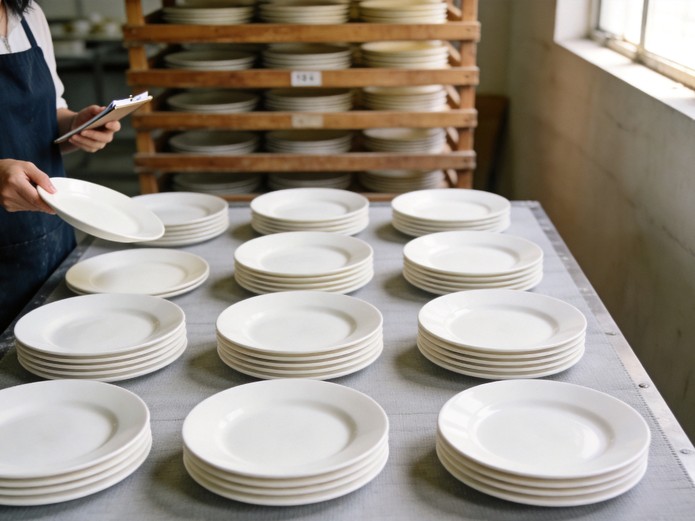
Assume three minutes per piece to check a dinner plate for glaze, rim, and dimensions — a working figure, not a measured factory value. Level II on 5,000 pieces is 200 pieces, ten hours; Level III is 315 pieces, 15.75 hours; Level I is 80 pieces, four hours, and an 11.3% blind spot. Sorting the whole lot is 250 hours: twenty-five times the Level II cost, plus rework and pieces damaged by handling everything twice.
| Approach | Pieces inspected | Hours at 3 min/piece | Protection against a 7.6% lot | When it is the right call |
|---|---|---|---|---|
| Level I, AQL 2.5 | 80 | 4.0 | Weak — 11.3% blind spot | Repeat SKU, supplier already on reduced inspection |
| Level II, AQL 2.5 | 200 | 10.0 | 1 in 10 | Default for a first or second order |
| Level III, AQL 2.5 | 315 | 15.75 | 1 in 16 | New supplier, hotel programme, decorated ware |
| Eight lots of 625 at Level II | 640 | 32.0 | 1 in 900 across the series | Multi-SKU, colour-critical order |
| 100% sort | 5,000 | 250.0 | Complete | After a rejected lot, on the buyer’s account |
More inspection buys a narrower blind spot at linear cost in hours, and nothing if the lot was badly formed or the draw was lazy. Lead time moves too: Level III adds about six hours to a pre-shipment window, and the switching rules can add a full inspection cycle when a lot fails. That cycle is the cheapest quality money a buyer spends, provided it is written before the order rather than negotiated after the report.
For a programme mixing decorated and undecorated ware, or a custom shape with its own glaze lot, split the AQL by decoration class instead of raising the level across the board: defect classification defines the split and the purchase contract makes it enforceable. The catalogue pages worth reviewing against an existing AQL inspection level are commercial plates and platters and hotel and catering dinnerware. Buyers who want the decision set per product line can send the shape and decoration brief before the PO is drafted, or ask for a sample plan matched to the order mix.
Frequently asked questions
Is AQL 2.5 a 2.5% defect limit on my shipment?
No. It is the process average the scheme is designed to accept across many lots. On a 5,000-piece lot at Level II, AQL 2.5 means 10 defects in a 200-piece sample, a 5.0% sample rate. The plan passes most lots at 2.5% and still passes a 7.6% lot about one time in ten.
Which inspection level should a first ceramic order use?
Level II is the standard’s default and the right start for a first or second order. Move to Level III for a new supplier, a hotel or airline programme, or any order where colour and decoration sell the product. Reserve Level I for a repeat SKU with a clean history, and expect a wider blind spot.
Does ANSI/ASQ Z1.4 give different numbers from ISO 2859-1?
For single sampling under normal inspection the code letters, sample sizes, and acceptance numbers are the same table. ANSI/ASQ Z1.4-2003 (R2018) is the current US edition, reaffirmed in 2018, and North American buyers often cite it by name. Either reference produces the same Ac and Re, at any AQL inspection level.
Can I reduce the sample if the last lots passed?
Only through the switching rules, and only after ten consecutive lots accepted on normal inspection with the cumulative defect count below the standard’s limit number. Choosing a smaller sample because last month went well is not reduced inspection; it is an unreported change of plan that forfeits the protection the scheme provides.
What happens to a rejected lot?
Under ISO 2859-1 clause 7.6 it is not resubmitted until every unit has been re-examined or retested and the supplier is satisfied the nonconforming units are gone. Practically that means a 100% sort, re-inspection at whatever level the responsible authority directs, and a decision about who pays. Agree that cost before the order ships.