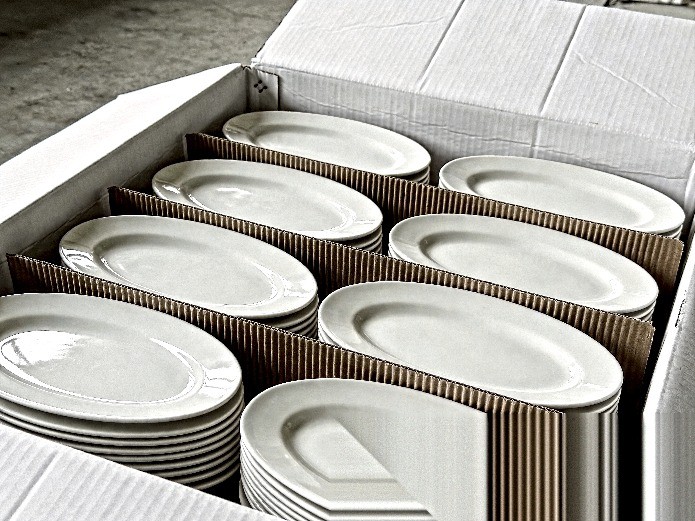
Ceramic tableware carton compression strength is set by the bottom carton in the stack, not by the grade printed on the flap. Take a 460 x 310 x 240 mm case pack of 24 stoneware plates at 18 kg gross, stack it eight high in a humid container, and let it stand a month: the laboratory figure of 360 kgf for 44 ECT board becomes 49 kgf of usable capacity once you divide by a safety factor of three. That box carries two layers above it, not eight. Here is the arithmetic that produces those numbers, the layer count each board grade really holds, and the clause block that puts the limit into a purchase order.
1. What a compression test proves, and what the ECT stamp leaves out
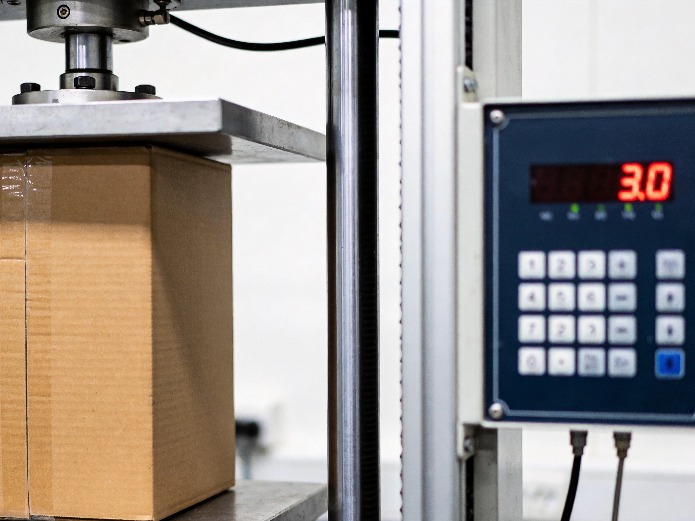
Two different numbers get called “box strength” and they are not interchangeable. ECT is a property of the board: a strip of corrugated is crushed on its edge between two platens, and the peak force per unit of edge length is reported, in kN/m under ISO 3037 or in lb/in under TAPPI T 811 and T 839. BCT is a property of the finished box: the erected, filled carton is compressed top to bottom until it collapses, under ASTM D642-25, ISO 12048:1994 or TAPPI T 804.
The bridge between them is the simplified McKee equation, published in 1963 and still the default in box design software. In US customary units it reads BCT = 5.87 × ECT × √(caliper × perimeter), with BCT in lbf, ECT in lb/in, caliper and perimeter in inches. The constant is dimensionless, so the same equation returns newtons if you feed it ECT in N/mm and dimensions in millimetres. What it does not accept is box height: the caliper term means board thickness, and substituting carton height there is the single most common way buyers generate a fake number.
The test detail that decides acceptance is often left off a supplier’s summary. ASTM D642 notes that fixed, locked platens tend to fail a box at its strongest point while a floating platen finds its weakest; the report must state which was used. ISO 12048 covers not only the peak compression but a stacking test that holds a loaded carton under constant load over time, which measures creep rather than collapse. China’s packaging series mirrors this: GB/T 4857.4-2008 for the compression and stacking test, GB/T 6545 and GB/T 6546 for bursting and edgewise crush of the board, GB/T 6543-2025 for single and double wall transport boxes, whose Annex D is a calculation method for compressive strength of an empty box.
Then there is the stamp. Buyers write “200 lb test minimum” intending to demand a strong box, and what they have specified is the Mullen burst test — a hydraulic diaphragm pushed through the board face, reported in psi. Burst and ECT appear side by side in the freight classification tables (NMFC Item 222 and UFC Rule 41) because they qualify the same weight and size class: 200 lb burst and 32 ECT share the 65 lb, 75 united-inch row. Shared row, different failure: the burst grade requires minimum liner basis weights, so a 32 ECT box can reach the same cell with lighter liners and still puncture more easily on a pallet corner. If your product travels stacked, ECT is the number that belongs in the specification; if it travels as a single heavy piece through parcel networks, burst is.
2. Working back from the bottom carton
Almost every carton that fails has failed at the bottom of a stack, under a load nobody calculated. The load there is not the weight of the box; it is the weight of everything above it.
The five-line arithmetic
Fix the case pack first, because every later number comes from it. Take the 24-piece carton above: 460 x 310 x 240 mm, 18.0 kg gross, of which 14.9 kg is product at 0.62 kg per plate and 3.1 kg is carton, dividers and wrap. Perimeter is 2 × (460 + 310) = 1,540 mm.
- Load on the bottom carton = gross weight × (layers − 1). At eight layers that is 18 × 7 = 126 kgf.
- Required working capacity = load × safety factor. At a factor of 3, 378 kgf.
- Required laboratory BCT = working capacity ÷ environmental multipliers. For 80% relative humidity and thirty days under load the multipliers are 0.68 and 0.60, so 378 ÷ 0.408 = 926 kgf.
- Compare against McKee from the board grade you were quoted, not against the supplier’s claim.
- If the answer is above any single-wall grade, you are choosing between a stronger board, fewer layers, or a smaller pack — there is no fourth option.
Run the equation for the four grades that appear on ceramic carton quotations, at this perimeter and the usual calipers of 3.96 mm for single wall C-flute and 6.5 mm for double wall BC-flute:
| Board | ECT | Lab BCT (kgf) | At 50% RH, no storage time |
|---|---|---|---|
| Single wall, C-flute 3.96 mm | 32 lb/in | 262 | 262 |
| Single wall, C-flute 3.96 mm | 44 lb/in | 360 | 360 |
| Double wall, BC-flute 6.5 mm | 48 lb/in | 503 | 503 |
| Double wall, BC-flute 6.5 mm | 61 lb/in | 640 | 640 |
| Double wall, BC-flute 6.5 mm | 71 lb/in | 745 | 745 |
The gap between the top and bottom row is 2.8 times, and that is only the board. Environment removes more than the grade adds, which is why the next two sections matter more than choosing a heavier liner.
3. How many layers each grade actually holds
Divide the lab BCT by the environment, then by the safety factor, and you have the usable ceramic tableware carton compression strength per carton. Dividing that by the gross weight gives the number of layers the carton can support above itself, and adding one gives the stack that box can sit at the bottom of.
| Board grade | Lab BCT (kgf) | Usable load, 80% RH and 30 days, SF 3 | Max stack height (18 kg carton) | At 70% RH and 30 days |
|---|---|---|---|---|
| Single wall 32 ECT | 262 | 35.6 kgf | 2 layers | 3 layers |
| Single wall 44 ECT | 360 | 49.0 kgf | 3 layers | 4 layers |
| Double wall 48 ECT | 503 | 68.5 kgf | 4 layers | 5 layers |
| Double wall 61 ECT | 640 | 87.0 kgf | 5 layers | 6 layers |
| Double wall 71 ECT | 745 | 101.3 kgf | 6 layers | 7 layers |
Three mistakes this table prevents
The first is treating the lab BCT as the answer. A 44 ECT carton at 360 kgf looks as if it holds twenty 18 kg boxes; it holds two above itself under export conditions. The second is buying the grade that satisfies the freight carrier rather than the stack — 32 ECT clears a 65 lb shipment and carries two layers of plates. The third is applying the safety factor but not the environment, which is half the derating and the more variable half.
4. The two deratings that cost you half the stack
Corrugated is paper. It loses compression strength as it absorbs moisture, and it continues to lose it while standing under load. The Fibre Box Association publishes factors for both, sourced from the USDA Forest Products Laboratory.
| Storage under load | Multiplier | Relative humidity under load | Multiplier |
|---|---|---|---|
| 10 days (37% loss) | 0.63 | 50% (no loss) | 1.00 |
| 30 days (40% loss) | 0.60 | 60% (10% loss) | 0.90 |
| 90 days (45% loss) | 0.55 | 70% (20% loss) | 0.80 |
| 180 days (50% loss) | 0.50 | 80% (32% loss) | 0.68 |
| 90% (52% loss) | 0.48 |
A Georgia Tech study by Roman E. Popil (2018, revised 2019) gives the mechanism behind the humidity column: short-span compression of kraft liner changes roughly ten percent for every ten points of relative humidity, and since ECT and BCT follow it, so do they. At 80% RH the study calculates a 27% loss from the moisture relation, close to the 32% tabulated, given that SCT, ECT and BCT each vary with a coefficient of about 7%.
For ceramic imports the practical consequence is that the conditioned laboratory figure describes a warehouse that does not exist, and the gap between that figure and real ceramic tableware carton compression strength is the whole derating. A container crossing the tropics in July, a non-climate-controlled DC, a port warehouse in the rainy season — all sit above the 50% RH of the standard test atmosphere (ISO 187 and TAPPI T 402 use 23 °C and 50% RH, harmonised with GB/T 10739). Write the derating into the requirement, and require a BCT report that states the conditioning it was measured at.
5. The ceiling is height, not strength
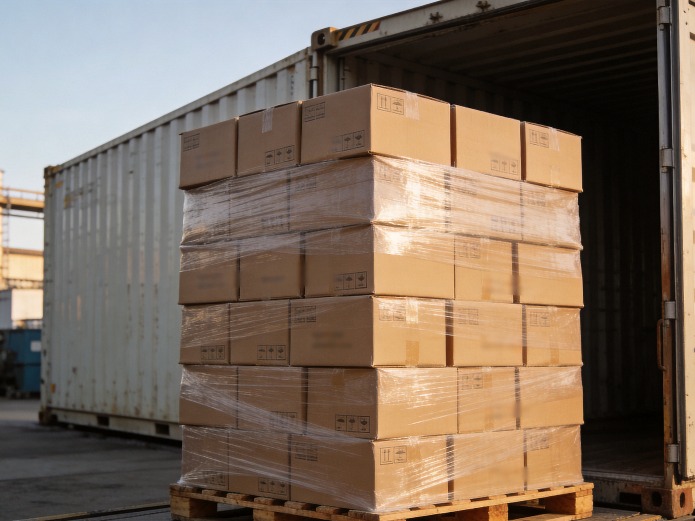
Now put the carton in a container and the arithmetic changes shape. A 40 ft high cube has an internal height of 2,698 mm and a door opening of 2,585 mm. On a 150 mm pallet, a 240 mm carton stacks ten high by internal height and ten high at the door. At six cartons per pallet layer and twenty 1,200 × 1,000 mm pallets in the box, ten layers is 1,200 cartons, 28,800 plates, 21,600 kg — below the 26,930 kg payload. The container is volume-limited, exactly as the fill arithmetic in ceramic tableware container loading sets out.
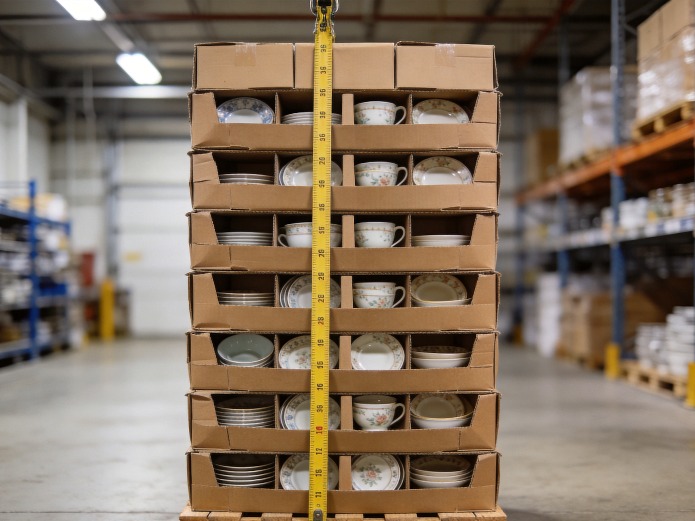
So the height ceiling is ten layers and the strength ceiling for 71 ECT board is six. The container runs at 60% of its cube, and the freight per piece moves accordingly, because freight is paid per container and the piece count is what divides it:
| Layers per pallet | Plates per 40HC | Gross cargo | Freight per plate vs 10 layers |
|---|---|---|---|
| 10 (height limit) | 28,800 | 21,600 kg | 1.000 (reference) |
| 8 | 23,040 | 17,280 kg | +25.0% |
| 6 (71 ECT limit) | 17,280 | 12,960 kg | +66.7% |
| 5 | 14,400 | 10,800 kg | +100.0% |
| 4 (48 ECT limit) | 11,520 | 8,640 kg | +150.0% |
Two thirds more freight per plate is not a rounding difference. It is the number that should decide whether the carton, not the board, is what needs changing.
6. Smaller cartons, taller stacks: the board-per-piece trade
Halving the pack halves the weight per layer, and weight per layer is what the ceramic tableware carton compression strength has to carry. A 12-piece carton at 340 x 250 x 180 mm and 9.0 kg gross reaches nine layers on 61 ECT double wall where the 24-piece carton reaches six, and it fits fourteen layers by height, so the strength ceiling stops binding.
The cost is board. A regular slotted blank is 2 × (L + W) × (H + W), so the 24-piece carton consumes 0.847 m² of board for 24 plates — 353 cm² per piece. The 12-piece carton consumes 0.507 m² for 12 — 423 cm² per piece, 19.8% more. In exchange, nine layers yields 1,296 plates per pallet against 864, so a 40HC carries 25,920 plates instead of 17,280: 50% more pieces for 33% less freight per piece.
That is the real decision, and it is not settled by principle. If your board is a small share of landed cost — typical when freight is the dominant line — the smaller carton wins. If board and labour dominate, the larger carton wins and you buy a stronger grade to reach six layers. Run both, with your own gross weight and your own rate, before you accept the case pack the factory proposed, because the case pack is usually set by what suits the production line.
Three practical costs sit on the small-carton side and belong in the comparison. More cartons per order means more print plates or more flexo runs if the carton is branded, and printed carton minimums are quoted per colour, so a short run carries the same setup as a long one. Inner dividers do not shrink in proportion to the carton, so partitions per plate can rise. And handling time per plate rises, which matters at the receiving dock rather than in the freight invoice. Ask for the carton supplier’s plate charge, minimum print run and lead time as separate lines before you compare packs. Custom carton development usually adds a week or two ahead of the ceramic production schedule, and that is the part that collides with a fixed opening date.
7. The clause block and the eight-point check
Everything above becomes enforceable only if it is written down. This is the block that carries the numbers, and it belongs alongside the other specification fields buyers leave blank, as set out in the ceramic tableware specification sheet.
The clause block
“Master carton: regular slotted container, 460 × 310 × 240 mm outside, board not below 44 ECT single wall or 61 ECT double wall. Case pack 24 pieces, gross weight not to exceed 18.0 kg. Stack height in the shipping configuration: not more than six cartons per pallet, column stack, no overhang. Carton to be supplied with a BCT report to ASTM D642 or ISO 12048, conditioned to 23 °C and 50% RH, stating platen type and minimum as well as average result. Supplier to confirm the working load calculated at a safety factor of 3 and at 80% RH after 30 days under load.”
That block does three things a test report cannot do on its own: it fixes the geometry, states the stack the box must survive rather than the strength the board must have, and forces the supplier to publish the derating they applied. If the carton arrives weaker than the clause, the shortfall is measurable against the report. Damage that follows is then a claims question rather than an argument about who tested what, which is where the notice deadlines in ceramic tableware damage claims start to run.
Eight-point pre-shipment check
Before loading, verify each of these against the physical carton, not the artwork proof:
- Gross weight of a sealed carton on a scale, against the clause — a 3% drift is normal, 8% means the plate weight changed without the carton being revisited.
- Outside dimensions, measured, because a 10 mm growth in height can cost a layer across the whole container.
- Board grade on the certification stamp, and the ECT value if the stamp carries one.
- The BCT report — method, conditioning, platen type, specimen dimensions, average and minimum, failure mode.
- Pallet pattern actually used, and whether it is column or interlock. Interlock stacks load corners off-centre and lose a large share of compression strength; a load arranged that way has already voided the calculation.
- Overhang at the pallet edge, measured rather than eyeballed.
- Dividers present at the specified count, since the carton is part of a system and an empty gap transfers load to the plates.
- Stretch wrap applied without crushing the top layer — a tight wrap applied at the top can pre-load the cartons before the container is even sealed.
Three things to change before the next order
Replace any “strong export carton” wording with a grade, a case pack and a stack height, and ask the supplier to confirm the ceramic tableware carton compression strength it will hold after thirty days in the shipping environment. Ask for the minimum BCT result rather than the average, because the bottom carton in a stack is one carton, not a mean. And test the pack as it will ship — the procedure choice and the report fields for that are covered in which packaging test procedure applies, and the carton needs to pass the distribution test after the compression clause is set, not instead of it.
If you want the clause block adapted to your own case pack and stack height, send us the pack details and we will return the arithmetic with your gross weight and layers in it. For buyers defining a printed or branded carton across several SKUs, the same calculation runs through our OEM and ODM programme against the plate and minimum-run costs for each design.
8. Questions buyers ask about ceramic tableware carton compression strength
Is 32 ECT strong enough for ceramic plates?
For a 24-piece carton at 18 kg gross, no. It clears the carrier’s 65 lb freight class, but at 80% humidity and thirty days under load its usable capacity is 35.6 kgf, which carries two layers above the bottom carton. It can work for a small, light pack — a 12-piece carton at 9 kg reaches four layers — provided the stack is limited to four.
Why is the supplier’s BCT so much higher than my load?
Because it is a collapse load measured in a conditioned laboratory, at 23 °C and 50% RH, on one carton, without creep. It is not an allowable load. Divide it by the environment factors and by a safety factor before comparing it to the weight above the carton. A 360 kgf report and 49 kgf of usable capacity describe the same box.
Does the safety factor have to be 3?
The safety factor is the third term in ceramic tableware carton compression strength, and it is a starting point, not a law. Some published guidance starts near 2.0 for short-term storage under a week with column stacking, uses 2.5 to 3.0 for up to a month and standard freight, and recommends 4.0 or above for long storage, high humidity, refrigerated or frozen conditions and mixed loads with overhang. Long ocean transit with a slow customs clearance belongs in the last group.
Can I just ask for a thicker board?
Up to a point. Going from 44 ECT single wall to 61 ECT double wall moves the lab figure from 360 to 640 kgf, a 78% gain. But the same 78% can be had free by stacking six layers instead of eight, or by cutting the pack from 24 pieces to 12. Board grade is usually the most expensive of the three levers and the last one to pull.
Does a carton that passed BCT still need a drop test?
Yes. Compression and distribution are different failure modes: BCT describes what happens to a stack standing still, and drop, vibration and impact describe what happens while the container moves. One does not substitute for the other, and a strong carton judged only on compression can still arrive with broken rims.
What if I cannot get a report at all?
Then specify the physical carton instead: board grade by ECT, case pack, gross weight limit, stack height in the shipping configuration, and the pallet pattern and overhang limits. A grade plus a stack height is enforceable at the loading dock with a scale, a tape and an eye. An unverified report is not.