Ceramic plate well diameter is the flat floor inside the rim, and it — not the outside width printed on the carton — decides how much food lands on the plate and whether the plate fits your dishwasher rack. Take a 10.5-inch plate with a 35 mm rim and a 10-inch coupe. The wider plate offers 30,388 mm² of usable floor. The nominally smaller coupe offers 44,488 mm², or 46.4% more. Across a 200-rack dinner service, that difference is a portion argument guests can see and your kitchen will be asked to explain.
What the well is, and why the label never mentions it
Every plate has two diameters. The outside is what the catalogue quotes and what a rack peg sees; the well is what a sauce, a fillet or a garnish sits on. The gap between them is the rim, and on a wide-rim plate it can swallow nearly half the top surface.
A 25 mm rim on a 266.7 mm plate occupies 18,983 mm², or 34.0% of the entire top surface. That third is glazed, fired, decorated, shipped, washed and stacked, and never holds food.
The label omits it because a mould is quoted by outside diameter — what the press holds and the rack accepts. Rim width comes from shape tooling that is often inherited or shared across three SKUs. Nobody writes it on the PO because nobody measures it, yet it is the largest lever on usable area a buyer can move without changing supplier, glaze or body.
There is a second reason to care. Under both the EU ceramic directive and the US FDA compliance guide, depth measured from the lowest point to the plane of the upper rim sorts a plate into a lead and cadmium category. That depth follows the well, not the outside width, so the geometry that sets your portion also sets which limit applies.
The arithmetic that decides your portion
Usable area is not proportional to diameter but to the well diameter squared, and the well diameter is the outside diameter minus twice the rim width. That is why the intuitive read fails.
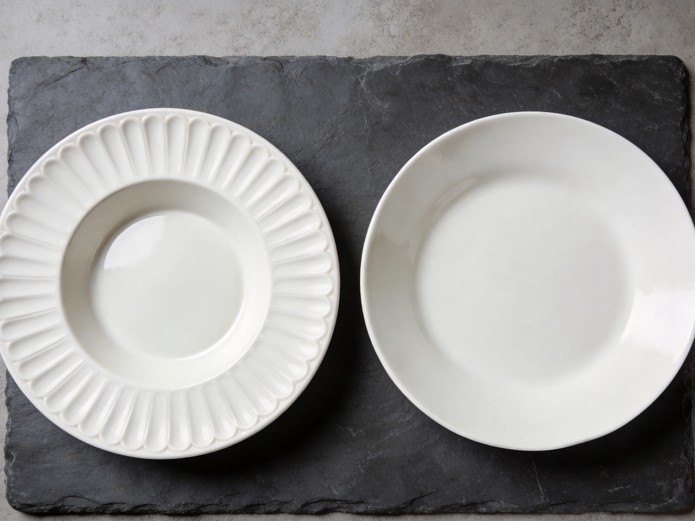
Compare a 10.5-inch plate (266.7 mm) with a 35 mm rim against a 10-inch plate (254.0 mm) with an 8 mm coupe rim:
- 10.5-inch, 35 mm rim: well 196.7 mm, usable 30,388 mm², 54.4% of the top surface
- 10-inch coupe, 8 mm rim: well 238.0 mm, usable 44,488 mm², 87.8% of the top surface
The 10-inch plate is 4.8% narrower. Reasoning from diameter alone, a buyer expects 0.907 of the larger plate’s area — a 9.3% deficit; the actual result is a 46.4% surplus. Diameter-based reasoning is off by 55.7 points because rim width never entered it.
Hold the outside diameter at 266.7 mm and move only the rim:
| Rim width | Well diameter | Usable area | Usable share of top surface |
|---|---|---|---|
| 8 mm | 250.7 mm | 49,363 mm² | 88.4% |
| 12 mm | 242.7 mm | 46,263 mm² | 82.8% |
| 20 mm | 226.7 mm | 40,364 mm² | 72.3% |
| 25 mm | 216.7 mm | 36,881 mm² | 66.0% |
| 30 mm | 206.7 mm | 33,556 mm² | 60.1% |
| 35 mm | 196.7 mm | 30,388 mm² | 54.4% |
| 40 mm | 186.7 mm | 27,377 mm² | 49.0% |
Read the last column against the second: a 20 mm rim to 35 mm gives up 9,976 mm² and drops usable from 72.3% to 54.4%, about 17.9 points on the same mould, body, glaze and freight.
Invert it: if the requirement is a specific usable area, rim width sets how large a plate must be bought.
| Rim width | Plate outside diameter needed | In inches |
|---|---|---|
| 8 mm | 212.7 mm | 8.37 in |
| 12 mm | 220.7 mm | 8.69 in |
| 20 mm | 236.7 mm | 9.32 in |
| 25 mm | 246.7 mm | 9.71 in |
| 30 mm | 256.7 mm | 10.11 in |
| 35 mm | 266.7 mm | 10.50 in |
This is where wide-rim collections inflate freight. To put the same 30,388 mm² of floor in front of a guest, a 35 mm rim needs a 266.7 mm plate; an 8 mm coupe needs 212.7 mm. That is 54 mm of extra fired ceramic per piece, carried across the order and through shelf height, for the same food.
Portion perception and the density number
Area is the arithmetic; density is the consequence. Take a 180 g mains portion and divide by the usable floor:
- 10.5-inch, 35 mm rim: 5.92 g per 1,000 mm²
- 10-inch coupe, 8 mm rim: 4.05 g per 1,000 mm²
The same scoop reads 46% denser on the wide-rim plate. Where a dish is costed to a margin, that reads as a short portion and invites a heavier scoop, so the plate raises food cost while the invoice shows the cheaper unit price.
The tolerance nobody writes, and the swings it hides
When rim width is not on the drawing, it is not controlled. A ±3 mm band around a nominal 35 mm rim on a 266.7 mm plate moves usable area: at 32 mm the well is 202.7 mm and area 32,270 mm²; at 35 mm, 196.7 mm and 30,388 mm²; at 38 mm, 190.7 mm and 28,562 mm². That is a 3,708 mm² swing, 11.5%, inside a band most factories call normal mould wear. Two lots can pass an outside-diameter check and still plate visibly differently, and the guest sees it before purchasing does. The fix is not a tighter mould but a written field: nominal, tolerance, measurement point, gauge. Without those, “10.5 inch wide rim” is a description, not a specification.
Rack fit: where 2 mm of diameter costs 16.7% of throughput
Rack capacity is quoted for a nominal plate size and the threshold is unforgiving. A Hobart P-18-12 plate rack, 500 x 500 mm with nine peg spaces, takes 18 flat plates up to 260 mm. A 254.0 mm plate clears it; a 266.7 mm plate does not, and falls to the P-15 rack rated for 15 plates from 180 to 320 mm.
Eighteen pieces per rack against fifteen is a 16.7% loss: at 40 racks an hour the line moves 720 plates instead of 600, and at 150 racks an hour — the certified speed of a conveyor machine — the gap is 450 pieces an hour. On two shifts that is a second rack unloader, or a queue at the scraper.
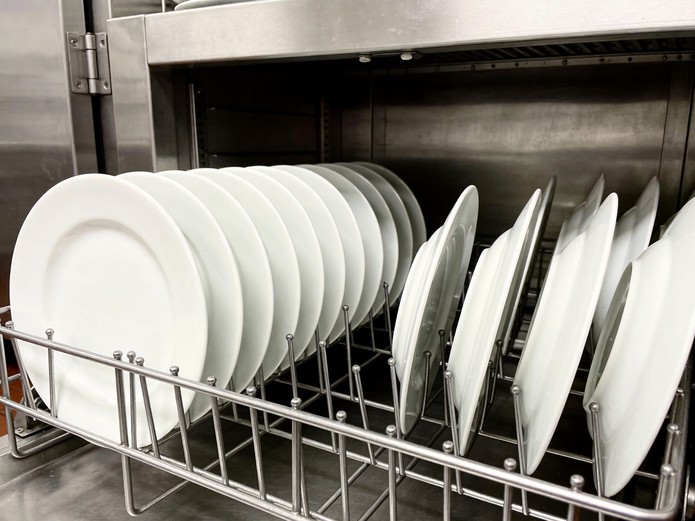
Smaller is not automatically better, which is the trap. A 212.7 mm coupe puts the same food area on a smaller disc and gains rack headroom, but it changes the visual frame and can read as under-plated at the pass. Sizing belongs to the whole system: usable floor, portion weight, rack programme, shelf height, and cycle length.
The compliance line that follows the same geometry
Depth is measured from the lowest point to the plane through the upper rim, and that depth is a function of the well diameter, not the outside width. Under Council Directive 84/500/EEC, Article 2(4), a fillable article whose internal depth does not exceed 25 mm falls into Category 1, with limits of 0.8 mg/dm² lead and 0.07 mg/dm² cadmium; articles exceeding 25 mm fall into Category 2, with 4.0 mg/l lead and 0.3 mg/l cadmium.
The US FDA compliance guide draws the same 25 mm line with different machinery. Ceramicware flatware — internal depth not exceeding 25 mm — carries a lead action level of 3.0 µg/ml as an average of six units. Small hollowware other than cups and mugs carries 2.0 µg/ml on any one of six units. The cadmium guide sets flatware at 0.5 µg/ml average of six and small hollowware at 0.5 µg/ml any one of six.
Two plates differing by 2 mm of well depth sit in different categories. Run it on a real piece: a 266.7 mm plate with a 226.7 mm well filled to 26 mm holds about 1.05 litres, so the Category 2 allowance is roughly 4.2 mg of lead. Tested as flatware, the same plate is assessed on 5.586 dm² at 0.8 mg/dm², around 4.47 mg. The routes land within 6% here — exactly why the distinction gets waved away, and why it bites when shape or fill depth moves them apart.
Both regimes treat measured depth as the discriminator, not the trade description: a dinner plate measuring 26 mm deep is hollowware for testing.
A specification clause you can paste into the next PO
Use this as-is, adapting tolerances to your mould capability. It turns ceramic plate well diameter from a description into a specification you can enforce.
- Outside diameter: nominal, tolerance, measured at the widest point at two positions 90° apart.
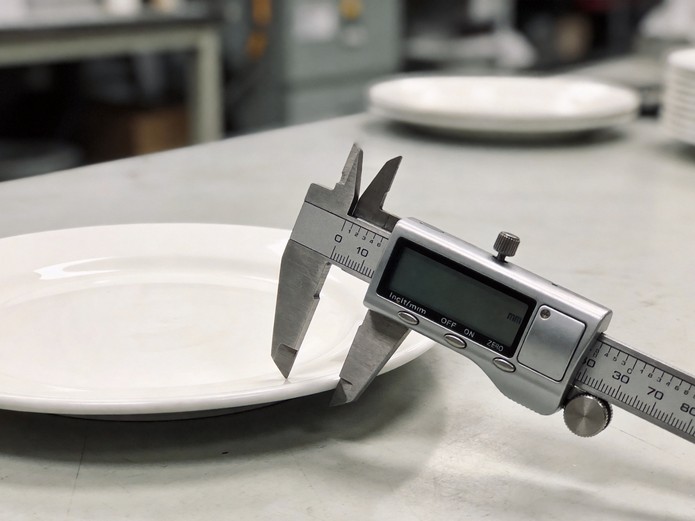
- Rim width: nominal with tolerance, measured at the base of the rim on the flat, caliper at four positions.
- Well diameter: nominal with tolerance, recorded per piece rather than per lot.
- Well depth: from the lowest point to the plane of the upper rim, stated as a number, not a category.
- Usable area: derived from measured well diameter, stated in mm² on the approved sample.
- Rack programme: rack model and rated plate diameter, named on the drawing and confirmed on a trial.
- Measurement method: gauge and datum for every dimension, so two inspectors reach one number.
- Category statement: for the destination market, the limit and the depth basis it was assessed against.
Every line is measurable at goods-in with a caliper and a plate gauge, and carries a reject consequence. Rim width without a measurement point is a number the factory can satisfy on one side and fail on the other; well diameter without a gauge is one two inspectors read 3 mm apart.
Four ways this goes wrong
Buying by diameter and assuming area follows. An 8, 10 and 12 inch collection delivers usable floors near 27,000, 40,000 and 49,000 mm² only if rim widths hold constant. Change the rim on one size and the progression stops. The plate costing least per piece can carry the least food, and per-piece pricing says nothing about per-portion cost.
Accepting an outside-diameter tolerance as sufficient. A ±1 mm band on 266.7 mm is ±0.4% and looks tight; the same ±1 mm on a 35 mm rim is ±2.9% and swings usable area over 5%. Tolerances belong on the dimension that does the work.
Sizing before checking the rack. A 10.5-inch plate looks the more generous choice until three plates per rack disappear. Rack capacity belongs in the sizing decision, in writing, before the mould is confirmed.
Treating the 25 mm line as marketing. Depth drives both the EU category and the FDA split. A decorating change adding 2 mm of well depth moves the piece into a different protocol and limit. If the drawing states neither measured depth nor measurement plane, the test house picks one for you.
Sourcing, MOQ and what to send
Well geometry is a tooling question before a production question. A rim change on an existing shape means a new or re-machined mould, quoted per shape rather than per order; a new body means a mould charge and a sampling cycle. Ask whether the factory can re-cut the existing tool, because the answer sets both cost and calendar.
Lead time splits into sample and bulk: sampling runs on the mould queue, bulk on body availability and kiln schedule, and neither quotes against a trade size. Packaging is shape-dependent too — a deeper well needs a taller divider and changes carton cube, so a packing test on the actual body is the only reliable answer.
Quality is where the written field pays for itself. Add a goods-in check on well diameter and rim width, sampled per kiln lot rather than per shipment, because rim width drifts with mould wear across a campaign. Migration claims belong tied to measured depth and market, and the report should name the category tested.
Send four things: a dimensioned profile drawing with rim width and well depth, the required well diameter with tolerance, the rack model, and the destination market. The last decides whether the depth question lands in the EU table or the FDA split, and changes which test the factory schedules.
For buyers building a programme across dinner, salad and platter sizes, the commercial plates and platters range is organised by profile rather than nominal size, which makes the rim comparison straightforward. Where a collection is being developed, the OEM and ODM service covers profile development, mould making and sampling against a written geometry, and the hotel and catering dinnerware range is where rack fit surfaces first, since those accounts run continuous wash lines.
Related guides cover the adjacent ground: the restaurant plate size guide maps trade sizes to menu courses, the tableware specification sheet guide lists the nine fields most often left blank, the stackable tableware guide handles the shelf-height side of the same geometry, the declaration of conformity guide sets out the paperwork that follows the depth category, and the serving platters guide covers serving-piece arithmetic.
The trade-off, stated plainly
A wide rim buys perceived value and decoration space; it costs usable floor, plate diameter per portion, rack slots and shelf height. A coupe buys floor and throughput, and costs visual frame. There is no universally correct answer, which is why it belongs in writing. What is not defensible is buying by outside diameter and meeting the trade-off after the reorder, once the mould is committed.
Send the profile drawing and rack model together and the geometry can be checked against both constraints before a sample is cut. Request a profile review with the measured well diameter and your rack programme.
FAQ
Is well diameter the same as the plate’s inside diameter?
Not quite. Inside diameter is usually measured across the top of the rim opening; the well is the flat floor below it. On a sloped or flared rim they differ by 10 mm or more, enough to change usable area 15–20%.
Can usable area grow without changing plate size?
Only by narrowing the rim, a tooling change rather than a production instruction. On a 266.7 mm plate, 35 mm down to 20 mm adds 9,976 mm² of floor and lifts usable from 54.4% to 72.3%, with no change to outside diameter or rack fit.
Does a wider rim change which lead and cadmium limit applies?
It can, indirectly. The limit follows internal depth to the plane of the upper rim, and a rim change alters that relationship. A plate measuring 25 mm or less is flatware at 3.0 µg/ml under the FDA guide; 26 mm puts it into small hollowware at 2.0 µg/ml.
Why do 10.5-inch plates miss the rack that takes 10-inch plates?
Because rack capacity is rated on a diameter threshold, not a range. A 500 x 500 mm rack with 18 flat-plate positions is rated to 260 mm, so a 254.0 mm plate clears it and a 266.7 mm does not — a 16.7% drop in pieces per rack.
How should rim width be written on a purchase order?
As a nominal with a tolerance, a measurement point and a gauge. “35 mm ±1.5 mm, measured at the base of the rim on the flat, caliper at four positions” is a specification. “Wide rim” is not, and passes while the plates still plate differently.
Does this apply to bowls and platters?
The same geometry does, with different consequences. On a platter the well sets how much a shared dish holds; on a bowl, depth dominates and the compliance category shifts, so a bowl spec should state measured depth with top diameter.