Ceramic tableware for bakeries needs to do three things well: frame your pastries attractively, resist staining from butter and cream, and survive daily commercial dishwashing without losing its surface finish. After ten years of sourcing ceramic tableware for foodservice clients, I have seen bakery owners waste thousands of dollars on plates that looked perfect in a catalog but stained within weeks of daily croissant service, or bowls that framed a parfait poorly and hurt impulse purchases at the counter. The right ceramic tableware for bakeries is not just “white and round” — it is a set of deliberate choices about shape, glaze, weight, and edge finish that directly affect how your products sell and how long your investment lasts. In this guide, I will walk you through the specifications that actually matter when sourcing bakery and patisserie tableware, what to request from suppliers, and the common mistakes that drive up replacement costs.
Why Bakery Environments Demand Different Ceramic Specs
Bakeries and patisseries place ceramic ware under stress patterns that differ from standard restaurant service. Flour dust settles on open display shelves and clings to matte surfaces. Butter and cream fats leave invisible film that degrades standard glazes over time. Acidic fruit tarts and lemon curds etch poorly fired surfaces. Commercial under-counter dishwashers in small bakeries often run shorter, hotter cycles that thermal-shock lower-grade ceramics. If you source the same spec you would for a casual dining restaurant, you will likely face higher replacement rates within the first year.
The key differences boil down to four factors:
- Stain resistance: Dairy fat and natural food colorings (beet, turmeric, berry) penetrate micro-pores in low-fired or improperly glazed ceramics.
- Display clarity: Bakery items are smaller and lighter in color than entrees; the plate surface must not compete visually with the product.
- Edge durability: High-turnover counter service means frequent stacking, unstacking, and sliding across display cases — rim chips are the most common failure mode.
- Temperature cycling: Items move from heated display to refrigeration to dish pit; thermal shock resistance matters more than in full-service dining.
Shape and Size: What Works for Pastry Display vs. Dine-In
Most bakery buyers order one size and hope it works for everything. That is a mistake. A macaron looks lost on a 10-inch dinner plate; a slice of layered cake needs a rim to hold structural integrity when moved. Here is what I recommend based on product type:
| Bakery Item | Recommended Plate Diameter | Shape | Why It Works |
|---|---|---|---|
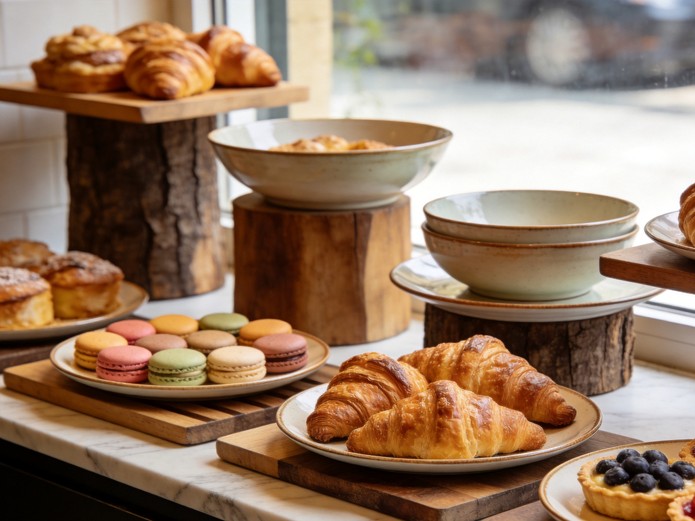
| Macarons (3-5 pcs) | 5.5–6 inches | Round or oval | Frames without excess negative space; oval adds perceived value |
| Croissants, danishes | 7–8 inches | Round with slight rim | Holds flaky debris; rim prevents sliding on angled displays |
| Cake slices, tarts | 7.5–8.5 inches | Round or hexagonal | Rim contains sauce or cream; hexagonal adds premium feel |
| Parfaits, dessert cups | 4–5 inches (saucer) | Round saucer or coaster | Stabilizes glassware; catches drips |
| Bread & butter service | 8–9 inches | Rectangular or oval | Accommodates longer loaves; fits bakery display trays |
| Shared dessert platters | 10–12 inches | Round or rectangular | Supports multiple items for table or counter sharing |
For dine-in bakery-cafes, I generally recommend ordering two plate tiers: a smaller set (5.5–7 inches) for individual pastries and a mid-size set (7.5–9 inches) for plated desserts and light meals. This keeps plating consistent and reduces the number of SKUs you need to manage.
Glaze and Surface Finish: Stain Resistance in a Fat-Rich Environment
The biggest hidden cost in bakery ceramic tableware is staining. Butter, cream cheese, egg wash, and natural food dyes all contain molecules small enough to penetrate micro-cracks in low-quality glaze. Once stained, a plate cannot be recovered — it must be replaced.
Here is how the common glaze types perform in bakery conditions:
- High-fire glossy glaze (vitrified, 1200–1300°C): Best choice. The glassy surface is non-porous and resists fat absorption. Easy to sanitize. Downside: shows water spots and fingerprints more readily on open display.
- Matte glaze: Popular for the “artisan” look but traps flour dust and butter film in surface irregularities. Requires more frequent cleaning. If you choose matte, opt for a “soft matte” rather than heavily textured.
- Reactive glaze: Visually striking but highly variable. Some reactive glazes have micro-pits that stain permanently with turmeric or berry dyes. Only source reactive glaze from suppliers who provide stain-resistance test data.
- Colored body with clear overglaze: A good compromise. The dense colored body hides minor wear, and the clear glossy overglaze provides the protective barrier.
My recommendation: For counter display plates, use high-fire glossy white or ivory. For dine-in plated desserts, a soft matte or colored body with clear glaze works if you budget for a 15–20% annual replacement rate. [VERIFY BEFORE PUBLISHING] Lead and cadmium content limits for food-contact ceramics vary by market: FDA (USA) sets a maximum of 3.0 mg/L for lead and 0.5 mg/L for cadmium in flatware; EU Regulation 1935/2004 requires migration limits; LFGB (Germany) is stricter on overall migration. Always request third-party test reports for the specific glaze batch.
Weight, Stackability, and Edge Finish for High-Turnover Counters
Bakery counter service involves more plate handling per hour than most dining rooms. Staff pull plates from stacks, slide them across display glass, and restack them dozens of times per shift. Three physical properties determine how well your plates survive this rhythm:
Plate Weight
Too light, and plates slide around on display; too heavy, and staff fatigue increases breakage from drops. For bakery service, I target 350–500 grams for a 7-inch plate. This is lighter than typical hotel dinnerware (600–800g) but substantial enough to feel premium in a customer’s hand.
Stackability
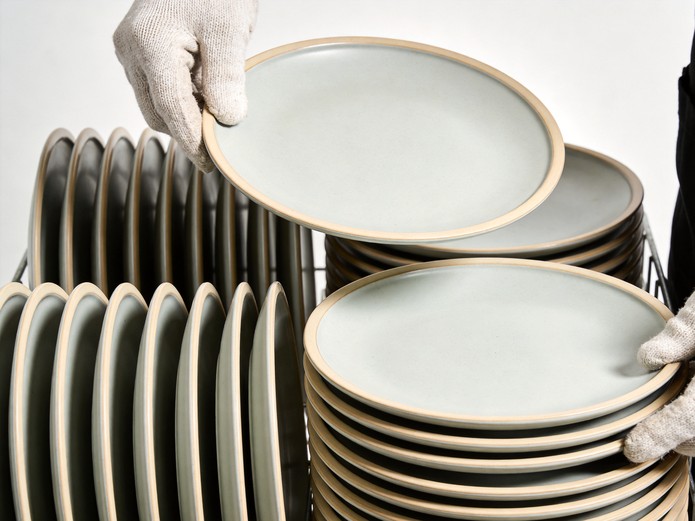
Look for plates with a slight foot ring or recessed base. This prevents the glazed surface of one plate from grinding against the face of another during stacking. Unglazed foot rings are acceptable but check that the ring is smoothly finished — rough biscuit edges will scratch display case surfaces over time.
Edge Profile
Rolled or slightly raised rims chip less than flat-cut edges. In a bakery, where plates are constantly slid across glass and metal surfaces, rim chips are the number one failure mode. Request samples and test the rim by tapping it lightly against a hard edge — a dull thud suggests a denser, more durable edge; a sharp ring can indicate a thinner, more brittle rim.
MOQ, Lead Time, and Customization: What to Expect From Suppliers
Bakery tableware orders tend to be smaller than hotel or restaurant contracts, which creates a negotiation challenge. Here is what I typically see in the market:
- MOQ per SKU: For off-the-shelf shapes, expect 500–1,000 pieces per item. For custom shapes or branded items, 2,000–3,000 pieces is standard. Some suppliers offer mixed-SKU MOQs (e.g., 3,000 pieces total across 3–5 shapes) for bakery accounts.
- Lead time: 45–60 days for in-stock shapes with standard glaze. 75–90 days for custom colors or logo application. Add 2–3 weeks if you require third-party testing (FDA, LFGB, EU).
- Sample policy: Most factories charge $30–80 per sample plus shipping. Some deduct this from your first order. Request 2–3 samples of each candidate shape so you can test one and keep one as a reference.
- Customization options: Logo decal application (underglaze or overglaze), custom glaze colors (Pantone-matched within ceramic limits), embossed patterns, and edge color accents. Underglaze logos are more durable for dishwasher environments but limit color range.
Trade-off to understand: Custom color matching extends lead time by 2–4 weeks and often requires a one-time glaze development fee ($200–500). If you are launching a new bakery brand, this may be worth it. If you are restocking an existing location, standard white or ivory is faster and carries less risk of color variance between batches.
Quality Control Checklist for Bakery Ceramic Orders
Use this checklist when evaluating samples or conducting a pre-shipment inspection. I have used a version of this on every bakery tableware order I have managed.
| Check Item | Pass Criteria | How to Test |
|---|---|---|
| Surface stain resistance | No visible stain after 24h contact with butter/cream | Apply butter, leave 24h, wash with standard detergent |
| Edge chip resistance | No chips after 20 light taps against metal edge | Tap rim against stainless steel counter edge |
| Thermal shock | No cracks after freezer (-18°C) to hot water (80°C) | Freeze 2h, immerse in 80°C water |
| Dishwasher fade | No glaze dulling after 50 commercial cycles | Run 50 cycles, compare gloss to new sample |
| Stacking wear | No surface scratches after 100 stack/unstack cycles | Stack and unstack 100 times, inspect under light |
| Foot ring finish | Smooth, no sharp edges or unglazed rough patches | Run finger along foot ring; check display surface for scratches |
| Weight consistency | ±5% across 5 sample pieces | Weigh 5 plates from same batch |
| Dimensions | ±3mm on diameter, ±2mm on height | Measure with caliper |
[FACTORY PHOTO REQUIRED: Insert photo of QC inspection process, plate samples on display]
Common Mistakes Bakery Buyers Make (And How to Avoid Them)
These are the three errors I see most often when bakery clients come to me after a bad first order:
Mistake 1: Buying on Price Per Piece Without Checking Firing Temperature
A $0.80 plate and a $1.40 plate may look identical in a photo. The difference is often firing temperature. Low-fire ceramics (below 1100°C) have porous bodies that absorb fat and stain permanently. High-fire ceramics cost more to produce but last 3–4x longer in a bakery environment. Always ask for the firing temperature specification — it should be 1200°C or higher for bakery service.
Mistake 2: Ordering One Plate Size for Everything
A single 8-inch plate cannot frame a macaron set and a cake slice equally well. Poor portion framing reduces perceived value and can hurt sales. Budget for at least two plate sizes: a small plate (5.5–6.5 inches) for individual pastries and a mid-size plate (7.5–8.5 inches) for desserts and shared items.
Mistake 3: Ignoring the Dishwasher Environment
Small bakeries often use compact under-counter dishwashers with aggressive alkaline detergents and rapid heating cycles. Not all glazes survive this. Before placing a bulk order, run your sample plates through your actual dishwasher for two full weeks. If the glaze dulls or shows micro-cracking, that spec will not work in your operation.
Copy-Paste Tool: Bakery Ceramic Tableware Specification Request
Send this template to suppliers when requesting quotes. It covers the specifications that matter and signals to the factory that you know what you are doing.
Bakery Ceramic Tableware RFQ — [Your Company Name]

Product Requirements:
- Material: High-fire stoneware or porcelain, ≥1200°C firing
- Glaze: High-gloss or soft matte, food-safe, lead/cadmium compliant
- Target market compliance: [FDA / LFGB / EU — specify]

Quantities:
- 7-inch round plate (pastry/dessert): [___] pcs
- 5.5-inch round plate (macaron/individual): [___] pcs
- 8-inch oval plate (bread service): [___] pcs
- 4.5-inch saucer (parfait base): [___] pcs
- Total first order: [___] pcs

Customization:
- Logo: [Underglaze decal / No logo]
- Color: [Standard white / Pantone reference: ___]
- Packaging: [Individual box / Bulk carton with dividers]

Requirements:
- Third-party test report for [specify standard]
- Pre-shipment inspection by [your QC / third party]
- Sample approval required before production
- Target lead time: [___] days

Please quote FOB [port] with breakdown by SKU.
Packaging and Shipping: Protecting Your Investment
Bakery tableware orders are typically smaller and lighter than hotel contracts, which changes the packaging economics. Here is what to specify:
- Inner packing: Each piece wrapped in foam or tissue, nested in corrugated dividers. For plates, I prefer “divider carton” packing over “bulk stack” — the per-piece protection cost is higher but breakage drops from 3–5% to under 0.5%.
- Outer carton: Double-wall 5-ply corrugated, maximum 15 kg gross weight per carton for manual handling in small bakery receiving areas.
- Palletization: If ordering a full container, request corner posts and stretch wrap. For LCL (less-than-container) shipments, reinforced cartons are critical because your cargo will be handled alongside heavy goods.
- Labeling: Each carton should list SKU, quantity, dimensions, and gross weight. This simplifies inventory receipt when you are running a bakery and do not have a dedicated warehouse team.
Cost-quality trade-off: Premium divider packing adds roughly $0.08–0.15 per piece. If your total order value is under $5,000, this can feel significant. But replacing even 2% of a 2,000-piece order costs more than the upgraded packaging. I always specify divider packing for first-time supplier relationships; you can relax this once you have verified the supplier’s handling quality.
When to Source Standard vs. Custom for Your Bakery
This is the decision framework I use with clients:
| Scenario | Recommended Approach | Lead Time | Budget Impact |
|---|---|---|---|
| Single-location bakery, first order | Standard white/ivory, off-the-shelf shapes | 45–60 days | Lowest risk |
| Multi-location chain, branding rollout | Custom Pantone color + underglaze logo | 75–100 days | +15–25% unit cost |
| Premium patisserie, display-focused | Custom shapes (hexagonal, oval) + reactive glaze | 90–120 days | +30–50% unit cost |
| Wholesale distributor, resale | Standard shapes, neutral glaze, bulk packaging | 45–60 days | Volume-driven margins |
| Hotel bakery program addition | Match existing hotel line glaze/color | 60–75 days | Match existing pricing |
My general rule: do not order custom on your first purchase from a new supplier. Use standard shapes to verify quality, delivery reliability, and communication. Once you have a proven supplier, custom work becomes lower risk and the investment in color/logo pays off in brand recognition.
FAQ
Can I use the same ceramic plates for hot savory items and cold pastries?
Yes, if they are high-fire stoneware or porcelain with a vitrified glaze. The key is thermal shock resistance — plates that handle rapid temperature shifts will work for both applications. Low-fire ceramics may crack when moving from hot to cold service.
How often should I expect to replace bakery display plates?
With proper high-fire ceramics in a typical bakery environment, plan for 15–20% annual replacement due to chips and wear. With low-fire or heavily textured matte glazes, replacement can reach 40–50% annually. These are estimates based on my client experience; your actual rate depends on handling practices and dishwasher chemistry.
Is bone china suitable for bakery use?
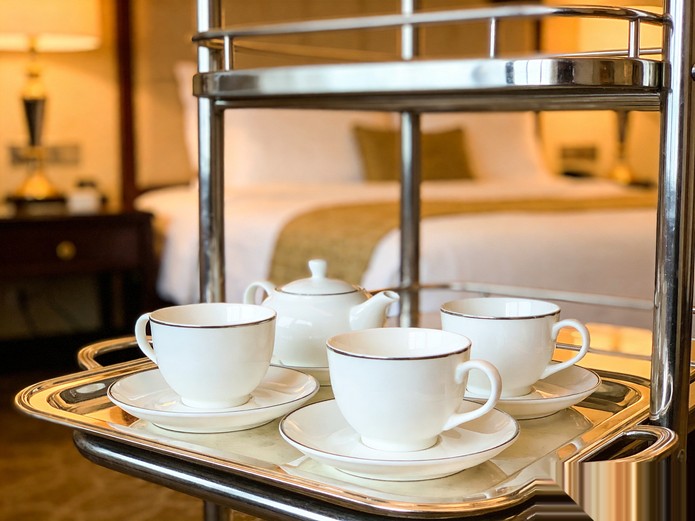
Bone china is beautiful and lightweight but generally too fragile for high-turnover bakery counters. It is better suited for dine-in afternoon tea service where handling is gentler. For bakery display and counter service, I recommend stoneware or hard-paste porcelain.
What is the minimum viable order for a small bakery?
Most suppliers will accept 500–1,000 pieces as a first order. For a single-location bakery serving 100–150 customers daily, this typically covers 6–12 months of operation including breakage reserves. If you cannot meet the MOQ alone, consider partnering with another local bakery for a combined order.
Should I request FDA testing for every order?
Request a test report for the first order from any new supplier. For repeat orders of the same glaze and body, a supplier declaration of conformity is usually sufficient, though some distributors and large retail chains require test reports for every shipment. [VERIFY BEFORE PUBLISHING] Always confirm current regulatory requirements for your target market before importing.
Ready to source ceramic tableware for your bakery? Request our bakery tableware specification sheet and get a tailored quote with MOQ, lead time, and customization options for your specific product range.