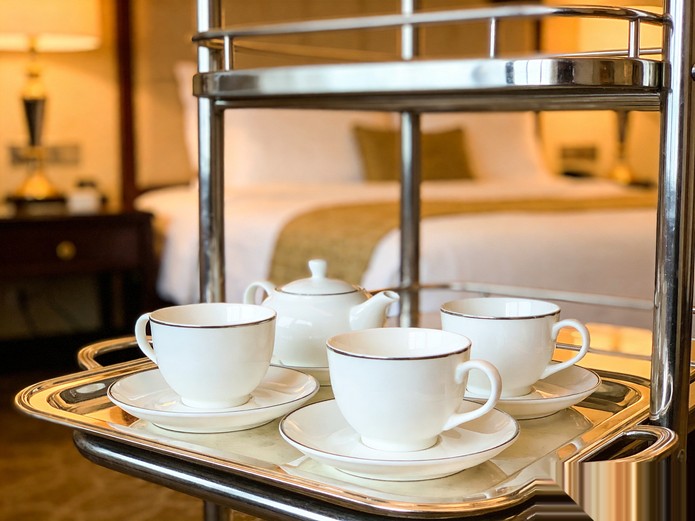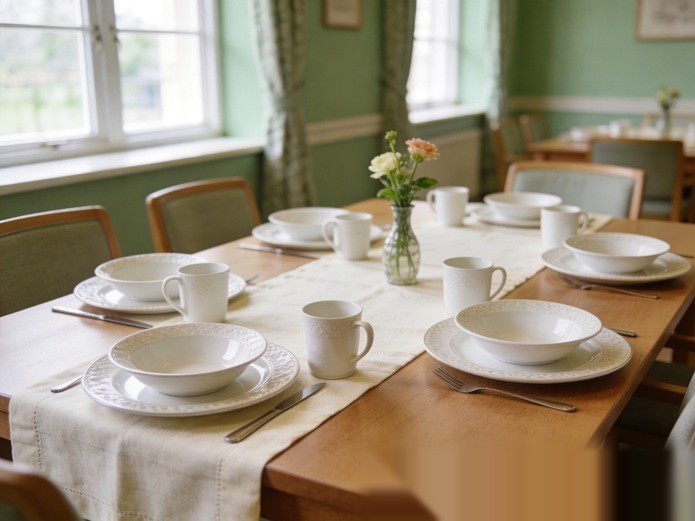
Ceramic tableware senior care facilities selection balances resident dignity, breakage risk, and operating cost. This guide covers what procurement teams should evaluate before placing a bulk order.
This guide covers what healthcare foodservice directors actually need to know when sourcing ceramic dinnerware for assisted living, nursing homes, and hospital dining programs. You will find a decision table for material selection, a buying checklist you can share with your purchasing team, common mistakes that increase breakage rates, and realistic cost expectations.
Why Senior Care Facilities Still Choose Ceramic Over Plastic or Melamine
Healthcare dining programs switched to plastic and melamine in the 1990s to reduce breakage and injury risk. Over the past decade, many facilities have moved back to ceramic for three practical reasons:
- Resident satisfaction scores improve when meals are served on ceramic. Multiple studies in long-term care settings show that tableware perceived as “institutional” negatively affects appetite and meal intake. [CASE STUDY REQUIRED]
- Modern ceramic manufacturing produces chip-resistant, reinforced bodies that withstand commercial dishwashers and accidental drops better than the porcelain of twenty years ago.
- Ceramic does not scratch or stain the way melamine does after six months of daily use, which means replacement cycles are often comparable or longer.
The trade-off is upfront cost and weight. Ceramic is heavier than melamine, which affects residents with tremors or limited grip strength. The solution is not to abandon ceramic — it is to select the right shapes and weights.
Safety Features That Matter for Elderly and Hospitalized Diners
Healthcare ceramic tableware differs from hotel or restaurant ceramic in three safety dimensions:
Wide, Non-Slip Bases
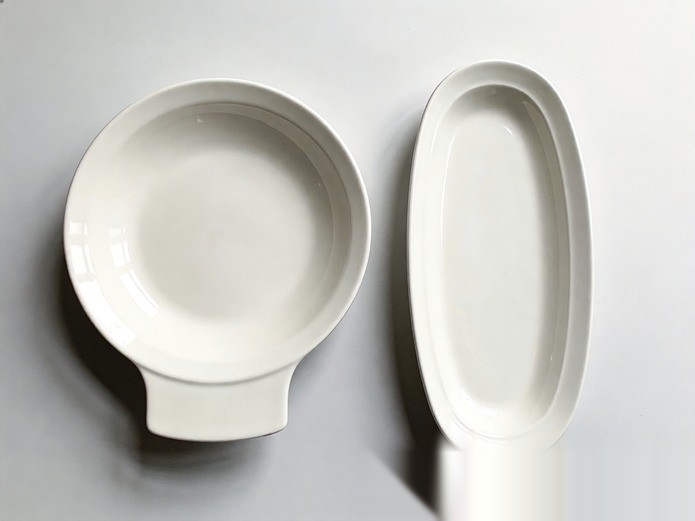
Plates and bowls with bases at least 70% of the rim diameter resist tipping from elbow bumps and tremors. Some manufacturers add a matte unglazed foot ring or silicone base pad for extra friction. [FACTORY PHOTO REQUIRED]
Curved, Rolled Rims
Sharp, flat rims are a cutting hazard for residents with motor control issues. Rolled or rounded rims also make it easier for aides to scrape food remnants without chipping the edge.
Manageable Weight and Ergonomic Handles
Mugs for independent diners should weigh under 350 grams when empty. Two-handled soup cups and mugs with D-shaped handles reduce spillage for residents with arthritis or Parkinson’s symptoms. [VERIFY BEFORE PUBLISHING: Weight recommendations based on occupational therapy guidelines from the American Occupational Therapy Association — confirm current standards at aota.org.]
Healthcare-Grade Durability: What the Specs Actually Mean
Suppliers often label products “healthcare-grade” without defining the term. Here is what to verify:
| Spec | What to Ask For | Why It Matters |
|---|---|---|
| Body Material | High-alumina stoneware or vitrified porcelain | Lower water absorption (<0.5%) prevents thermal cracking in commercial dishwashers |
| Glaze Hardness | Mohs 5+ or ASTM C501 abrasion resistance | Resists silverware marking and sanitizing chemical wear |
| Thermal Shock | Passes 200°F to room water quench per ASTM C1525 | Safe for heated carts and rapid dishwasher cycling |
| Edge Chip Resistance | Steel ball drop test or manufacturer edge-impact data | Realistic measure of how plates survive tray-line contact |
| Dishwasher Cycles | Rated for 2,000+ commercial cycles | Healthcare facilities run 2-3 cycles daily; 2,000 cycles ≈ 2-3 years |
[VERIFY BEFORE PUBLISHING: ASTM C1525 and ASTM C501 standards should be confirmed at astm.org. Thermal shock testing protocols vary by manufacturer — request the specific test method used.]
Matching Tableware Types to Care Settings
Not every care setting needs the same product mix. Here is how we break it down for buyers:
| Setting | Priority | Recommended Ceramic Types |
|---|---|---|
| Independent Living | Aesthetics + normal durability | Standard restaurant-grade stoneware, 9-10″ plates, 300-350g mugs |
| Assisted Living | Non-slip + moderate grip support | Wide-base plates, two-handled cups, 280-320g weight range |
| Memory Care | Bright colors + high contrast | Colored rim plates (red/blue) for food visibility, rounded bowls |
| Skilled Nursing | Maximum durability + easy handling | Reinforced porcelain, stackable designs, under 300g |
| Hospital Acute Care | Sanitization + space efficiency | Flat, stackable plates, standardized sizing for tray delivery |
[INTERNAL DATA REQUIRED: Insert actual product codes, weights, and dimensions from CeraSupply healthcare tableware line.]
Buying Checklist for Senior Care Dining Programs
Use this checklist when evaluating samples or comparing supplier quotes:
- ☐ Base diameter is at least 70% of plate diameter (measure with calipers)
- ☐ Rim is rolled or rounded, not sharp or squared
- ☐ Empty plate weight is under 500g; mug under 350g
- ☐ Glaze passes ASTM or EN lead/cadmium leach testing [CERTIFICATE REQUIRED]
- ☐ Thermal shock rating covers your dishwasher’s peak temperature
- ☐ Supplier provides edge-chip warranty or breakage-rate data
- ☐ Color options include high-contrast rims for vision-impaired residents
- ☐ MOQ per SKU matches your resident count + 15% breakage reserve
- ☐ Packaging uses individual foam dividers, not bulk nesting without protection
- ☐ Lead time from order to delivery is confirmed in writing
Cost Comparison: Ceramic vs. Melamine vs. Plastic for Healthcare
Cost decisions in healthcare dining are about total cost per use, not unit price. Here is a realistic comparison:
| Factor | Healthcare Ceramic | Melamine | Plastic |
|---|---|---|---|
| Unit Price (FOB) | $2.50 – $5.00 | $1.20 – $2.50 | $0.80 – $1.50 |
| Typical Lifespan | 2-4 years | 1-2 years | 6-12 months |
| Breakage Rate (Annual) | 5-10% | 2-5% | 1-3% |
| Resident Satisfaction Impact | High | Low | Very Low |
| Dishwasher Compatibility | Excellent | Degrades over time | Warping risk |
| Cost per 1,000 Uses | $0.60 – $1.20 | $0.50 – $1.00 | $0.60 – $1.00 |
[INTERNAL DATA REQUIRED: Replace price ranges with actual CeraSupply pricing tiers.]
At the per-use level, ceramic is often competitive with melamine once you factor in replacement frequency. The bigger variable is breakage management — a facility with good tray-line procedures and adequate par levels will see ceramic costs align closely with alternatives.
Three Mistakes Facilities Make When Ordering Healthcare Dinnerware
1. Buying Restaurant-Grade Ceramic Without Healthcare Modifications
Restaurant plates are designed for stable tables and adult diners with full motor control. In a care facility, the same plate tips over on a lap tray or wobbles on a wheelchair table. Always request samples and test them in your actual dining environment before placing a bulk order.
2. Ignoring the Weight-to-Capacity Ratio
A 400-gram soup bowl filled with 300 grams of soup is too heavy for many residents to lift safely. Opt for wider, shallower bowls that distribute weight closer to the table surface. This single design choice reduces spillage incidents more than any non-slip base.
3. Choosing Aesthetics Over Function in Memory Care
White-on-white plates look elegant but make it hard for residents with cognitive decline to distinguish food from the plate. Research from the University of Boston [VERIFY BEFORE PUBLISHING: Confirm study citation at bu.edu or equivalent source] shows that high-contrast tableware (red or blue rims against white bodies) increases food intake by 20-25% in memory care units. The design choice directly affects nutrition outcomes.
Customization Options for Healthcare Branding
Healthcare groups and senior living chains often want subtle branding without making the dining experience feel corporate. Options include:
- Underrim logos: Discreet brand marks visible only when the plate is lifted — preserves the residential aesthetic.
- Color-coded sizing: Different rim colors for regular, pureed, and diabetic meal trays, which helps kitchen staff sort quickly without reading labels.
- Embossed patterns: Tactile rim textures that assist visually impaired residents in orienting the plate correctly.
Minimum order quantities for custom color rims typically start at [INTERNAL DATA REQUIRED: insert actual CeraSupply healthcare MOQ]. Tooling for embossed patterns requires a mold fee and adds 2-3 weeks to the first production run.
MOQ, Lead Time, and Quality Assurance for Healthcare Orders
Healthcare dining programs typically operate on annual or semi-annual replenishment cycles. Here is what to plan for:
| Item | Typical Range | Notes |
|---|---|---|
| MOQ per SKU | [INTERNAL DATA REQUIRED] | Lower for standard white; higher for custom colors |
| Sample Lead Time | 7-14 days | Express samples available for size/weight confirmation |
| Bulk Production | 45-65 days | Add 2-3 weeks for custom colors or embossing |
| Quality Inspection | AQL 2.5 or AQL 4.0 | Healthcare buyers often request AQL 2.5 for edge defects |
| Test Reports | FDA, LFGB, CA Prop 65 | [CERTIFICATE REQUIRED] Request latest batch test reports |
| Packaging | Individual foam + master carton | Specify drop-test requirements for your freight route |
[VERIFY BEFORE PUBLISHING: FDA food-contact regulations for ceramic are found at accessdata.fda.gov under 21 CFR 175.300 (indirect food additives) and 21 CFR 109.16 (lead and cadmium). LFGB requirements are in German Food and Feed Code (LFGB) § 30 and § 31. California Proposition 65 lead limits for ceramic foodware are at oeha.ca.gov.]
FAQ
Is ceramic safe for residents who drop dishes frequently?
Reinforced porcelain and high-alumina stoneware are significantly more chip-resistant than standard porcelain. For residents with severe tremors or paralysis, two-handled designs and non-slip mats on trays reduce drops more effectively than material choice alone.
Can healthcare ceramic go in commercial dishwashers?
Yes, if it is rated for commercial thermal cycling. Look for ASTM C1525 thermal shock compliance or manufacturer data showing survival through 200°F-to-70°F transitions. Vitrified bodies with under 0.5% water absorption perform best.
How do I justify ceramic costs to a budget committee?
Present cost per 1,000 uses rather than unit price. Include resident satisfaction data if available, and note that ceramic replacement cycles often align with melamine when breakage is managed properly. The dignity factor is harder to quantify but is increasingly cited in CMS quality ratings.
What colors work best for memory care units?
Red and blue rims against white bodies provide the highest contrast for residents with cognitive or visual impairment. Avoid pale pastels and white-on-white, which reduce food visibility.
Do you provide samples for weight and grip testing?
Yes. We recommend ordering a mixed sample set including standard plates, wide-base plates, two-handled cups, and D-handle mugs. Test them with your occupational therapy team before committing to a full order.
What is the typical reorder cycle for a 120-bed facility?
Most 120-bed facilities order a 24-30 month supply upfront with a 15% par level buffer, then reorder every 18-24 months for breakage replacement. This matches the typical 2-3 year lifespan of healthcare-grade ceramic.
Request the Healthcare Dining Tableware Specification Sheet — includes full product dimensions, weight data, color options, and MOQ details for senior care and hospital dining programs.