Ceramic tableware subscription boxes can justify a $45-75 price point while costing you $3-8 per piece landed—if you choose the right items, packaging, and supplier terms.
We will cover which ceramic products work best in subscription boxes, how to align MOQs with uncertain subscriber counts, what packaging actually protects items through last-mile delivery, and how to brand ceramics without committing to ten-thousand-piece custom mold runs. By the end, you will have a decision framework and a supplier evaluation checklist you can use immediately.
Why Ceramic Tableware Fits the Subscription Box Model
Ceramics offer a rare combination of high perceived value and manageable unit cost. A stoneware mug that costs $2.50-4.00 ex-factory reads as a $15-20 retail item to most subscribers. That perceived value gap is what makes ceramics attractive for box curators who need subscribers to feel they got their money’s worth.
Weight and size constraints matter more in subscription boxes than in standard wholesale because you are paying for outbound shipping on every single unit. A standard 12-ounce ceramic mug weighs 320-380 grams. Add individual protective packaging and you are at 450-550 grams per piece. If your box ships at a 1.5 kg ceiling, that leaves room for one mug plus 2-3 lighter items, or a smaller espresso cup plus more variety. Understanding these hard limits before you select products prevents costly mid-program redesigns.
Photographability is another underappreciated factor. Ceramic surfaces photograph consistently under studio lighting, which matters when your marketing depends on unboxing videos and flat-lay social content. Matte glazes reduce glare. Reactive glazes create visual interest. Both outperform plastic or metal alternatives in user-generated content.
Product Selection: What Works in a Curated Box
The most successful ceramic subscription boxes focus on one hero item per shipment rather than assembling full place settings. A single distinctive mug or small bowl carries enough perceived value to anchor a box. Attempting to include a plate, bowl, and mug in one delivery blows the weight budget and increases breakage risk exponentially.
Size limits by common box dimensions:
- Small mailer (23×16×8 cm): Espresso cups (80-120 ml), small sauce dishes, or ceramic coasters.
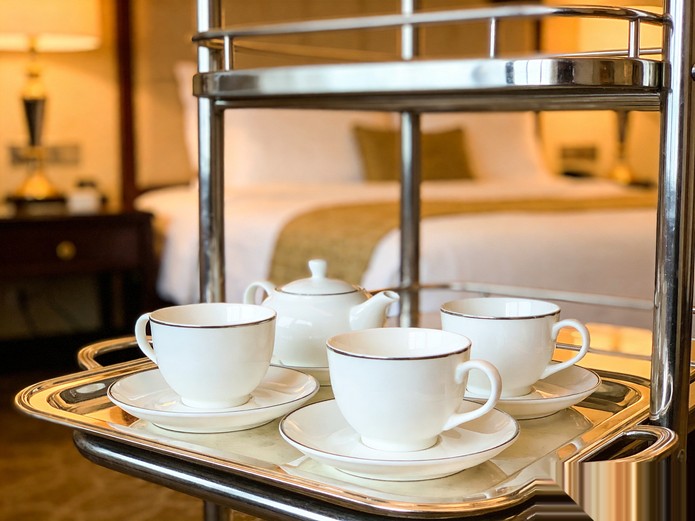
- Standard box (30×22×10 cm): Standard mugs (300-400 ml), small bowls (12-15 cm diameter), or tea cups with saucers.
- Large box (38×28×12 cm): Large mugs (450-550 ml), ramen bowls, or paired items with nested packaging.
Seasonal rotation is standard practice. Q1 leans toward warm-tone mugs and cocoa cups. Q2 shifts to lighter pastels and outdoor dining pieces. Q3 introduces harvest-themed earth tones. Q4 focuses on gift-ready packaging and limited glaze runs. Planning a 12-month product calendar before your first order prevents rushed, off-theme selections.
MOQ, Pricing & Lead Time Breakdown
Subscription box volumes fluctuate. Your January subscriber count may be 2,000; by June it could be 800 or 5,000. This uncertainty makes traditional MOQ structures painful. Here is how to think about order sizing. For a deeper look at MOQ negotiation strategies, see our ceramic MOQ strategy guide.
| Box Frequency | Subscriber Base | Annual Ceramic Units | Recommended Order Size | Unit Cost Range (Landed) |
|---|---|---|---|---|
| Monthly | 500 | 6,000 | 1,500-2,000 per quarter | $3.20-5.50 |
| Monthly | 2,000 | 24,000 | 6,000-8,000 per quarter | $2.80-4.20 |
| Quarterly | 1,000 | 4,000 | 2,000-2,500 per shipment | $3.50-5.00 |
| Quarterly | 5,000 | 20,000 | 8,000-10,000 per shipment | $2.50-3.80 |
Custom glaze colors or decals typically require 3,000-5,000 piece minimums per design. Stock designs with custom packaging (printed sleeve, insert card, or box label) drop that threshold to 500-1,000 pieces. For your first 2-3 shipments, stock ceramics with branded packaging is the lower-risk path. Transition to fully custom pieces only after you have 6+ months of reliable subscriber data.
Lead times for stock stoneware or porcelain items run 25-40 days from order confirmation to FOB port. Custom decals add 10-15 days. Custom molds add 45-60 days on top of the base production time. Plan your first order 90 days before your intended ship date. This buffer absorbs sampling delays, pre-production approval cycles, and shipping variability.
Packaging That Survives Monthly Fulfillment
The packaging inside your subscription box does two jobs: protect the ceramic from the fulfillment center to the subscriber’s doorstep, and create an unboxing experience that justifies the monthly fee. These jobs are not in conflict if you design the protection layer as part of the presentation. Our packaging and shipping guide covers general export practices; this section focuses on subscription-specific constraints.
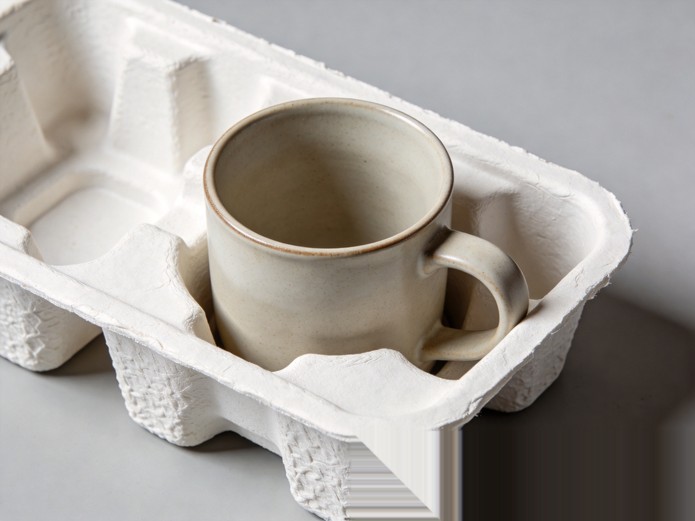
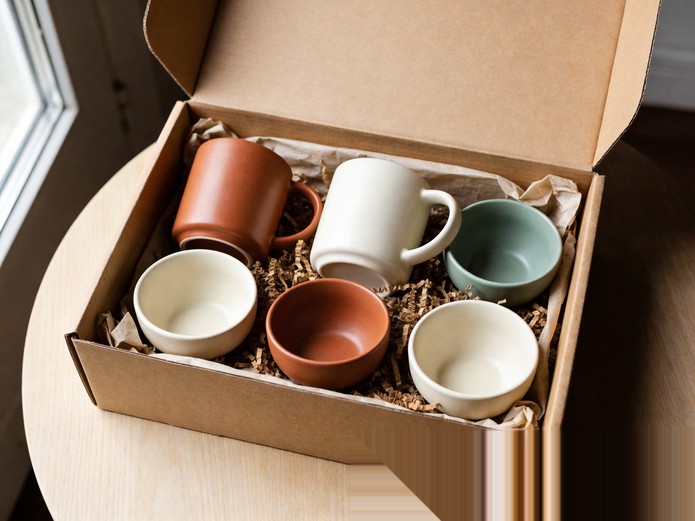
Individual item protection is non-negotiable for ceramics. Each piece needs its own corrugate insert or molded pulp tray. Nested packing—where a smaller ceramic piece sits inside a larger one with a fitted divider—can reduce per-unit protection cost by 30-40% while maintaining structural integrity. Never rely on bubble wrap alone; it compresses during transit and transfers impact force directly to the ceramic surface.
Weight budget matters at scale. A molded pulp insert for a standard mug weighs 45-60 grams. A full corrugate wrap weighs 80-120 grams. At 2,000 units per month, that 60-gram difference is 120 kg of extra shipping weight per shipment. Over a year, that adds cost and carbon footprint. Request sample packaging from your supplier and weigh it before committing.
The unboxing experience layer sits on top of protection. A printed kraft sleeve with your brand story, a care card with dishwasher-safe confirmation, or a QR code linking to a recipe or styling guide turns a functional package into a retention tool. This layer costs $0.15-0.40 per unit and has measurable impact on subscriber satisfaction scores [INTERNAL DATA REQUIRED].
Branding & Private Label for Subscription Ceramics
Subscribers expect curated box items to feel exclusive. There are three practical ways to achieve this without ordering 10,000 custom-molded pieces. For full customization options, see our custom ceramic tableware guide.
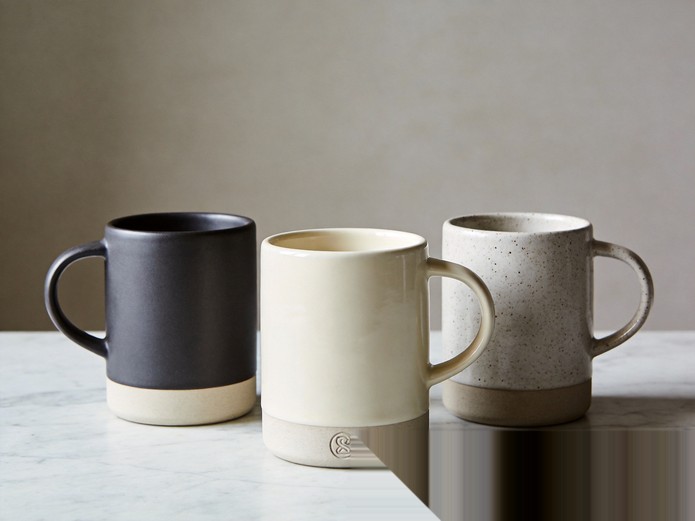
- Base stamp or bottom mark: A simple debossed logo on the ceramic base. MOQ: 3,000-5,000 pieces per design. Cost add: $0.10-0.25 per piece. Best for: Established programs with predictable volume.
- Decal or transfer logo: A fired ceramic decal applied to the exterior. MOQ: 2,000-3,000 pieces. Cost add: $0.20-0.40 per piece. Best for: Programs wanting visible brand presence on the item itself.
- Branded sleeve or insert: Printed paper or card stock wrapped around a stock ceramic piece. MOQ: 500-1,000 pieces. Cost add: $0.15-0.30 per piece. Best for: New programs testing subscriber response before investing in custom ceramics.
Custom glaze colors require the largest commitment: 5,000-10,000 piece minimums and 60-75 day lead times because the supplier must test and stabilize the glaze batch. If you want a signature color, start with a stock glaze that is close to your target and transition to custom only after proving demand.
Co-branded strategy—where your logo appears alongside the manufacturer’s mark—reduces minimums and signals quality to discerning subscribers. White-label strategy, where the manufacturer’s identity is hidden entirely, requires higher volumes but builds stronger brand equity over time.
Three Common Mistakes Subscription Box Buyers Make
Mistake 1: Ignoring the Breakage-Rate Economics
Subscription box ceramics see more handling touchpoints than standard wholesale: supplier → freight forwarder → port → ocean → port → customs → fulfillment center → sortation → last-mile carrier → subscriber. Each touchpoint adds risk. A breakage rate that seems acceptable at 2% becomes a customer service disaster when you are shipping 5,000 boxes per month. At that volume, 2% means 100 replacement shipments, 100 apology emails, and potential churn from subscribers who received a broken item as their first impression. Budget for 3-5% replacement stock in your initial orders and negotiate breakage allowances with your supplier [VERIFY BEFORE PUBLISHING].
Mistake 2: Overcommitting to Custom Molds on Low Volume
A custom-shaped mug or bowl feels unique, but mold development costs $2,000-5,000 and requires 5,000-10,000 piece commitments. If your subscriber base is under 1,000, you are locking yourself into 5-10 months of inventory for a single SKU. Start with stock shapes in signature glazes or decals. Reserve mold investment for your third or fourth product cycle, after you have subscriber retention data proving the concept.
Mistake 3: Treating Ceramic Lead Times Like Apparel Lead Times
Apparel buyers are used to 30-day turnarounds with air freight options. Ceramics do not work that way. Kiln firing schedules are fixed. Glaze testing cannot be rushed. Ocean freight from China to the US or EU is 25-40 days with no express alternative that is economically viable for ceramics. Planning a June box shipment? Your production order needs to be confirmed by late February. Missing this window means air freight at 5-8x ocean cost, which destroys your margin.
Cost, Quality & Delivery Trade-offs
Every subscription box program faces the same three-way tension. Here is how to navigate it.
| Strategy | Unit Cost | Subscriber Perception | Lead Time | Best For |
|---|---|---|---|---|
| Stock ceramic + branded sleeve | Lowest | Good | 25-35 days | Launch phase, testing |
| Stock ceramic + custom decal | Low-Medium | Very Good | 35-50 days | Growth phase, building identity |
| Custom shape + custom glaze | Highest | Excellent | 75-100 days | Mature program, retention focus |
Price-per-piece matters less than subscriber lifetime value. A $0.80 cost increase per unit for custom decals may feel significant on a 5,000-unit order, but if those decals improve 6-month retention by even 5%, the math flips decisively in favor of customization [INTERNAL DATA REQUIRED].
Single-source strategy simplifies communication and often earns volume discounts, but it creates concentration risk. If your sole supplier has a kiln failure or misses a glaze batch deadline, your entire fulfillment calendar shifts. A dual-source strategy—splitting orders between two suppliers with overlapping capabilities—adds 5-10% to unit cost but protects against single-point-of-failure disruptions. Most mature subscription box programs move to dual-source by their second year.
Supplier Evaluation Checklist for Subscription Box Ceramics
Use this checklist when vetting a new ceramic supplier for your subscription program. Print it or save it for every supplier call.
- Can they provide FDA or LFGB food-contact test reports for the specific glaze and clay body? [CERTIFICATE REQUIRED]
- What is their documented breakage rate for individually packaged ceramics shipped by sea?
- Do they offer molded pulp or corrugate insert samples you can test in your actual box dimensions?
- What is their minimum order for custom decals, base stamps, and glaze colors?
- Can they produce a pre-production sample within 14 days?
- What is their typical production window from sample approval to FOB?
- Do they have experience with subscription box or D2C fulfillment clients? [CASE STUDY REQUIRED]
- Can they ship to your fulfillment center directly, or only to port?
- What is their policy on defective or broken items—replacement, credit, or no coverage?
- Can they provide a production schedule with milestone dates you can align to your fulfillment calendar?
Regulatory Notes for Subscription Box Ceramics
Ceramic tableware sold in the United States must comply with FDA regulations for lead and cadmium leaching under 21 CFR 175.300 and California Proposition 65. In the European Union, Regulation (EC) No 1935/2004 governs food-contact materials, with specific migration limits tested per EN 1388 or EN 12875 methods. If your subscription box ships to multiple markets, your supplier must provide test reports covering each target jurisdiction [VERIFY BEFORE PUBLISHING].
Germany’s LFGB (Lebensmittel-, Bedarfsgegenstände- und Futtermittelgesetzbuch) requires additional testing beyond EU baseline. Some subscription box companies avoid the German market initially because of these stricter requirements. If Germany is in your plans, request LFGB-compliant certificates before placing your first order [VERIFY BEFORE PUBLISHING].
FAQ
What is the minimum viable subscriber count to justify custom ceramic branding?
Most suppliers require 3,000-5,000 pieces for custom base stamps or decals. At one item per box, that means 3,000-5,000 subscribers for a single shipment, or a smaller base with multi-month commitment. If you are below that threshold, start with branded packaging sleeves.
How much should I budget for packaging per ceramic piece?
Individual protective packaging (molded pulp insert or corrugate wrap) costs $0.25-0.60 per piece at 1,000+ unit volumes. The branded presentation layer—sleeve, card, or sticker—adds $0.15-0.40. Total packaging budget: $0.40-1.00 per ceramic item.
Can I mix ceramic and non-ceramic items in the same subscription box?
Yes, and most curated boxes do. The ceramic piece anchors the perceived value while lighter items (tea, spices, linens, recipe cards) add variety without blowing the weight budget. Design your box around the ceramic’s size and weight first, then fill remaining space.
What breakage rate should I expect, and who pays for replacements?
With proper individual packaging, expect 1-3% breakage through ocean freight and domestic fulfillment. Without individual packaging, 5-10% is common. Negotiate a 2-3% breakage allowance with your supplier before placing your first order. For subscriber replacements, budget 3-5% of each shipment as replacement stock.
Should I order all 12 months of ceramics at once, or quarterly?
Quarterly ordering is the safer approach for newer programs. It limits inventory risk, allows design pivots based on subscriber feedback, and avoids warehouse storage costs. Annual ordering earns 8-15% volume discounts but locks your design decisions 9-12 months in advance. Most programs move to semi-annual ordering after 18-24 months of stable subscriber counts.
Three Actionable Recommendations
1. Order a physical sample box before committing to any production run. Have your supplier pack the exact ceramic piece, protective insert, and branded sleeve into your actual mailer dimensions. Ship it to yourself via standard post. Open it exactly as a subscriber would. If anything is damaged, misaligned, or underwhelming, fix it before spending $10,000 on inventory.
2. Lock your production calendar 120 days ahead. Map every box shipment date backward through ocean freight, customs, production, and sampling. Build in a 15-day buffer for delays. Share this calendar with your supplier and get written confirmation of every milestone date. Ceramic production does not tolerate last-minute changes.
3. Start with stock ceramics and branded packaging, then phase in customization. Your first 2-3 shipments are about proving product-market fit, not building a signature collection. Use the lower MOQs and faster lead times of stock items to test subscriber response. Once you have 6+ months of retention data and predictable volumes, invest in custom decals or base stamps.
Subscription box ceramics are not a side project for a wholesale supplier. They require different packaging, different MOQ structures, and different lead time planning than standard hospitality or retail orders. The suppliers who understand this distinction—and have the sample kits and fulfillment experience to prove it—are the ones worth building a program around.
Ready to Evaluate Ceramic Options for Your Subscription Box?
Request a subscription box sample kit to test fit, weight, packaging, and branding on your actual product line. We pack sample ceramics with protective inserts and branded sleeve mockups so you can evaluate the full unboxing experience before placing a production order. Contact our team to discuss your program requirements, subscriber volumes, and fulfillment calendar.