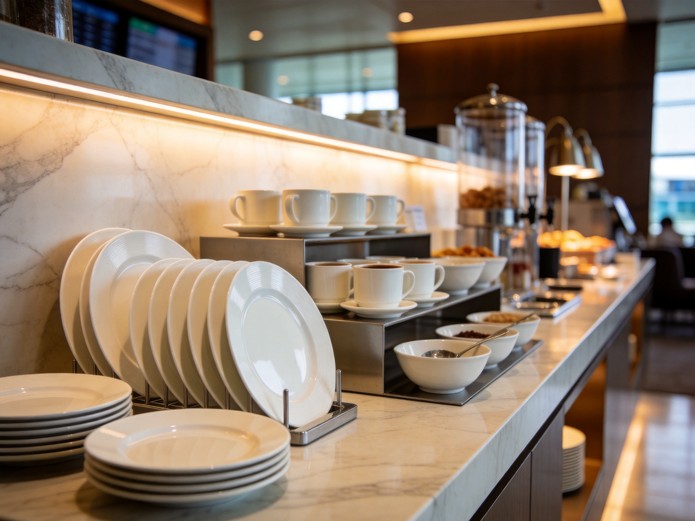
Airport lounge ceramic tableware sits at a unique intersection between hospitality durability and brand prestige. Unlike standard restaurant dinnerware, lounge ceramics must survive rapid dishwasher cycles, compact galley-style storage, and frequent handling by travelers who may not treat pieces gently. The right sourcing decision can cut replacement costs by 30-40% over a three-year cycle while preserving the premium atmosphere that justifies lounge access fees. This guide is written for airline procurement teams, lounge operators, and aviation F&B managers who need hard specs, not generic advice. We cover material selection, stackability requirements, quality checkpoints, and the cost-per-use calculations that determine whether your budget goes toward durable stock or endless replacements.
What Makes Lounge Tableware Different from Restaurant or In-Flight Ware
Restaurant ceramics are designed for table service with moderate turnover. In-flight ware is built around extreme weight limits and single-use efficiency. Lounge tableware borrows from both worlds but adds its own constraints:
- High turnover with short seat times: Business lounge guests often eat within 20-30 minutes, meaning dishes return to the dish pit faster than in a sit-down restaurant.
- Compact storage behind counters: Most lounges lack full-size commercial kitchens. Stackability and uniform dimensions matter more than in standalone restaurants.
- Brand alignment pressure: Premium carriers expect lounge F&B to reflect cabin service standards. A chipped rim on a lounge plate can undermine a first-class brand promise.
- Cart transport risk: Dishes move from central prep areas to multiple serving stations on wheeled carts. Vibration and stacking pressure create edge-chipping risks that restaurant ceramics rarely face.
These factors mean lounge buyers should prioritize chip resistance and stackability over decorative complexity. A reactive glaze that looks stunning on a showroom shelf may wear unevenly under industrial dishwasher detergent and 200+ cycles per week. Temperature swings are another overlooked risk: plates move from a 65°C hot-holding cabinet to a chilled salad counter within minutes. Ceramics with low thermal shock resistance will craze or crack under this stress, particularly in lounges that serve both hot breakfast buffets and cold all-day options from the same counter setup.
Key Specs Airport Lounge Buyers Should Request
When requesting quotes from ceramic suppliers, include these specifications in your RFQ. Omitting them leads to samples that look acceptable in a photo but fail in daily operations.
- Edge chip resistance: Request ASTM C368 or equivalent impact test data. [VERIFY BEFORE PUBLISHING] Standard restaurant porcelain often scores 0.4-0.6 J on edge impact; lounge-grade ware should target 0.8 J or higher.
- Stack height limit: Specify maximum safe stack height (typically 12-16 pieces for plates, 20-24 for cups). Ask for supplier stacking test documentation.
- Dishwasher cycle rating: Commercial dishwasher detergent is harsher than domestic. Request fade resistance data after 500+ industrial cycles.
- Base flatness tolerance: A warped base causes wobbling on tray tables and cart surfaces. Specify +/- 1.0 mm flatness for plates over 200 mm diameter.
- Thermal shock resistance: Lounge food holding often involves hot-holding cabinets. Request thermal shock data from room temperature to 140°C per ASTM C1525.
[INTERNAL DATA REQUIRED: Insert specific thermal shock and impact test results from your current or target supplier.]
Material and Glaze Choices: Cost, Quality, and Turnover Trade-Offs
Not all ceramics perform equally in lounge environments. The material choice determines replacement frequency, which in turn drives total cost of ownership.
Porcelain remains the default for premium lounges. It offers the cleanest surface for branding decals and transfers, and its white body accepts custom underglaze colors well. The trade-off is lower impact resistance compared to stoneware. A 280 mm porcelain dinner plate in a high-traffic lounge may need replacement every 18-24 months.
Stoneware is increasingly popular in contract lounges and mid-tier airline clubs. It is denser, absorbs less water, and withstands edge impact better. The downside is weight—stoneware plates run 15-25% heavier than equivalent porcelain, which increases cart load and staff fatigue during restocking.
Bone china is rarely suitable for self-service lounge buffets. Its translucency and lightness are prized in first-class cabin service, but the lower wall thickness makes it vulnerable to chipping in high-turnover buffet lines. Bone china works best in staffed lounge dining rooms where handling is controlled.
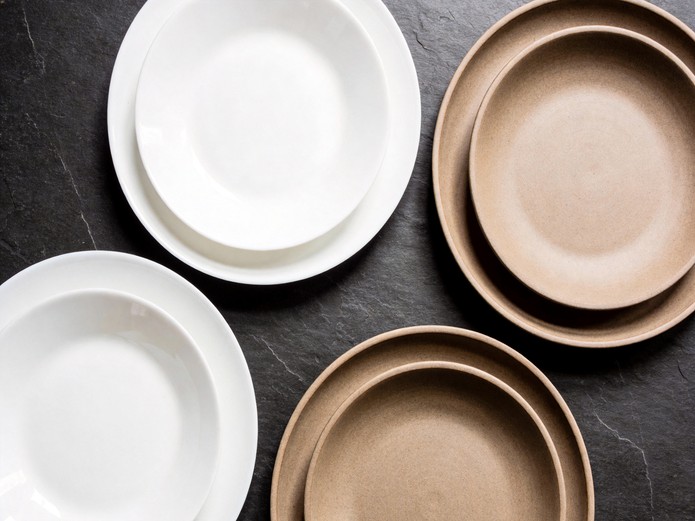
Procurement Decision Table: Porcelain vs Stoneware vs Bone China for Lounges
| Criteria | Porcelain | Stoneware | Bone China |
|---|---|---|---|
| Best for lounge type | Premium airline lounges, flagship clubs | Contract lounges, mid-tier clubs, high-turnover buffets | Staffed dining rooms, first-class annexes |
| Impact resistance | Moderate (0.4-0.6 J) | High (0.7-1.0 J) | Low (0.2-0.4 J) |
| Weight (280 mm plate) | 450-550 g | 520-680 g | 350-420 g |
| Dishwasher fade (500 cycles) | Minimal with quality glaze | Excellent | Minimal but scratches show easily |
| Custom branding ease | Excellent | Good | Excellent |
| Typical lifespan in lounge use | 18-24 months | 30-42 months | 12-18 months (buffet) / 36+ months (dining room) |
| Approximate unit cost (FOB) | $2.80-4.50 | $2.20-3.80 | $4.50-7.00 |
| Stackability | Good (12-16 pcs) | Good (12-16 pcs) | Poor (6-10 pcs) |
The cost-per-use calculation favors stoneware for contract lounges with tight budgets, while porcelain wins in flagship locations where brand presentation justifies higher replacement costs. Bone china should be reserved for controlled-service areas only.
Quality Checklist for Incoming Lounge Tableware Shipments
Use this checklist during pre-shipment inspection or upon container receipt. Mark each item pass/fail and photograph defects for supplier records.
- Visual surface check: No pinholes, bubbles, or glaze crawls exceeding 2 mm on the food-contact surface.
- Edge inspection: Run a fingertip along the rim of every 10th piece. Chips, rough spots, or thin glaze at the edge are rejection criteria.
- Flatness test: Place plate on a level glass surface. No rocking or visible gap greater than 1.0 mm under any edge.
- Stacking test: Stack 16 identical plates. The stack must remain stable when pushed lightly from the side. No piece should stick or bind.
- Decal alignment: If branded, check logo position tolerance +/- 2 mm from specification. Color delta E should not exceed 3.0 against approved sample.
- Base marking: Every piece should carry the manufacturer’s backstamp or your private label marking. Missing marks suggest mixed-source production.
- Dimensional tolerance: Diameter variance within +/- 3 mm of stated size. Height variance within +/- 2 mm.
- Water absorption test: Weigh a dry piece, soak 24 hours, re-weigh. Weight gain should be under 0.5% for vitrified porcelain or stoneware.
[CERTIFICATE REQUIRED: Attach supplier-provided ASTM or ISO test certificates to this checklist for each shipment.]
Three Common Mistakes When Sourcing Lounge Ceramics
1. Prioritizing Aesthetics Over Stackability
A scalloped rim or asymmetric shape may look distinctive in a supplier catalog, but it reduces safe stack height by 30-50%. In a lounge with 2.5-meter-high storage shelving, that translates to 40% more shelf space per SKU. Always test stackability with the actual piece before approving molds.
2. Ignoring Cart Transport Vibration
Most buyers test durability by dropping a plate on tile. Few test what happens when 30 plates rattle against each other on a cart rolling over expansion joints for 200 meters. The edge-to-edge contact during transport causes micro-chipping that accelerates failure. Request suppliers to wrap plate edges with non-abrasive foam separators, or invest in cart inserts with individual slots.
3. Ordering Mixed Glaze Finishes Within the Same SKU
Some buyers order half matte and half glossy plates to create visual variety. This doubles your QC workload because matte and glossy glazes have different defect signatures, different cleaning requirements, and different fade behaviors under dishwasher detergent. A single uniform glaze simplifies staff training, replacement ordering, and supplier QC.
Actionable Sourcing Tips for Aviation F&B Teams
These recommendations come from procurement patterns observed across premium and contract lounge operators. Adapt them to your specific contract terms and volume.
- Order 15% spare capacity in the first PO: Lounge tableware suffers higher breakage in months 1-3 as staff learn proper handling. A 15% buffer prevents stockouts while you calibrate actual replacement rates.
- Negotiate a 24-month price lock: Ceramic raw material prices fluctuate with fuel and mineral costs. Locking pricing for two purchase cycles protects your budget and simplifies reordering.
- Request a dishwasher fade test before mass production: Send your actual detergent brand and cycle parameters to the supplier. Ask for a 500-cycle fade report on the exact glaze and color you plan to order. [VERIFY BEFORE PUBLISHING] This test is not standardized across suppliers, so compare results against your own benchmark sample rather than absolute scores.
MOQ, Lead Time, and Packaging Considerations
Most lounge operators do not need the volumes that justify full container loads. This creates a sourcing challenge: you need restaurant-grade durability with smaller lot sizes.
MOQ realities: Custom shapes and branded decals typically require 500-1,000 pieces per SKU. For a lounge running 8 plate sizes plus cups and bowls, that is 8,000-12,000 pieces minimum. If your budget or storage cannot absorb that, consider these alternatives:
- Start with supplier stock shapes and add branding via post-firing decal. MOQ drops to 200-300 pieces.
- Partner with a supplier already serving other aviation clients. Shared tooling costs lower your entry threshold.
- Negotiate a staggered delivery: 40% at month 1, 30% at month 4, 30% at month 8. This spreads cash flow and reduces storage pressure.
Lead time: Standard production runs 45-60 days after sample approval. Custom molds add 20-30 days. Branded decal production adds 10-15 days. Plan 90-105 days total from PO to delivery for first-time orders.
Packaging: Lounge ceramics need tighter inner packing than restaurant ware because cart transport introduces vibration damage. Request individual PE foam sleeves for plates, and corrugated dividers for cups. Outer cartons should not exceed 18 kg per box to comply with most airport receiving dock weight limits. [VERIFY BEFORE PUBLISHING]
Get the Hotel Dinnerware Catalogue
If you are specifying ceramic tableware for a new lounge fit-out or a refresh cycle, start with a physical sample comparison. Our catalogue includes stackability data, impact test results, and dishwasher fade ratings for each piece. Request samples and a production schedule estimate tailored to your lounge’s turnover and brand standards.
Frequently Asked Questions
How often should airport lounges replace ceramic tableware?
High-traffic contract lounges typically replace stoneware every 30-42 months and porcelain every 18-24 months. Premium flagship lounges with lighter turnover may extend porcelain to 30 months. Monitor edge chipping rates monthly; when more than 5% of active stock shows visible rim damage, plan a replacement order.
Can lounge ceramics carry airline branding?
Yes. Underglaze decal and post-firing transfer are both viable. Underglaze offers better dishwasher durability but limits color range. Post-firing transfer allows full-color logos but may fade after 300-400 industrial cycles. Most carriers choose underglaze for core marks and post-firing for promotional seasonal designs.
What plate sizes work best for lounge buffets?
A three-size system covers 90% of lounge buffet needs: 210 mm salad plates, 270 mm dinner plates, and 160 mm bread or dessert plates. Avoid oversized platters unless your lounge offers full plated service; buffet guests prefer manageable pieces that fit on compact tray tables.
Is bone china ever appropriate for lounge use?
Bone china works in staffed dining rooms within first-class lounges where plates are carried by attendants rather than placed on buffet lines. For self-service areas, stoneware or reinforced porcelain is the safer investment. The cost-per-use math rarely favors bone china in high-turnover environments.
How do I calculate total cost of ownership for lounge ceramics?
Divide the landed unit cost by the expected number of uses before replacement. A $3.50 porcelain plate lasting 20 months at 150 uses per week delivers a cost-per-use of roughly $0.0015. Add storage, breakage replacement, and dishwasher detergent costs for a full picture. If your finance team requires a formal TCO model, request a spreadsheet template from your supplier or build one tracking unit cost, lifespan, replacement rate, and storage cost per SKU.
What certifications should lounge ceramic suppliers hold?
Request FDA 21 CFR 175.300 compliance for US lounges and EU 1935/2004 plus EC 84/500 for European operations. [VERIFY BEFORE PUBLISHING] SGS or Intertek test reports for lead and cadmium migration are standard. If your lounge operates under a specific airline’s quality program, confirm the supplier can meet those additional audit requirements before sampling.
Related Reading
For more on hospitality ceramic sourcing, explore our guides on hotel and restaurant ceramic tableware, fast-casual chain sourcing, and fine dining ceramic selection. If you are comparing materials, our ceramic vs melamine vs glass cost-per-use analysis provides side-by-side durability and lifetime cost data. For procurement planning, see our ceramic tableware reorder strategy.
Need a custom shape or branded decal for your lounge refresh? Our OEM/ODM services cover mold development, underglaze color matching, and quality inspection. Contact our team to discuss your specifications and timeline.