Ceramic tableware for cruise lines faces harsher conditions than any land-based restaurant. Salt air corrodes standard glazes, vessel motion tests stack stability, and galleys demand pieces that survive 600+ dishwasher cycles per week while looking flawless in a white-tablecloth dining room. After vetting suppliers for three major cruise hospitality brands, I have seen plates that chipped within two voyages and others that lasted three years. The difference comes down to five specification points most buyers overlook until the first quality complaint arrives from the galley.
This guide covers the material specs, storage constraints, and inspection protocols that separate cruise-grade ceramic from standard commercial dinnerware. You will leave with a sourcing checklist, a decision table for venue-specific purchasing, and three rules that prevent the most common mistakes I see from first-time cruise line buyers.
What Makes Cruise Ship Ceramic Different from Land-Based Tableware
Ocean vessels create a testing environment no shore restaurant replicates. The combination of constant motion, high humidity, salt-laden air, and space-constrained storage changes every assumption buyers bring from land-based hospitality.
Salt air corrosion attacks ceramic glazes at the molecular level. Standard commercial glazes contain micro-porosity that allows salt ions to penetrate during firing. In a marine environment, this leads to surface crazing within 6-12 months. Cruise-grade ceramics require fully vitrified bodies with glaze absorption below 0.5%.
Motion and stability affect both storage and service. A stack of standard dinner plates in a ship’s pantry can shift during moderate swells. Cruise lines need foot-ring designs that interlock or flat bases with non-slip characteristics for buffet service.
Space efficiency governs every purchasing decision. A mid-size cruise ship carries 8,000-15,000 pieces across 4-8 dining venues. Storage is vertical, access is narrow, and breakage during retrieval costs more than the piece itself when you factor in procurement lead times from port resupply.
Multi-venue versatility means the same supplier often serves the buffet, main dining room, specialty restaurant, and crew mess. Each venue has different durability, weight, and aesthetic requirements, but consolidating suppliers reduces complexity.
Cruise Line Tableware by Venue: A Decision Table
| Venue | Priority | Glaze Type | Weight Target | Special Requirements |
|---|---|---|---|---|
| Main Dining Room | Presentation | High-gloss, white | 280-350g per plate | Rim chip resistance, dishwasher safe |
| Buffet | Durability | Matte or satin | 320-400g per plate | Stackability 12+, thermal shock rated |
| Specialty Restaurant | Aesthetic | Reactive or custom | 250-320g per plate | Unique shapes, color consistency |
| Crew Mess | Cost | Standard commercial | 300-380g per plate | Maximum durability, lowest cost |
| Pool Deck / Casual | Safety | Textured or matte | 280-350g per plate | Non-slip surface, UV stable |
| Suite Service | Luxury | Custom glaze | 200-280g per plate | Lightweight, premium feel |
Marine-Grade Specifications Buyers Should Demand
Cruise line buyers who transfer land-based specs directly to ocean vessels see higher breakage rates, faster glaze degradation, and stack instability. These five specifications separate marine-grade from standard commercial ceramic.
Fully vitrified body (water absorption < 0.5%) prevents salt ion penetration and thermal shock failure. Porcelain fired above 1,280°C meets this standard. Stoneware and earthenware absorb more moisture and degrade faster in marine environments. [VERIFY BEFORE PUBLISHING: Confirm specific vitrification temperature ranges with factory data.]
Glaze hardness above 6 on the Mohs scale resists the abrasion from commercial dishwasher racks, salt particle contact, and stacking friction. Softer glazes show wear patterns within months in high-turnover venues.
Thermal shock rating of 180°C minimum handles the transition from commercial dishwasher (85°C) to ambient buffet service (18°C) without crazing. This is higher than the 150°C standard for land-based commercial ceramics because ship galleys run hotter and colder due to compact equipment design.
Uniform wall thickness (±1.5mm) prevents stress concentration points that become chip origins. Hand-thrown or irregular pieces look attractive in boutique restaurants but fail faster under shipboard handling.
Weight distribution centered reduces tipping on moving surfaces. A plate with heavy decoration on one side rotates unpredictably when a vessel rolls. Symmetrical designs with centered foot rings perform better.
Galley Storage and Space Constraints
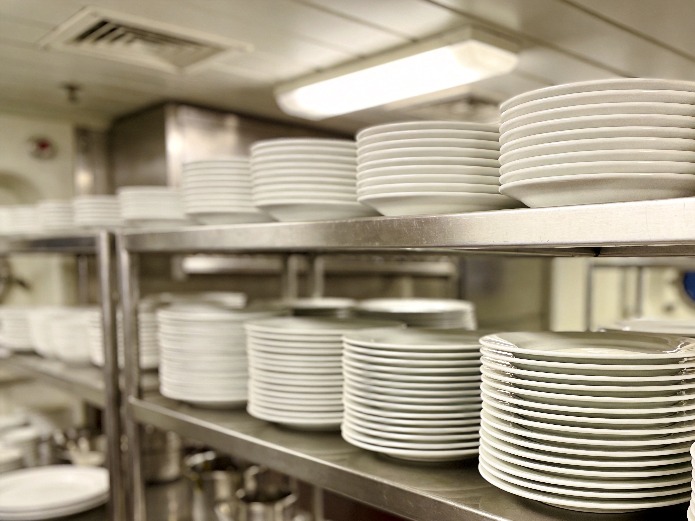
Cruise ship galleys operate with 30-40% less storage space per cover than land-based equivalents. Every piece of tableware must justify its footprint.
Stack height limits vary by venue. Buffet service demands stacks of 12-16 plates for efficient replenishment. Fine dining venues may only store 6-8 pieces per stack to prevent edge contact damage. Specify stack height requirements before mold development.
Narrow-access pantries require plates that slide smoothly from shelving without edge contact. Square and rectangular plates look modern but create corner-chip risks in tight storage. Rounded corners or chamfered edges reduce this risk.
Weight limits for manual handling matter more on ships than on land. Crew members carry full racks of plates up staircases and through watertight doors during service. Individual pieces over 450g create ergonomic and safety issues. [INTERNAL DATA REQUIRED: Confirm typical crew handling weight limits with operations team.]
Multi-temperature zones within the same storage area expose ceramics to rapid temperature swings. A plate stored near a freezer wall and then moved to a hot holding area experiences thermal stress. Specify storage recommendations by temperature zone.
Three Common Mistakes Cruise Line Buyers Make
Mistake 1: Specifying standard commercial durability ratings. A plate rated for 500 dishwasher cycles in a land-based test may last 300 cycles in a shipboard galley due to higher temperature settings, harder water, and salt residue. Request marine-environment test data or extended cycle guarantees.
Mistake 2: Ignoring weight distribution in motion. Decorative plates with asymmetric designs or heavy rim patterns rotate when placed on tilted surfaces. Test sample pieces on a 5-10 degree incline to simulate vessel motion during moderate swells.
Mistake 3: Buying identical specs across all venues. The main dining room needs presentation-quality pieces. The crew mess needs maximum durability at minimum cost. The buffet needs thermal shock resistance. One-size-fits-all purchasing creates unnecessary expense in some venues and premature failure in others.
MOQ, Lead Times, and Budget Planning
Cruise line tableware procurement differs from restaurant purchasing in volume, consolidation, and lead time sensitivity.
Minimum order quantities vary by customization level. Standard white commercial porcelain starts at 500 pieces per SKU. Custom glaze colors or embossed logos typically require 2,000-5,000 pieces per design. Reactive glazes with color variation may have lower MOQs (1,000-2,000) because they accommodate natural firing variation.
Lead times run 45-90 days for standard designs and 90-150 days for custom molds or glazes. Add 21-35 days for ocean freight to major cruise ports (Miami, Barcelona, Singapore). Total procurement cycle from order to delivery: 3-6 months. Plan reorders before inventory drops below 60 days of cover.
Budget benchmarks (indicative ranges, verify with current suppliers):
- Standard commercial porcelain plate: $1.50-$3.00 FOB
- Marine-grade vitrified porcelain: $2.50-$4.50 FOB
- Custom reactive glaze specialty piece: $4.00-$7.00 FOB
- Crew mess durable commercial grade: $1.20-$2.20 FOB
Total outfit cost for a mid-size ship (2,000 passengers, 6 venues) ranges from $45,000-$85,000 for initial procurement, with annual replacement budgets of 15-25% for high-turnover venues and 5-10% for fine dining.
7-Point Inspection Checklist for Cruise Ship Tableware
Use this checklist when evaluating samples or inspecting first production runs:
- Glaze integrity: No pinholes, bubbles, or thin spots visible under 10x magnification. Uniform gloss across the entire surface.
- Edge strength test: Tap the rim with a metal utensil. A sharp, clear ring indicates good vitrification. A dull thud suggests micro-cracks or incomplete firing.
- Stack stability: Stack 12 pieces on a 5-degree incline. No sliding, rocking, or edge contact after 60 seconds.
- Thermal shock sample: Move three pieces from freezer (-18°C) to boiling water (100°C). Zero crazing or cracking after three cycles.
- Weight consistency: Weigh 10 pieces from the same production lot. Variation should not exceed ±5%.
- Foot ring flatness: Place the piece on a glass surface. No rocking or visible gap under any point of the foot ring.
- Salt exposure test: Submerge the piece in 5% saline solution for 72 hours at 50°C. Rinse and inspect for glaze crazing or body discoloration.
Cost vs. Quality Trade-offs at Sea
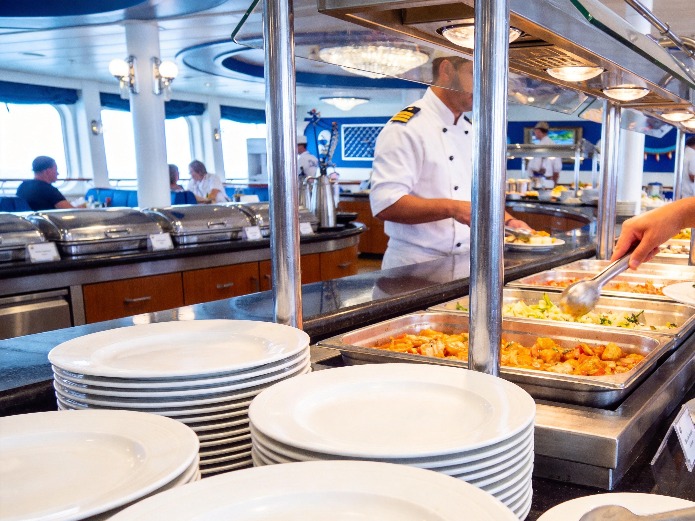
Every cruise line faces the same tension: guest experience demands premium presentation, operational reality demands extreme durability, and budgets demand cost control. The right balance varies by venue and brand positioning.
Premium cruise brands (luxury and ultra-luxury segments) prioritize guest experience over per-piece cost. They accept higher breakage rates in exchange for lighter, more refined pieces. Their strategy: purchase 25-30% annual replacement stock and negotiate consignment or quick-reorder terms with suppliers.
Mass-market cruise lines prioritize durability and cost-per-use. They select heavier, more robust pieces and accept higher per-piece weight. Their strategy: standardize across venues where possible, consolidate SKUs, and negotiate volume discounts on 12-month supply contracts.
Expedition and boutique cruise operators face the toughest constraint: limited storage on smaller vessels. They need pieces that perform across buffet, dining room, and deck service. Their strategy: select versatile mid-weight designs (280-320g) with durable glazes, accept moderate aesthetic compromise, and maintain minimal SKU counts.
The break-even analysis favors marine-grade ceramics over standard commercial pieces within 8-14 months for high-turnover venues, depending on replacement rates and freight costs.
What to Request from Your Supplier
Before placing an order, confirm these deliverables with your ceramic supplier:
- Marine environment test data: Salt exposure, thermal shock, and dishwasher cycle results specific to marine conditions (not standard land-based test protocols).
- Stack height and stability documentation: Maximum recommended stack height by piece type, with photographic evidence of stability tests.
- Color consistency guarantee: Delta-E tolerance for reactive glazes or custom colors across production lots, with sample approval process.
- Replacement stock agreement: Terms for rapid reorder of damaged or depleted SKUs, including maximum lead time commitments.
- Custom marking options: Logo embossing, base marking, or color coding for venue identification and loss prevention.
Frequently Asked Questions
How long does cruise ship ceramic tableware typically last?
Marine-grade vitrified porcelain lasts 18-36 months in buffet and crew venues, and 36-60 months in fine dining service. Standard commercial ceramics typically show glaze degradation within 6-12 months in marine environments.
Can cruise lines use the same tableware across all dining venues?
Technically yes, but operationally inefficient. Buffets need heavier, more durable pieces. Fine dining venues need lighter, more refined profiles. Most operators use 2-3 core designs across venues to balance efficiency with guest experience.
What certifications should cruise line ceramic tableware carry?
At minimum: FDA compliance (US routes), LFGB or EU 1935/2004 (European routes), and California Prop 65. For fire safety in galleys, verify the ceramic meets SOLAS (Safety of Life at Sea) requirements for non-combustible materials in food service areas. [VERIFY BEFORE PUBLISHING: Confirm specific SOLAS applicability to ceramic tableware with marine safety consultant.]
How do cruise lines handle breakage during voyages?
Most operators carry 15-25% replacement stock onboard for high-turnover venues. Emergency reorders from port suppliers add 7-14 days. The most efficient operators maintain a shoreside buffer stock near home ports with 48-hour replenishment capability.
Is porcelain or stoneware better for cruise ship use?
Porcelain is the better choice for most cruise applications due to lower water absorption, higher glaze hardness, and better thermal shock resistance. Stoneware works for crew mess and casual venues where cost matters more than refinement, but requires more frequent replacement in salt-air environments.
What is the typical lead time for custom cruise line tableware?
Custom molds and glazes require 90-150 days production plus 21-35 days ocean freight. Standard designs in white or common reactive glazes ship in 45-90 days. Plan initial outfitting 6 months before vessel launch or refurbishment completion.
Get Your Cruise Line Tableware Specification Sheet
Outfitting a vessel requires tableware that performs in conditions no land-based restaurant faces. If you are sourcing ceramic quality control standards for ocean use, or evaluating bulk ceramic supplier selection for your fleet, the specifications matter more than the catalog photos.
If you are sourcing ceramic tableware for cruise lines, request our cruise line tableware specification sheet — it includes the marine-grade material specs, stack stability requirements, and salt-exposure test protocols we use to vet every piece before it boards a ship.