Building a private label ceramic tableware brand from China is one of the most cost-effective ways to enter the hospitality or home goods market with products that carry your name. Most buyers who succeed treat it as a structured project — not a one-time order. This guide breaks the process into five phases, with realistic budgets, decision frameworks, and the specific pitfalls that catch first-time brand owners.
By the end, you will know how to select a manufacturer capable of private label work, structure a design workflow that protects your IP, budget for a minimum viable launch, and avoid the compliance mistakes that delay shipments by months. If you are also exploring customization options for logo and color, read that guide alongside this one.
Phase 1: Define Your Brand Position and Product Mix
Before contacting any supplier, lock in three decisions: who you are selling to, what problem your line solves, and how many SKUs you need for a credible launch.
Most successful private label launches start with 8–15 SKUs, not 50. A focused collection is easier to photograph, stock, and market. Decide whether your angle is durability for commercial kitchens, artisan aesthetics for boutique hotels, or cost efficiency for chain restaurants. Each path leads to different clay bodies, glaze specifications, and packaging requirements.
Key decisions at this stage:
- Target segment: Commercial hospitality, retail home goods, or corporate gifting
- Price positioning: Budget, mid-market, or premium (affects clay type, decoration method, and packaging)
- Geographic market: US, EU, or both (determines required certifications)
- Launch SKUs: Dinner plates, salad plates, bowls, mugs, and one signature piece
Phase 2: Find and Vet a Private Label Manufacturer
Not every ceramic factory accepts private label work. Some specialize in OEM production for large brands and will not touch small runs. Others lack the design support or decoration capabilities to execute branded packaging and custom glazes.
Look for manufacturers who explicitly offer private label or white label services. During vetting, ask these specific questions:
- What is your minimum order per SKU for private label? (Typical range: 500–3,000 pieces)
- Can you produce custom Pantone-matched glazes, or do you work from a standard color library?
- Do you offer in-house decal printing, laser etching, or embossed logo application?
- Can you source and print branded packaging (retail boxes, insert cards, barcode labels)?
- What is your sample lead time for new private label designs?
Request samples of their existing private label work. Examine logo crispness, glaze consistency across pieces, and packaging finish. A factory that sends sloppy samples will deliver sloppy production. For a deeper look at evaluating manufacturers, see our ceramic sample evaluation guide.
Phase 3: Design Workflow — From Concept to Production Sample
The design workflow is where most first-time brand builders lose time. A structured handoff prevents revisions that add weeks to the timeline.
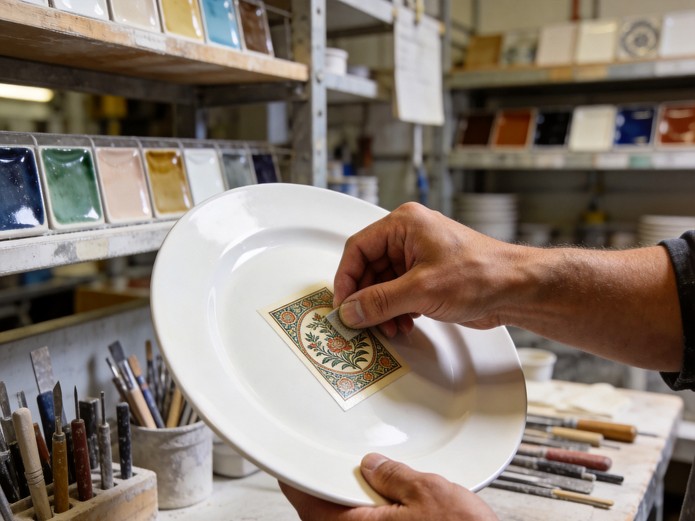
Week 1–2: Design brief. Submit vector artwork for logos, Pantone codes for colors, and dimensional drawings or reference photos for shapes. Specify placement: centered on the base, offset on the rim, or embossed into the foot ring.
Week 3–4: Mold and decal preparation. The factory creates silk screens or decal films and, if needed, a new plaster mold for custom shapes. Confirm that you own the mold — some factories charge a mold fee but retain ownership, locking you into repeat orders with them.
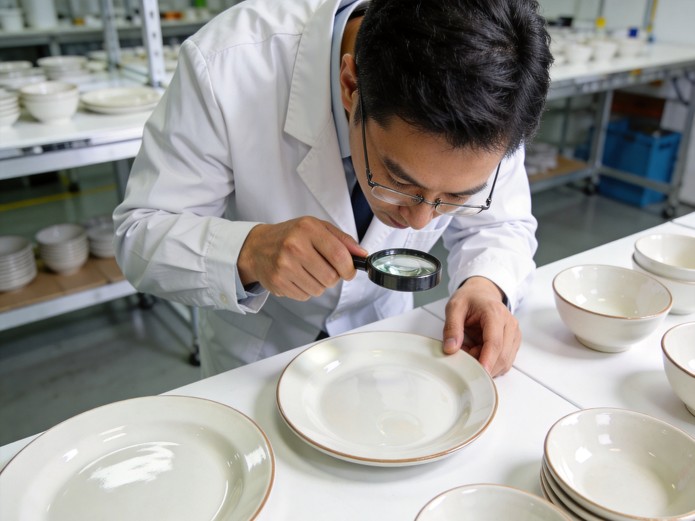
Week 5–6: Pre-production samples. Evaluate at least two samples per SKU. Check logo alignment under magnification, glaze coverage on edges, and weight consistency. A 5% weight variance between plates in the same SKU is normal; more than 8% signals kiln temperature control issues.
Week 7: Sample approval. Approve in writing, with photos, and specify any final adjustments. Do not approve verbally.
Phase 4: Regulatory Requirements and Compliance Prep
Your brand name goes on the product. That means your compliance responsibility, not the factory’s.
For the US market, ceramic tableware must comply with FDA 21 CFR 175.300 (indirect food contact coatings) and California Proposition 65 for lead and cadmium. [VERIFY BEFORE PUBLISHING: Confirm current FDA extractable lead limits via FDA.gov or consult a compliance specialist.] For the EU market, Regulation (EC) No 1935/2004 and the Ceramic Directive 84/500/EEC set the framework, with EN 1388 as the referenced test method. [VERIFY BEFORE PUBLISHING]
Most private label buyers commission third-party testing through SGS, Intertek, or Bureau Veritas. Budget $400–800 per SKU for a full heavy metals and food contact safety panel. Factor this into your launch budget before you place the production order. Our certification standards guide covers the full testing landscape.
If your packaging includes claims like “microwave safe” or “dishwasher safe,” those must be supportable by test data. Unsupported claims create liability exposure.
Phase 5: Budgeting and Order Planning
Use this framework to estimate your first private label launch budget. All figures are ranges based on typical China sourcing conditions for a 10-SKU launch:
| Cost Item | Range (USD) | Notes |
|---|---|---|
| Mold fees (custom shapes) | $300–1,500 per mold | One-time; confirm ownership |
| Decal / screen setup | $100–300 per design | Reusable for reorders |
| Pre-production samples | $200–500 total | Air freight included |
| Production (10 SKUs x 1,000 pcs) | $8,000–18,000 | Varies by clay, glaze, decoration |
| Third-party testing | $4,000–8,000 | $400–800 per SKU |
| Branded packaging | $1,500–4,000 | Boxes, inserts, labels |
| Shipping (FOB to port) | $2,000–5,000 | 20-foot container typical |
| Total first launch | $16,000–37,300 | Excludes customs duties and inland freight |
Trade-off to understand: ordering 3,000 pieces per SKU instead of 1,000 typically drops unit cost by 15–25%, but ties up more capital and warehouse space. For a first launch, 1,000 pieces per SKU is the safer position unless you have confirmed pre-orders. Read our MOQ strategy guide for negotiation tactics.
Common Mistakes First-Time Brand Builders Make
These three errors appear repeatedly in projects I review:
1. Skipping the sample-to-sample comparison
Buyers approve a single pre-production sample, then discover on arrival that production pieces vary in weight, glaze tone, or logo position. Always request two samples minimum and compare them side by side before approval.
2. Treating packaging as an afterthought
Branded packaging often takes longer to produce than the ceramics themselves. Carton printing, insert card design, and barcode generation need 2–3 weeks. If you finalize packaging after production starts, your shipment sits waiting for boxes. Plan packaging design in parallel with sampling. Our packaging and shipping guide covers export-ready specifications.
3. Ignoring mold ownership terms
Some factories include mold fees in the unit price but retain ownership, effectively locking you in. Negotiate mold ownership upfront. Get it in writing. If the relationship ends, you should be able to move the mold to another facility.
Private Label Launch Checklist
Use this checklist to track your launch progress. Save or print it.
- ☐ Brand positioning document completed (target market, price tier, 8–15 SKUs)
- ☐ Logo files prepared in vector format (AI/EPS/PDF) with specified Pantone codes
- ☐ Manufacturer vetted: private label MOQ confirmed, sample quality evaluated
- ☐ Mold ownership terms agreed in writing
- ☐ Design brief submitted with dimensional specs and decoration placement
- ☐ Two pre-production samples received and compared
- ☐ Sample approved in writing with photos
- ☐ Compliance testing commissioned (FDA / Prop 65 / EU as applicable)
- ☐ Branded packaging designed and production scheduled
- ☐ Production order placed with 30% deposit standard
- ☐ Third-party pre-shipment inspection booked
- ☐ Shipping terms confirmed (FOB, CIF, or DDP)
- ☐ Customs documentation prepared (commercial invoice, packing list, CO if needed)
Frequently Asked Questions
How long does a private label ceramic launch take from first contact to delivery?
Realistically, 14–20 weeks. Design and sampling take 6–8 weeks. Production and decoration add 4–6 weeks. Shipping and customs clearance take 3–4 weeks. Rush timelines compress sampling but increase revision risk. For a detailed breakdown, see our production lead time guide.
Can I start with just one SKU?
Most private label manufacturers require a minimum total order value rather than a per-SKU minimum. A single SKU at 3,000–5,000 pieces may satisfy their threshold, but a multi-SKU launch spreads fixed costs across more products and creates a more credible brand presence.
Do I need to register a trademark before production?
You do not need a registered trademark to manufacture, but you should have one before selling in most markets. Trademark registration in your target countries protects against copycats and is often required by major retail partners. Start the application during the sampling phase so it processes while production runs.
What happens if production quality does not match the approved sample?
Your purchase agreement should define acceptable quality variance and include a right to reject non-conforming goods. Pre-shipment inspection by a third party (SGS, Bureau Veritas, or a local QC firm) is the standard safeguard. Build this cost — typically $300–500 per container — into your budget.
Should I visit the factory before placing the order?
For first orders above $15,000, a factory visit is strongly recommended. You verify production capacity, QC processes, and working conditions firsthand. If travel is not feasible, request a live video factory tour and ask to see active production lines, not just showrooms.
Can the factory handle Amazon FBA prep and labeling?
Some can, but most ceramic factories are not set up for FBA-specific prep (polybagging, suffocation warnings, carton labeling). If you sell through Amazon, plan to handle FBA prep at a third-party logistics warehouse after import clearance. Confirm this workflow before you design packaging dimensions.
Ready to Start Your Private Label Brand?
Launching a private label ceramic tableware brand is a multi-phase project, but each phase is manageable with the right supplier and clear documentation. If you have a design concept or logo ready, the next step is a feasibility review to confirm what is technically and economically viable.
Submit your design for feasibility review and we will assess mold requirements, estimated unit costs, and sample lead time for your specific product idea.