Ceramic tableware for wedding rentals must survive transport, industrial washing, and repeated stacking while still looking pristine on a bride’s reception table. After ten years of supplying event rental companies across North America and Europe, we have learned that the plates that fail are rarely the cheapest ones — they are the ones bought without understanding how rental wear differs from restaurant wear. This guide shows you what specifications actually matter, what styles photograph well, and how to calculate whether ceramic makes financial sense for your rental inventory.
Why Rental Companies Still Choose Ceramic Over Disposable
Disposable tableware has improved, but wedding clients paying $150+ per head for catering expect the weight and feel of real dinnerware. Ceramic plates signal quality in a way that compostable alternatives cannot replicate. The decision is not ceramic versus disposable — it is ceramic versus melamine or high-grade resin.
Melamine costs 40-60% less upfront and does not chip. However, it scratches visibly after 30-50 industrial wash cycles, develops a cloudy surface, and cannot withstand oven or warming cabinet temperatures above 70°C. For rental companies offering full-service packages that include food warming, ceramic remains the only practical option. The break-even point depends on your rental frequency: if a plate rents 25+ times per year, ceramic’s longer lifespan offsets the higher purchase price by the second year.
| Factor | Ceramic | Melamine | Disposable |
|---|---|---|---|
| Upfront cost per plate | $2.50-6.00 | $1.20-3.00 | $0.15-0.40 |
| Lifespan (rental cycles) | 150-300+ | 80-150 | 1 |
| Oven safe | Yes (up to 250°C) | No | No |
| Dishwasher safe | Yes | Yes | N/A |
| Client perception | Premium | Mid-range | Budget |
| Weight (transport cost) | Heavy | Light | Very light |
Durability Standards That Separate Rental-Grade from Restaurant-Grade
Rental ceramics endure different stress than restaurant ceramics. A restaurant plate moves from kitchen to table to dishwasher in a fixed location. A rental plate travels in plastic crates, stacks unevenly in vans, and may be scraped by metal serving utensils at off-premise venues. The specifications that matter most are not the ones typically listed on restaurant supply catalogs.
Chip Resistance: The Edge Test
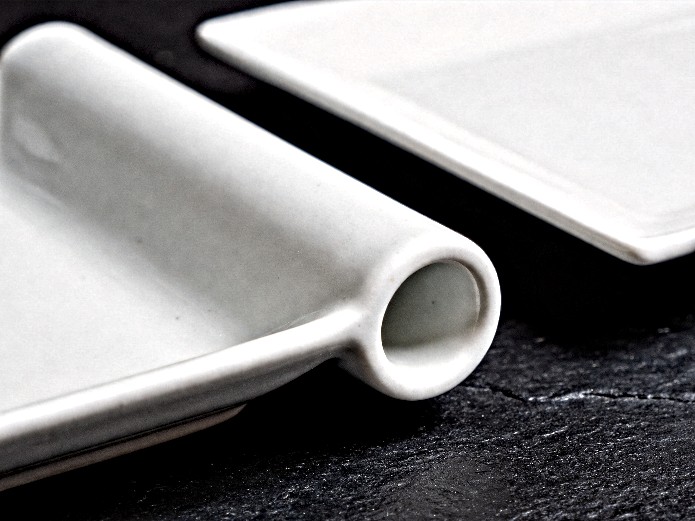
Look for plates with fully vitrified bodies and rolled or beveled edges. A rolled edge — where the rim curves downward and the glaze wraps over the edge — chips 40-60% less than a sharp 90-degree edge during transport. Ask your supplier for the edge chip resistance rating. [VERIFY BEFORE PUBLISHING: Specific test method reference needed — ASTM C368 or equivalent edge impact test data.]
Glaze Hardness: Scratches Show Before Chips
Metal cutlery at wedding receptions causes fine surface scratches that accumulate faster than chips. Request glaze with a Mohs hardness of 5.5 or higher. Most commercial ceramics use glazes rated 5.0-5.5, which scratch visibly within 80-120 rental cycles. A harder glaze adds $0.30-0.80 per plate but extends cosmetic life by 50%.
Thermal Shock: From Warming Cabinet to Cold Room
Catering teams often move plates directly from warming cabinets to refrigerated transport. Standard ceramic withstands temperature swings of 120°C. For rental operations in climates with extreme seasonal variation, specify thermal shock resistance to 150°C. The difference is usually a slightly different clay body composition, not a price increase.
Style Selection: What Photographs Well and Stocks Efficiently
Wedding rental inventory must cover multiple aesthetics without requiring thousands of SKUs. The most successful rental companies we work with stock three core styles that cover 85% of market demand:
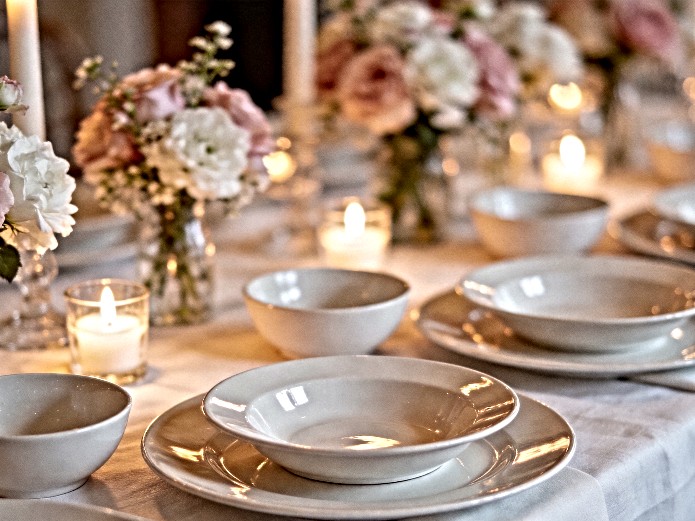
- Classic white coupe: Rounded, rimless profile. Matches every tablescape and photographs consistently under varying lighting. Best-seller for formal and semi-formal events.
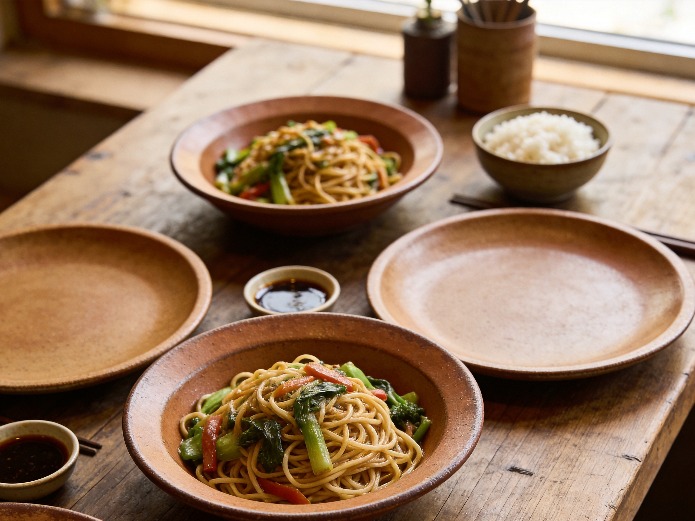
- Textured stone-effect: Matte finish with subtle surface variation. Appeals to rustic, barn, and outdoor wedding themes. Hides minor scratches better than glossy glazes.
- Minimalist rimmed: Thin, defined rim with matte or satin glaze. Bridges modern and traditional aesthetics. Popular for urban loft venues and corporate events.
Avoid heavily patterned or colored glazes for core inventory. They date quickly and limit reuse across different client preferences. If a bride requests a specific color, source it as a special order with a 500-piece minimum rather than stocking it year-round.
MOQ, Lead Times, and Pricing Structures
Most Chinese manufacturers set MOQs at 500-1,000 pieces per item for custom shapes and 300-500 for stock designs. For a rental company building initial inventory, this means a $3,000-8,000 minimum order per style. Here is how to structure your first purchase:
- Round 1 (test market): Order 300 dinner plates, 300 salad plates, and 200 bowls in one style. Total investment: $2,000-3,500. Rent for one season to confirm demand.
- Round 2 (expand): Add a second style and increase quantities of the best-seller. Order 600-800 of the proven item, 300 of the new style.
- Round 3 (optimize): Replace chipped stock and add serving pieces (platters, cake stands) which command higher rental fees per piece.
Lead times run 45-65 days for stock designs and 75-90 days for custom shapes. Plan replenishment orders 90 days before peak wedding season (April-June in North America, September-November in Europe). Rush orders are possible at 20-35% surcharge but limit your color and finish options.
The Hidden Costs: Transport Crates, Cleaning, and Replacement
The purchase price per plate is only 60-70% of your true cost. Factor these into your rental rate calculations:
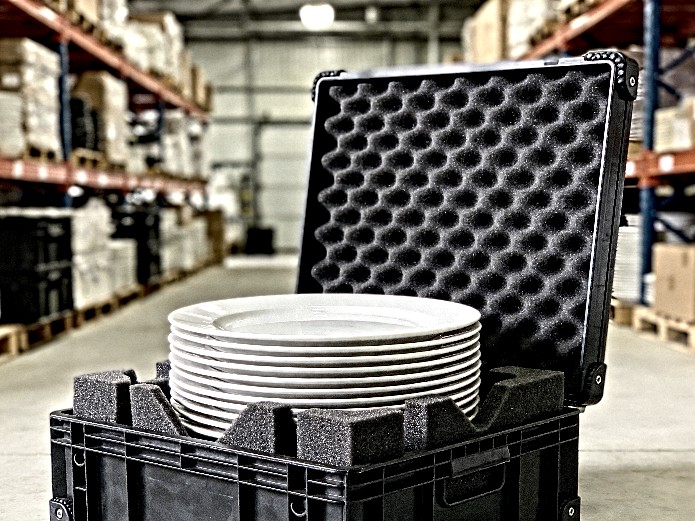
- Transport crates: Custom foam-padded crates cost $45-80 each and hold 40-60 plates. Budget 1 crate per 50 plates. Foam inserts need replacement every 18-24 months.
- Industrial dishwasher detergent: Standard ceramic-safe detergent costs 15-20% more than metal-safe formulas. Using the wrong detergent degrades glaze over 12-18 months.
- Replacement rate: Even rental-grade ceramic loses 3-5% of inventory annually to chips, cracks, and client damage. Price your rental fees to recover replacement cost over 30-40 rentals.
- Storage footprint: Ceramic requires 3-4x the warehouse space of melamine. A 1,000-plate ceramic inventory needs 80-120 square feet of racking versus 25-35 for equivalent melamine.
Three Mistakes That Destroy Rental Ceramic Margins
These are the errors we see most often when rental companies switch from disposable or melamine to ceramic:
Mistake 1: Buying Restaurant Surplus Instead of Rental-Spec
Restaurant liquidation auctions sell ceramic at $0.50-1.50 per plate. The problem: restaurant plates have sharp edges, thin bodies, and soft glazes designed for gentle handling in fixed locations. We have seen rental companies lose 30-40% of auction purchases to transport chips within the first six months. Buy from manufacturers who understand rental logistics.
Mistake 2: Ignoring Stack Height Limits
Stacking ceramic plates more than 12-15 high in transport crates causes micro-cracks in the base glaze. These cracks do not appear immediately but spread after 20-30 dishwasher cycles. Your crates should have internal dividers every 10-12 plates. This adds crate cost but reduces replacement rates by half.
Mistake 3: Pricing Per Piece Instead of Per Place Setting
Clients think in place settings, not individual pieces. A five-piece setting (dinner, salad, bread, bowl, cup) should rent as a bundle at $4.50-7.00 rather than as individual items that clients pick apart. Bundling increases average order value by 40% and reduces piecemeal loss.
Your First Ceramic Rental Order: A Practical Checklist
Use this checklist before placing your first bulk order. Print it or save it for your procurement meeting.
- Confirm glaze hardness rating is 5.5+ on the Mohs scale
- Verify rolled or beveled edge design, not sharp 90-degree rim
- Request thermal shock test data to 150°C minimum
- Order physical samples: 2-3 pieces of each item for edge-drop and dishwasher testing
- Confirm dishwasher-safe certification from supplier (not just assumed)
- Check that stack height of 12 plates does not cause base glaze contact with the plate below
- Verify MOQ, lead time, and whether rush surcharges apply to your timeline
- Request breakage replacement policy: will supplier replace chipped items at cost or full price?
- Calculate true cost per rental cycle including crates, cleaning, storage, and replacement
- Test one style with 300 pieces before committing to a full inventory build-out
Request our wedding rental ceramic catalog with MOQ and pricing by style — we stock rental-spec dinnerware with rolled edges, 5.5+ hardness glaze, and thermal shock ratings suited for transport-intensive event use.
Related Resources for Rental Business Owners
If you are building or expanding a rental tableware inventory, these guides cover the surrounding decisions:
- Browse our wholesale ceramic tableware products to see rental-spec dinnerware styles with rolled edges and 5.5+ hardness glaze.
- Explore OEM and ODM services if you need custom shapes, branded backstamps, or exclusive colors for your rental catalog.
- Read our ceramic vs melamine vs glass cost-per-use analysis for a detailed breakdown of lifetime costs across materials.
- Review the packaging and shipping guide for bulk ceramic orders to minimize transit damage on your first container.
- Use our ceramic quality control checklist when inspecting your first sample shipment.
Frequently Asked Questions
How many times can a rental ceramic plate be used before replacement?
Rental-grade ceramic plates typically last 150-300 rental cycles with proper handling and industrial dishwasher use. The limiting factor is usually cosmetic scratching rather than structural failure. Plates with 5.5+ hardness glaze reach the higher end of this range.
Is ceramic cost-effective compared to melamine for a new rental business?
For rental frequencies above 20 times per year per plate, ceramic becomes cost-effective by year two. Below that frequency, melamine’s lower upfront cost and lighter transport weight produce better margins. Most established rental companies run mixed inventories: ceramic for premium packages and melamine for budget options.
What is the minimum inventory size to serve wedding clients?
A starter inventory of 300 five-piece place settings (1,500 total pieces) covers weddings up to 250 guests with backup for breakage. This requires approximately $8,000-12,000 in ceramic purchases plus $2,000-3,500 in transport crates.
Can rental ceramic go in standard commercial dishwashers?
Yes, but use ceramic-safe detergent and verify your dishwasher’s rinse temperature stays below 85°C. Higher temperatures accelerate glaze crazing. Most rental companies run dedicated ceramic wash cycles separate from metal and glassware.
How do I handle color-matching for client-specific wedding themes?
Color-matched ceramics require 60-90 day lead times and 500+ piece MOQs per color. Most rental companies stock neutral white and cream as base inventory and add colored napkins, chargers, or glassware for theme matching. This reduces inventory risk and increases reuse rates.
What insurance or damage waiver should I charge clients?
Industry standard is 8-12% of the rental total as a damage waiver, or itemized replacement pricing for major breakage. Document pre-event condition with photos. Ceramic damage rates run 2-4% per event for professional caterers and 6-10% for self-service or backyard weddings.