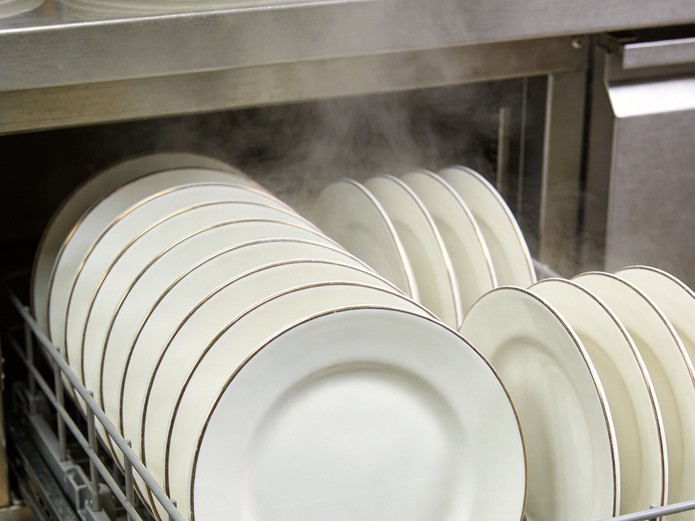
Open stock ceramic tableware sounds like a promise: every piece carries its own SKU, so you can buy one dinner plate this month and eleven more next quarter. It is not a promise about year three.
The term is used loosely. Lenox defines open stock as “any dinnerware that is sold individually” rather than by boxed place-setting count. Wilmax, writing for trade buyers, adds the sentence catalogues leave out: “The open stock does not mean a pattern is available indefinitely… When the dinnerware firm states it will not discontinue a pattern, it means they will make it available only when enough orders have accumulated to make production profitable.”
The SKU is permanent. The ability to remake it is not. What you buy is reorderability, and reorderability is decided by four physical things in the factory, none of which appear on a price list.
What Open Stock Promises – and What It Does Not
Open stock is a sales format, not a manufacturing guarantee. It tells you the supplier will not force you into a 20-piece carton; it says nothing about whether the mould that made your plate survives year three, whether the glaze can be matched, or whether the compliance file is still valid.
For a hotel or restaurant group that gap is expensive, because breakage does not arrive evenly. You lose a few plates a month, then a tray goes down the stairs and you need 36 pieces of one size in one colour to match stock bought two years ago. A set-only pattern forces you to buy a whole box; a pattern that is open stock on paper but unbuildable in practice forces a 3,000-piece run — or a mid-life tabletop rebuy.
So the question for a supplier is not “do you offer open stock”. It is: at what quantity, at what lead time, and under what conditions can you remake this exact piece for the next five years? Four gates answer it.
Gate One: The Working Mould Is a Consumable
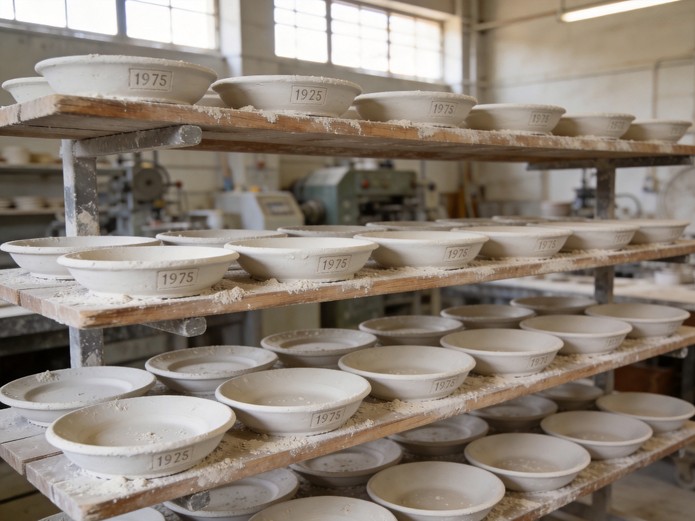
The mould that shapes your plate does not sit on a shelf forever. In conventional porcelain production it is plaster, and it wears out. Holst Porzellan, a German house that publishes its production data, calls the process “mould consumption” and states that with a plaster mould for relief items “the fatigue process begins after around 50 production runs”.
Their published average yields explain why the same drawing costs wildly different amounts at different factories:
| Forming route | Yield per working mould | Sets for 3,000 pcs |
|---|---|---|
| Casting, plaster | 40 – 100 pieces | 30 – 75 |
| Roll-over relief, plaster | 40 – 60 pieces | 50 – 75 |
| Pressing, traditional | 50 – 130 pieces | 23 – 60 |
| Overrolling, plaster | 80 – 150 pieces | 20 – 38 |
| Screwing in, plaster | 60 – 350 pieces | 9 – 50 |
| Pressing, mechanised | 5,000 – 20,000 pieces | under 1 |
| Isostatic pressing | 80,000 – 150,000 pieces | under 1 |
| Forming route | Yield per working mould | Mould sets for 3,000 pieces | |—|—|—| | Casting, plaster | 40 – 100 pieces | 30 – 75 | | Roll-over relief, plaster | 40 – 60 pieces | 50 – 75 | | Pressing, traditional | 50 – 130 pieces | 23 – 60 | | Overrolling, plaster | 80 – 150 pieces | 20 – 38 | | Screwing in, plaster | 60 – 350 pieces | 9 – 50 | | Pressing, mechanised | 5,000 – 20,000 pieces | under 1 | | Isostatic pressing | 80,000 – 150,000 pieces | under 1 (nominal) |
The mould-set column is arithmetic, not a quotation: 3,000 divided by the yield band. A plaster route burns 20 to 75 mould sets to fill one modest order, and someone pays for the plaster, the mould maker’s time and the drying racks. An isostatic press burns a fraction of one.
Gate Two: The Mother Mould Dies of a Different Cause
Working moulds are made from a mother mould, and the mother mould is what lets a factory remake your shape at all. Holst describes hardened stainless master moulds as surviving “many decades if they are stored in a dry place”, and quotes the German trade saying: “The mould stock is the capital of a factory.”
The same page names two ways a sound mother mould becomes worthless, and neither is abrasion: the composition of the raw materials changes, and with it the degree of shrinkage; or the type of moulding machine changes. Either one “quickly renders a master mould worthless”.
A factory that switches body supplier to chase a cheaper clay, or replaces a press line, may keep your mother mould on the shelf and still be unable to produce a piece that matches your 2026 delivery. The mould is intact. The output is not. This is how open stock promises break without anybody lying: the supplier is truthful about having the mould, and truthful when the sample returns 3 mm wider and half a shade darker.
Two questions close this gate: does the mother mould live at your factory or a partner’s, and has the body or forming machine changed since my last run? Get it in writing per reorder, not once at sampling.
Gate Three: The Glaze Batch Fails Silently
Glaze and decoration are where a reorder stops matching even when geometry is perfect. Colour drift between runs is measurable and covered in our guide to ceramic colour consistency; what matters here is what a glaze change does to compliance.
Directive 84/500/EEC sets lead and cadmium migration limits by category, and Article 2(5) provides a tolerance route: an article exceeding a limit by no more than 50% is still recognised as conforming if at least three other articles “with the same shape, dimensions, decoration and glaze” are tested, their average stays within the limits, and none exceeds by more than 50%.
Those four qualifiers define a matched reorder. Change the glaze on a rerun — a different liner, a reformulated reactive finish, a cheaper frit — and you fall outside the article population the tolerance route was written for. You must then prove conformity on the new pieces alone.
The limits are in the table below. Testing follows Annex I: 22 ± 2 °C for 24 ± 0.5 hours in 4% v/v acetic acid.
| Category per Art. 2(4) | Lead | Cadmium | 50% band, Art. 2(5) |
|---|---|---|---|
| 1 – flat or ≤ 25 mm depth | 0.8 mg/dm2 | 0.07 mg/dm2 | 1.20 / 0.105 |
| 2 – other fillable | 4.0 mg/l | 0.3 mg/l | 6.00 / 0.450 |
| 3 – cookware, vessels > 3 litres | 1.5 mg/l | 0.1 mg/l | 2.25 / 0.150 |
Article 2(3) adds a detail for lidded pieces: the limit applies to the vessel alone, vessel and lid inner surfaces are tested separately, and the two extraction levels are summed against the vessel’s area or volume. Tureens are bought piecemeal and their test protocol is easiest to get wrong.

Gate Four: The Declaration Has a Renewal Trigger
Since Commission Directive 2005/31/EC, a ceramic article not yet in contact with food must travel with a written declaration under Article 16 of Regulation (EC) No 1935/2004. Annex III of 84/500/EEC fixes four items: identity and address of the manufacturer and of the Community importer; identity of the article; date of the declaration; and confirmation that it meets the relevant requirements of the Directive and the Regulation.
Then comes the sentence that turns filing into a reorder risk: the declaration “shall permit an easy identification of the goods for which it is issued and shall be renewed when substantial changes in the production bring about changes in the migration of lead and cadmium.”
A new body supplier is such a change. A new glaze is such a change. A new press, a different firing profile, even firing thicker to hide a wearing mould — all can move migration, and each obliges a fresh declaration. Each is also the kind of change that makes a rerun cheap, which is why paperwork and tooling belong in one conversation: the saving that makes a rerun attractive is often the change that voids the document your customer’s compliance team holds. The four fields and their audit points are covered in our declaration of conformity guide.
Article 17 of 1935/2004 adds traceability at all stages, so a defective batch can be recalled; Article 3 sets the underlying test, and Article 15 fixes carton labelling. A pattern you cannot trace back to a run is a pattern you cannot defend.
The Replenishment MOQ Arithmetic Nobody Quotes at Sampling
The sentence that explains most open-stock disappointments, again from Holst: “While manufacturers in China are primarily interested in using up the working moulds completely — i.e. wearing them out — most other production companies… store their working moulds, as these can generally be used for further production cycles. This is one of the reasons for defining the so-called MOQ.”
A factory that stores working moulds carries a warehouse of plaster it must pay for. One that wears them out carries nothing and rebuilds a mould set every run. Both recover the cost — one through storage, one through the batch — and they produce different minimum quantities. The buyer who never asked which model they face gets the surprise at the second order.
What 36 pieces actually costs
Put numbers on it. At a 500-piece replenishment MOQ, needing 36 pieces means buying 14 times what you need; the useful share is 7.2%. At 3,000 pieces the same 36 are 1.2% of the run.
That does not make small MOQs better. A supplier who runs 500 pieces of a four-year-old pattern does you a favour paid for somewhere — usually unit price, sometimes a substitution nobody mentioned. The test is not the number but its stability: ask what the replenishment MOQ will be in year three, and whether it matches a new pattern’s. One whose replenishment MOQ ratchets up as the pattern ages is telling you their mould stock is thinning. The mechanics sit in our MOQ strategy guide.
Eight Questions to Send Before You Sign
You do not need a factory visit to close these gates. One email does it, and the answers are hard to fake: specific facts, not assurances.
- Which forming route does this piece use — casting, roll-over, jiggering, mechanised pressing or isostatic?
- What is the average yield per working mould on this exact shape, and how many sets does a 3,000-piece run consume?
- Is the mother mould held at your factory or a third-party plant, and in what material?
- Have the body formulation or forming machine changed since the sample I approved?
- What is the replenishment MOQ in year three, and does it differ from the first-order MOQ?
- Can you give the last three production dates for this SKU with each glaze batch reference?
- Will the declaration be reissued after any change in body, glaze or firing — and told to us before the change?
- For 36 pieces in year three, what is the lead time and unit price against my original order?
Questions five and eight separate a real programme from a catalogue line. Ask before the tooling is paid for; afterwards you have no leverage.
Three mistakes that cost a pattern
**Specifying open stock without a mould clause.** The order says the pattern stays available; nothing says the tooling must be retained. Add a retention obligation with a review period.
**Treating the sample as the specification.** A sample proves one run. Without the mould route, yield and glaze batch on file you cannot prove a later run is off-spec — only feel it. The fields are in our [specification sheet checklist](/ceramic-tableware-specification-sheet/).
**Letting the body change quietly.** A cheaper clay is the commonest reorder cost reduction, and it moves shrinkage, every dimension and migration. Require written notice before any change.
Cost, Quality and Lead Time: What the Four Gates Cost
Every gate has a price, and the trade-off is not the obvious one. Mould retention costs money — plaster and steel earning nothing between orders. Expect it in the unit price of small reruns, and expect a supplier offering it cheaply to wear moulds out.
Glaze continuity costs too. Holding a frit and liner to a reference standard, and re-qualifying after changes, is overhead a volume-driven factory skips. The visible symptom is a shade difference; the invisible one is a declaration that no longer covers the goods.
Stability of the replenishment MOQ buys lead time. A supplier committed to 500 pieces in year three must keep the mould set and body recipe alive, and that is what lets you plan a six-week rerun instead of a fourteen-week rebuild. A supplier quoting only the original MOQ hands you a shorter price and a longer horizon. Planning cycles for both are in our reorder strategy guide and lead time guide.
The pattern that survives is rarely the cheapest at sampling. It is the one whose tooling and paperwork were built to be reused — how a three-year collection roadmap avoids a mid-life swap.
FAQ
Is open stock the same as a pattern that will never be discontinued?
No. Open stock describes how a pattern is sold — individual pieces rather than boxed sets. Wilmax states plainly that it “does not mean a pattern is available indefinitely”. Reorderability is separate, decided by mould retention, glaze continuity and lead time.
How long should a supplier keep a mother mould?
There is no standard figure; anyone quoting one is guessing. Stainless master moulds survive decades in dry storage, so the constraint is commercial — the factory must be willing to hold the tooling. Write the retention period into the order.
Why does my reorder not match the original, if the mould is the same?
The mould may be intact and the output still wrong. A reformulated body moves shrinkage; a new press or firing profile moves dimensions and surface; a new glaze batch moves colour — all while the mother mould sits untouched.
Does a glaze change on a rerun require a new compliance test?
It should. Under 84/500/EEC the declaration is renewed “when substantial changes in the production bring about changes in the migration of lead and cadmium”. It also removes the pieces from the Article 2(5) tolerance population, which requires identical shape, dimensions, decoration and glaze.
What breaks most often — the mould or the paperwork?
Both, usually together. The change that makes a rerun cheap is often a body or glaze change — exactly what voids the declaration your customer holds. Audit them as one system.
Can I verify this without visiting the factory?
Most of it: the eight questions are answerable in writing and checkable against a verification run. What resists remote checking is whether the mother mould is truly in dry storage at the stated plant — worth one visit for a pattern you mean to keep.
Next Step
If you are specifying a pattern you intend to keep for five years, send us the eight questions with your target shape and annual volume. We will answer them against the forming route we would actually use, and quote a replenishment MOQ beside the first-order price. Start from our hotel and catering dinnerware range or send the brief via our contact page.