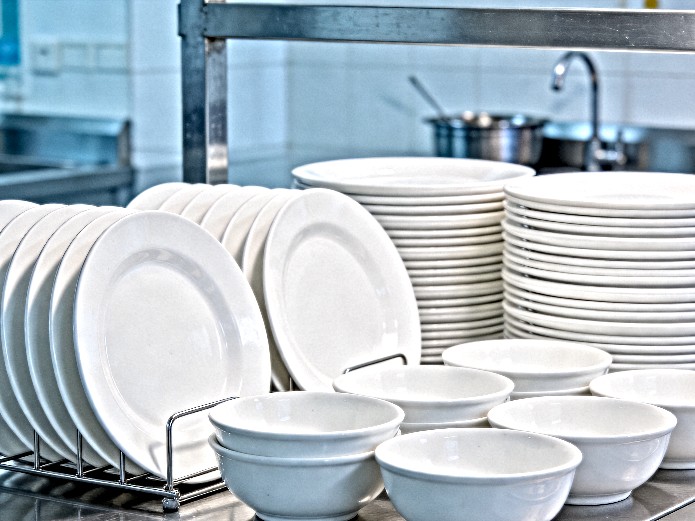
Ceramic tableware for hospitals faces demands that standard commercial dinnerware never encounters. Industrial dishwasher cycles reach 82°C with caustic detergents. Infection control protocols require surface finishes that do not harbor bacteria in microscopic cracks. And replacement budgets are tight, so every piece must last. After ten years of sourcing ceramic for healthcare clients, I have learned that the right hospital ceramic tableware is not simply “durable commercial grade.” It is a specific category with its own material requirements, testing standards, and supplier capabilities. This guide shows you what to specify, what to verify, and what mistakes to avoid when sourcing ceramic tableware for hospitals.
Why Hospital Ceramic Tableware Differs from Standard Commercial Grade
Most buyers assume that “commercial grade” ceramic works everywhere. It does not. Hospital environments expose tableware to conditions that restaurants, cafes, and hotels rarely replicate:
- Temperature stress: Industrial tunnel dishwashers run at 80–85°C with alkaline detergents pH 11–13. Standard commercial dishwashers top out at 65–70°C with milder chemistry.
- Cycle frequency: Hospital cafeterias and patient dining services turn tables three or more times daily. A single plate may see 1,000+ wash cycles per year.
- Infection control: Surface micro-cracks, pinholes, and unglazed foot rims create reservoirs for biofilm. Healthcare facilities cannot tolerate this risk.
- Handling intensity: Tray lines, cart transport, and stacked storage in ward kitchens subject ceramics to repeated impact and abrasion.
These differences mean that sourcing criteria for hospital ceramic tableware diverge from general commercial buying guides. The material specifications, testing protocols, and supplier vetting questions are distinct from those for ceramic tableware for senior care facilities or standard hospitality settings.
Infection Control Standards Every Healthcare Buyer Must Verify
Infection prevention and control (IPC) teams in hospitals scrutinize every surface that contacts food or hands. Ceramic tableware must pass three categories of verification before a hospital procurement committee approves it:
Food Contact Safety
Hospital ceramics must comply with FDA 21 CFR 175.300 for food-contact surfaces and, for European suppliers, EU Regulation 1935/2004 on materials intended to contact food. [VERIFY BEFORE PUBLISHING] Lead and cadmium migration limits follow FDA Compliance Policy Guide 545.450 and California Proposition 65 thresholds. Request third-party test reports from your supplier—not certificates of conformance, but actual laboratory results with lot numbers. For a deeper review of compliance documentation, see our guide to FDA and LFGB compliance requirements for ceramic tableware.
Surface Integrity
HACCP principles require that food contact surfaces be smooth, impervious, and free from cracks. For ceramics, this translates to:
- Fully glazed interior and exterior surfaces, including the foot rim
- Water absorption rate below 0.5% (ASTM C373) to prevent liquid penetration and bacterial growth
- No visible crazing, pinholes, or glaze bubbles after thermal shock testing
Dishwasher Compatibility
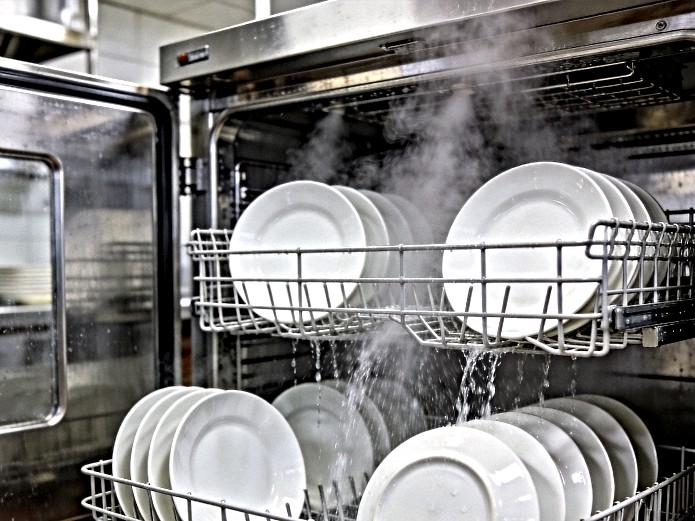
Not all ceramics survive industrial dishwashing. Specify that samples pass 50 consecutive cycles in an institutional dishwasher at 82°C with standard healthcare detergent formulations. Inspect for glaze dulling, edge chipping, and surface erosion after the test. [FACTORY PHOTO REQUIRED]
Material Specifications for High-Cycle Hospital Use
The material you specify determines whether your ceramic order survives two years or six months in a hospital environment. Here is what I specify on hospital orders:
- Body type: High-fired vitrified porcelain (1,280–1,350°C) or fully vitrified stoneware. Avoid earthenware and low-fired ceramics entirely—they absorb water and weaken under thermal cycling.
- Alumina content: Specify 25–30% alumina in the clay body for added strength. This raises raw material cost by 8–12% but reduces breakage rates by 40–60% in hospital tray-line operations.
- Glaze hardness: Mohs hardness 5+ to resist abrasion from metal utensils and stacked storage. Softer glazes dull within months in high-cycle environments.
- Thermal shock resistance: Delta 150°C minimum (ASTM C1525) to survive rapid transitions from hot food to cold refrigeration and back through industrial dishwashing.
- Edge reinforcement: Rolled or compressed rims resist the micro-chipping that starts at plate edges and spreads across hospital ceramics.
These specifications narrow your supplier pool, but that is the point. Not every ceramic factory can meet them, and the ones that can are the ones worth a healthcare contract. For testing protocols that validate these specs, refer to our commercial durability testing methods guide.
How to Vet a Supplier for Healthcare Foodservice Contracts
Supplier vetting for hospital ceramics goes beyond the standard factory audit. You need evidence that the supplier understands healthcare requirements and has delivered on them before. Ask these questions:
- Healthcare references: Have you supplied ceramics to hospitals or institutional foodservice operators? Can you share client categories without naming them? [CASE STUDY REQUIRED]
- Test report traceability: Can you provide test reports with batch numbers that match the shipment—not generic reports from a different production run?
- Batch consistency and lead time: Confirm within-batch dimensional tolerance (±2mm), weight variance (±5%), and production lead time of 45–60 days plus 25–35 days freight. Verify MOQ flexibility for 500–2,000 piece trial orders. See our MOQ negotiation tactics.
- Healthcare packaging: Specify individual PE wrapping plus corrugated dividers in master cartons. Hospital receiving docks handle palletized shipments; inner packaging must survive forklift transport.
If a supplier cannot answer these questions with documentation, they are not ready for a healthcare contract—regardless of how low their price is. Use our factory audit checklist to structure your supplier evaluation.
Cost, Durability, and Replacement Cycle: A Three-Way Comparison
Hospital procurement committees weigh unit cost heavily, but the real metric is cost per use over the replacement cycle. Here is how the three common material categories compare in healthcare foodservice:
| Material Category | Unit Cost Range (FOB) | Expected Service Life | Annual Replacement Rate | Best Application |
|---|---|---|---|---|
| High-fired vitrified porcelain (alumina reinforced) | $2.80–$4.50 | 4–6 years | 12–18% | Patient dining, executive cafeteria, long-stay wards |
| Fully vitrified stoneware | $1.90–$3.20 | 3–4 years | 20–25% | Staff cafeteria, high-turnover food courts |
| Standard commercial porcelain | $1.50–$2.50 | 1–2 years | 35–45% | Not recommended for institutional dishwasher environments |
The higher upfront cost of alumina-reinforced porcelain pays back within 18–24 months through reduced replacement orders, lower labor for breakage cleanup, and fewer patient complaints about damaged dishware. When I run total cost of ownership analyses for hospital clients, the premium material almost always wins over a three-year horizon.
A 12-Point Inspection Checklist for Hospital Ceramic Orders
Use this checklist during pre-shipment inspection or upon receipt. It is designed for healthcare procurement teams without deep ceramic engineering knowledge.
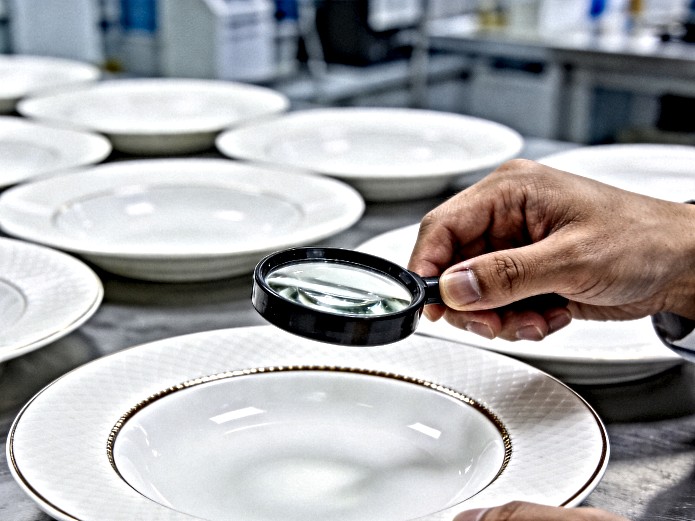
- Surface is free of visible cracks, crazing, pinholes, or glaze bubbles
- Glaze covers 100% of the food-contact surface and exterior, including foot rim
- Edge profile is smooth with no chips, rough spots, or thin glaze coverage
- Maker’s mark or batch code is legible on the base for traceability
- Dimensional tolerance within ±2mm of specification for stackability
- Weight variance within ±5% across the sampled batch
- Thermal shock test passed (sample heated to 150°C, plunged into 20°C water, no cracks)
- Dishwasher simulation passed (50 cycles at 82°C, no glaze degradation)
- Lead and cadmium migration test report matches the batch number
- Packaging integrity verified (no cartons crushed, no pieces touching without dividers)
- Batch sample size: minimum 2% of order quantity or 32 pieces, whichever is larger
- [CERTIFICATE REQUIRED] Third-party laboratory accreditation confirmed (ISO 17025 or equivalent)
Print this checklist and bring it to the factory during pre-shipment inspection, or send it to your third-party inspector as the inspection scope.
Common Mistakes When Sourcing Hospital Dinnerware
These three mistakes cost hospital buyers the most money and operational disruption:
Mistake 1: Applying Restaurant Standards to Hospital Procurement
A plate that survives 200 wash cycles in a restaurant may fail within 90 days in a hospital industrial dishwasher. Restaurant ceramics are rarely tested against institutional dishwasher chemistry and temperatures. Always specify hospital-grade testing, not general commercial grade.
Mistake 2: Ignoring the Foot Rim
Many buyers inspect the top surface and ignore the foot rim—the unglazed ring on the base. In hospital tray lines, the foot rim contacts metal surfaces repeatedly. If it is rough or unglazed, it abrades tray surfaces and creates micro-particles that contaminate food. Specify a fully glazed or precision-ground foot rim.
Mistake 3: Buying on Unit Price Alone
The lowest bid often wins hospital tenders, but a $0.80 plate that lasts 12 months costs more than a $3.50 plate that lasts 48 months. Build total cost of ownership into your evaluation matrix, including replacement labor, storage space for spare inventory, and disruption from stockouts.
Frequently Asked Questions
Can standard commercial-grade ceramic work in a hospital?
Only if it has been specifically tested against institutional dishwasher parameters. Most commercial-grade ceramics are tested at 65–70°C with mild detergent. Hospital dishwashers run hotter and more caustic. Without verification testing, standard commercial ceramics show elevated breakage and glaze degradation within six months.
What is the typical MOQ for hospital ceramic orders?
Initial trial orders typically run 500–2,000 pieces per SKU. Full container orders for established programs range from 3,000–8,000 pieces depending on piece size and weight. Suppliers focused on healthcare foodservice are usually more flexible on MOQ than mass-market exporters.
How long does production take for healthcare tableware?
Standard shapes: 45–60 days production plus 25–35 days ocean freight. Custom shapes or molds add 20–30 days. Plan procurement cycles 90–120 days ahead of need, and build a 15–20% safety stock buffer for breakage replacement.
Do hospital ceramics need certifications beyond FDA food contact?
Most U.S. hospitals accept FDA compliance as sufficient for food-contact ceramics. Some European hospital groups require EU 1935/2004 and LFGB compliance. Joint Commission-accredited facilities may ask for material safety data sheets (MSDS) and supplier quality documentation. Confirm your facility’s specific requirements before ordering. [VERIFY BEFORE PUBLISHING]
What glaze type works best for infection control?
High-gloss, fully vitrified glazes with low porosity perform best. Matte and reactive glazes can harbor bacteria in surface texture irregularities. If your design requires a matte finish, specify a micro-smooth matte glaze with porosity below 0.1% and confirm dishwasher compatibility through cycle testing.
How should hospital ceramics be packed for bulk shipment?
Individual PE film wrapping plus corrugated dividers in five-layer master cartons. Palletize with corner boards and stretch wrap. Mark cartons with “FRAGILE” and “THIS SIDE UP” labels. For overseas orders, specify humidity-resistant carton board and silica gel packs if the destination climate is humid. [INTERNAL DATA REQUIRED]
Ready to Source Hospital Ceramic Tableware?
Sourcing ceramic tableware for hospitals requires specifications that go beyond standard commercial buying guides. The right material, tested against real institutional conditions, saves money and reduces operational disruption over the contract term. If you are evaluating suppliers for a hospital or healthcare foodservice program, start by requesting samples that match the specifications in this guide, then run your own dishwasher cycle test before placing a bulk order.
Request hospital tableware specifications and samples from our team. We provide detailed material datasheets, test report samples, and MOQ breakdowns by product category for healthcare procurement teams. Browse our healthcare ceramic tableware catalog to see available shapes and sizes.